Live Vibe Coaching with the LLM Pioneer Who Scaled Before ChatGPT | Will Manidis
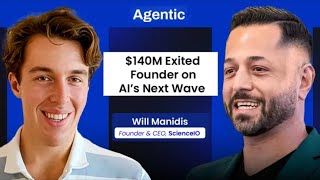
This is a YouTube video titled "Live Vibe Coaching with the LLM Pioneer Who Scaled Before ChatGPT | Will Manidis" created in June 2025. It features a conversational podcast-style session hosted by George Bandarian with guest Will Manidis, co-founder of Science IO, discussing the early days of AI startups, challenges in building AI companies, talent acquisition strategies, and differentiation in AI markets. The content includes multiple speakers interacting in a live coaching format, addressing audience questions about AI startup growth, defensibility, and product development.
I do think the constriction in experimental AI spend will rip people's faces off. As you think about what the dominant AI companies of tomorrow will be, they will be the ones that touch incredibly deep parts of the enterprise workflow. I'm not necessarily sure that companies that are doing 500 million in revenue that were doing zero last year, where 98% of that is being transacted on corporate cards, I don't know how sticky those are. Part of the reason OpenAI APIs are still so well used and even something like Google Geminis are not is just scale. So I, I do think fundamentally go to market matters, technology matters, data matters, workflow matters, talent matters, funding matters. But it's a much more amorphous thing than software used to be.
The things that Google and OpenAI are absolutely going to go after and get are going to be anything that has the horizontal broad tam. What they're really not going to go after in the near future is the hair on fire, deep domain specific workflows. Will Menaitis co founded Science IO, one of the earliest LLMs focused on healthcare and scaled it to $140 million exit to Veridym where he now serves as SVP of AI. If I'm just starting out, I don't have an idea yet. I'm not biased to a solution. How would you think about what the white space is or what's most important to think about? Welcome to the Agentic podcast where we dive deep with the pioneer AI founders reimagining business and investors betting on them. We bring you the war stories, insights and perspectives you won't hear anywhere else. I'm your host George Van Dareen, the General PODC partner of Untapped Ventures, a VC fund that invests in early stage AI startups. Let's go. Let me introduce our special guest. I'm joined by Will Manitis, co founder of Science IO, one of the earliest and most ambitious AI startups in healthcare. He pioneered. He basically built one of the first LLMs and he helped make LLM adoption incredibly fast going from messy unstructured medical data computable at scale. Science IO was recently acquired by Veridigm for 160 million and Will serves as their senior VP of AI. Will briefly attended college before becoming a deal fellow and dropping out to build full time. So we'll ask him about that. And so in today's Fireside we want to rewind to that founder journey. What he built, how he scaled, what he learned, what his advice is. And then after this fireside then we'll jump into the vibe coaching with founders from the audience. So with that said, let's get started. Will so you are in D.C. now, on your way to Greece, but why don't we rewind a little bit. Tell us a little bit about your origin story and journey to becoming a Thiel Fellow.
Yeah, totally. So good to be here with you all today. The very quick version of this background is kind of always was interested in computers as a kid. I was very lucky that my dad and my grandfather both worked for Bell Telephone, which back in the day was obviously a very interesting place with lots of technology innovation, but grew up in a small town outside of Philly. Always kind of tinkering with computers and programming and hardware, but truly middle of nowhere. Ended up in Boston for school at a small college called Olin College, studying computer science with focus on natural language processing. And this was pre LLM. So the field of NLP at this point was a little bit of a cultural backwater. We had made some Progress in the 90s and not a huge amount. I was particularly interested in looking at early Latin and Greek text and doing cross language work using n gram models. Obviously the field of Latin is not growing at a very high rate, so you need to get out and do something else. And ended up and in healthcare, after having a series of kind of healthcare challenges myself both as a kid and throughout college, I got very lucky to join a company called Foundation Medicine. That was a cancer diagnostics business my freshman summer and then stayed on there. Foundation was our core business was tumor biopsies. Unfortunately, if you end up with cancer, take a biopsy, take a sample of it, sequence it, use the outcomes of that sequencing to inform the kind of care you received. And the partnership I worked on was with a company called Flatiron Health. Flatiron had clinical data that is, you know, all of the stuff your doctor writes in the electronic medical record. We had genomics data, the stuff that we learned from your DNA. And we merged those two things together to be able to create the Clinical Genomic database, which was a database of outcomes and clinical inputs and genomic inputs to determine care outcomes. That was amazing. You can go and read the history of that product. We got many drugs approved as a result of it. But what was interesting about that product is in order to make that data usable, you needed to have doctors and nurses and all kinds of medical professionals inside of Flatiron Health with a medical record on one screen, a spreadsheet on the other screen, copy and pasting. And it Became really obvious to me at the time and to my co founder, who was also at foundation, that if fundamentally, if we wanted to make healthcare a data science industry, like an industry that can react in real time to data, we needed to do that in a way that wasn't humans essentially playing monkey on typewriter to make that data usable. At the same time, Alec Radford, who also is an Olin College graduate, oddly early OpenAI researcher, and a few other people released a paper called Attention Is all youl need, which was an early look at the transformer architecture. We saw it, took it deadly seriously and said, hey, look, we think this large language model thing has legs. We think this is very interesting. How about we take a try at making healthcare data usable out of the BO with transformers? So that's what we did in 2019, 2020. Don't hold me to that year. I'm horrible at dates and got to run the company for five years before joining Paradigm, so really fun run. Happy to dig into any part of that, but that's really the origin.
Nice. Very cool. And so somewhere at the beginning of all that, talk to me, what was the whole deal fellow process like?
Yeah, so I was lucky in that I stumbled into it. So I didn't drop out of college on purpose. Olin is a very special place. I don't know, it might not exist for that much longer. It's like, get in while the getting's good. I think I could save it. We'll see. But I got really lucky to join Foundation Medicine and the company was just a rocket ship. You can look at the public listing. We ultimately get acquired by Roche for something like $6 billion. And it was an incredible run and it just felt like too much responsibility to go back to college for. So ultimately, after the ROCH acquisition, it became pretty obvious that I both did not want to go back to college. And I don't know if I was particularly welcome back to college. I think I did not handle off ramping particularly well. And the Fellowship, I knew a few people that had gone through the process. I was lucky enough to get shepherded through it relatively quickly, but I do think it was a very transformative moment. The fellowship's obviously a bit of a weird program. When it started, dropping out of college was, you know, controversial and brave. You know, maybe graduating college today is the more controversial option if you work in tech. But it was, it was an amazing program and an amazing community.
Very cool, Very cool. Awesome. So I guess if we now dive into the science IO experience. So I Guess what were some. You were really early on that there was no chatgpt at that time, right?
No, we were free. Yeah. This was like when OpenAI was working on self play and a lot of robotics and ultimately a lot of stuff that would fade for the generative AI wave.
So you must have been innovating quite a bit and solving difficult technical and probably regulatory problems for the first time. Maybe. Talk to us what some of those look like.
Yeah, I think it's funny to imagine this now, looking back on it, but so much of the substrate that made generative AI possible just doesn't exist today. When we started, science usage based billing was very much an unsolved problem. The idea that you would pay for tokens was a thing Stripe did not support. So we spent a bunch of time building billing infrastructure, which sounds crazy if you think about the state of the industry today. Certainly we didn't have the infrastructure to do scaled model hosting like you have via every single cloud provider today. And at the time we were still buying GPUs that we'd install on gaming PCs and keep them in our office and train on premises. It was just an entirely different world. And the techniques certainly back then were a little more open than they are now. I think if you're in the industry today, the state of knowledge about how to train a very, very large foundation model is somewhat known. But if you're outside of industry attempting a de novo training run, you're kind of up the creek without a paddle. But at this point it was literature. I remember there was a lab in South Korea focused on biomedical nlp. They probably still exist. That was publishing World transformer literature in 2019. It was just a very, very different industry. And as the industry matured and ultimately became more secretive over time, I think a lot of that DNA and a lot of that knowledge became harder and harder to find. So it was interesting to see kind of commodification happen at the model layer, despite that information becoming more and more proprietary. And ultimately the thesis we had, which I think ended up being correct, was that all these vertical domains would require custom models. That doing anything in a complicated, highly regulated space was really a result of the data used to train the model on and the efficiency of that training process. And that's really kind of how we ended up in Varadigm is it was the best data in the world, but it took a while to figure out where the industry was going.
Man, sounds so exciting. It's like I'm reliving your journey with you and I can only imagine it.
Was a lot of fun.
It was like at that time again, Pre Pre Chat GPT doing LLMs. So, all right, so in the end you had a great arc over a relatively short period of time to bring it to a nice exit. What would you say are maybe your top one or two biggest lessons you'd pass on to today's founders that are building in an entirely new environment?
In AI, I think you need to be, yeah, you need to be really sober about where differentiation comes in the space. And I think kind of fundamentally at the end of the day, if you're building a model company, which tpd, if that's an advisable thing to do today. But if you're building a model company, the things that matter are access to the workflow to get really high quality reinforcement learning feedback from experts and access to highly proprietary data sets. And basically everything else is a rounding error. And as we enter a very weird stage of the market where I think there is more demand today than will exist in two years. Right. There's a ton of experimentation happening right now and you're seeing revenue grow really quickly. Being able to make that revenue durable over time, to be really sticky, to be a part of the workflow is going to take a lot of work, a lot of proprietary data and a lot of access to that reinforcement learning. So I think the importance of things that look like BD are going to come back like it's not just, you know, low level enterprise sales anymore. It's like big strategic deals. And I also just think the relentless focus on talent will continuously be a differentiator.
Did I hear you say that you think enterprise demand for AI is going to go down?
I think there's a lot of experimentation happening right now and I think distillation will happen. Right. So if you think about like an F500 today, they're probably procuring, you know, cursor, windsurfer, dozens of AI solutions. There's not other categories in enterprise software where you see an enterprise allowing employees to put thousands of dollars on like various point solutions. Right. So over time I think the category spending will go up, but it's going to consolidate to a very limited number of vendors.
Yeah, that's a really interesting insight that makes a lot of sense and I agree with that. So any, any, if I know you well, you know, you're a, you're a contrarian. So any contrarian takes for founders today.
Do you think the constriction in kind of experimental AI spend will rip people's Faces off. I really think today like we're spending a lot of time looking at things that are like 0 to 100 million in 48 hours kind of stories and there's this like really big focus on how much you can scale revenue overnight. Candidly, I think extremely fast growing revenue is often extremely fragile revenue. And as you think about what the dominant AI companies of tomorrow will be, I'm not sure those will be the ones that grew the fastest today. I think they will be the ones that touch incredibly deep parts of the enterprise workflow and are able to be sticky and able to go through these big procurement motions. I'm not necessarily sure the companies that are doing 3, 4, $500 million in revenue that were doing zero last year, where 98% of that is being transacted on corporate cards, I don't know how sticky those are. So I love enterprise sales. I think it's kind of a lost art, but I do think tacking towards the enterprise will be a really. People that will remember that as a good tactic right now.
So, so then based on that, what would be your advice, you know, for a lot of early stage startups, you know, we got a lot of questions and I would say the majority of the questions were around this topic that we're talking about, differentiation, defensibility, moats. And the first person we're going to call up, Devin, actually had had a question on that. So we will dig into that. But I guess just to finish your train of thought, if that's the core issues that you've outlined. So then if I'm just starting out, I don't have an idea yet. I don't have, I'm not biased to a solution. How would you think about what the white space is or what's most important to think about?
Yeah, so it just got 100 times easier to build softw in the last year. Right. Like cursor, like cursor makes me a good software developer. That's like crazy, right? That's like superhuman stuff. And that means that counterintuitively it just got way more expensive to build truly great software because a lot of the low hanging fruit are going to be much more easily picked by like 20 year old college kids with cursor. Which means that the stuff that's really interesting, the stuff that's really durable is either intensely technologically difficult. There is like a big build mode or a big integration mode which is interesting and there's, that's a path you can go down or things that are intensely difficult to Sell. And I think tech has been engaged in something of a shell game of kind of high, high end tech enterprises selling to high end tech enterprises. That TAM is, is large, but it's not infinite. And if you're going to build a big AI business in a traditional industry, a lot of it's going to require going to the procurement departments of companies that are not native AI. Procurers are certainly not going to put $30,000 a cursor on their corporate credit card. They're not using ramp to save 5% on their expenses. Right. Like this is like a fundamentally different motion and learning the motion as soon as possible and getting excellent at it as a company I think will be a strategic advantage over time.
All right, that was firewill. Thank you. And by the way, if I haven't told you, you have a very special place in my heart. Science IO, as you know, is the first exit in our portfolio.
Yeah, it's really fun to get to do it together. I mean the company, it's crazy to think we're now like a year past that the world doesn't feel like it's changed that much, but like it's been a little bit of time. So glad we got to do that together.
Definitely, definitely. So, so with that, why don't we continue the conversation.
Hello? Hello.
Hey, how's it going man?
Doing well. Can you hear me?
Yes.
Awesome. Thank you so much. Yeah, appreciate it. Sorry, my connection not great here, but hopefully I'm coming through clear enough.
Yeah, no, it's good. So you had a question about how to approach and poach world class talent and the core risk mitigation strategy of attracting the right talent.
Yeah, so like I guess a little background. We're an AI research company. We built some things that we're incredibly proud of that you know, we're quite confident that even the major labs don't have. And I had some personal experience chatting with some senior researchers at the labs and can pretty well confirm it. And we want to grow our team. Right. We want to, you want to grow our presence and ability to just scale what we built. I guess for context, we're not building language models, at least not yet. We're focused on time series models. So the idea is kind of build a digital point of the global economy and predict down to the future. So we predict the next second minute, hour, day, week instead of the next token. But we want amazing researchers. So how do you go about trying to have these conversations with these senior members of world class organizations and being like, hey, we have some really cool things. We love the way you think, we love the way you work and let them know that hey, we have really cool things that you think you'd enjoy without giving too much away or potentially threatening starting a war with potential other lab or creating awkward situations as possible.
We spend a ton of time thinking about this. I think talent is your only arbitrage, only compounding advantage over time. And fundamentally you're not going to be able to out compete on comp versus the foundation labs if you're, you know, if you're a marginal OpenAI researcher getting paid 20, 25 million dollars a year. Like fundamentally, the, the barrier to take you to a startup is really, really high. And I think you can do it. And I've seen plenty of companies do this, but it's very different from I think how traditional recruiting processes look. So I think people want to think recruiting is a thing you do in 20% of your time where you're like, I have a pipeline, I have some people, I'm going to move those people down the pipeline. So I don't think that works. I think people are going to jump to your company because they're friends with you, because they believe in you and they have a huge amount of surface area on you, which means you need to spend a huge amount of time with them, which is obviously very difficult when you're running a company as well. So the people that I've seen do this really well are relentless about just calling them for five minutes every week over months, hey, who are you? What are you working on? What's top of mind? Their reliance is about just like sharing content. Like I send journal articles to hundreds of researchers a week that I read. I thought they were interesting. I was like, hey, this is kind of interesting. Do you have thoughts on it? And I engage in like earnest conversations with them. Like our, our head of machine learning I talked to for the first time four years before we hired him. Like that is you have to play these incredibly protracted long games to get top talent because you will never be the most interesting. No matter how exciting you are, you will never be the most interesting opportunity for one of these people. But you will be the most, you can make yourself the most attractive landing spot by building an intense and personal relationship and making that informal as soon as humanly possible. Yeah.
It gets me thinking. I definitely like the idea of maybe like a papers club or just sharing stuff that just is mutually beneficial to everyone. Sharing cool stuff that comes out and building that relationship for finding alpha and side of, you know, spaces that they care about that they're, they're not used to finding.
Consistent like even outside. Like I think journal clubs are hard because they like require time, right? Like people have to dial in. It's so much easier to be like, here's a PDF, I'm texting you over imessage. Like my imessage is like thousands of PDFs. Like I don't even have half these numbers saved. I'm just like spamming content. Like obviously very directed, targeted, relevant content. But it's like continuing these conversations. I'm also seeing in the chat a comment about going X us. I think that is true. I think there is like legitimately very excellent, particularly applied AI talent X us a ton in Eastern Europe that we've worked with historically. I think that talent is a little less steep for kind of foundational AI research just given the concentration of talent and expertise in the labs right now. But I do think there is also high alpha in just finding weird sources of talent. Like the best recruiter I know, best company builder I know. Whenever the IMO Math Olympiad results come out, he just calls everyone on that list or when the IIT entrance exams come out every year, he just calls the top 20 IIT kids. And those kids are 16. It's going to take years for them to go to college. They're probably going to go to college in India, then come to the us. It's a years long game. But I think just finding weird indicators of early contrarian talent and doing it and compounding on it over time, you should be spending like 50, 60% of your time recruiting. The other difficult advice that I think is a little annoying is like Twitter really works. I think Twitter is somewhat of a profound mental illness. I think it has made my brain worse in every single way. But like it's good post, good posting nonstop. But it's like there's a huge amount of surface area of me in the world that allows me to build a one to many relationship with people that may choose to work at a thing I'm working on on versus kind of continuous pushing.
No, that makes a lot of sense. And when you said earlier about recent reaching out to like you know, these talent, I mean I've started to cultivate a little bit relationships with them. It's you know, it's still early days. I mean, I guess, you know, once you kind of have the habit, I think it's easy but I guess kind of transitioning to like, oh yeah, we've gone to a couple of the same parties before to like actually starting to do those one on one calls. Do you have any recommendations on what's worked for you to like kind of like make that bridge?
Yeah, it's awkward and I think you just kind of got to rip it. Like I am like oddly, I like push to imessage as quickly as possible and then I just awkwardly make it intimate as quickly as possible. I think you got to kill the formality quickly. I think these people are used to getting kind of thousands of recruiters inbounding them. They're not used to getting a text every Monday morning at 7:30am with an interesting article.
That's totally fair. Well, I super appreciate it.
Well, yeah, well that was amazing. You know I also had pinged one of my top recruiter friends, Todd Gitlin. He runs a large recruiting company for, for venture backed startups. Big focus on AI just to kind of get his thoughts on it as well. So maybe I'll, I'll touch on the second part of your question which was about the kind of the risk mitigation strategy, right. And not sharing big secrets or starting a war. And I think that's on that side. What I'd say is that there's a natural give and take there that happens. Right. So you know, if you continue from where Will's at, you're sharing some info, they're willing to get on a call, they're, you know, they're starting to share their comp data or what they're interested in, you're sharing a little bit more about your business, they get interested, they're asking more questions, you're sharing a little more. Now they want to dig deeper. You know, you're qualifying them that they are open to make a change. Maybe it goes a little deeper. There's an NDA sign, right. And so you're kind of walking down this path. You're not just kind of revealing the secret sauce on day one. And I think I, I think you could also tell when their questions, the energy is different when their questions start to go down a path where it does feel like it's corporate espionage. And they're not asking you because they're interested to join your company, but they're asking for other purposes, whatever that may be. You can kind of just feel it. So you know, you know, again I think, you know, start, you know, you reveal a little, they reveal a little. You reveal a little more, they reveal a little more. And I think that's, you know, that would be like my simple advice on, on that side of it.
Just like, just to maybe to rephrase it back just like like are they do they seem to kind of really intuitively understand the vision and theoretically if you're competing they, they can understand. They're able but even better to able to articulate your vision versus the company they're working at. And if they can't, then it's kind of like, then maybe it's more of a trying to get information versus like oh wow. Actually this makes more sense to be.
A part of tell. I like to. It's like the we tell when they start like saying we like me and you, like we're in this together. We could do this together. That's like good when you hear like you or like you guys, like you want to make them feel like they're already part of the company, part of the family. And when you start hearing like we could do, we could do, we should try. That's a good sign. They're already imagining themselves as like part of your org.
Awesome.
No, I appreciate this, thank you.
Great. Thanks Massey. Good luck. And I, I had a look at what you guys are up to. Super interesting. And you know, happy to chat afterwards as well.
Yeah, yeah, totally would be down.
Hey Devin, everybody. How are you man? Doing well.
Thanks for having me, guys.
Yeah, for sure. So you had a question about defensibility and differentiation and moats, right?
What a great time to be building. Yeah. My question is, you know, when everybody has access to the same cutting edge models, what how do you guys think about differentia differentiation and defensibility and building a moat? And how does a company, like even a huge company like Cursor actually sustain that moat?
Yeah, it's a good question. I'm not sure there are obvious answers and the answers I would give you seem to change every 14 days. So I'll caveat that I'll give you kind of today's pov. I think there is very limited differentiation if the business you're in today is building big foundation models. Like if you come to me today and you're like I'm going to build OpenAI but marginally better. Even if you have like some technique that makes you 80 times cheaper, 80 times better. I just don't. It's really hard to imagine a business there that compounds over time. It's too volatile, there's too much diffusion.
Right.
The secrets you have diffused too quickly across organizations. That said, I think there's a good lesson there. That scale is still fundamentally emote. Right. Like part of the reason OpenAI APIs are still so well used and even something like Google Geminis are not. It's just scale, like it's just the default developer option. It's easy to use, it's easy to onboard. That said, I don't know where those moats go over time. I do think fundamentally go to market is still the most important moat. Big customer bases that like your product have signed multi year contracts with you and are not charging you on a credit card month to month is still the most defensible thing in the world. And I think it's a thing that basically no one is spending time on today. I think like so much of healthcare. Sorry, not healthcare. I'm in a healthcare thing right now, so my brain is right. So much of AI is chasing really fast, really volatile consumer revenue. That's amazing. It's just fast on, fast off. So I do think fundamentally Go to market matters. Technology matters to a degree, data matters, workflow matters, talent matters, funding matters. But it's a much more amorphous thing than software used to be.
Yeah. And I think what I would add to that is. Well, any reflections on that so far, Devin?
Yeah, it's interesting. Like obviously I've been thinking about this for a while. I'm building on the application layer and I've heard some really smart people say some things and I really just am so unsure still, which makes me very scared for how any of these companies are going to be defensible at the end of the day. I kind of agree that go to market could be the moat and I guess that's the Cursor Windsurf case to make. But I also don't know that there weren't five other coding platforms before Cursor came along. And what was the differentiation that Cursor had? I still don't really know.
I agree with you. Like Michael Truell, who started Cursor, was a college buddy of mine. He actually, like I talked to him when the seed was being raised and the thing they were working on was an AI assisted CAD tool. Yeah. And like it's really easy to imagine Cursor is a kind of marginal AI CAD tool. And it's really, you know, we're in a world where cursor is now a 9, $10 billion outcome in two years. And I don't think I can give you kind of a de novo explanation of why that went down one path and not the other.
Yeah, that seems to be the pattern.
Yeah.
So I mean, I think at the application layer. Right. Some ways to think about it are first of all, the things that Google and OpenAI are absolutely going to go after and get right are going to be anything that has the horizontal kind of broad tam, especially text based or more simple, right? Image, text, video, they could ship that at scale. So anything that's focused on that or anything where they can leverage their distribution leverage, right? So it plugs into these multi billion user surfaces. So if it plugs into Microsoft products, Google products easily, that's fair game. And you should expect that they're going to add that the old like well why won't Facebook, Facebook add this or Instagram add this as a feature? I, I think, I think that's what they're going to go after, right? That what they're really not going to go after in the near future is the hair on fire, deep domain specific workflows, right? Going deep into workflows, owning that workflow process end to end, right regulated or high liability heavy verticals, right, where there's just financial compliance, insurance compliance, nuclear defense. Like it's just that's not their, their market that they want to sell the model, they want to, they want to own the market, they want to sell their APIs. You know, where there's deep integration required with legacy systems. So it's not just automating a workflow, but automating a workflow with integrations, right, as part of your solution because you understand that. And then the compounding data loops, right? So you have like continuous data loops that, that are helping improve it. So if I summarize that like there's this four layer data modes, right? Or the four layer moat stack, I should say so you have the data, you have the workflow depth, you have the distribution wedge and then you have the model agility. And I'm going to go into more detail on all these topics tomorrow. On tomorrow's Masterclass I have slides and visuals and we could talk more in depth but, but you know, at least from our perspective as a vc investing in the space, you know, those are some of the things we're looking for is like Will said earlier, do you have some proprietary data and is that continuing to grow, you know, 10x in the next year? You know how mission critical is the workflow in the process, you know the distribution wedge like Will was talking about. Do you already have some network effects or some go to market strategy that wouldn't be be difficult to, that would be difficult to copy? And then you know, how much model agility do you have? How easily can you swap in and out the latest model and, and how much, what models are you building on top of using the other models to, to, to kind of bring it to life. So you know, I think I, you know, that's, that's the way we look at it and I think that leaves some, some opportunity for like for example, agentic vertical AI workflows, right where there's a, it's a, it's a gentic vertical AI plugging into a business process. It's replacing a lot of the existing tools, it's integrated with the existing erp, CRM and whatever other line of business applications you have. It's continuing to get data, it's improving upon that data, it's using the enterprises data versus like just LLM making LLM calls only. So I think things like that are interesting but also that window is closing because we're, you know, vertical AI has been filling up pretty quickly and even agentic AI, even agentic vertical and agentic horizontal AI is filling up very quickly. So it's not like these are all green fields waiting for new entrants. Insurance has all kinds of solutions for finance, healthcare. Right. So I think, you know, making sure to do a proper competitive analysis as well to know who are the existing players, you know, how much have they raised, what's their unfair advantage? What's your unfair advantage? What's your right to win? You know, all of these questions are at play, so I don't know, how does that land? Devin, do you have a specific idea that you're working on and like what happens when you hear all that feedback?
Yeah, really good feedback. Thank you for that. First off, I am working on vertical AI agents funny enough. So I'm kind of right in the wheelhouse here. And a question I get asked a lot, even by investors or who not is if OpenAI or Manus or whoever gets access to all the data and has all the plugins, what's to stop them from going to do the same thing 95% as well, but is going to cost a fraction of the price. And ultimately I've got certain theories on this around whether it be the training or the expertise or like you said, using different models in different places and having that array set up properly for the customer, for the end consumer. That said, I think we're all just guessing right now and it's really, really hard to tell. I think the one thing that I've heard over and over that has resonated really well is the data flywheel. I think that even cursor, my best guess for Their moat is the data flywheel, right? Every line of programming that a program will put into cursor will make the next line better, hypothetically. And that is extraordinarily powerful. But again, that's a winner. Take most market style. And I don't think that there's going to be a whole lot of room for five other cursors, for example. And I'm just curious, when everybody is building the same platform, then, you know, how does anybody differentiate against each other? And I think it's yes, really hard question.
One final point on this and then I'll shut up for a second. But I do think I'm a big finance history buff and one really important lesson from the history of Apollo, which is my favorite businesses. It's like complexity is often about and data that is responding to the comment in the chat about corporates being able to reoriginate data sets that startups can originate, I agree, but there is truly arcane data in the world that is either impossible to access, impossible to index, or impossible to get hands on. Like in veriadigm, we simply have access to tens of millions, hundreds of millions, some number of patient profiles that just don't exist anywhere else in the world. And there are these truly arcane datasets that exist in nature that you can find through highly complex BD relationships that if you can get access to them, they're incredibly differentiated. Like Microsoft kind of has this via the GitHub corpus. It's a question of like how proprietary that is. But I do think complexity is a moat and people go for very easy kind of corp devi style data deals. And in reality the real data is like going to be like onboarding archaic massive data sets.
Awesome. Well, thanks Devin. Hopefully that's helpful not just to you but everybody else. I really do think that that discussion that we had is the number one discussion AI right now. So with that I want to move on to Alexandra from Sunlot.
First of all, thank you for opportunity.
Yeah, for sure. So your question was designing like a basic MVP for a marketplace?
Yes, I'd like to design basic MVP using Vibe coding and currently I explore all those tools such as Lovable Bolt Replit and Cursor. But I'm a solo founder so I'm not a tech expert, although I understand very well the frameworks. I don't know how to utilize the coding tools the most efficient way so that I can reflect through MVP such features as social commerce and marketplace. And actually my startup is trying to connect social commerce and marketplace, focusing on fashion and beauty brands.
Yeah. So I would say as you're thinking about this, it's really important to be really narrow on what your value is. I think like mvp, you need to get very, very narrow. Right? Like, what is like the single killer feature that will cause users to use your product over everything else and attempt to start building that. I think if you go into Cursor and you're like, I need to build this highly complicated marketplace with authentication and billing and using and shipping, that's like a really hard challenge. Even if you were technical and especially given that you, you're a solo founder and you're learning as you go, which is great. Like, I've seen this work many a times. It's important to get like really narrow on what the actual thing is that will allow you to prove that you have value. And I think there is an impulse in founders to try to overbuild, to make sure they're ready for scale before they have it. And I think you can be like, oh, I want to build this like, highly robust, really technical platform when it's not obvious you have users yet. So my advice would be like, cursor is like really good. You should like find a week and drink a ton of coffee, maybe pop a Zen, do whatever you need to, like stare at a monitor for 30 hours and just go, go. And it's not going to work. And the software is going to be really, really bad. But you're going to figure out over time how to get there. I don't think there's like great, there's like some good vibe coding tutorials on YouTube, but I do think the returns to just like extremely focused, dedicated work on one of these tools over time are really high. I've used Lovable, I've used Windsurf, I've used Cursor. They're all good. I think Lovable is like slightly. I've had less success with lovable. That might just be a style thing, but I would spend a lot of time, especially the more you can do in Figma, the more you can mock up, the more you can bring into these tools and have them build out natively. But I would just be hyper narrow about what your value is and spend a lot of time thinking about where that value is and how you can build the features that prove that value works as quickly as possible.
Thank you, Will. And from the perspective of initial features for Social Driven Marketplace or Social Commerce Driven Marketplace, what do you think would be the. The most important features in MVP to raise? Starting from 500, 000 batch.
Yeah, totally. I honestly think you could raise for a marketplace without having built a technology product. I think the. The hard marketplaces are really hard. But you should talk to FJ Labs first of all. They're in New York. They're really good. You should obviously talk to the untapped capital people too. But FJ is like the brilliant marketplace people I know. Jeff Weinstein. They're very smart. Demand matters, right? Like, marketplaces are hard because you have to balance supply and demand and you need a bolus of sellers and buyers. That's traditionally why marketplaces are great businesses to scale and really horrible businesses pre scale. So the way I would think about this, like, I recently invested in a company called Silvi. Silvi is an antiques marketplace. That aggregate supply of beautiful old world antiques, brings them to America and sells them. Sylvie started as an Instagram page that got to very, very big scale before they built a technology product. And then when they were able to build a technology product, they then had the demand to fill that marketplace as quickly as possible. They went influencer first. Chelsea, the founder there, is an incredible. She was like the head of influencers for Instagram and Clubhouse and all this stuff. So she had the networks. But I think going demand first on the marketplace matters much more than any technology. I've never seen a marketplace differentiate on technology. I've always seen them differentiate on demand.
Yeah. And what I was going to add to that is, so I wanted to keep it more around the AI tools, not necessarily around where the conversation's going now. So I think what I want to add is the following. Hopefully a lot of people on the call are familiar with the tools that we're quickly throwing out, but some people may not be as familiar. So I think, you know, what I would say is you have Windsurf and Cursor that are tools that have made typically engineers developers be able to be 10x better and faster. Right. So if you're already technical, at a minimum super technical or an engineer, those are the two tools. If you're not, the two tools that are catching a lot of attention are Lovable and Bolt. But like Will said, there's been mixed reviews. Like, it's very quick to prompt and get like a website, but not a fully functioning app. Now, one of the investments in our portfolio is a company called was. So they're solving that and their mission is to build the Shopify for the app builders. Right, the AI app builders. So just like Shopify didn't just help you build your Storefront, but you're billing your payments, your taxes, your marketing, your APIs, your integration, they're doing that. So full production level, something that you could turn on and onboard a hundred thousand users and it's not going to break. So if you're interested to check them out, it's with was.com they just graduated the YC winter cohort. Really happy about their progress. But with that said, I would agree with Will. And I think that the first job to maybe go back to maybe what your main pain point is, which is validation, is you really just need a clickable prototype to be able to show to customers, get feedback and validate. Is this a problem that they have? Are they willing to solve it with your solution? How much are they willing to pay and are they willing to pay now? And there's even great AI tools that are just for automating the design side. So like one of them is a company called Subframe based in sf. S U B F R A M E. I've personally worked with that to to you know, in an hour build a clickable prototype, you know, walking through multiple screens as a non designer that I could show people so that I could show investors, I could show customers and validate or invalidate an idea. So that, so that would be my advice there.
Thank you so much.
Thank you.
You got it. All right, let's take a look at the Q A. All right, so if you're building an AI solution in a specific area, example, reviewing scientific research literature, how do you think about building and training your own model versus connecting existing models to additional data sources like a rag? What suggestions do you have on acquiring data?
Yeah, this is, I mean we spent a bunch of time thinking about this. You no longer need to de novo train models for every task. Also, most tasks are better solved by kind of workflows of various models than they are single monolithic models. Right? Like if you think about what makes Cursor a really unique product experience, it's much less the code gen model. It's actually much more their quick autocomplete model that is tiny, you know, sub 50 million params that just finishes the line you're writing as is. Right? So I would think about breaking your task into as many sub models as humanly possible, figuring out where you can use a big, you know, closed source model, 0304 etc. When you could use something like a llama based model to fine tune on your task and when you want to de novo train something. But I think most AI solutions over the next five years will be some combination of all those models orchestrated together for various parts of the task. On the scientific literature part, this is a domain where I think there's very little interesting data that is left in the world. Right. Like all the foundation models have trained on basically all of literature. All the big publishing houses have struck deals with OpenAI and cursor and everything else. You need to figure out a way to get access. One, they're probably good enough for whatever you need. Like if you're doing like medical literature review as a service, like O3 can do that. But if you really, really need depth in this domain, you're going to need to find really interesting, really deep and really proprietary information that's going to be hard to get. Like there's just not that many tokens left for you to harvest here. Also Rag. Rag. Everyone loves to say rag is dead. It's just not like no matter how big the context windows get, search and memory is a really important use case. There was a very early investor in a business called Chroma, which is the one a leading vector database company. They power Rag for a huge part of the Internet. Every week the numbers go up. Like Rag is still a very important part of that workflow. There's still a lot of art in chunking and what embedding models to use and all of that stuff. It takes a while to get right. But ultimately multiple models are kind of where you go.
Yeah. And I mean I think what I'd add to that for Amit's question is that goes back to what we were talking about, right. That's kind of more generic, horizontal, reviewing scientific literature, competitive. You're not going to win at that. Right. So now if you said that you're plugging that in to a certain workflow process to come in and like as a user is doing something, accuse the literature and helps them do something 10x100x better and complete a process, then that's a little different. Different, right. And that then now your frame changes and it kind of answers your question. I like Wes's question.
We don't.
So Wes asks. Founder of KURU Building agentic expert research platform to help institutional investors make smarter, faster investment decisions, we recruit industry experts as paid consultants on our platform and often use cold outreach to connect with them. What are some unique strategies for differentiating outreach in the gentic era? Outside of personalized cold email, this is mainly around cold outreach.
I love this kind of question. I think there's no excuse to be lazy about outbound at this point, like if you think about your. Your experts are getting spammed by TGEs and Alpha sites every day, offering them 500 bucks, thousand bucks to, you know, get on the platform, do an expert call. You can't compete on price. And I think people are really afraid to sell, to spend money to acquire customers when there's like a clear price value. Like you would rather overpay for a customer 2x than spend $30 to acquire them. One of my favorite things to do is send prospective customers books with notes, right? Like a book is like 20 bucks on Amazon, right? If you like, you know, input their social Ask OpenAI to pick an interesting book and mail it to their address. Like that's a pretty high touch, really personalized inbound. I just think like more and more email is not actually going to get you there. I think cold calling is universally a horrible experience, but it works. I also think Twitter is just really good.
Cool. Well, let's end off with you. Some people were really curious about how you built such a rapid exit. Was that the strategy from inception or how did that evolve to the extent that you'd like to share?
Yeah, totally. So I, not the strategy from inception, like science was built to be the company I ran for the rest of my life. Just the way that this market moved was such that it was obvious that if you wanted to stay intensely competitive and build the best models that were the best for customers, you needed access to workflow and you needed access to data and paradigm. Obviously, you know, speaking for myself, these views are not my employers. Non investment advice, standard public company disclosures. Veridigm is a very special place because we have access to huge amounts of data and huge amounts of expert workflows and the company is all in on making those AI enabled to help providers and help patients. So it's a really unique combination of us sitting there at a kind of crossroads saying wow, we need a lot of data and wow, this veridigm data is incredibly interesting. Doesn't exist anywhere else, certainly doesn't exist inside of other EMRs. And it's the kind of thing that would be impossible for us to get without joining it. So not at all an engineered strategy. I think like plenty of people happy to talk about M and A offline if anyone wants to talk about it. It's a complicated process with lots of emotions involved on every side. But like it just felt so natural as a home for us given the data and the workflows.
That's awesome. And I just launched our kind of feedback poll here at the end, if you guys want to take a moment and fill that out. This is obviously probably different than a lot of events you've attended and that we've done in many ways. So let us know if it was valuable and if you'd like to have more of it. And then in terms of next steps, Sean, if you want to drop those links again, you can feel free to. If you're AI founder raising, we'd love to hear from you. If you feel like you have some of the defensibility and differentiation and talent and everything else that we talked about that we're looking for, you could pitch us on our website and a number of other options to connect and. And be in touch with us. Check out our podcast and all that good stuff. With that said, Will, this was awesome. You did great. Yeah, I love hearing your perspectives, and it was fun to do this with you. We should. We should do this again.
Appreciate it. Smart. Thanks, guys.
All right, man. Enjoy your time in Greece. Thanks.
Bye. Bye.
Bye, everybody. Have a good one.
More from George

The AI Agent Getting More Supplier Data in 5 Weeks Than a Team Did in 2 Years








