Where Top VCs Are Placing Their AI Bets In 2025 | Agentic EP 04
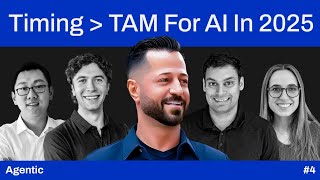
This is a YouTube video titled "Where Top VCs Are Placing Their AI Bets In 2025 | Agentic EP 04" containing an English panel discussion recorded in early 2025. The content features multiple venture capitalists including George Bandarian, Ippen Zhao, Hari, James, and Nicole discussing the current state and future of AI investing, particularly focusing on agentic AI, horizontal versus vertical AI startups, investment theses, and the evolving AI landscape. George Bandarian acts as the host and participant, guiding the conversation among leading AI-focused VCs about market trends, startup strategies, and technological challenges in AI.
Some of the traditional very labor heavy business can become high margin business like insurance agents. That's the beauty of AI is to unlock some of the business that traditionally impossible.
If we are moving to an agentic world. Investing in a human in the loop is something that's less appealing to us.
The full autonomy. I don't think we need it. Human intervention sometimes could be really good and useful and almost necessary.
Some people argue that you don't have to be as technical because it's easier to build. You need that technical founder that is being able to catch up and being that leader in the space. And then you also need some vertical expertise.
Fundamentally you need fewer people and less payroll to build something and to get a product to market. I think there's a reset happening. It takes 5 to 10 years to percolate throughout the entire VC ecosystem.
Horizontal is the platform that's broad. Like for example, an HR solution that any company can use versus vertical is like starting off with a very specific vertical use case. But they have pros and cons like how you start, where you start.
Sometimes you choose.
We have a lot of lessons learned like vertical versus horizontal sas, then vertical versus horizontal AI. And now we're in vertical versus horizontal agentic AI. Welcome to the Agentic podcast where we dive deep with the pioneer AI founders reimagining business and investors betting on them. We bring you the war stories, insights and perspectives you won't hear anywhere else. I'm your host George Van Darren, the general partner of Untapped Ventures, a VC fund that invests invests in early stage AI startups. Let's go. Welcome back to the Gentek podcast. If you enjoyed the perspectives of six SF VCs in episode two, then you'll get a ton of value. Hearing from four leading LA AI VC firms in this episode including Khosla Ventures, 101110 Embark Ventures, Fika Ventures. This was recorded live at our Agentic and Vertical AI event in LA at my alma mater usc. And today's discussion is packed new insights as we explore essential questions such as where are we at in the AI revolution right now? Why is agentic AI generating so much excitement? And how can startups create differentiation and competitive advantage? And what are today's VC firms looking for when making new AI investments? I think you'll get a ton of value out of this. With that said, let's dive right in. So let's go ahead and get cracking here. Welcome our VC panel. Super excited about this. Now that we put the founders first, one of our questions could be what you thought about, what you heard, what did you like, what were you concerned about? And we can have an open conversation without anybody getting hurt, anybody's feelings getting hurt. But before we dive into that, why don't we just start off, go around. Let's meet our VC panel. Start off with some intros so we get to know who you are, what firm, where you're based, what you invest in, what you're looking for, all that good stuff stuff.
My name is Ippen Zhao. I'm a partner at a firm called Embark Ventures. We are a boutique firm based in Los Angeles focused on early stage deep tech. We manage a little over $100 million across two funds and been investing in AI and sort of AI adjacent area since 2018. So six years I guess more relevant. So before, you know, long before more than 12 years ago I was a PhD student focused on empirical process research. Now AI, so a lot of statistical learning stuff. So had a bit of, a bit technical background but obviously haven't done any coding for like 12, more than 12 years. But you know, it's great to see AI come back to life. So happy to discuss more about my thought.
Hey Hari. I'm a venture partner at Khosa Ventures. Khosla for those who don't know, is a fairly large multi stage VC firm. We're currently actively managing about 3 billion in assets and we do AI investing, myself included. I have a focus mostly on Enterprise and B2B applications and prior to this I was running a healthcare company based in la.
I hate when we lose deals to Khosla because you guys are willing to pay top prices. Anyway. Hey everyone, I'm James, nice to meet you. I work for a venture fund here in Los Angeles called Fika ventures. We are B2B software focused seed fund, just a hair over 500 million total AUM across four funds. Now I help run our dev tools and infrastructure vertical. We have a couple other vertical focuses in fintech and supply chain. My past life I was a private equity investor so I moved out west from New York for greener pastures in earlier stages and the rest is sort of history but happy to get more into it. Thank you all for coming.
Hi everyone, I'm Nicole, I'm at 10One10 Ventures. We're a pre seed and seed stage fund investing in technical founders, transforming major, major normally old and boring industries. We come from four, three founders themselves that started a bunch of companies and had a bunch of exits. So yeah, trying to find those, those techie founders and in terms of me, yeah My past life, I also was an investment banker and a consultant for a long while. Ended up consulting very early stage companies before switching to ventures. So excited to be here.
Great. And it's, it's great to have co invested with I think just about all of you on a number of deals, at least your firms. So the first one, let's go back, before we go to the founders, let's go back to my presentation. Any thoughts on that? Anything you guys like strongly agreed or disagreed with about kind of how I laid out the potential for agentic, where we're at, what the opportunity is. Any thoughts from anybody want to kind of kick off on that in any order?
I guess largely agree with what you presented, but for me maybe a little controversial, but agentic AI, it just kind of like rebrand your SaaS to be honest. Right. So I'm not sure if the right definition is presented. Right. So I do feel like when we talk about agent, we need a full autonomy versus partial autonomy. We are what we have right now cut into pieces. Small agent is kind of just a vertical SaaS. Right. So I would agree most of say, but the definition of agent, AI, agentic, I think for me it's a little bit kind of like we need more, we need a stronger argument. Agent AI. Right.
So yeah, it's a term that has a lot of gray area. And you know, I think Andrew from AI Fund even like had that famous quote where he acknowledged that and he's like the biggest thing to look at is autonomy and how much autonomy does it truly have?
Exactly. Yeah.
But don't you think that's where we're going? Like isn't that kind of like it?
I mean, I think that's the thing.
Like that's also why I put it in 2025. Right. Like we're starting it, but I don't you think we're going to get there next year.
But I think that's the broader definition about sort of generative. Like what's really intelligence means. Right. So intelligence can mean a lot of different things to different people. Right. So the full autonomy, frankly speaking, I don't think we need it. Right. And I don't know if it will get there. Right. I think we can get into the technical details of why I don't think it will get there. But we don't need it. We don't need full autonomy. Right. It just goes to Aria's point. Human intervention sometimes could be really good and useful and almost necessary. Right. So I don't think we need to really Struggle on the definition of agent AI or whatever, let's just build something people want versus kind of like figure out what's the definition of fully Autonomy. Right. It's 90%, 80%, 70%. Right. It didn't really matter honestly to me. So.
I think, I think one other thing that that's mediated by is the idea of having humans in the loop or humans as a co pilot. Full autonomy we're still just behaviorally not able to get to yet as a species or as a worker in a workflow. The we talked about a lot about AI, but Betty Crocker as an example, they used to make brownie mixes where it was already liquefied, it already had eggs and all the ingredients and it barely sold. They changed it to a dry powder form where you had to add the egg and add the water and sales went through the roof. And that's I think sort of what we're seeing in the moment right now where there's this vision for fully autonomous agentic products. But you actually need to have a human co pilot in the mix. And to make it more specific, just looking at a company called Everstar that helps nuclear reactor companies with their permitting workflows, filing registration documents with the Nuclear Regulatory Commission and these, these documents are so critical to the workflows and existence of these nuclear reactor companies that they don't want to abdicate a single thing, a single sentence, a single word to AI. So it's helpful from a first drafting perspective. But ultimately from a creative control vantage there still needs to be a lot of human involvement. So I think that's partly why we're not at fully autonomous yet.
I am well on the other side of the coin here and the way that the dust as F is completely on the other side, I think we basically almost entirely stopped at that co pilots as a belief that the rate of progress at foundational model there is just way beyond the weight that the current perception of the world is. That's just a likelihood that we can actually technologically get some version of what I'm talking like you were saying is going to happen sooner. On my way here I was like in my car and I just was using ChatGPT's new voice mode that was coming on ask a weird question, something that was like, you know, what is Hntki? How do you think about that definitionally? And so chatting pizza to EOS side. You know, you should think about like autonomous vehicles as an example of that. And what's so funny about that, I'm sure now that Way about is in la. A lot of folks here have probably used them or seen them around is like, yeah, like whatever version of eugenic AI you want to have. Waybo's probably a really good example of that. But none of the core technological infrastructure of Waybound. Not much to do with the rise of Transformers today. Rainbow's been around for much longer to 2017, even if it was within Google. And I mean what we're seeing that we don't yet understand, there's a new paradigm that's kind of come out with 01 and I'm sure start seeing all those other foundational model companies is the ability to do tasks end to end autonomously is going to come faster than we realize.
So just to clarify, so that we could appreciate what you said, so, so you're saying Khosla as a thesis has stopped. And so I had a slide where I said we went from LLMs to horizontal AI to vertical AI. Now we're on agentic AI on our way to AGI or whatever's next. And I was saying at least our thesis is we're not investing in anything before agentic. Like we think we're, I think we're in the era of agentic. We'll be here for the next six to 12 months, maybe 18 months until whatever's next. So you're, can you clarify what you're saying? So like how is Khosla thinking about what you're not investing in and what you're actually looking to invest in?
Yeah, I think it's probably unfair for me to like say what the firm as a whole does. And we also like support all of our portfolio companies that have done work years prior and new portfolio companies.
Yeah, and to clarify, what I was talking about was for early stage pre seed and seed investing, not late stage.
Or growth or IPO markets.
On my timeline.
I forgot to mention that.
So for new early stage investors.
Yeah, I don't know if I, I, I fully agree or grok with the horizontal to vertical to agentic as like distinct parts of a continuum. But what I am saying is if we are moving to an agentic world, investing in a human in the loop world is something that we're, we have as less appeal to us, I guess.
Just maybe push back a little bit on the full autonomy. Right. Like can you define full autonomy? Is this no human intervention at all? Or like in Waymo's case, is this one intervention per thousand miles? Per A million miles. Right. How do we define full autonomy? I think that's a question Mark here. Right. So if we have a very weak definition of autonomy, for sure, Right. That will happen 20, 25. But if we have a strong definition of full autonomy, like as in human intelligence, then I think we're way far away. Just because the foundation models we have, including O1 fundamentally is not possible. Right. Like to get into the strong full autonomy. Right, But I'm not saying autonomy is not possible. Right. I guess. Like, what's the definition of full autonomy here? Right.
So in the Waymo example.
In Waymo example, Right. It's the example. It's easy but hard also. Like, is it 1 per million miles? Is 1 per 10 million miles. But you need a human intervention. So Wimos number is 1 per, I think 10,000 miles. Right. So, and that's for me, that's not for autonomics. You need someone remotely remonitoring all this vehicle. And that's a human intervention. Right, so are we talking about zero human intervention or tiny bit of human intervention? Right. I think that that's my question mark here. In terms of what's the full autonomy?
I think it's a fair question. That kind of depends on Apple.
Right?
Right.
Yeah. It's also a little bit semantic.
Right, Right.
Yeah, yeah, yeah, exactly. I think the way I would look at it is like, for example, the task that they needed, the enterprise, needed the human security application, security engineer. There's no longer that person. They might have some humans in the loop. Right, but and then same with like in Joe's case and the other. And certainly in the Waymo, there's no human driver. Of course we still want to have. But you're right, that, that, that'd be good. Like to define that a little bit better and maybe there's some simple definition around. As long as the primary function the humans would do is gone, then that's autonomous. Even if behind the scenes there's humans in the loop that are just making sure that there's like the upkeep and all that. I mean, that would be my thoughts on it. I'm kind of participating on the VC panel, but maybe we could bounce over to Nicole. What are your thoughts on all this?
Yeah, of course. And I agree with you in the part that the timeline I was thinking I don't think horizontal, then vertical, then agentic. I think there's still room for horizontal and vertical.
You think there's still room for horizontal? You would invest in the horizontal AI?
It's hard for the firm I work in, but I think there's still room for horizontal in certain Use cases, especially in consumer. I think there's going to be a lot of horizontal solutions. I think there's space for both horizontal and vertical. The perfect example is. I don't know if you guys saw this, but I think it was last week where they said in tennis there will finally not be a judge saying where the ball if it's outer in, even though it was a big thing because of Wimbledon and whatever. But it will now be an agent, if you want to call it, which I. That's another discussion. I don't think that's even AI, but that's a very specific vertical solution that makes sense for it to be vertical versus for other types of. And it's just a very simple way of explaining something versus for other types of solutions. It just makes sense for it to be horizontal. And then for agendic. I agree that it's like it's a term that it's. It's hard to explain. I think Gil was, one of our partners, was telling me yesterday, he's like, nobody's using the word gen AI anymore. I wonder if they'll be using agentic AI in three months. Because it's just a type of technology and a way for consumers to easily understand what type of AI technology you're using. And sometimes these agents will be baked in in a solution that's not necessarily an agent itself. I hope that makes sense. So. So I think it's hard to differentiate these three things of horizontal, vertical identity when I think they're all happening right now as we speak. And then with that, the other thing that we were talking about in a meeting yesterday is when will that timeframe for these agentic solutions end? I think, for example, I don't know if you guys know Scopely, but it's one of the. The companies that one of our venture partners was a founder in, they really noticed that there was a very specific time for these consumer apps and there was suddenly this place where you could sell it and sell it really well called the App Store. And they took full advantage of it. But Eitan was saying this wouldn't work today. I couldn't start this company and be as big as I was because there is a specific window. And I think for early stage, we do have that 24, 20, 25 timeframe to find these companies that will be big later. It doesn't mean they'll work in a year or two. I think it'll take longer than that, but we'll see. Nobody knows.
Yeah. So we had three examples. Any thoughts on what you heard from the founders, three agentic AI founders building in different spaces. Obviously this wasn't a demo day or anything like that. But is there anything you really liked? Is there anything you were concerned about from what you heard? I think it'd be helpful to them. I think it'd be helpful to the audience as well, kind of to get the VC's hot takes on the founder panel since they went first this time. James, you want to kick off?
Happy to start us off. I think where I was going in my head is asking the questions of where's the moat potential? Where does that exist with all of these companies? And that's I think the hardest question to figure out some sort of tenable answer to because there's not much to be had from a moat potential perspective. Unless you want to buy the data as a moat vision and just pure machine learning off of volume and understanding patterns that are more actionable for the desired end output and remapping the correlation coefficients accordingly like that is what you have to believe is a moat potential for all of these companies. The other is more, again, somewhat qualitative, but owning the workflow, owning the full workflow. And I think that gets back to asking what's the job to be done. Talking about these paradigms of vertical versus horizontal versus agentic, I think all of these companies I would call more vertical, but there is a horizontal bend to each of them. Like every company at the stage that we're investing in is going to be a vertical point solution. To begin, you need a wedge that is addressing this hair on fire, mission critical problem for their target buyer. And then it's, you know, this whole narrative of what's bundling versus what's unbundling. If we build a point solution, are we eventually going to have to cobble together all of the various, you know, other point solutions to own a whole horizontal workflow? I think that's probably where these, these companies go. And to make it more tangible, I'm working with a company right now that's called ivo, that is a contracting co pilot selling to in house general counsel. So it's basically embeddable into Microsoft Word. They instill all their playbooks as like what do we want to do from a contracting perspective with our MSAs, our NDAs, our vendor agreements and streamline the entire redlining and review process. They are coming after the ironclads and icertuses of the world, which are called contract lifecycle management tools. They have document repositories, things like Dropbox, they have redlining tools they have, you know, sort of procurement style, like, you know, send it to vendor a type of tools and also the docuSign, the signature aspect. So AIBO's pitch was to unbundle the CLMs. They started with this redlining tool. Guess what they're building next? The repository. Guess who else has a repository. These big CLM tools. So it's this unbundle to rebundle vision that is kind of a funny paradigm that we're seeing happen now because you need to start with that vertical point solution. But you also want to combat the, I guess, price contractive dynamic that we talked about before, where there's sort of a shrinking of the pie of willingness to pay. So I think that's why you eventually need to build horizontally anyway.
Right. And I'm excited to have the horizontal versus vertical debate next, but maybe just finishing. Any other thoughts on the founder panel and what you heard? Anything stick out? Any advice to the founders? Anything else from anyone else?
I'd say not specifically from this panel, but when you say advice to the founders is. In this specific panel, everyone seemed to have a very technical solution that was actually AI, but something that we've been noticing a lot is people just, just using basic regression models and things that we've known how to do for like over 50 years and bundling it as, hey, I have this AI solution and trying to throw all these technical jargon, which is not really always necessary, especially when the investors are technical. That's something that I didn't see this, but something that did stand out that I liked a lot in this panel that I think is something that a lot of founders struggle with is distribution is now more important than ever. At least I like to argue that because building things is getting easier and easier to build. So being fast to market, being able to get customers quickly is very important. And I really like their, their different approaches and I think it's very specific to different verticals. Maybe what works for one type of company doesn't work for another. A lot of like in manufacturing, it's just go to conferences basically. That's what I've seen work. But yeah, I like that they still have that focus on distribution because go to market is more important than ever and technical ability.
But yeah, all right, so why don't we move on to horizontal versus vertical? So we've kind of been touching on it and dancing around it, and in our prep call we had some good conversation around it. So how do I want to tee this up? So does everybody know what we're Talking about when we're talking about horizontal versus vertical. Right. Horizontal is the platform. Right. It's kind of like something that's broad. Like for example, an HR solution that any company can use, for example. Or I've built this cool agentic customer service app and it's just general, like voice AI.
Voice AI is big one where there's all these general purpose horizontal.
Exactly. Whereas vertical is like starting off with a very specific vertical use case. You have a very specific customer Persona and problem in mind. It's usually an industry and a business process. So like said, it could be in legal, you know, large, you know, legal departments of large companies. And the pain point is in managing the contract process. And so it's a very vertical solution. So they, they have pros and cons. Right. Like how you start where you start. Sometimes you can't choose you. You kind of, with some of your friends, you just built something and, and now you're you. You kind of, whether you like it or not, you started as horizontal because you guys built this cool thing and now you're taking it around and trying to find product, market fit. But what are the thoughts from the panel? You know, do you, what are your thoughts about horizontal versus vertical? When you're investing at the early stage, do you have a preference in general? Right. And this comes from the SAS days. So we have a lot of lessons learned like vertical versus horizontal sas and then, then vertical versus horizontal AI. And now we're in vertical versus horizontal agentic AI, which you, Peng, would say it's all the same, but a little different.
Yeah, okay, I'll say. I mean, for me, I agree with James. I feel like it always goes down to vertical and the horizontal. Right. Unbundle and then bundle. Right. So at least for us as venture investor, it's very hard to invest in a niche point solution because it's just very hard to have venture skill by the same time. To go to market in the initial stage, you might need to have a winner product, the beachhead market. But I feel like you always need, it's kind of horrendous solution to really win the venture game in a sense of build a big enough product portfolio or whatever, big enough market to really win like venture skill. Right. So for me, I feel like long term, I really want to see more horizontal play. But I also understand short term you need to have a kind of a point solution to really win the game early on. Got to go to market. Right. So, but yeah, I'll say I'm more pro horizontal play but it's just my.
Thought we get excited around both sides of the equation and I think it would be a little bit foolish to say we're only going to do one thing and use SaaS as an analog. When it comes to being a new company. I will say like going horizontal and first is very difficult. The places where we were the first venture investor that really took a horizontal approach that are very agentic are basically like OpenAI and Devon or Cognition Labs for those that are familiar that is really hitting coding agents but trying to make them very generalizable across companies and they've seen a lot of success, success. But it requires like you know, best researchers, best engineers in the world to try and come up with something that is a flywheel that they're able to do better. So if you want to go horizontal, I just really think very, very carefully, very hard around what your advantage is because people are going to come into whatever niche you want to go after.
Yeah, I think you ask me horizontal, vertical, agentic, I say what's the traction, what's their slope, what's the pipeline looking like? And ultimately I think that's what it comes down to more and for better or worse in this paradigm vertical companies are much quicker to show that they're doing account based marketing, they're going top down enterprise sales. Horizontal is much more open source or PLG or maybe the right users will find us or hitting the ground hard with conferences. So and even that's probably too specific because it's a horizontal tool. You don't know what conference to go to but it's very commingled in my view and I think the near term traction and what the loaded canon can look like from a revenue activation perspective favors vertical companies. And I think vertical companies can probably transmogrify themselves into horizontal companies with enough time. So I'm pro vertical companies for now, but that's my stage bias showing as well.
I mean I basically agree and like I said, I still think there's going to be some big horizontal companies that will win. The main problem for us as 10110 is those good big horizontal ones tend to be very expensive and the vertical ones just we know how to help them, we have experience with them. Like you said, distribution is easy, you start as a wedge and you can grow from there if you want. But in the pre seed and seed stage it's just, it's easier to be vertical and grow from there repeating everything they said.
Okay, awesome. So let's move on to maybe some more specifics around like what are you guys looking for right now? What specifically is like your AI thesis or mandate? There's a lot of founders in the audience. They probably want to see who might be a good fit for them. So what are you guys looking for and are there any recent investments in this space that you could talk about and why you made that investment and why you're excited about it?
Yeah, I mean I can go ahead. I think it all goes back to Team and TAM. At the end of the day at TAM 1 10, we stick to that. I think we've always been about technical founders and we're at that stage where we think it's more. Some people argue that you don't have to be as technical because it's easier to build. We do not argue that. We argue that it's more important than ever to be technical. These technologies are just moving so fast that you need that technical founder that is being able to catch up and be faster if possible and being that leader in the space. And then you also need some. Since we mostly do vertical, you want some vertical expertise. Like if you're building a solution for preventative maintenance in the plastic manufacturing space, which is a company we have called tristar. We like that. One of the founders grew up, his father had a plastic manufacturing company. He worked there forever and he knows how to sell it to that specific customer and he's really good at selling and understanding what the pain points are. So that mix of founders will forever be important for us. And then obviously tam, we want a big enough market and a good enough distribution. So sticking to our basics.
Team and tam. Yeah, first I heard team and talent.
Oh, team in Tamil. Sorry.
Yeah, okay, got it.
Happy to hop in. I think all the horizontal founders left already when they heard us make those prior comments.
But.
So qualitatively we look for this is, you know, VC Fortune cookieism. But we look for mission critical problems, problems to solve today, hair on fire, things like for the addressable user. Not something that is outside the top three organizational priority, not something that is something that you can get away with solving tomorrow. Something that is so pressing in your face. Need to need to address this now. So qualitatively we look at some of those problems and quantitatively, I guess more specifically with respect to pockets that I'm looking at, I feel like there's something to do in sentiment analysis with respect to consumer research or market research. I've been hunting for something here. So if there's anyone building in that space, please let me know, you know whether it's a market research agency working on a consulting type project for their customer to improve their ad campaigns or improve the product design. Whether it's a political company or someone who wants to understand the political economy and doing some synthetic testing around demographically tuned Personas to get at a product or, you know, response to some sort of promotional campaign. I feel like there's a lot to be done there.
I also, they actually have a portfolio company that does exactly those two things.
Let's talk about it. The other, the other area that given our LA proximity, we're close to El Segundo, the, you know, mecca of all things modern hardware. We don't have as sexy a name as American Dynamism or whatever the other entries and folks are calling it. But software for hardware, I feel like is one of these big informational asymmetries with respect to what is digitized from like a structured versus unstructured data context. We made a recent investment in a company called Epiphany that effectively is helping surface errors that are caught in the manufacturing process earlier in the product design process. So selling to a bunch of OEMs and automotive and aerospace to basically save tens if not hundreds of millions of dollars in production errors by surfacing them earlier. So think of it like a JIRA or a stack overflow for hardware development. So that's an interesting one and a lot of other things that are going on in software for hardware.
So when we think about team, especially when it comes to agented AI, we think a lot about how technologically differentiated are the capabilities of this key. I think us, I Think Our Life PhDs per capita activity is probably higher than almost any other venture. Save a couple biotech firms in Boston. And I think we really, you know, that's like paid off for us really well. I do like to invest in people that have a technical edge for what they're doing because it is so someone here said earlier, so easy to build now. And when it comes to agents, accuracy, reducing collisions, being able to do 10 different things, planning and executing without errors to get to full or almost full autonomy is so important. And today that is as much of a way research problem as a pure software engineering problem. So teams that can kind of fit that together or we're very good now those teams are few and far between. But that's when I said OpenAI and cognition, those are companies where like you look at the profiles and the founders and you're just like oh yeah, like kind of fits the bill there. Now when it comes to Tammy way That we think about the agentic AI and someone asked a really good question like right when I was coming in at the last panel around, like how do you think about things that are deflationary versus not? And what I think about deflationary, I think about. Well, in regards to what? I don't think the things we're investing in in agentic AI are deflationary to existing SaaS products. I think it's deflationary towards existing work. And so when we talk about what are we excited about investing in from a TAM standpoint, we think about what are the things that we can do that effectively when you get to some version of full or almost full autonomy, are replacing work units. And the way that we evaluate that is understanding can you sell effectively some unit of work? I think yeah, I heard this, this is not a fully company, but I've heard this. This company even up that people may know a race that recently raised at a billion dollar valuation, a relatively young company, they are charging for like a work packet that they sell to personal injury firms and they're charging, you know, three four person firms on the order of 6K or like six figures, so 100K plus. And you're just like, oh, that's not SaaS in terms of what they're doing, they're selling work. And that's something we get really excited about.
Yeah, the AI services kind of market.
That'S where you know, TAM is basically. I mean it's almost infinite depending on what sector you're looking at.
Right? Yeah. And I think that's one of the exciting areas. And we have some portfolio companies as well that you know, it's not based on seats, it's not based on licenses, it's based on, on the outcome. Right. And so there's like this gray line of are they AI? They started as AI software, then they started doing the service. Now like in the case of one of them that I'm talking about tat, they, they built an agent to automate insurance and sell insurance. And so they first built it for five to ten person insurance agents. That did great. And they would just hand contract.
Right.
Like policies actually you need a human in the loop because you need a licensed agent to, to book that policy and insurance. So even though the AI, the voice AI which reaches out via email and text can do the whole thing, in the end it needs to go to a human. And I thought in the pitch they were going to say they send it to the customer's human, but no, they send it to themselves. The Two founders are licensed insurance agents. Their founding team is insurance agent licensed insurance agents. So when they finally the customer answers the question, gives the quote, handles the objections, the customer says yes then it transfers it to them, they book it, they, they bind the policy. So they did that for small 5 to 10 person insurance agencies got a bunch of traction, got noticed by the big carriers. The big carriers said well can you come do that for us? And they said yeah sure. So they, you know, they did a few engagements, things are hunky dory. And then some insurance bigwigs said wait a minute, if you could do this, why are you doing it for the agents or the carriers? You should just build your own insurance agency. You could be, you could have the fastest scaling, very profitable, more profitable than you doing it as a service. So now they have these three different go to markets available to them which is a nice place to be as an early stage startup to build something that works and you could kind of scale in three different paths. That just reminded me of that.
Yeah, optionality is scary. Report of Blender I really said you also need to focus. So taking three different business models to infinity probably leads you to just like keel over and die. But right now that sounds great.
Yeah, I think you bring a very good point. So with AI, with agentic AI, whatever autonomy we have, some of the traditional very labor heavy business can be really become a high margin business like insurance agents. Right. So without AI it's a very non scalable, high labor cost, basic lifestyle business. But with agentic AI you can actually build this into a scalable venture venture skill business like services. Right. So that's the beauty of AI is to unlock some of the business that traditionally impossible. So I think that's something at least for us we try to look for it.
So just to go back to your question about the deflationary right. I think like most insurance SaaS might be, I don't know what the small agency is paying 5k 10k ARR, 20k ARR at the most for like the license for 5 users. But they priced it right off the bat initially off of what it costs to hire a new insurance agent. So and they went after people that posted the ads that they're looking to hire and said hey, instead of hiring would you be willing to try this and we'll deliver it to you as an outcome. So they started there on 35,000 per rep per year so higher ARR and then grew it from there to outcome based based on the recurring of the policy. Right. So I think There's a lot of exciting things that you guys could do as it relates to the pricing, new pricing models that we couldn't really do as much with SaaS and, and really being able to have higher, higher margin businesses. We'll go to questions in just a minute. So I feel like we covered a lot of our questions and I bounced around a little bit. But is there anything else that you guys really want to share that you had thought about? As we kind of prepped talking to Chat GPT on the way here, I.
Basically answered all the question with chat GPT so it's.
In the future we'll send our AIs.
Yeah, I don't think you need an agent replace me. Right, Like a VC is the first to be replaced.
Actually I have a question for you guys. How if at all are you using what used to be called generative but is now agentic or whatever we're calling it? How are you using AI in your day to day as a vc?
That's actually a great question. So I would say I'm relatively technical, like I'm geeky guy. So I would say at the first ChatGPT started, I actually started agent, I built up my own agent to essentially manage the deal flows and stuff. And what I found is reliability is horrible. I still use ChatGPT every day. I still use all the gen AI tools every day. But I yet found a really perfect tool that can actually have a reliability I need. Even for writing emails. Surprisingly, even writing email, a simple task like we can do every day, it's just not there yet, right? Like yeah, but like I really try to use more tools in my daily workflow but it just doesn't work yet. I guess I don't know what's. Maybe I'm not building it better or I don't know the good tools to use, but it's just not there yet.
No, I agree and we've talked about this so much in house because we want to build an agent that does everything for us. We're like let's just do it ourselves. We've talked to a couple startups that are working with VCs to help them with their workflows, but we just don't know if they're going to get enough funding because there's like 3,000 VCs in the whole United States. But yeah, like I try to do the same. I try to build an agent that would just see a deck and be like yeah Nicole, you'll like this didn't work. So we're like okay, what if we build it? But a lot of it is we're waiting because I think the reason we're not there yet and the reason it's because we appreciate investor to invest in this or seed investor to invest in these technologies is because we still have a big capability versus reliability gap. I don't know if the words of reliability, but I think so. And a lot of that has to do with still more than the complex LLMs of the application layer building all those tooling and we still don't know what the correct tooling is. And that's why we like talking to more and more founders that are technical and the first companies are setting the way for the next wave of companies because we still don't have those founders that come from these big agentic winners that say hey, these are the best practices, these are the way to do it like we now see in software. So I think I went on a segue. But yeah, so we're not there yet. So the only thing I use is GPT to sometimes help me write memos. That's it.
One of my most surprising delight apps that came out earlier this year what maps came out with an app called Rear which basically lets me take any form written content, URL, like PS whatever and I could do it like audio verb, like books and I can just like upload that to this app and it'll just like pick the words that I want and read it out to me and I can speed it up to my like crazy 2 1/2 SV. It's just a couple of ingrained habit for me. And you know that type of application introduces like three or four different types of AI and combines it to a user experience that I just find very delightful.
My quick answer to that is I have three little boys and so I just love that we use chat GPT on, on my mobile all the time with them and replace the Alexa. And it's just to me like to see an older generation technology right. Like I always joke, Alexa is like your old grandmother that doesn't here as well. She doesn't respond as well. But you still have an affinity for her. But she's definitely, you know, Alzheimer's, dementia, something's kicked in. And then there's Chachi PT that you know the, the young star. So yeah every, yeah we do, we do everything on there together and it's, it's a blast. So with that said I'd love to open it up for questions. We have one here Kevin and then we'll go to the back for another one. Thank you everyone. This is amazing. I have a question from like finance background. I was working in New York and everything on west coast is very, very fast. And I was talking to regulators about AI. I have a couple of questions about interpretability, explainability and you know, one mistake in finance can cause a bearing bank and a shoe or you know something.
Science Direct said that you can write.
The paper by ChatGPT if you will, but all the mistakes are yours, right? So how is the VC community as insurance thing when you were saying I manage money for insurance, so that was giving me a heart attack that somebody can automatically write all the underwriting goes to. So how do you look at interpretability, explainability and risks which will emanate in future and how fast I was talking to OCC and World bank how fast.
These things should be implemented. These are good questions and the answers vary depending on what application you're going for. Now I don't think we need to deflate speed with the importance of like great interpretability, explainability. And I think the scandal is collecting a state of the east coast generally in Europe. And like most issues we have is we conflate like, oh man, there's a hard problem, so let's just take a long time to solve them. And that's the world goes on and everyone who's not here. Instead I think you need to have like really good feedback sets that you can showcase to whoever is on the other side of the point, be it a regulator, be it a customer, et cetera, to understand, hey, this is what I do. But you, you can have over time AI write some of these CDL sets and understand it. But to me that ends up being really important. Just like if I wanted to build a healthcare AI application and eventually I need to convince someone who is in control of our health that like these results are really good. Now I could do that. There's like a version 1.0 which is like, oh, I'll be a co pilot and you have to review it and that's okay. The interpretability, explainability is not that important. But in that world, eventually you want to do things like randomize control time files where your AI results are compared to human results and show it like, no, definitively we're at or above human performance. And that's why this can be okay, right? When it comes to autonomous vehicles, which we kind of talked about at length, there is every regulator regionally and nationally has a whole set of criteria that's important for how they think about whether something can be deployed. I don't know if I define that as explainability or interpretability rather than just like a number of disengagements where number miles. But I think that's a totally fine proxy. And if you have a technical ability like a way of possibly a Tesla down the road, you're gonna make it. And if you cut corners, you may end up like clues where you're just gonna end up really hurting yourselves because you don't solve the problems that actually matter.
I actually don't think it's that important as long as you have a solid metrics on what you need to get right. So and let's be honest, the deep neural network structure of AI is hard to explain it and to go there is kind of like waste of time, to be honest. Right. So what we should do is waste, not waste time, but spend time model angles. Right. So and there can be a well defined angle for almost every industry. Right. So self driving, insurance, finance, human also big mistakes.
Right.
AI is bad human, we can move on.
Right.
Since you brought up the insurance one, it's not that hard to ask what make and model is your car for auto insurance, do you want 100 or 300? Everything the human would have done, the voice AI is doing. Same with the home. Tell me your address, is it one or two story, all that stuff. Right. So it's not as like scary once you map out the logic that you would have used in the human scenario. Let's save it for the offline. Great. Did you have the next question?
Yeah.
Thank you so much for the panel.
So this question I've been asking the.
Founders for the last two, three days.
And I've never got the answer because.
Everybody'S saying it's blurry, we don't understand.
So I really want to understand from.
You guys, especially when you mentioned that the building of the product has been very easy nowadays.
So how do you differentiate between pre seed and seed and then series A also? So I think building is easier. I don't think it's very easy. I think it's hard to be technical enough to do something very special. Know this is on especially harder than it was before. So I think a perfect example is I think with ML, they said 20, 80, 20% of the engineers were 80% better than the rest. And I think now it's like 10% like that wedge is growing because it's harder to build something good, but it's easier to build things that were harder to build before anyway. And pre seed versus seed, I mean at the end of the day, it's semantics. I don't know if you guys would agree, but pre seed tends to be more of, hey, I have this idea, I have something built sometimes. Sometimes nothing depends on the firm. And in. Yeah, it really does depend on firm, company founder. But what we usually say is if you're in the seed stage, you've raised money before, so you have a product at this point and you maybe have signed pilots, some revenue. Yeah, it doesn't. Sometimes you have 6 pilots and 50k or 20k in revenue, sometimes you have more. It's, it's. I don't like saying 500k in revenue. I hate those numbers because it really just depends on the industry, the founders and where you're at, how much you've raised. It's hard to draw a line.
Yeah, I totally agree. It's all nomenclature, semantics. I heard someone say they're raising a mango seed recently. So I don't know exactly what that means, but apparently that's a big seed. Please, please don't attribute that to me. It was not my. I did not come up with that. But I think we're actually amidst a broader reset as to what the capital needs are for any specific round. We talked about the deflationary pressures, especially on the workforce, as you talked about. So fundamentally you need fewer people and less payroll to build something and to get a product to market. So I think there's a reset happening. It takes, you know, five to 10 years to percolate throughout the entire VC ecosystem. But I would love to see a world where we go back to what precede and seed rounds look like in the late 1990s where a seed was 500K, you know, a Series A was 2 or 3 million like that. That's what it really could get to with these new paradigms of how easy it is to build and deploy software. So. So let's hope we get there and let's hope we find the right companies to ride that wave.
I want a mango. A. Sorry, I meant to say watermelon. A watermelon. Series A. I just repeated yours. Next question. Hi, my name is Andy Anderson, CEO.
Of Mind Over Media.
So we build both agents, but also the management layer for entertainment companies and specifically around the corporate entertainment workflows. So not production or content creation, more.
In marketing, sales and distribution.
My question is about moats and technical moats. Are they still a thing?
Do we still.
Do you also care about, are moats still a thing?
And if they're.
If they are, what are the Moats that you guys really support and look for.
And what are the ones that are.
Basically irrelevant now for us at least we really care about type of moat.
So we really say, you know, in this age you need more tangled modes to some degrees than it goes to.
The product you build.
But how do you define modes? You know, nothing is, you know, flavorful, right? So you always have a little bit hack star, right. I think the mode can kind of give you one year for your hats are.
So you never have a real mode.
But you can have a Haska.
So that's what we're looking at, right?
So I'll give you an example.
So ev, for AI space, we give you this one permicron maki down there have which they use essentially AI to do metal sheet forming, right? So that sounds like easy task, but there's a lot of things goes into it, right? So it's a subtle, the multiple technical difficulty that you have to solve along the way, right. But that doesn't mean they are the only one can solve it, but they.
Solve it a year ahead of other people, right.
So and that's the model we're looking at. Not like you can maintain this world forever, but give you a head start, right?
And then in the eventual world, you.
Know, the speed is really gorgeous. You need to win in one year time, otherwise you are losing.
So I guess, yeah, one thing, I'd say we talked about this a bit before. I think that that is the question that we're trying to ask ourselves these days. What is the mode? What is the defensibility? There's a couple different layers of that. I think from a data source perspective, like the corpus of data that these models are trained on. There's a lot of ways that that can be proprietary or otherwise defensible. For example, General Catalyst literally bought a healthcare system like no other venture investor, private equity growth investors doing anything like that. So they have a proprietary access to all of the patient engagements, all the trial data, all these things that are going on in that hospital context. So I think any medical technology AI that is going to be built within the General Catalyst confines is going to have that proprietary data advantage. Going back to the user market research tool that I'm curious to learn more about, there's another one that I looked at that was incubated by Bain Consulting. So all of their thousands of hours, you know, millions of actual interviews of people are doing like that's all logged in their insights tool. When they're creating these synthetic Personas that are demographically tuned so there's ways to do it then there's also mapping the engagement flows of the actual users to do that reinforcement and machine learning that we talked about before. So a couple of different ways to do it. But you have to believe that data is a moat in itself as opposed to actual tech superiority. So I think it's teasing apart those two.
I'm just gonna add it's funny because yesterday David, our partner said I don't believe pre seed founders when they say they have emotes. I want to how they are going to develop a moat for the same reasons. But. But sometimes it does happen. Like you said, like we have a company called Clara. It's an EA not in production yet, an agent EA and they previously were a company that provided human EAs to companies. So they have thousands and thousands of records of emails and calls that they're leveraging for this ea. So it's kind of a data mode. But that data moat won't last long.
So yeah, so I'm very similar to what he does, but I'm on the content side, so. And we've actually got a granted patent for our technology, so it's a bit of a moat. So we can talk about that later offline. But the question I've got is, and I'm a little bit confused because when I think about horizontal versus vertical, I'm wondering where the workflow fits in. Is the workflow horizontal? Is the workflow vertical? Is a workflow both horizontal and vertical? Okay, all right, so then, so then I guess the second part of this question is then if you look at something that is going to be of most value and let's take a really big juicy problem like systems change and working on some of the global issues like climate, poverty and famine, what is the next thing? Is it AGI that's going to solve systems change or is there something between Agentic and AGI you need to wait.
In one year time, otherwise you are losing.
So I guess, yeah, one thing I'd say we talked about this a bit before. I think that that is the question that we're trying to ask ourselves these days. What is the mode? What is the defensibility? There's a couple of different layers of that. I think from a data source perspective, like the corpus of data that these models are trained on, there's a lot of ways that that can be proprietary or otherwise defensible. For example, General Catalyst literally bought a health care system like no other venture investor, private equity growth investors doing anything like that. So they have A proprietary access to all of the patient engagements, all of the trial data, all these things that are going on in that hospital context. So I think any medical technology AI that is going to be built within the General Catalyst confines is going to have that proprietary data advantage. Going back to the user market research tool that I'm curious to learn more about, there's another one that I looked at that was incubated by Bain Consulting. So all of their thousands of hours, you know, millions of actual interviews of people are doing like that's all logged in their insights tool when they're creating these synthetic Personas that are demographically tuned. So there's ways to do it. Then there's also mapping the engagement flows of the actual users to do that reinforcement and machine learning that we talked about before. So a couple different ways to do it, but you have to believe that data is a moat in itself as opposed to actual tech superiority. So I think it's teasing apart those two.
I'm just going to add it's funny because yesterday David, our partner said I don't believe pre seed founders when they say they have a moat. I want to hear how they are going to develop a moat.
Yeah. Which is really a combination of both workflow and agentic. Do you know what I mean?
Yes. Sorry for the facetiousness. I do think there you have to define the endpoints. Side note, you have a lovely accent.
For the same reasons. But. But sometimes it does happen. Like you said, like we have a company called Clara. It's an EA not in production yet, an agent EA. And they previously were a company that provided human EAs to companies. So they have thousands and thousands of records of emails and calls that they're leveraging for this ea. So it's kind of a data mode, but that data mode won't last long.
So yeah, so I'm very similar to what he does, but I'm on the content side and we've actually got a granted patent for our technology. So it's a bit of a moat. So we can talk about that later offline. But the question I've got is, and I'm a little bit confused because when I think about horizontal versus vertical, I'm wondering where the workflow fits in. Is the workflow horizontal? Is the workflow vertical? Is a workflow both horizontal and vertical?
Yes.
Okay. All right. So then I guess the second part of this question is then if you look at something that is going to be of most value and let's take a really big juicy problem like systems change and working on some of the global issues like climate, poverty and famine. What is the next thing? Is it AGI that's going to solve systems change, or is there something between agentic and AGI, which is really a combination of both workflow and agentic? Do you know what I mean?
Yes. Sorry for the facetiousness that do think there. You have to define the endpoints. Side note, you have a lovely accent, by the way, so thank you for, for the question. I think when it comes to tackling those broader existential societal problems, it's still about defining the endpoints. Like, if we're making inroads on energy development, then it's like, okay, what state of stable reactor, you know, plasma formation do we want to get to? If we're working on hunger? It's like, how many people do you want to get to? Minimum, you know, baseline food quantity and nutrient quantity. So I think it's really about defining endpoints. If we're zooming into the software world, it's like, okay, procurement process, swapping out one vendor, putting in another vendor, that's still a fixed endpoint. So when we're talking about workflow, I think that's, that's really what we're talking about. And it again conflates between all these different lattice works of evaluation that we're doing, whether it's horizontal, vertical, bundled, unbundled. But it's what is the job to be done and what is the endpoint of that, and that's what we mean by owning the workflow.
Okay, so round of applause for the VCs.
More from George

The AI Agent Getting More Supplier Data in 5 Weeks Than a Team Did in 2 Years








