The Luxembourg PE/VC Stories - Interview with Gilles Mougenot, Argos Wityu Partners
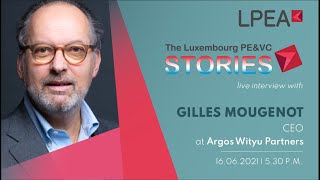
Interview with Gilles Mougenot (Argos Wityu) covering the firm’s history (founded 1989), pan‑European footprint (six offices across eight countries), and investment strategy focused on majority investments in SMEs facing complex situations summarized as “buy complexity, sell simplicity.” The conversation reviews recent activity and sectors (software, professional services, healthcare, logistics), organisational setup (≈50 employees, >30 investment professionals, Luxembourg fund registration), COVID‑19 response (low leverage ~2.5x EBITDA, Fund VIII launch targeting €650m), ESG initiatives (internal program, portfolio due diligence, Friday initiative, carbon offsetting), and Mougenot’s personal background, values and advice for young professionals.
Chapters
Good afternoon and welcome to the Luxembourg PVC stories with today, Gilles Mougeneau from Argos with you. Hi Gilles, how are you? And where are you today?
Hello everyone. I'm fine, I'm in Brussels. You cannot see the beautiful blue sky behind me, but great weather, great time.
Let's start then. Gilles, what can you tell us about Argos? How, when and who started this whole adventure?
Before Argos, I joined Initiative Finance, which was one of the pioneer in the Lvos market in France in 1985. And I tried to organize my MBO on Initiative Finance. I failed and then I took the decisions to set up my own organizations and I met Maurice Dweck. So Maurice Dweck was the founder of Soditik so a bank and asset manager in Geneva. So that's why the name, original name of Argos was Argos. And we moved to Argos with you a few years ago. And we launched in 1989 with two partners. One unfortunately died a few years after and one left and the remaining founder of the group. And the strategy was really to set up a pan European investment group. So Initiative Effinace was more or less a pure French player and also with an entrepreneurial mindset. And since then, so after 40 years we have managed 80 transactions, we have six different offices, so Geneva, Milan, Paris, Brussels, Frankfurt and Luxembourg for sure. And we are covering eight countries and we are currently managing 1.2 billion euros funded by international first class investors.
Thank you Gilles, for this introduction. And don't be worried. We love the explorers, the pioneers, specifically when they have great stories to tell and no else. If we could summarize now, Argos made Activity. You touched upon a few points, but also. What's your core philosophy?
It was not determined at the beginning, but in year 2000 we did a deep analysis about our deal flow, competences and return. And we took the decisions to first of all concentrate our investment in majority investments in SMEs with strong fundamentals, but facing complex situations. So complex situations is covering a lot of different situations. So MBI opposed to MBO, carve out spinoff, asset arbitrage, shareholder dispute, privatizations, P2P. And in that perspective we bring our complexity expertise with a rigorous approach to value creations. And we have in a nutshell, defined our strategy, which is buy complexity, sell simplicity. And behind that our core philosophy is really entrepreneurial, business minded, transparent, reliable, truly European, really oriented to human capital and people close to management teams. And again, true majority shareholders and prudent leverage approach. Why? Because when you are dealing with complex Situations the situation is not easy to leverage and we believe that we can really achieve nice returns without a lot of leverage. But with a huge emphasis on the transformation of the companies.
Wow. That's really a clear motto. And also philosophy from complexity to simplicity. And you mentioned then also the SMEs. What are the core sectors you are specifically monitoring or investing in? Are there any specific deals, recent ones you would like to highlight?
In this regard we are sector agnostic. We exclude real estate, gambling, but basically we are generalists. However, we perform transactions in different sectors. Software, professional services, healthcare and logistics. And I can provide recent examples. For example epc. So rather complex because EPC is a listed company. So in France Olin, so in financials as well as Sicura which is proposing services in Italy around fire safety. So rather large in terms of sector, in terms of experiences.
Wow. And in order to handle such deals, what can you tell us about the Argos setup? Where are your main offices and how many persons to work for Argos globally?
It's an excellent question and I think that it's really something really different. In our organization we are 50 people on which you have more than 30 professionals. And if you look the number of deals or company in our portfolio and number of people, we have two professionals for each single company. And why Easy to explain that to transform the company you need really a lot of manpowers during the holding period. In terms of footprint, as already explained, six offices covering eight countries. Our fund is now registered in Luxembourg with the French afm.
You mentioned Luxembourg and also the French afm. What about your Luxembourg presence and which operating model do you use here? And finally, what's the composition of your local team?
As you know, we are moving from French Jersey situation to the Luxembourg. So we didn't do a full Luxembourg fund. I mentioned the French ifm. So we don't need to be AFM at the level of Luxembourg. So today we have an holding company and with two professional and most of our funds gps also located in Luxembourg as well as a number of dedicated SPV in order to structure our underlying.
And in such a configuration. Do you think that also globally in Luxembourg we could find more front office roles? Since you have a large experience including then Switzerland, Belgium and France, for example investor relations or fundraising activities, would those make sense in Luxembourg?
Hello, we were rather complex situation with back office here and there. I mentioned Paris for the afm. Then we are clearly moving to Luxembourg and I think that it's a question of time where we will see our Luxembourg office growing and probably Integrating some of the services that you just mentioned, IR and other stuff like that. Yes, it's a nice phase out of, let's say, of the existing situations to a new world where Luxembourg will clearly play a very important role.
Great, thank you, Gilles. Because we always look for new opportunities, how we could further develop the Luxembourg ecosystem. And those could be, for example, interesting examples such last year, complicated year, I think for everybody, I mean many digitalized or discovered those technologies. What happened at Argos in 2020, the.
Fact that we are myself, but also some of our partners quite old, means that we knew what, let's say a crisis can damage companies. And for the people who were there during the year 2008, 2009, I think that every expert in private equity has probably reached and let's say by the experience has grown his learning curve. So when we saw, and honestly thanks to our expertise and also some of our companies were based in China, we knew that something was coming. So immediately I think that we took very seriously the first wave of the COVID 19 in Q1 2020 and we try to support our management team and the businesses they run. So 2020 was really very hands on to protect the human capital of our portfolio companies and as well as their liquidity positioning. And what is really interesting, when you look at the European scale, you will see that countries react very differently. So France is probably, let's say, quick in their reactions and they provide a lot of Peugeot loans to companies they were very nice to have where other countries are, let's say, much more demanding. So for example Belgium, Netherlands and Italy. So we face different situation in different countries. Honestly, no major issue in our portfolio across Europe, which also confirming our reasonable approach to our financial leverage. Because we are not fun, as I said previously, we are not fan about leverage. In average we have 2.5 times EBITDA as debt. It's very helpful when you are managing such crises, you are not thinking about breaking, let's say ratio and so on. And we were really concentrated to manage the different situations. And by the way, we are also simultaneously started the launch of our Fund 8 with a target slide of 650 million euros.
Congratulations. That's what you call resilience. And I also liked your anecdote of different countries being more generous than others. Where there, for example, survival is how you have done your setup and how you are able also to become agile and react to it. But for experts of complexity, as you said, this was something well, well planned then.
It'S a very interesting period. It's not Finished, to be honest with you, because we will see what's coming next after, let's say this fantastic, let's say, reopenings into brackets and what come next. That's very difficult to see because today everybody is really excited, optimistic on the short term, what comes next on the medium and long term, we'll see. But anyway, we are ready.
Nice. And esg, sustainable finance really increasing continuously increasing trends. What about that? How has Argos defined its policy or strategy? How active are you already?
Well, I think that a part of the COVID which is a massive disruption. I think that there were two interesting elements from the beginning of 2021. The first one is demography in China. So we have all in mind that we are, let's say, growing, let's say a growing population everywhere and we reach 14 billion, 40 billion inhabitants, which is not anymore the case, particularly when you see a decrease in China, in Italy or other nations. And the second element for me is a different, let's say, decisions taken by court and for example, in Netherlands, the court which has condemned Shell to reduce massively its carbon footprint by 45% between now and 230, and this is really, for me, reveal that it's not only, let's say, the flavor of the, let's say years or decades, because we know that ESG is now very important. But to be honest, if I have to categorize the esg, it's more a top down approach coming from very large investors under the pressure of stakeholders and I already believe the total opposite way, which is for me a bottom up. Bottom up means in our organization two things. First of all, we didn't hire any ESG specialists, but we think that ESG should be shared by some of our people internally and particularly around me, because I'm, let's say, in charge of the ESG program. We have involved four other people, so one investment manager, so Arnie Louvaghi in Belgium with me, but also Olivier Laguerniere who is our General secretary in Luxembourg, the head of communication, because we have also to communicate more and more and also our compliance associate, Lilia Cadai. So that's the first level. The second level is at the level of the portfolio companies. And really what we're asking is not to, let's say, impose any ESG program, but really to help each portfolio company to develop actions and KPI at their level and they should decide what sort of actions they want to run for a medium term period. So we launched our internal policy and we have published in 2021 on top of everything, we took the decisions to launch what we call the Friday initiative. So we are giving two days per year freely to dedicate for each member of our group, each employee to dedicate their time to social activity or their choice. And their choice and the action that they are taking will be discussed at least in their internal review, which happen in our organizations two times a year at the level of the portfolio company, as I said, systematically we are doing pre acquisition, due diligence, ESG and by constructions we have for each company to, let's say, determine what actions and to report at the level of the board. So really, and this is very interesting because what is behind is also to promote some of the actions of one specific portfolio company in order maybe to generalize the actions over our European portfolio, or to organize some beauty contests, maybe attribute some subventions or some money. Last but not least, we took the decisions to offset the carbon footprint. So we did it last year and this year and every year we are offsetting in attributing the amount to one specific company. So last year we took the decision to attribute the money to the Good Planet Foundations, which is run by Janet of Bertrand, the famous photographer and director. This year we have attributed the amount to a non profit organization in Belgium. So Napier Pont, which will plant 4,350 square meters of new forest around Brussels. And next year Germany will decide what.
Sort of.
Actions or nonprofit organizations they will attribute the offset. So it's quite interesting, quite large, and it's not finished. For the moment we are working on specific topics and for example, we will launch an individual questionnaire about ESG in general for each employee for sure, on an anonymous basis, to understand how they feel about esg, about inclusions, diversity and so on.
Lots of nice initiatives. And I particularly like the one where you allow your colleagues and also staff to work in parallel on specific project. That really makes sense. Yes, yes. And we should all inspire ourselves. I've seen fingers here in the studio and people telling me that also like to do the same. So you see, that's how you share great ideas.
Thank you.
Concerning the more general now private equity landscape, the ecosystem, what's your view currently on our favorite industries? Anything specific? You also see for Luxembourg, which could be further upgraded in the future.
Well, you know more than me, but honestly, if I have to summarize your positions, you are a very prosperous country with the aaa. You have a skilled and multilingual workforce and for a French citizen, a proven stable political environment, which is absolutely key to develop private Equity in the ecosystem center of Europe in terms of geography and the fact that you can easily rich talk exchange with the authorities is for me a very clear positive component. I was, as if you remember, I was the chairman of the French association and we spent a lot of time to explain what is private equity, what is the interest to develop private equity in our countries. And for example, it's an abuse strength that the private equity ecosystem is very largely developed indeed.
We like the short and pragmatic ways. That completely makes sense.
Yeah.
Now more on a personal basis. Gilles, what did you study and where did you start your career?
So I'm a lawyer. I have a lawyer background. So I started I was graduated by Master at Paris de Assas plus Deoss at parisinque plus Comparre. So I was perfectly trained to become a lawyer. And by the way, when I was at Parisinq I studied with two great legal professional. One, Xavier Jaspar became the top partner as Mayor Brown in the buyout structuring activity. And the second one, Frederic d' Engutvabre set up Taxon, so probably one of the most successful, let's say tax and legal company in France. So we were all three basically very entrepreneur. But I'm the only one who choose the private equity. So I start my career as a trainee advocate training and then I joined a non profit organization called inco, which was the Azure National Polacration Entropy. I set up the merger and acquisition department. So in 1982 I set up the first organized the first event conference on buyout in 1984. So just few months before the reform called Eros Parle Salarier which was, let's say the first tax initiative taken by the government to facilitate the merger and acquisitions. And basically five years at Initiative Finance. So we started with a very small FCP error of 50 million French francs, so around 9 million euros. Then we have transformed the company into a holding company listed in 87. Super successful. When I quit Initiative, I organized or financed myself more than 23 buyouts in 1990. So it was a very good time, Fantastic period, like all the pioneers periods.
Wow. Again, very impressive. And also all the time very entrepreneurial, always moving on. In such a context, any specific values you personally appreciate and respect? I mean either with your team, but also the target companies, etc.
Well, to be. I'm a boomer, so boomer means very old guy. And to be very transparent to you, what I like are the bourgeois values. And basically what are the bourgeois values? It's a work, individual freedom and high Sense of responsibility.
So.
For sure I love also the team spirit because when you set up an organization which is people business oriented, you want to really infuse team spirit. But let's say I like the idea that the bourgeois values are still valuable.
Great. And any specific advice you would like to give to young talents who would like to enter the private equity industry and also work with us in the future.
There are two different approaches. They are very, very different. The first one is to say guys, before joining a private equity group you should spend some time in the industry, maybe a bank, MA department and so on. And then it will be easier for you to penetrate the private equity. I have a very different approach which is as soon as you can join the private equity. And by the way, I trained many of my partners when they were very, very young. So Louis Baudin joined Initiative Finance at the age of 20, maybe 20 something. 8 Karel Poupin just after finishing his MBA at HSL. So honestly, depending on the structure, but I like very much the idea that as soon as you can, you join private equity pool. By the way, the other advice is LBL was fantastic. I love pioneering. I love to really develop businesses without any constrain, any let's say people who are touching your shoulder and say guys, you are not doing the right thing. So my individual freedom is absolutely key. So today if I was young, I will enter into a venture company because honestly there are so many things to develop. And the other alternative which is rather commemplane is esg because I truly think that ESG is really opening new horizons and also sometimes reconciliating money with values, let's say like that.
Well, very exciting. And also to end up, as you said, if you would start anew now that you would kind of end up in the more venture capital oriented business but it would still be very entrepreneurial and certainly also contain then those either values or technology.
I think that technology is a new horizon every day. We are also facing challenges because for the the old people and let's say old strategy, we have to adapt our behavior to the new technology. It's exciting, but it's also challenging.
Yes. And also why it's important to have really strong UX designers helping out in order to make that use as simple as possible and effective. Absolutely. Did any specific leader or person inspire motivate you when you were younger, now or whenever?
Again as a boomer, I will name people who are very, very old. So General De Gaulle, because he was also a guy who took a very brave or bold decisions. And I like the idea to be against the mainstream and by the way, fantastic politicians. So Obama, I love America. I had a house for a long time in America and I'm fan of this very large country and very happy to see a new Democrat president after four years of nightmare. And Obama for me is a perfect example of what United States is capable to do. So this very traditional, sometimes conservative country is able to elect African American guy. That is absolutely fantastic for me. And the last one, which is also a little bit the same, is for sure Nelson Mandela. Because a guy who really transform a company, let's say, without taking any violent actions, is also spending his time in prisons, is a fantastic example for the future.
Great names and rest assured, Gilles, I think that our audience and certainly community knows those fabulous examples too. Charles de Gaulle, you could even have cited gfk. Sure, no problem. And Obama, as you said. Yes, that completely makes sense. And on a very light note, in order to finish also our interview, any great book series or podcast or even music you would recommend to our audience. I mean it can be business linked, but can also be on other, I don't know, hobbies you would have or passions.
I need more than half an hour a day to explain what are my hobby because I have so many, to be honest, outside of the private equity, because I'm really passionate. First of all, in terms of books, I highly recommend the Overstory, which is Richard Powers fiction book which won the fiction's Pulitzer pride in year 2019.
Why?
Because it's talking about trees. It's different stories, but around the trees. And then when you are reading the book, you are considering more or less than a book is a person and not an object. So very interesting for sure. The last book of Obama. Well, and last but not least because I have to do my own publicity. A fantastic book that you should buy everything you need to know about private equity. By the way, I'm very happy to publish this book with my Luxembourg editor Legitech and we are, let's say, publishing the next version in a few weeks time and also publish a new version of the book in English because honestly the first version was very poor and we are doing a lot of effort to be, let's say, more clear and more detailed, not only in French but also in English. The theories. The theories. Again I highly recommend. I don't know if you are familiar with the Kominsky method. I don't know in Netflix. Why? Because it's Michael Douglas who was the most important role and what's happening to him because in the movie the series he has above 70 years old. It's a little bit refreshing for me, which is facing more or less the same issue. So I love the Kaminsky and metal in music. So I'm fond of every kind of music, but particularly the jazz. I'm a fan of jazz and the two are for me, the two are great singer are Gregory Porter and his last record, Nat Pinkhole and Me is for me, top of the top. Natine Cole was also a fantastic singer. The first African American, let's say recognized as a true singer in the. In the 50s. And the second one is a lady Melody Gardeau with his last record, Sunset in the Blue.
A very nice taste also here. And next time we see each other in Luxembourg or wherever else, I mean, we'd be very happy to fill our LPA library with your book and signed version.
For sure. No problem. I will be more than happy to dedicate my book to your associations.
And just before finishing, I wanted to thank you, Gilles, for sharing all those insights, for taking the time also of all those great anecdotes. We love this very entrepreneurial spirit. That's great. And also the no constraints part. We listen to that. See you soon again. And we say goodbye.
Thank you. Bye bye.