250th Anniversary Celebration for the United States Marine Corps
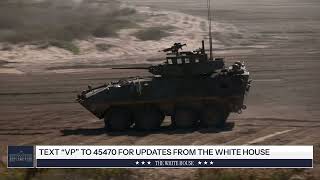
Transcript of a 2025 Beach Blast event at Camp Pendleton celebrating the 250th anniversary of the United States Marine Corps. The content interleaves narrated amphibious demonstration descriptions (air/sea/land operations, platforms, tactics) with keynote speeches and remarks from senior leaders, veterans, and public figures emphasizing Marine history, readiness, combined Navy–Marine operations, and the Corps' warrior ethos.
Chapters
These forces give America options. They can project strength, deter aggression, and if called upon, fight and win. They are forward, mobile and ready, standing watch and projecting power in support of our national security objectives. Today's demonstration is more than a show of strength. It is a reminder of purpose. The ships, the aircraft and the Marines you see are part of a living legacy stretching back 250 years. A force that remains as ever, the first to fight. Long before armor hits the beach, Marines and sailors are shaping the fight. Under the COVID of darkness, reconnaissance Marines are inserted by a KC130J Super Hercules executing a high altitude, low opening insertion, also known as a HALO jump. Marines land in contested areas inaccessible by other platforms. Because Marines go where others can't, the Super Hercules ramp drops. The reconnaissance Marines move out, disciplined, deliberate, light on their feet, heavy with purpose. They carry sensors, communications assets and the mindset of trading comfort for mission success. Their task is to locate obstacles, chart enemy positions, refine landing lanes, and report exactly what the assault force will encounter when it lands. These Marines are the eyes and ears, observing the situation on the ground and relying critical intelligence to the mission commander. Simultaneously, a SEAL team employing a dry combat submersible take the beach undetected, infiltrating the area of operations. This mission confirm enemy disposition, identify obstacles and establish a landing zone for follow on forces. They use advanced sensors acoustic, thermal and visual to gather critical intelligence. This is a direct descendant of the scout swimmers used in World War II, but with exponentially increased capability. Ask them where the aircraft are.
Waiting on aircraft, sir.
One minute. Setting conditions for the marines and sailors coming ashore. Aviation assets conduct strikes on enemy positions, thinning the enemy formations and distracting from the coming insertion of additional Navy SEALs. Over the water. Special warfare combatant crewmen begin shaping the littoral environment from combatant craft. Medium, a direct action SEAL team descends from the sky, inserting via helocast. This airborne low signature technique allows the seals to use a combination of boats to rapidly infiltrate the beach. Their mission is the key to neutralize enemy strong points, clear obstacles and establish a secure beachhead. The seals are not seeking a protracted engagement. They are creating a window of opportunity for the main assault force. It's it. Above it. All strike aircraft stand ready to deliver deep effects on a commander's order, ensuring every move is backed by overwhelming American air power. Together, the quiet work of recon, the shaping of naval special warfare, and the mass and maneuver of the Marine Corps create conditions for victory before the first wave even hits the sand. This is the culmination of shaping operations Stealth and precision, enabling the massed, disciplined momentum of the Marine Corps. Sensor data flows into analytic tools that highlight threats, predict enemy movements and surface opportunities. The Marine Corps of 2025 makes decisions in minutes, sometimes seconds. Every Marine is a sensor. Every vehicle is a node in a network that shortens the kill chain. As naval infantry Marines exist to seize enemy beaches from the sea. Known as forcible entry operation, the layering of reconnaissance, surface and air assets enables Marine to arrive violently on the enemy shore, establish a beachhead and flow Marine and joint forces ashore. As the amphibious combat vehicles prepare to make landfall, the previously inserted seals have found their first target. An enemy machine gun bunker established to interdict the landing of marines, preventing the 11th Marine Expeditionary Unit from establishing a foothold on Red Beach. They will fail communicating with strike aircraft providing overwatch. High above the reconnaissance Marine, a qualified joint terminal attack controller requests an airstrike to destroy the enemy threat.
Board of flight. Advise when ready. Game Plan 9 lockdown ready. Type 2 bomb on target 1 by GBU 54 each aircraft cutlass 2 niner 8 11.3123ft. Enemy machine gun bunker 8 digit grid Mike Sierra 566 niner 83 niner 6 negative mark Southwest 200 meters. Egress L pull ram forward 16 block 1 8. Final attack heading 2 niner 0 through 32 0. Danger close. Initials Juliet Sierra. Go with read backs.
I read back from my system 123ft 8 digit grid Mike Sierra 566 niner 83 niner 6. Final attack heading 2 niner 0 through 32 0. Danger Close. Initials November Whiskey.
Good read backs immediate push.
Pushing cutlass. Continue in 3:10.
Cleared hot battlefield effects for bombs.
It.
That's.
On the horizon is the USS Boxer. Flagship of this amphibious ready group, a WASP class amphibious assault ship, Boxer is sovereign US Territory. A floating airfield, hospital and command center. She carries Marines aircraft and landing craft wherever America needs them. Today she leads this formation, just as her namesake fought with distinction in the War of 1812. The original boxer was known for the bravery of its crew and its effective use of naval tactics. The current USS Boxer carries a diverse air and surface warfare capability to support the Marine Expeditionary Unit's missions. Set beside her sails the USS Comstock, a dock landing ship named for the pioneering history of the American West. She delivers Marines vehicles and craft to the fight. At H hour, the exact synchronized moment when the assault hits the beach. The ocean transforms into a battlefield. From beyond the horizon, amphibious combat vehicles smash through the surf, their armored hulls carrying Marines straight into the Fight expeditionary and modernized in design, the ACB integrates with naval shipping and ship to shore connectors. The ACB's ability to use the ocean and waterways to carry Marines and equipment make it well suited for a variety of operating environments. The ACV is lethal, balancing performance, protection and payload, enabling it to support standin forces in the Pacific. Overhead, helicopter pilots prowl the battle space, hunting targets and passing target data back to the Marines ashore. UH one Yankee Venoms slice low across the surface, their sensors fusing with unmanned systems to extend the battlefield picture. AH1 Zulu vipers orbit like bird of prey, digitally linked to advanced sensors on air, land and sea. Every rocket, every burst of 20 millimeter fire is synchronized across the kill web. Precision, speed and shock brought together in one fight.
These aircraft are part of the Muse Aviation Combat Element, which comprises tilt rotor aircraft, transport helicopters, attack helicopters, fixed wing aircraft, air defense teams and ground support assets. The Air Combat element boasts about 600 personnel to man and maintain all things air. Aviation is essential for distributed forces to leverage massed effects without the vulnerabilities of concentrated forces. As part of force design and force modernization, Marine aviation continues to enhance its capabilities for operating in austere and distributed littoral environments. To support stand in forces.
It. Ch53e Super Stallions roar in low. Marines surge into the dust and chaos. They will fan out instantly, rifles up, establishing a security cordon, locking down approaches, feeding target data back into the fight and setting the conditions for the assault to push inside. Marines never enter a fair fight well before the actions on the objective. Marines have set conditions for victory through training, planning and technological overmatch. In support of the landing, ACVS, a combined anti armor team or CAT consisting of 20 Marines loaded onto various armored vehicles, trucks and large all terrain vehicles move into the objective area to provide support by fire to the assault force. Comprised of two sections, the CAT consists of a joint light tactical vehicle, gun trucks that are modern armored and capable. Outfitted on these JLTVs are heavy weapons, M250 caliber machine guns, M 247.62 millimeter machine guns and Sabre missile systems. The Sabre missile system is a tube launch optically tracked wire guided missile that enables Marines to punch through enemy armor and reinforce positions. Alongside these JLTVs is the Marine Corps latest kinetic anti drone system, the lmatis. The light Marine Air Defense integrated system is mounted to a highly mobile and versatile ultralight tactical vehicle. In this era of modern warfare, the LMATIS enables Marines to switch, spoof, jam and defeat drone threats from non kinetic electronic Attack capabilities.
This isn't theory, it's proven. In July of 2019 aboard the USS Boxer, Marines employed the El Mattis to take down an Iranian drone threatening the ship in the Strait of Hormuz. No missiles, no explosions. A non kinetic strike delivered at the speed of electrons sent that unmanned aircraft crashing into the sea. Precision control. Real world success. The kind of success that defines the Marine Corps in modern warfare. The marines aboard the ACVs represent the ground combat element. The GCE is comprised of a battalion landing team, a reinforced infantry battalion with significant combat power. The ground combat element has the greatest number of personnel within the MEU at approximately 1100 Marines and sailors. Representing a balanced fusion of modernity and Marine grit, the Marines of the ground Combat element embrace emerging technologies to outpace future threats while relying on timeless battle proven methods to fight and win. As the infantry centered core of the Marine Air Ground task force, the ground combat element will harness robotics, artificial intelligence and advanced sensors to expand reach and tempo across the multi domain battlespace.
It's.
4F A18s thunder low over the formation, their vapor trails painting the sky above them. Two F35s burn steady and silent, watching every angle. This is more than a spectacle, it's a message. A show of force shapes behavior. It deters the hesitant and sends a clear message to any adversary. We can see you, we can strike you. And if need be, we will. Supporting Marines on the ground, compressing decision time for the enemy and creating a deadly air ground dilemma that. It. It's got to be coming. High above the battlefield, the sky erupts into an integration of generations. F A18 Hornets carve aggressive turns, climbing and diving, pushing the fight with raw speed and agility. From above, stealthy F35 Lightning IIs lock on their sensors, fusing every moment into digital battlespace. What you're watching is more than a dogfight. It's Marine Corps aviators creating air superiority. This allows ground forces to seize and hold the objective. Hornets and Lightnings proving that the modern fight dominance comes from teamwork across the spectrum. Fast, lethal, unstoppable. It. Over red beach. The F35 Bravo demonstrates what sets it apart from every other fifth generation fighter. The ability to hover. The vertical lift fan engine engages, holding the aircraft steady in midair. A capability unique to the Marine Corps. Hover flight allows the F35B to operate in the most austere environments. Far from established runways, Marines can build forward arming and refueling points known as FARPs. In the dirt, on the road or on an island airstrip. And Keep these aircraft in the fight where they're needed most. And when the fight shifts to the sea, the F35 Bravo brings that same flexibility to the Navy. This short takeoff and vertical landing variant can touch down on amphibious assault ships, giving the Navy and Marine Corps a fifth generation strike fighter that can project power from any climb or place. Amphibious combat vehicles rants drop as Marines surge into the fight overhead. UH one Yankee Venoms and AH one Zulu Vipers rake enemy positions with rockets and cannon fire, while F A 18 Hornets scream down and deliver precision strikes. Targets shift and move, but there is no confusion. Every round, every bomb, every burst of fire is deconflicted with the Marines pressing forward on the ground. That discipline, that synchronization, comes from our joint terminal attack controllers. JTACs orchestrate the modern battlefield with a radio and a tablet. They control ordinance from joint aircraft in close proximity to maneuvering forces linking air, land and sea fires into one decisive punch. And the Marine Corps doesn't just employ JTACs for ourselves, we provide them to the joint force, setting the standard for precision integration and battlefield control. With fire synchronized, the battalion landing team presses into the objective area. Squads pushing through breach points, clearing house by house, street by street, every corner secured, every building taken until the objective is seized. Over the horizon, the sea roars, riding cushions of air Navy landing craft, air cushions ELCAX burst into view. These massive hovercrafts, capable of carrying 60 tons and reaching speeds of 50 knots, carry the fight to the shore, bringing Marines vehicles and heavy firepower directly across the surf. From ship to ship, Elkacs give the Navy and Marine Corps team unmatched speed, reach and surprise, delivering combat power where the enemy least expects it.
The Navy does more than bring Marines to the fight, it sustains them. Ships offshore purify water, generate power, provide medical care and deliver ammunition. Without sailors, the fight ashore would falter. With them, it endures.
It.
The logistics combat element surging supplies ashore is comprised of the combat logistics battalion personnel and equipment designed to support and sustain the MEU for up to 15 days in an austere environment. The logistics this combat element also provides service support that includes postal, medical, dental supply, explosives, ordinance, disposal, fuels and more. They accomplish this with just 300 Marines and sailors.
It. A three ship amphibious ready group consists of one big deck and two modern amphibious transport docks or dock landing ships that enable fleet and geographic combatant commanders options. This formation operates independently or in aggregate, and the sea based Marines can be tailored for a wide range of missions conducted from ship to shore. The amphibious Ready Group and Marine Expeditionary Unit is always present and always ready to project sustained combat power ashore. Exactly when and where the joint force needs. Look to the sky. Layered Navy air power thunders overhead. At 1,000ft, fighters roar low, ready to unleash fire at a moment's notice. At 4,000 and 5,000ft, strike and electronic attack aircraft circle like hawks stacked for speed and dominance. Every jet you see was launched from the deck of the USS Theodore Roosevelt. A carrier strike group that carries the fight anywhere in the globe from sea to sky to shore. This is the full might of carrier aviation. Loud, fast, unstoppable. As carrier aviation owns the skies and Marines press inland, the Navy sustains the fight. LCACs offload additional vehicles and supplies and reinforcements. Every load extends endurance. Every delivery builds momentum.
The beachhead continues to grow. Marines establish a defensive perimeter, securing ground for for follow on forces. Landing craft deliver artillery and vehicles. Light armored reconnaissance pushes inland, striking quickly and generating tempo.
The Nemesis light armored vehicles M777s and HIMARS rocket launchers deploy onto the sand, delivering armor and long range precision dominance straight from the sea to the shore. The Nemesis is a ground based offensive anti ship capability that contributes to the fleet's ability to achieve sea control, sea denial and defense against maritime threats. Nemesis allows Marines to support the surrounding naval forces by countering surface threats without reliance on traditional naval platforms. The remotely operated capability of the Nemesis enables a smaller, more expeditionary deployable capability. Partnered with remote firing positions. It increases survivability on the battlefield and enhances operations for forward deployed forces. Sam. It. The ARGMU is the initial stabilizing force that creates the necessary conditions for the arrival of the joint force overhead. The B1 Lancer leads a formation of long range strike assets armed with precision and conventional weapons to deliver devastating firepower. They conduct a global strike to project power rapidly and decisively anywhere in the world to achieve strategic objectives. Now that the Marines have massed combat power ashore, we begin to set conditions for movement to other objectives further inland. The king of battle arrives. M777 howitzers are emplaced and prepared to support ground maneuver. The M777 fires the 155 millimeter M795 high explosive round with precision sustained at two rounds a minute, surging to four when demanded. Operated by a section chief and nine cannoneers directed by the Fire Direction center approved by the Fire Support Coordination Center. This is not only steel and power. It is calculation and courage, timing and trust. The quiet math that makes Thunder purposeful. The call for Fire flows from the forward observer located with the assault force to the fire direction center. The mathematicians of Mayhem, the fire direction officer and ops chief, run the numbers. Data is verified and the fire command is sent to the gun line. The crew moves like a single organism. One shoulders the high explosive shell. Another sets the point detonating fuse. Finally, the charge is added. Breach closed. Tube elevated. The battery is ready. Then silence. Thunder. The gun recoils, the earth shakes and 155 millimeter shell tears through the air. Speed, mass, steel rain. Inbound corrections flow. The crew repeats the rhythm builds. One, two. A metrodome of steel fire. Sustained pressure unrelenting. Motor T waits with fuel and trucks. Comms log every shot. Battalion Commander XO Gunnery Sergeant First Sergeant. Eyes sharp watching the battlefield transformation, We witness the arrival of the Carrier Strike group, a formidable force of naval power and precision as it sails into position to support a dynamic amphibious assault. The carrier Strike group represents the pinnacle of maritime capability, seamlessly integrating air, surface and subsurface assets to project power and ensure dominance across the battle space. At the heart of the strike group is the aircraft carrier, a floating fortress of innovation and strength, serving as the centerpiece of naval aviation. The carrier Strike group stands ready to support the amphibious assault, demonstrating the unmatched capability of the United States Navy and the United States Marine Corps team.
Behind every movement you have seen is a resilient command and control network hardened against cyber threats and protected by Marine cyber warfare operators. This seamless flow of data ensures Marines never fight blind. The Marine Corps of 2025 is connected, resilient and decisive.
This choreography of warfare is directed by the Marine Expeditionary Unit Command Element. The command element, comprised of approximately 200 Marines and sailors, is led by the Marine Expeditionary Unit Commander and supporting staff. They exercise command and control over the Aviation Combat Element, the ground Combat Element and Logistics Combat element. They have special detachments like Signals Intelligence, Counterintelligence, Civil affairs, communication strategy and Operations and reconnaissance. From flintlocks to fifth generation fighters, from wooden decks to steel carriers, the Navy and Marine Corps continuously evolve. But their fighting spirit endures. The message is simple. The Navy and Marine Corps team is ready, ready to deter, ready to fight, ready to defend the homeland. The Amphibious Ready Group troops and Marine Expeditionary Units give our nation's leaders flexible, forward deployed options that are sovereign, scalable, ready and in position when it matters most. These formations respond in hours, not weeks, without relying on access, basing or overflight permissions. Their presence alone can deny adversaries the decision space they crave, shape the battle space and introduce doubt before the first shot is even fired.
For two and a half centuries, Marines have stormed beaches, fought in jungles, deserts and cities and carried our nation's colors with honor. At Belleau Wood, Marines earned the name Devil Dogs. On Iwo Jima, Marines raised the flag. Seen around the world in Fallujah, Marines fought block by block to bring stability in chaos. What you see today is that same spirit sharpened by modern technology, amplified by our brothers and sisters in the Navy and carried forward by the Marines of 2025.
It. It's. For 250 years Marines have answered the nation's call. Today we honor that legacy. From distributed maritime operations to precision long range fires, from amphibious assaults to cyber defense, the Navy Marine Corps team is equipped to win. This is the raw strength of America, ladies and gentlemen. This is our nation's 911 force.
It's.
Always forward, always faithful, always ready. Ladies and gentlemen, your United States Navy and United States Marine Corps.
It.
Ladies and gentlemen, please welcome retired U.
S. Marine Corps officer and fitness advocate Kagan Dunlap.
It. Look familiar? Scenes like these are happening all over the planet right now. You could be next. That is unless you make the most important decision of your life. Prove to yourself that you have the strength and the courage to be free. Join the marines.
Oh man.
I was hoping that some of you would get that reference. I'm glad some of you did. So 250 years ago today, or not today, but this, this next coming month. This year, Captain Samuel Nicholas and his friend Robert Mullen started recruiting marines in ton tavern in Philadelphia, Pennsylvania. Little did they know that the United States Marine Corps would become known as one of the greatest and most respected fighting forces that the world has ever known. The people they recruited weren't Superman. They didn't have superpowers. They weren't in a Marvel movie. They were farmers, they were blacksmiths, they were tailors and sailors. They were hunters and people that worked with their hands. These, these people stormed ships, they seized forts, and they stared down the world's greatest navy, which at the time was the British nav. We didn't offer them riches, we didn't offer them glory. But we did offer them the opportunity to become part of something that was much greater than themselves. Today, when I look out at all of you, I see a bunch of people from all over the world. From all over the United States of America. From all over the like everywhere. Some people might be from California, there might be some people from Indiana, maybe some from Alaska, maybe some from Hawaii. Some of you may have grown up with lots of money. Some of you might have grown up poor. Some of you might have parents. Some of you might not have parents. But guess what? All of us are here for a reason. We are a family. That's what brought us together. One of the greatest parts about this organization is that we don't care who you are, what you look like, where you're from, what you're experience level is. But you are welcome here if you can earn it. And believe you me, you have to earn it. Just like what Sergeant Dakota Meyer said, it's not given. You have to work hard for it. And anything valuable that I found in my life that I've earned was something I had to work very hard for. That's just been my personal experience. Now, like I said, when I look out on all of you, I see my brothers and my sisters. You are all family to me. And as far as I'm concerned, we bleed the same blood. We're from the same timeline, we're from the same DNA line as far as I'm concerned. And come hell or high water, we need to support each other. We have to. Because one day we are going to go to war again. And when that happens, the only people you're going to be able to rely on is that Marine or sailor to your left and your right. And that's it. None of the other stuff going on in the world's gonna matter at that point. It's gonna be you and your friends to your left and your right. And believe me, if we go to war, it's not just gonna be the infantry that's out there. It's gonna be everyone we're all going. To. So one of the things you can do, since it is inevitable that this happens, make yourself better than you were yesterday. Even if it's just going to the gym. Make yourself tougher. Make yourself more resilient. Make yourself smarter. Study, read, look things up. Be situationally aware about things that are happening in the world around you. Because believe it or not, that will affect you, you directly. Things that happen on the other side of the planet can impact where you deploy. Now, 250 years is not an accident.
All right?
The reason we're here is not because America needs us. Right? Because the army can do everything that the Marine Corps can do, right? They have all the same capabilities. The army even has ships. Did you know that? I didn't know that for the longest time. I didn't realize the army had ships, but they do. But the reason we exist is because. Not because America needs us is because they want us. I don't know if you guys noticed, but recently, the other day when Secretary Hagseth was speaking to all of the generals of the entire United States military, one of the things he was talking about was instituting a new fitness test for all the other branches. I don't know if you guys remember that. Who do you think that he got that idea from? I'm just saying we've been running two fitness tests for a long time.
Have we not?
We run a combat fitness test and we run a physical fitness test everywhere every year. Do we not? You hear a lot of people talking about standards. Well, we set that standard, at least in my mind. The way I perceive that is that we set a standard that other people saw and they're like, you know what? I really like that. Maybe we should try that with other people too. Obviously, it's been impactful. It's been effective with the Marine Corps. I bet it could work with other branches, too. Let's try it out. You know how the best way you can affect changes? The best way you can affect change or influence people is by setting the example. If you want to. If you want to impress upon other people to be physically fit, be physically fit yourself. If you want to impress upon other people to go shooting and get out and learn stuff about the country they live in, do it yourself, too. You got to lead by example. That's the. That's the best way that you can convince other people that that's the right way to do business.
All right?
And it's going to be hard sometimes because some of the most rewarding things I've found in my life are not easy. They're hard. It takes a lot of work. It takes discipline. I wake up every morning at 4:30, not because I want to, but because I have things to do. I don't like waking up at 4:30 every single day. My alarm goes off and I'm like, it's like Groundhog Day. But I do it anyway because I know it's the right thing for me to do because I have things I need to do. I need to get up. I need to shave my face. I need to cook breakfast. I have work to do.
You know.
And I'll tell you right.
Now.
I know a lot of you are a lot younger than me because.
I joined pretty late.
I was 27 when I first joined the Marine Corps.
All right?
And I may not be as young as I was then, but I still take good care of myself. I work out on a Very regular basis. That's like a non negotiable for me.
I don't know about you guys, but.
I want to make sure that I said this to all of you out there because you're in a different place in your life, right? If nobody told you today, Marines, I believe in each and every one of you. I want you to know that every single one of you out there, I believe in your ability to carry out the mission. I believe in your ability to defend and support the Constitution of the United States. And I believe in your ability to protect and defend the American people. I'm not going to see any of you next month, probably because it's November and I can't be here at that point. So because I'm not going to be here in November, I want to wish you all a happy birthday and Semper Fidelis.
Ladies and gentlemen, please welcome former Force.
Recon Marine and best selling author, Chad Robichaux.
Samuel Marines.
What an absolute honor to be here celebrating 250 years of marine Corps badassery. And I don't know if you guys enjoyed that demo, but that was either the best recruiting content that the Marine Corps is going to have for many years or the strongest message to our enemies to never test the capability and ferocity of the United States military. It's also an honor to be opening tonight today for the Vice President of the United States of America, J.D. vance. How cool is that? If you guys don't know, by the way, he is a United States Marine. Standing here among each of you is a very surreal feeling. I represent multiple generations of warriors in my family from World War I, World War II, Korea. My father was the first Marine in our family, serving as a rifleman in Vietnam. Myself and both of my sons also Marines, one of which also served in Afghanistan. But I have to be honest. While I've had the opportunity over the years to serve and speak to thousands of Marines through my work at Mighty Oaks foundation, today I struggle with feeling worthy to stand up here and address you all. Not because I don't have anything to say, trust me, I have a lot to say. But because of the weight and knowing that so many have paid such a heavier price on the altar of freedom than myself. Marines, we stand on the shoulders of giants of titans. And as I stand here on Del Mar Beach, I feel very pressed to inform you that this wasn't always a place for special events. Del Mar was once a place where Marine recon candidates, ropers as we call them, would come here and get crushed in at frigid surf over to our left in the sands of this beach right here, or the remnants of lots of sweat and blood, my own included. And I recall laying in that surf zone next to an always grinning Foster Harrington. Foster and I served together for 10 years. He was an incredible force reconnaissance Marine leader and friend who paid the ultimate price for freedom by giving his life in Al Emir province, Iraq, in 2004, when he exposed himself to enemy gunfire to direct the teammate to safety. I knew Foster well. He served in my wedding. He was there when my kids were born. And Foster definitely deeply believed that being a Marine was to be someone special. He believed that being a Marine allowed you the opportunity to do something special, something more important, yourself for your nation and for those around the world who couldn't defend themselves. You all felt that same sacred feeling when the moment your drill instructor pressed the EGA into your palm of your hand when you finished your crucible. I think back of Foster's life, his service, his sacrifice, and so many warriors like him who came before U.S. marines in Belleau woods and Iwo Jima, Insha and Kaesong, Ramadi, Helman Province. All those who rose to the occasion in every battle our nation has engaged in since 1775. Marines like Dakota Myers, who you heard earlier, and Kyle Carpenter. The list of our titans goes on and on. And as I think about them and the selfless acts of courage they displayed on the battlefield, I can't help but ask myself, where in this day and age, can we find such incredible warriors? Where can we find those with the desire, the grit, and willingness to lay everything down for the sake of others? The answer is right here. It's you. Because I truly believe that inside the heart of every Marine and Fleet Marine Force sailor is the same warrior spirit that led Foster Harrington, outside of COVID and concealment, to lead a fellow Marine to safety. Now, I don't know what that does for you, but I can tell you what it did for me. In 2003, I had the opportunity to serve on a contract with the JSOC Task force. And over the following years, I did eight consecutive deployments to Afghanistan. It was the honor of my life to get to represent the reconnaissance community in the Marine Corps at what I believe to be our premier special operations unit in the world. And over my time there, there were some great successes that I'm very proud of, but there was also some hard losses. I lost a number of friends, some Americans and some Afghan teammates. We have many wartime allies that we served alongside with, especially in Afghanistan, like my brother Aziz, who I did all my deployments with, who's right here in this crowd. And I'm thankful for him and our wartime allies that served alongside of us. Like many warriors before us, I came home and struggled with many of the same experiences. I dealt with debilitating panic attacks, anxiety, depression, and it almost cost me everything to include my family and a personal battle with becoming another veteran suicide statistic. There are a lot of things that played a role in my recovery. Friends, family, getting active again. But nothing was more profound than the restoration of my faith and committing my life to Jesus. The Marine Corps calls this. The Marine Corps calls this Australia spiritual pillar and is the foundation of our pillars of resiliency. And through that decision, I found restoration, I found hope, and I found purpose. And when I came to a place of clarity, I looked back to Foster Harrington and others like him. And I thought about their lives and I thought about their sacrifice. And I became both convicted and challenged to live my life to the absolute fullest and live it with purpose. To not mourn their death, but embrace the life and freedoms that they died for. That's part of being here with you today, passing on the lessons from one generation of Marines to the next. 250 years in and still going. Life as a Marine is hard, but being a Marine is special because it is hard. And as a Marine, you will be asked to do hard things. But when it gets hard, you can always look back and remember those who came before you. We have an incredible heritage of legends like Foster Harrington, to learn from those who challenge us, to dig in when we're called, to do the impossible and respond with the words we read in scripture from Isaiah 68. When I When asked, who shall I send and who will go for us? And I responded, here am I. Send me Marines and sailors. Never in my lifetime, and I've been around this gun Club for 30 years now, never in my lifetime have we been more supported by leadership from the top. You have a president and vice president who love you, you believe in you. And I can tell you from being in D.C. behind the closed curtains, they're doing everything they can to support you. You have a Secretary of War. And by the way, I love that Secretary of War. I don't know if everybody else feels the same way, but I don't like being on. I don't like being on defense. I like being a war fighter. But we have a Secretary of War, Pete Hexev, who I love, by the way, but based on his PT scores, I Think he should have been a Marine. I don't know why he chose to be in the B team, but nonetheless, we love him. He's an incredible leader and he is focused on our readiness, our lethality, and supporting you to do your jobs. We are blessed and equipped, and this is a time to celebrate. So happy. 250 years of being part of the greatest fighting force the world has ever known. The United States Marine Corps. Semper Fidelis. God bless you. Hoorah.
You can only pick one branch. Which one are you taking?
Marines and Marines. Marines.
Marine.
Marines. Marines. Marines.
Marines.
Marine.
Marines.
Marines.
Marines. Marines.
Marines.
Marine.
Corps.
Marines.
Marine. Marines. And of course, Semper Fidelis.
Yes.
Semper 5.
Ladies and gentlemen, please welcome retired US Navy Seal Commander and best selling author, Jocko Willink.
Marines.
All right, Marines, I want to let you know that I consider you to be my brothers and I want to tell you why that is. First of all, it's because I grew up in the SEAL teams down in Coronado and we came up here and worked with Marines all the time. Throughout my career. I did work ups right here at Camp Pendleton. Did hydrographic reconnaissance on Red Beach.
Yeah.
Hiked up Las Polgas Canyon. Launched boats out of the Del Mar boat basin. Get some. And working with the Marines back then, that's when I first learned about the professionalism and the expertise of the Marine Corps. But when the war started, I had the honor of seeing Marines in action, real action, specifically for me in the battle of Ramadi in 2006, fighting alongside 3816 Anglico, I saw with my own eyes the glory that is the Marine Corps. Now it was the 38 Marines Lima Company that showed us the ropes. When we got to Ramadi, they taught us the tactics that they were using. They briefed us on how the enemy fought. They took us on patrols to familiarize.
Us with the Al.
We also learned from Kilo Company, that was down at the Gov center.
Where.
They were fighting daily, daily gun battles with insurgents. And there is no doubt, no doubt that the lessons that we learned from those Marines made us more lethal and kept us alive. But it's not only what they taught us. On many occasions, Marines aggressively answered the call and provided QRF and fire support that crushed the enemy and got my seals out of some pretty rough spots. And we in the SEAL teams will never forget that. We also conducted countless operations with Anglico. We patrolled streets with them, we cleared buildings with them. We set up sniper overwatch positions with them. And they were outstanding. Outstanding. Marines in every respect. But this was a tough deployment. Soldiers and Marines were wounded and killed in Ramadi. Every day we were fighting against a demonic and determined enemy, an enemy with no rules of engagement, no respect for the civilian populace, and no value for human life. And one day, after some of my seals turned over a rooftop position to our Anglico brothers, one of those men, Corporal Chris Leon, who was a complete stud of a Marine, he was shot and killed by a single wretched enemy bullet. And Chris Leon was the first Anglico Marine that was killed in Iraq. And he died doing his duty, scanning for the enemy and protecting the troops on the streets below. And a short While later, on August 2, 2006, Mark Lee became the first SEAL killed in Iraq when he was hit by enemy machine gun fire while assaulting a building in South Ramadi. And later that evening, on August 2nd, we mustered at the airfield on Camp Ramadi to send Mark home on his final flight back to America. And when we got there, we discovered that he would not be alone on that journey. Because earlier that same morning, Corporal Joe Thompsey, 4th Platoon, Lima Co. 38 Marines, one of the outstanding Marines who had taught us how to effectively fight this.
Battle.
He was killed by an IED while he was on patrol in North Ramadi.
So.
We SEALS and Marine together, bonded by blood, as brothers, we stood side by side and loaded those two fallen warriors onto a Marine Corps Ch. 46 for their last flight home. And many more brave souls made the ultimate sacrifice on that brutal battlefield. And we will never forget them. And that is one of the reasons why I consider Marines to be my brothers. But there is another reason.
And the.
Other reason is actual, actual brotherhood. Because you see Mark Lee, the first SEAL killed in Iraq. His brother, Chris Lee, he was a Marine. And Ryan Jobe, one of my other seals in Ramadi, who was shot in the face, was gravely wounded, and who later died of his wounds. His brother, Aaron Job, he was a Marine. And finally, Michael Mansour, another SEAL with us in Ramadi who jumped on a grenade and sacrificed his life to save three of her other teammates, who was posthumously awarded the Medal of Honor. While Mikey Mansour's father, George was a Marine who served in Vietnam. And Mikey's two brothers, both of his brothers, Joe and Jim, they're also Marines. And that is why it is an honor to be here today. That is why it is an honor to call you all my brothers. And that is also why. That is also why I know. I know that despite all the people that fear the rise of evil in the world. Despite all the people that are concerned about the future of freedom, and despite all the people that are concerned about the fate of our great nation, I can tell you this. I am not concerned at all. Because I know that no matter what.
Happens.
There are some men, there are a few good men and women called Marines. And I know that you will never back down. I know that you will never surrender. I know that you will uphold the ideals of this blessed country. And I know that with fire and steel and sweat and blood, you, every one of you, will uphold the heroic ideals of the United States Marine Corps. And that's what I got. Devil dogs. Happy birthday. Guns up.
Semper fi.
Ladies and gentlemen, please direct your attention to the video screens for the world premiere, an exclusive release of the full 250th birthday message from the 39th Commandant and 20th Sergeant Major of the United States Marine Corps. Since the birth of the core, we have answered the call. Through every battle, every climb, in every place, No matter the odds, no matter the obstacles, we adapt, we overcome and close with and destroy the enemy. We know the future will not be the same. But the one thing we know will always remain is the Marine. For 250. For 50 years we have formed ranks and held the line we will for the next 250. Wave Corps is a far flung organization. Detachments of Marines are serving in every Navy art naval station and guarding every naval activity everywhere else in the world. I visited a great many of those places. Everywhere I heard expressions of goodwill towards the Marines.
Everywhere I observed the friendly relations existing.
Between the people and the Marines.
For two and a half centuries, we.
Have shouldered the responsibility of freedom on behalf of our nation. Every battle fought and every sacrifice made has been etched into our legacy.
We're Marines.
We always find a way to work things out. No matter what happens anywhere, we can make something happen that will turn the tide of battle.
We are that adaptable to whatever the situation is.
We trust our corporals with more responsibility.
Our lieutenants with more responsibility. Our lieutenant colonels have more responsibility than any other branch of service because we do more with less.
There's no other branch that can do that.
It's by far the greatest institution still in my mind, on the face of the planet. Because not everybody can be a Marine. You have to earn the Eagle, Globe and Anchor. And I think that's what attracts the.
Type of people that the Marine Corps has.
Every Marine who has earned the Eagle, globe and Anchor bears a responsibility that stands to the test of time to The Marines, past, present and future.
We don't join the Marine Corps.
We are the Marine Corps. Core of our being is that we're.
Convinced we're the best fighting force in the world. And the truth is we are.
I believe the immediate bond between Marines.
Is so strong just because of the way we're trained. We have a very specific niche culture.
Of, you know, greatness, our heritage, our warrior ethos. I think all those things separate us.
And we find them in each other.
You may have a reason why you.
Join, but there's a reason why you stay.
You stay because of everything you're learning.
About how to be a warrior, how.
To maintain those warrior ethics so that when that bomb goes off, you're ready to do your part.
As Marines, our warrior mindset is something that can never be defeated. For 250 years, the Marine Corps has been successful because that's the only option. Success is all we know.
The character of war has and will continue to change. We have adapted, evolved and innovated, but our warrior spirit remains consistent. The nature of war is taking something that somebody else has that you want.
And it's never changed, probably never will change. The character of war, however, has changed a lot.
World War II, we used ships, planes.
Bombs all the way to today. We use, as you can tell by.
The news, we use ships, planes, bombs.
We just have a lot better technology.
I don't know that one battlefield's ever been the same for any generation.
The types of war, the ways of.
War, all that is constantly going to be changing. What's going to decide our next and our future wars is not going to be the technology. It's not going to be money. It's going to be the level of.
The belief of our people of what.
They believe in and the standards that.
They hold themselves to.
We are more lethal, more capable and more ready than ever. While grounded in the traditions that made us who we are, we will not win the next fight. On platforms alone. It is the Marine who will break the will of the enemy.
As Marines, I believe the most powerful aspect of our training and such an important part of who we are, holding on to that history that came before us. The Marine Corps is lethal because of our willingness and our eagerness to take the fight to the enemy in any clime or place and win those battles, sometimes at any cost.
Our history is not only a story of battles won. It is a story of people, of commitment, of family, an unbreakable bond that transcends ranks that last a lifetime.
I think the only way to honor them is to live a life that's.
Worthy of their sacrifices.
And the only way that you can.
Do that is by going out and.
Being the best that you can be.
By going out and by still upholding those standards as a Marine, by celebrating them, by telling their stories and giving the next generation some legacy to live up to.
Cream rises to the top.
And that's what we have in the Marine Corps today.
The Marine Corps is operational Marine Corps. But there's another aspect of the Marine Corps.
It's those former Marines or former active duty who are out there in all walks of life.
It's amazing when you think of it. Being in service was a privilege. It was the best time of our lives. But it was a sacrifice. And your family is part of that sacrifice. And Marine wives or Marine spouses, they deserve a lot of credit as well.
The kids being uprooted, moving. It's a sacrifice to serve our country.
Without the support of their loved ones and their immediate family, it's hard for them to complete their job. So again, it's just. It's so important for military families, Marine Corps families, to understand that their role and the role that they play in supporting their loved one while serving is just as important.
For 250 years, we have proven there.
Is no better friend and no worse.
Enemy than a US Marine.
For those people who wish evil upon the greater good.
David Bellavia said it best.
You know, somebody else will raise your.
Children.
To the enemies of our nation. Don't get comfortable.
Whether you're in the air, at sea, or on the ground, we adapt. We always have and we always will.
If it comes down to one on.
One mano a mano and you turn.
Us loose, I can promise you this, you're not going to survive.
From our first amphibious landing at Nassau to the black sands of Iwo Jima, to urban combat in Fallujah, our Corps has come a long way since Samuel Nichols first took command of two battalions at Ton Tavern. Though weapons, platforms and technology continue to evolve, our individual Marines, grit, discipline, resolve, remain our decisive advantage.
For two and a half centuries, Marines have preserved our legacy as America's premier expeditionary force. Because we are forward ready and lethal. From the moment a Marine earns their eagle, globe and anchor, they inherit a.
Rich, rich tradition of honor, courage and.
Commitment and legacy that is etched on our souls forever. Our history is one of winning our nation's battle. And make no mistake, we will be called to fight again. We will be ready and we will win.
Since our foundation, we have fought in every Climate place, upholding our oath and preserving who we are, the few and the proud. But we cannot break stride. We must continue to trained for the next fight because victory will go to those who seize the initiative, impose their will and never yield. The pursuit of excellence in the profession of arms is our heritage forged by an unbreakable fighting spirit. The memorial behind us stands as a testament to that fact. We stand on the shoulders of the giants that came before us. We must not fail them. The challenge is on all of us every day to uphold the standard that the title Marine demands.
Happy 250th birthday, Marines separate Fidelis.
Ladies and gentlemen, at this time we would like to acknowledge the exceptional leadership, dedication and unwavering Support provided by Lieutenant General Christian F. Wortman, Commanding General, 1st Marine Expeditionary Force, Vice Admiral John F. Wade, Commander, U.S. 3rd Fleet, and Brigadier General Michael R. Nakanese, deputy commanding general, 1st Marine Expeditionary Force. Today's demonstration of military might and the grit shown by the Marines and sailors participating is a direct result of your leadership expertise and steadfast devotion to mission success. The scope of your accomplishment here is unprecedented in this century. The American people can take comfort in our military's readiness to defend the homeland and our nation's interest abroad.
Ever since men and women have walked on the earth, they dreamed of flying. They wondered what the birds could see.
That they could not.
Even 500 years ago, artist and inventor Leonardo da Vinci dreamed of flight and made drawings of a flying machine. But it wasn't until 1903 that two brothers from Dayton, Ohio, Wilbur and Orville Wright, built a powered airplane and overcame gravity and taught the world to fly. And that's what we're gonna do today, Camp Pendleton.
We are gonna fly.
Good afternoon, ladies and gentlemen and boys and girls. The 2025 Beach Blast is about to begin. In the next few hours, you're going to see the Navy's precision parachute team, the leapfrogs. You'll get a close look at the Navy's F35C Lightning II, the world's the Navy's first stealth fighter. We'll see the EA 18G growler electronic warfare aircraft. We're going to see one of the most unique aircraft in the world, the tilt rotor, the MV22 Osprey. We'll see a flag presentation flyby. And also we'll see The Marines own F35 Lightning II right here at the beach at Camp Pendleton.
Come on, Marines, let's get some noise going.
All of this in the air as we celebrate, as we aviate and as we commemorate. It's a great day to wave the flag as we celebrate this 250th birthday of the Navy and Marine Corps. Ladies and gentlemen, the 2025 Beach Blast starts now. Hello, everybody. I'm Rob Reiter. I'm from Cincinnati, Ohio. And I am deeply honored to be able to bring you the action this afternoon here at the Beach Blast. In a moment, we're going to see coming overhead, the US Navy Leapfrogs. They are the precision parachute team of the United States Navy. All Navy seals. And we're going to get a close look at two versions of the United States military's Joint strike fighter. The F35 Lightning II. The C model representing the United States Navy and the B model that has replaced the AV8B. Harrier 2 is the Navy's premier as the Marine Corps premier. Short takeoff and vertical landing aircraft. Shortly, if you will look off to your right, you will see a C130 Hercules from the United States States Navy. And aboard are the members of the Leapfrogs. They will be jumping from about 6,000ft. As they exit the aircraft, they will reach terminal velocity, 120mph high. And to your right, just to the north of center point here at the show, there's that C130. The C130 Hercules has been around since the mid-1950s and continues to serve our United States military today and the militaries of a number of different countries around the world. Over 2,500 have been built and they are still coming off the production line. New at Lockheed Martin's Marietta, Georgia production facility. Jumpers are away. All of our jumpers originally learned the skill of military free fall as part of the extensive SEAL training pipeline. Prior to joining the operational SEAL team, SEAL team operators train extensively and tactical parachuting providing the capability to penetrate denied or contested areas virtually undetected. Though today's demonstration takes place in broad daylight, these missions are typically conducted under the COVID of darkness over both land and sea. If you will look carefully high and.
Above.
On the right, three parachutists have come together. It's a three stack. This daring maneuver begins at approximately 2,500ft. They will fly their open parachutes into each other. They stacked their canopies vertically. The bottom SEAL then climbs up his teammate's legs, locking legs together and flipping his parachute upside down. This display of teamwork and precision requires the bottom two seals to hold the formation together with their legs while the top SEAL navigates them to the drop zone. When they reach about 800ft, the pilot will release, allowing the two lower parachutists to separate and accelerate toward the ground at 50 miles per hour before releasing their legs. At just 400ft above the drop zone, You can see that one of the jumpers is upside down. Almost direct, almost directly overhead.
Check.
One, two.
Now, ladies and gentlemen, high and above. The two jumpers are now in a downplane with the American flag.
It.
As the flag approaches the ground, we ask that you stand as the official presentation of the colors takes place. Represented by members of the Marine Ceremonial Guard.
Lego camera.
Present.
Ladies and gentlemen, please stand for the singing of our national anthem.
O say can you see by the dawn's early light what so proudly we hail at the twilight last gleaming Whose broad stripes and bright stars through the perilous fight O' er the ramparts we watched Were so gallantly streaming and the rocket red glue the bombs bursting in air Gave proof through the night that our flag was still there O say does that star spangled by no yet wave O' er the land of the.
Free.
And the home of the brave.
Ready, color?
Ready. Good.
Color guard ray.
Turn.
March. Forward march.
Savage. Ladies and gentlemen, please welcome the Chief of Naval Operations, Admiral Daryl Caudle.
God, I'm like a titan that's rising.
On Just you watch.
All right. Well, good afternoon, Camp Pendleton. It is an honor to be here with the war fighters who make Southern California the front line of building, training and delivering our maritime combat power. We just had a greatest opportunity ever returning from a world life experience of exceptional amphibious demonstration off the coast. And let me tell you, your Navy Marine Corps team absolutely crushed it. Mr. Vice President, thank you for joining us today. Witnessing firsthand the integrated strength of integrated sea power. I'm sure this brought back some vivid memories of your time in uniform. It's great to welcome you back among your Marines. Secretary of War Hegseb, thank you for your steadfast support of our men and women in uniform and your focus on uncompromising standards. You continue to be a tireless champion of the warfighter and the ethos required to win in combat. Secretary Phelan. As always, sir.
Apparently.
Pleasure to be your wingman. Thank you for your leadership and partnership. From robust ship to shore operations, to close in air support, to seamless handoffs between blue and green forces. What we witnessed today was not just a demo, but a textbook execution of integrated all domain warfare. That kind of performance doesn't just happen. It's forged through discipline, training and a unified commitment to mission success. No other maritime Force on Earth can generate and project combat power with this level of speed, scale and synchronization. Let's give a round of applause to the men and women who made this happen. As your chief of Naval operations, I couldn't be more proud to represent this extraordinary team. You embody what it means to be forward focused and lethal. Whether you're on the bridge, in the cockpit, in the well deck or on the beach, we're all part of a single integrated fight. For over 250 years, it's been this unity between sailors and Marines that has given our nation the decisive edge from the shores of Tripoli to the waters off the Red Sea. And today as then, we stand the watch together delivering maritime dominance and extending America power from sea to shore. In January, the President gave us a clear Defend the homeland, deter aggression, project strength through an all domain integrated force. And, and that's exactly what we've been doing day in and day out across every ocean and every contested region. Our Navy Marine Corps team is leading from the front, reassuring allies, restoring deterrence and responding with precision and resolve when called. And you have just shown the world that American sea power is not just a concept. It's an unmatched capability. And, and you, all of you, our sailors and Marines are the competitive edge, the enduring advantage that no adversary can match. Today we were able to get a glimpse into why the Navy and Marine Corps team operates as a joint force all to itself. You showcase why our amphibious forces remain vital to winning future conflicts. And this, this is just the beginning of what we can become. We are the operational overmatch, Agile, persistent and expeditionary. We bring unrivaled combat flexibility, delivering force and options from seat to the fight on our terms and on our timeline. I want to close by thanking all of you and your families for your service, your sacrifice and your commitment. You. You make our team what it is. It is an honor to serve with you. Thank you. And Semper fortis.
Ladies and gentlemen, please welcome Commandant of the U.S. marine Corps General Eric Smith. American soldier and American beside my brothers and my sisters I will proudly take a stand.
When liberty's in jeopardy, I will always do what's right.
I'm out here on the front lines sleeping. Peace tonight American. So hoorah Marines.
Get some hoorah. That never gets old, does it? That never gets old. Good afternoon, Marines, sailors, family, friends, Vice President Vance, Secretary of War Hegseth, Secretary of the Navy Phelan, my shipmate, the cno. Elected officials, distinguished guests, far too many to name. What a day. What A perfect amphibious day, and what a sight to behold. What I'm talking about is you not talking about the equipment, not talking about the ships. I'm talking about you, the Marines. Because that's who we are. That's what we're all about. We're about the individual Marine. Because that's who wins battles. That's who wins wars. Before I begin, I want to thank those who made today's demonstration possible, especially the phenomenal team here at Marine Corps Base, Camp Pendleton, and the Marines and sailors of the 1st Marine Expeditionary Force and the 3rd Fleet. From the first aircraft overhead to the final wave on the beach, you showed what American amphibious strength looks like in action. You do not want to be on the receiving end of that bunch of ass whooping. You do not. If you're an adversary, Hoorah. If you're an adversary. And you, you want to have your butt kicked, then mess with the Marine Corps. Because we'll do it. We'll do it for you. I also want to thank our many distinguished guests and civic leaders for joining us in the celebration this afternoon. You know, if you go to Marine Corps Air Station, Cherry Point, North Carolina, or if you go to Marine Corps Air Station, New river, it says, pardon our noise that's the sound of freedom well, pardon our noise today that's the sound and look of freedom that's what it takes to get you free thanks as well to our national leadership for standing alongside your Marine Corps as we mark this historic milestone. 250 years young. The first 250. The next 250 are going to be even tougher than the first 250. And there's going to be more fights ahead. But we'll overcome all obstacles because we're Marines. That's what we do. We don't know how to fail. Finally, thank you to our military families whose strength, patience and sacrifice make everything we do possible. You serve this nation alongside your Marines and sailors and your support is the foundation of our readiness. For 250 years, our Corps has fought and won our nation's battles. Again, we don't know how to lose. We're Marines, founded even before our formal independence as a country. We were created as an expeditionary force in readiness, always faithful to the nation we serve. From muskets to missiles, wooden ships to amphibious combat vehicles and signal flags to satellites. The tools of our trade have changed, but their purpose has not. We remain America's Naval Expeditionary Force, ready to respond and ready to win. Today we witness the power of the Navy and Marine Corps team through Our premier force offering the Amphibious Ready Group and Marine Expeditionary Unit employing combined arms to deliver decisive effects and compel the enemy to do our will, to do what we want to have happen, not what they want to have happen, but none of what you saw. The precision fires, the air assault, the seamless integration of firepower, none of that means a thing without the Marine behind it. Without the marine behind his M4, without the marine sitting in the vehicle driving it, without the pilot flying the aircraft. It is all about the Marine. It's all about you. The strength of the MAGTAF lies in its Marines. Their warrior ethos and core values strengthen us and sustain us during difficult times. It is the Marine, resolute beneath our nation's flag, who carries the day every time. Honor, courage and commitment are the living code of a corps that endures because of uncompromising standards. Standards that guide us in our purpose, unite us in battle and bind us across generations. From Belleaud to Iwo Jima to Ramadi and Fallujah and Helmand Province, we're still the same. We're a corps of Marines. We are a band of warriors dedicated to the defense of this nation. The Marines here today are cut from the same clothes as those who seized Tarawa, withstood the cold of Korea, and fought through the streets of Iraq and the mountains of Afghanistan. And the next fight is coming. Trust me, it's coming. Across battlefields, our character has never wavered. Just as the nature of war, the clash of wills, the test of fortitude, the demand for discipline remains the same to our Marines here today and around the world. I could not be more proud of you. Sergeant Major Ruiz and I have the easiest jobs in the Marine Corps. We get thanked every day. And yet you do all the work. Our jobs are easy. Your jobs are hard. We don't pay enough. You don't have all the equipment that you need, but you still get the job done. Why? Because we're Marines. That's what we do. That's all we do. We do war fighting. We do America's war fighting. You remind us that our power is not found in steel or armaments, but in the faith we keep with one another. You are our most valuable asset. No modernized ship, vehicle or weapon system can replace the sheer will, determination or grit of a US Marine. It is you who will close with and destroy the enemy. To locate, close with and destroy the enemy or repel the enemy's assault by fire and close combat. Close combat. That's what we do. It is you who will seize the objective and seize the day. It is you who will win our nation's battles. This is why I have absolute confidence in the future of our Corps. Today, tomorrow, and for the next 250 years. When the next fight comes, and sadly, it will come, Marines will be ready. Ready to fight, ready to win. Because that is who we are. That is what we do. It is all that we do. We're warriors. That's all that we do. We are America's Crisis response force. We're the 911 force. We're the people who go out the door at zero dark thirty to get our mission done. To accomplish it on behalf of the American people. To stick a bayonet in the heart of our adversaries, just like we did at Belleau Wood. Just like we did at Bladensburg and Chapultepec and Iwo Jima and Iniwetak and Kwajalein and Khe Sanh and Ramadi and Fallujah. That is who we are as a Corps. Never forget that. Never forget that it is up to you to pass on the Marine Corps to the next generation of Marines who are currently in high school or middle school or grade school or just being born. We owe it to them to pass on our heritage and our legacy unvarnished, untarnished and sharp as a razor. That's who we are. That's who we've always been. That's who we will always be. We are America's Crisis Response Force. Don't ever forget that, Marines. Be proud of that eagle, globe and anchor that you wear tattooed onto your chest. You earned it. Only you can own it. Only a few, a very few, are capable of earning the title Marine. I'm proud of each and every one of you. Thanks for being here today. Thanks for stepping up to serve when so many couldn't or wouldn't. Thanks for being Marines. Hoorah. Semper fidelis.
American soldier and American beside my brothers.
And my sisters, I will proudly take.
A stand where the liberties and jeopardy.
Me, I will always do what's right.
Ladies and gentlemen, please welcome to the.
Stage the United States Secretary of the Navy, John Phelan. Well, good afternoon, everyone. Good afternoon. This is an incredible sight. I can't think of anything better than being here with thousands of Marines, sailors and their families here on red beach, celebrating 250 years, the United States Marine Corps, the world's premier expeditionary force. Add to that what we just witnessed, an awesome display of maritime power. It really doesn't get any better. Thank you and well done. To every single Marine sailor, civilian and partner who made this amphibious demonstration possible, let's give them a hand. On behalf of President Trump and the Department of the Navy, I want to thank every Marine and sailor across the globe for standing in defense of our nation. With honor, courage and commitment. You carry forward a legacy that began in tun Tavern in 1775, when a few tough men decided this nation needed a corps of warriors who would always be the first to fight. Two and a half centuries later, that decision still echoes across every battlefield in beachhead where freedom has been tested. Mr. Vice President, thank you for your faithful service and your continued leadership, proving always that once a Marine, always a Marine. Secretary of War Hegseth, thank you for your continued service and for your unwavering advocacy for our sailors and Marines. Thank you as well to the Commandant, CNO and to our senior Navy and Marine Corps leaders, and to members of Congress, state and local leaders and distinguished guests. Thank you for joining us today and for your continuous support. It is the privilege of my lifetime to stand with you as the 79th Secretary of the Navy, celebrating two and a half centuries of the United States Marine Corps, the world's finest fighting force. From the frozen hills of Korea to Tripoli, from Belleau Wood to Fallujah, Marines have always been raised for the hardest jobs and entrusted with the most consequential fights. From the beginning, the Corps was built on conviction, on the belief that courage and character are the true measure of a warrior. As Major Doug Zembeck said, be a man of principle, fight for what you believe in, live with integrity, lead from the front, be valorous on the field of battle, and take responsibility for your actions. That is what it means to be a Marine, to live by a code that endures long after the battle ends, to serve with honor and to stand firm when others falter. For two and a half centuries, that spirit has carried the Marine Corps through every test and every generation, upholding a promise that when freedom is threatened, America will send its very best. And as Secretary of the Navy, I can tell you that promise is alive and strong. The Navy and Marine Corps team remains unmatched, a global force for peace through strength, ready for any challenge anytime, anywhere. This legacy begins on the yellow footprints at Parris island, right here in San Diego and Quantico. That is where discipline takes root, pride is earned, and character is forged. Those qualities are why, when the nation calls Marines, answer. They are why allies trust us and adversaries fear us. The line from those footprints to today's formations is unbroken. Marines carry the Same courage forged at Guadalcanal, where the 1st Marine Division, hungry and exhausted, refused to quit and prove that grit and discipline win battles. When others said it could not be done, Marines said, watch us. Every generation of Marines has found new ways to fight and new tools to wield. Innovation is not a break from tradition. It is the continuation of it. The character of war is changing rapidly, but the character of Marines remains unshakable. The initiative, ingenuity and grit that carried this force through every battle must drive innovation in every formation. The future belongs to those who adapt faster than the challenge before them. This is a challenge our Marine Corps and Navy team will win. Lt. Gen. Victor Krulak once wrote, americans believe when trouble comes to our country, there will be Marines. And that when Marines go to war, they invariably turn in performance that is dramatically successful. Not most of the time, but always. That trust was earned through action on every battlefield, in every era by Marines who proved that excellence is not a slogan, but a standard. That conviction has carried Marines through 250 years of hardship and victory. And what we have seen here today proves it still burns bright. The Corps continues to deliver on its promise to the American people, standing as both the ideal and the standard to which the next generations of Americans can aspire. Because when it matters most, it is not technology or equipment that wins the day, but the dependability, decisiveness and character of the Marine or sailor who wields it. One of our greatest weapons has always been and will always be the United States Marine. As we celebrate 250 years of the United States Marine Corps, we look forward as much as we look back. We honor not just the Marine Corps history, but its spirit, the unbreakable will that defines every Marine who has ever worn the eagle, globe and anchor. The next chapter will be written by Marines just like you who fight in new domains, face new challenges, encounter new threats. To every Marine here today, thank you for carrying a legacy 250 years strong. You are the embodiment of Semper Fidelis. Always faithful to one another, to the Corps and to the nation we serve. And behind every Marine is a family, a spouse, a parent, a child who stands the watch with you. They endure the deployments, the moves, the missed birthdays, the late night calls and the endless goodbyes. They are the quiet strength of the Corps. And today, we honor them too. To every Marine family here at Camp Pendleton and around the world, thank you. Your sacrifice makes this legacy possible. Bravo Zulu Third Fleet Semper Phi1mef. Happy birthday, Marines. May God bless You. May God bless the United States Marine Corps and Navy team. And may God bless the United States of America. Thank you. I hope you have a great day today.
Thanks.
Fantastic.
Yeah. Ladies and gentlemen, please welcome to the stage the United States Secretary of War, Pete Hegseth. How we doing?
Oorah, Marines. Man, that is beautiful. Let me just say this might be one of the most beautiful sights I think I've ever seen. In fact, I'm not supposed to say this, really not, but I think you guys might be my favorite. Don't tell anybody. Marines, it's great to see you. It's an honor to be here. Chief Commandant, Secretary of the Navy. Thank you. It's an honor to be at Camp Pendleton and looking out at these Marines today and the Navy seals. I had a chance to do PT with this morning. You know, I do PT all around the country now with the troops and it's turned into smoke. The secretary. It's clear to me why President Trump says all the time we're the strongest, most powerful, most lethal and most prepared military on the planet. Because you are that strength, you are that power, you are that lethality. And you are prepared. And President Trump's going to make sure it stays that way. Being here with you is the perfect way to mark 250 years of the beautiful and beloved United States Marine Corps. President Trump has made our mission clear. We needed clarity and he provided it. America first. Peace through strength and common sense at every turn. We are the War Department and you are warriors. The Marine Corps embodies the warrior ethos. You see, when other parts of the department wavered in years past, not anymore. In years past, the Marine Corps stood strong. When other parts of the department wanted to go woke, the Marine Corps stood strong. When other parts of the department wanted to lower standards, the Marine Corps stood strong. You, ladies and gentlemen, are the backbone of the United States military. You always have been. And that's why we're proud to Honor you today. 250 years ago, Major Samuel Nichols formed the Continental Marines. The next year, the Marines won the Battle of Nassau, capturing two forts from the Brits. Since that day, the very mention of the Marine Corps stirred panic in the hearts of our enemies. From the halls of Montezulu to the shores of Tripoli, Marines have been the tip of the spear of our armed forces and the vanguard of the fight for freedom. Just as they are right now in the Caribbean. Hope the wrong people don't f a f o around there. In the most critical battles our nation has ever faced, it is often Marines, forged by unique traditions and tough as nails training, who land first. And they volunteer to put themselves in harm's way thanks to the blood and sweat of men who came before you. Every American knows the truth of the phrase. It's not just a phrase. It's a way of life for all of you. Semper Fidelis. Always faithful. You see, because I look out at this crowd, I see a lot of different types of faces. The truth is your diversity is not your strength, never has been. Your strength is in your unity of purpose. It's in your shared mission. It's in your oath to the Constitution. It's the bond that turns individuals into single minded fighting units. You see, you are set apart. You're not civilians. You're devil dogs, leathernecks. United States Marines. Oorah. You are set apart for a distinct purpose. You kill bad guys and break things for a living. You close with and destroy the enemy for a living. And as we mark the 250th birthday of the Marine Corps, take a moment and remember where you are in the great American story. Everybody likes to talk about 1776, and that was a pretty important date. But we're not here without 1775.
When.
Americans were willing to stand up and pick up a rifle and say, we will live free. That spirit lives in all of you. That story includes heroes like Chesty Puller, Daniel Daly and our own great Vice President and Marine, J.D. vance. Take pride in that story and continue making yourselves worthy of that legacy. As the commandant said so beautifully, standards, discipline, accountability, war fighting lethality, they live in the Marine Corps. We get a chance to see our commander in chief fight for all of you every single day. I know because I see it. President Trump appreciates your dedication, your valor, your tenacity, the sacrifices you make and the sacrifices that all of your families make. We know no Marine serves alone. They serve alongside a family. Someone else who understands that is Vice President Vance, who is right there alongside President Trump, who he himself has made the same types of sacrifices that you have. Your vice president enlisted after high school in the Marine Corps and served in Iraq. Your vice president knows and shares the dedication of this force, and he represents you always in Washington. I have an honor. I have the honor of getting a chance to watch Vice President Vance day in and day out live the values of the Marine Corps, speak up and tell the truth, have courage, stand alongside President Trump. It's an incredible thing to watch. And as I tell every warrior I meet, our president and vice president, they have your back and I promise you. So do I. Support from the top is all I ever wanted when I was a young infantry lieutenant in Iraq or in Afghanistan, where my boss actually happened to be Marine. He was tough, he was brave, and a little bit crazy. But I loved him for it. And I knew he would do anything for me. So, on behalf of the Department of War, thank you. Congratulations on 250 years of success. And here's to 250 more I can say to you. We've got seven little kids in our stead. Not so little anymore. A couple teenagers. Man, I would be proud as a dad if I ever saw one of them put on the uniform of a United States Marine. You serve your country, you make us proud. We have your back. God bless you. God bless our Marines. And may God bless our great republic. Godspeed. Thank you.
More from Your







President Donald J. Trump and First Lady Melania Trump Visit Grieving Texas After Deadly Floods

💪 Thinking of starting a #biz? Go for it! — Kerry Boyle, Vermont #SmallBiz Person of the Year

President Trump Participates in a Bilateral Meeting with the Prime Minister of Canada, May 6, 2025

