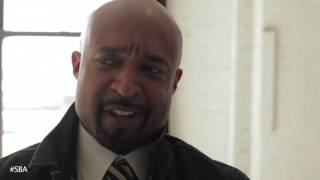
This is a short interview between host Mike Muse (SBA Millennial Entrepreneur Champion) and Jason Mowatt about Jason's music-festival venture (True Electro) and millennial entrepreneurship. Jason describes how the festival began (a rapid spring 2012 launch), the festival's focus on emerging artists and experiential events, and how combining hybrid skills (economics, behavioral insights, art) and campaign-style digital marketing (including use of the Thunderclap platform) helped the festival gain traction. The conversation emphasizes millennials' preference for experiences, the value of curiosity and combining disciplines, and practical social-media and content strategies for audience building.
Questions this video answers
Spring of 2012.
Thunderclap.
"the SBA's my brothers keeper, millennial entrepreneurial champion".
April 26, 2016.
Chapters
What's happening, America? I'm Mike Muse, and I am the SBA's my brothers keeper, millennial entrepreneurial champion. And I am so excited to present to you this video series on millennial entrepreneurship. Millennials see entrepreneurship differently, and we want to give you the tools that you need to be successful. I am so excited to present to you six millennial entrepreneurs that come from a wide spectrum of industries, from fashion to digital to music to agencies. The list goes on. And through their stories, they're going to show you how you can.
On your.
Terms, on your agenda, on your platform. Welcome to Biz My Way. Well, first, hello, twin. I'm excited to learn about and to really to hear about the work that you're doing with true electro, right? When you think camo, you think fight, right? And camouflage, you think being in a zone or being in a battle, right? And what's interesting is that that's really the place that the music industry is in right now. It's almost any other industry, too, right? In terms of battling to find where the next revenue stream is going to come from. Festivals now are the new thing. So tell us about what true electro is, and how did you come into the idea of starting your own festival?
I think it has a lot to do with the fact that millennials are about experiences. Like, my generation, we don't really care about owning cars and all these physical objects. We care more about experiences. So the most interesting person in the room is a person who's traveled, who's been to festivals and stuff like that. And then when you have platforms like social media, it's like adding gas to it, because now you can share these experiences and you can get that positive feedback of people liking and favoriting your post. So I think events are going to be big, and I think it's going to be that way for this generation. Like, I wasn't really interested in the music industry or anything like that. I was investing in the stock market, and I was doing pretty well, but I knew I was just lucky and it was time for me to do something else. So I was looking at other ventures to get into, and a friend of mine came to Visit me in D.C. one of the guys I met when we were hanging out ended up doing a Kendrick Lamar concert, like, a few months later, and it was a huge success. And so in spring of 2012, I hit him up and I was like, hey, man, if you had more money, what could you do? Could you do something bigger? And we batted back and forth ideas like, oh, hey, college electro and coming up with the whole idea. And within a month, we put the whole thing together, and it was a success. And then it sort of just been building on that. It's about discovery, like, putting people onto new music, introducing them to new artists. You know, we don't necessarily try to book the biggest artists all the time. Like, that was the original concept of the festival. It was about finding artists that were emerging but had a really passionate fan base. One of the important things is just, like, being curious and keeping an open.
Mind while you're discovering your curiosity. How did you feel about coming from such a very traditional career, coming from a very, like, statesman, stately kind of position, and working for Capitol Hill and then also, too, working and living in the District. Right. And, like, how comfortable were you to follow your curiosity? Because I'm sure many people in that space would say, capitol Hill is the get. Capitol Hill is the destination. Why don't you think about anything else? But you embraced your crazy by finding curiosity. And now we got Schoolboy Q and Kyle of Greens, like, on your show. How did that work? How did you go against that and embrace your crazy? Because that's crazy.
One of my principles is take a crazy idea and take it seriously. I think I've just been lucky throughout my life. You know, I've had people that encourage my curiosity. So when I was in college, I studied economics, but I also took, like, a lot of psychology classes. I took, like, three years of art. I was taking theater. I was taking dance. Like, a great man once told me, you know, if you ever try to be good at one thing, you're probably not going to succeed. Like, there's always going to be 15 people in the world that are better than you. But if you can take two slightly eccentric things and bring them together, then you have the chance of being really, really good at those two things combined, like, in that sweet spot. So that's the mood I've always taken.
But you really hit on the whole notion of hybrid, of, like, combining these two entities together and not really being afraid. Do you feel that's where we're going towards as millennials? And what's really encouraging entrepreneurship to look different for millennials, Right? Because we are now combining these things.
Once you start combining, like, different industries, different areas of study, that's when you start getting insights. That's when you start seeing things that everyone else has missed, and that's where you see all the opportunities. When I was in college, I was sort of obsessed with the Obama campaign. And then using behavioral economics, you Know, using analytics and data to help Obama win his first term. And so I looked at it and I saw that as an opportunity. I was like, if we market this festival the way you'd market, you know, a campaign, like do all the digital stuff that Obama does, like, we could make up for not being able to, not being able to book like a really big artist with a big name. We came across this crowd speaking platform called Thunderclap that allows you to create a social media flash mob.
I saw this and I was like.
Oh man, this is nuts. Like, we could use this to let the fans announced the lineup. This would be something that no one had ever done before and it would help us get our message out there. So, you know, that was one of the really cool things. And when we ran the campaign, it did extremely well. Got tons of people to sign up, including the artists on the bill, and got the festival trending nationally.
And that's the key, is where you want your product or your brand to be something that's worth mentioning and people getting excited about. But Jason, as women entrepreneurs, we think the best marketing, and really sometimes the only marketing which can be a mistake is go straight to social media. That may not be the best thing immediately. Right. So do you believe that's a pitfall to think that? And if it is a pitfall, how do you then find a solution to get people to orientate their minds differently about how to use social media more impactfully?
I don't think social media is like a one size fits all. It's definitely an art. Everyone thinks it's about the tools, but you can give a paintbrush to a chimp and give a paintbrush to Picasso, you're going to get two different results. Social media is like the levers you pull to like, alright, this is the part of the story I can tell through Instagram. This is the part of the story I can tell through Twitter. What I would tell millennial entrepreneurs is there are two really important things to master when you're dealing with marketing. The first is content. So you need to have something that's going to make people feel. And emotion isn't just something that makes you sad, it's something that makes you laugh, something that makes you giggle, like some sort of insight. Once you have something you got to feel, figure out how to get it in front of as many people as possible. Start building your audience like that's the most important thing. And if you can consistently give quality content to people that make them feel things and still communicate your brand like you're all. You're gonna win.
I just wanted to thank you for embracing your crazy right, helping us find our audience and helping us find our voice, man, and learning, really, how to do biz your way.