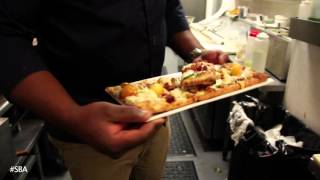
This is a recorded interview from the SBA "Biz My Way" series (host Mike Muse) featuring Chef Max Hardy. The conversation explores Max Hardy's journey from Detroit to becoming a private/celebrity chef, the lack of African American representation in professional kitchens, and practical entrepreneurial lessons—branding, pricing (cost×3 rule), and maintaining quality to grow a culinary business. The setting is the Essex House presidential suite and the tone mixes personal anecdote with actionable business advice.
Chapters
What's happening, America? I'm Mike Muse, and I am the SBA's my brothers keeper, millennial entrepreneurial champion. And I am so excited to present to you this video series on millennial entrepreneurship. Millennials see entrepreneurship differently, and we want to give you the tools that you need to be successful. I am so excited to present to you six millennial entrepreneurs that come from a wide spectrum of industries, from fashion to digital to music to agencies. The list goes on, and through their stories, they' how you can do biz your way on your terms, on your agenda, on your platform. Welcome to biz My Way. Max Hardy. It is so great to be sitting here and talking with you. Or should I say Chef Max?
Either or. Either or. Either or. I go by both.
Now, listen, Chef Max. We are in the presidential suite of the Essex House.
Gorgeous, gorgeous.
Known for, I'm sure, exemplary room service.
Right? Sure.
An exemplary room service built.
Right, right, right.
I gotta know, like, we're in this incredible setting overlooking these incredible views. What would be a typical dinner that you would create for someone who lives on the storied Fifth Avenue neighborhood of New York City?
I mean, with this view, man, you kind of. You kind of open to a lot of great, you know, things. And so you have this amazing apartment. So I would do, you know, just. A royal feast is for a royal setting. We definitely make it something grand. I don't know, man. We have to bring out some champagne and lobsters and caviar. You know, I'm a big deviled eggs guy, so we'll do some caviar, deviled eggs, with a little prosciutto of some sort, you know, so you just. You just open up to so many different things up here.
So what time is dinner?
You call it five o'. Clock. Isn't it five o'? Clock? It is. Absolutely, Chef.
The reason why I was so excited to talk with you in particular, for us, eating is a lifestyle, and there's nothing more frustrating to me that there's not a lot of us in a culinary world. So talk to me about your thoughts within that space.
The hard part for us is that we didn't see that growing up. We didn't see an African American chef. We just saw Big Mama cooking. We saw Auntie cooking on the weekends, and we just understood, wow, she can really cook. But that was really her showing her love, you know, it was a little more than just her cooking, but we didn't understand how to take it to the next level. We just said, okay, we're gonna leave it there. Maybe grandma might sell some pies on the weekend or, you know, for Thanksgiving or peach cobbler or something. But it wasn't something that we thought of a career path. But now you have a lot of chefs that becoming this rock star, you can really make it and feed your family and change your lifestyle and change the world through food.
I love how you mentioned we saw grandma or Big Mama as an expression of her giving love. So for the millennials who are out there, who see their grandmothers, who see their mothers and their fathers, right, showing acts of love and who know they can do it as well, how then do we translate that from an act of love to an act of enterprise?
For me, I wanted to take my skills and my love and turn it into an empire. So every little thing behind cooking, behind culinary arts, I wanted to turn that into a business.
You come from Detroit. As we all know, Detroit is going through a renewal, if you will. Right. And going through transition, redefining who they are. Right. How does rebirth. Absolutely. How does someone go from a city of Detroit that's going through a rebirth and end up cooking and being a private chef for the chef of the Prime Minister of Dubai. Right. For being the celebrity chef, private chef for Amar Escademayer.
Like, how does one do that coming from Detroit? That's a rough city, you know, but at the same time, it's a great city. You know, it shows you hustle, it shows you, you know, passion, shows you how to be humble as well. And so a lot of things that I've learned coming from Detroit, I stayed true to those things and Detroit stayed true to just my city, pretty much what we stand on. It's funny because it became just like a word of mouth deal. You know, the first client walked into his house and not knowing who he was, you know, was John Walsh from America Most Wanted. Didn't really know what was going on then thought, this is a birthday party, you know, it's been, you know, a birthday party with a lot of different clients there. And so they taste the food that night and then one person wants you to do another event because they're like, oh, wow, this is great. My personality kind of the city I'm from, kind of just my style of dress. So you get all this in one, in one component. And I think the clients really, you know, is transparent to the cloud clients that, you know, wow. This real person here that's really given us great love and passion behind this cook.
As we are encouraged to go to higher education. Right. We're Always encouraged to do the traditional routes. The doctors and the lawyers and the engineers. Very traditional route. Culinary isn't in that conversation. So how did you get your nerve or confidence to go against the grain?
I mean, for me it started and it really didn't start cause I really wanted to be a chef. It started cause I thought I was gonna be an NBA player and make it out the hood playing basketball, right? But I got hurt my junior year in high school and couldn't play for six months and my left hand was shot. So I'm like, all right, well I'm out. I might as well find another passion. I always liked cooking, but it wasn't like something that jumped out of me. This gonna be my career path. But then when it started, I'm like, okay, well I'm going to culinary school, I'm going to Miami. This is gonna be great. I'm gonna be this wonderful chef. But then I ran into a wall where I didn't see any of us in it. So I had to figure out how to knock that wall down to continue going because no one let me in. But then I gave myself a go. I ended up being executive chef of a five million dollar country club at 21. Everybody has a, I guess a level of pride to be great. They just got to find out what that pride is and wherever that passion is and figure out what that burning desire is to, to be great and go and go chase it.
What I love about this story is that what I'm hearing the thread is you can do what you like and bring it and sell it, right? But with that, it's hard, right? So how do you monetize? How do you go about learning how to do price structures for something of idea that's new?
That was something you just got to learn along the way. You really don't know what to charge a dinner for five. You know, when you first start, what does that really cost you? What is your time? What's your worth? You know. And so I had to figure out what my worth was as a chef before I could start charging people, you know. And then when I, when I figured out my worth and I set the, set the bar and I set the number in the price structure of it, I just had to figure out, you know, where I wanted to be, you know, and cost it out. So I always say, you know, my cost is three times what it cost me. So that's what I'm charged them. I'm gonna give you the same love, same passion, the same cooking style, the same food. If I would, I would charge you $500. You know, it's the same thing. So I think our brand has been able to grow and stay where we at because of that. We haven't, you know, changed out. We haven't changed the quality, but we're also always changing and being competitive.
Oh, my God. I can't tell you how excited I am for that comment that you just gave, because million entrepreneurs now are doing things so differently. You always give. The brand is important. The quality of the product that you're dishing out. No pun intended. And every time you dish out the good product, again, the product speaks for itself. That sets the economic drivers, and then for you, takes you into far off places and land. That's the secret.
Absolutely.
I'm so thankful you shared that secret.
Absolutely.
Well, Chef Max, I can't thank you enough for just sitting down and talking with me today. But more importantly, I can't thank you enough for what you represent.
Absolutely.
I can't thank you enough for what you represent to our community and showing us how to go from consuming that fantastic food at Big Mama's house on Sundays to actually showing how that could actually become an enterprise. Thank you.
Absolutely. Thank you for having me. It was great. Thank you, Sam.