Do I Have to Pay My Employees for That? Common and Not-So Common Workplace Scenarios
ADP and SCORE walk through federal wage and overtime rules under the Fair Labor Standards Act, then apply them to real workplace situations: off-the-clock work, training time, meal breaks, travel, and when you have to pay employees for showing up. Covers exempt vs. nonexempt workers and contractor classification.
Questions this video answers
$7.25 per hour.
$455 per week.
$27.63 per hour.
At least $100,000 total annual compensation.
One and one‑half times (1.5×) the employee's regular rate of pay.
Chapters
Hello everybody and thank you for joining us today. My name is Tony and I will be moderating today's webinar and I would now like to begin today's conference and turn the call over to Candice from SCORE for opening remarks.
Thanks so much Tony. Hello everyone and welcome to this Small Business Week webinar. And a big thank you to the SBA for your support of SCORE and small Business. As Tony said, my name is Candice Stennett and I'm the Director of Marketing at score. Before we begin today's presentation by adp, I wanted to tell you about the free support available to you through SCORE to help you succeed. SCORE is your small business resource. Our mission is to foster vibrant small business communities through mentoring and education and our goal is to ensure that every person has the support necessary to thrive as a small business owner. Score was formed in 1964 as a resource Partner of the Small Business Administration whose mission is to help aspiring and existing small businesses succeed. Since then, We've helped over 10 million small business owners in pursuit of their business goals. We've helped these small businesses through a network of over 10,000 volunteers located in chapters across the nation that provide free mentoring and low or no cost educational workshops. Contact a SCORE mentor in your community or you can connect with one online at www.score.org. we can provide guidance on business planning, funding, marketing, human resources, startup basics, operations and more. You can come to us with one question or 1,000. We're here to support you as you work to achieve your goals. In addition to our free mentoring services and training workshops, you can also take advantage of business Roundtables networking sessions in your community. These events can help you meet and learn from local entrepreneurs and business experts and you can also access our library of free online resources including business templates, blogs and weekly live webinars. So if you're starting or growing a small business, you really don't have to go it alone. You've got tons of free resources and support at your disposal with SCORE and the SBA to increase your chances for success and avoid costly mistakes with advice from our experts. Learn and grow in a way that feels most comfortable for you with one on one mentoring with local or online workshops or using our online business tools and resources. Again, you can find a mentor@www.score.org. or if you're not ready to ask a question and get advice, you can certainly connect with us on social media or subscribe to our newsletters to stay abreast of new trends and tools for small business owners but with that, I'd like to go ahead and turn the presentation over to Tony and adp. Thank you so much for your time.
All right, thank you, Candice, very much. And we will now be going over to adp. Great. Thanks very much. Hello everyone, and welcome to our webcast. Do I have to pay my employees for that Common and not so common workplace scenarios. We're excited all of you could join us. My name is Richard Alloway. I'm General Manager and vice president of ADP's specialty products group. And with me today is Tara Wolkenhauer. Tara is VP of Human Resources for adp, Small Business Services, and Total Source Groups. I'd like to start first by going over our disclaimer and the agenda, and then I'll turn the presentation over to Tara. Please take a moment to review the disclaimer which is intended to inform you that the information contained in this webcast provides a high level overview and practical information concerning the subject matter cover. It's provided with the understanding that neither the writers nor the presenters are rendering legal advice or other professional services. So today's webcast is broken out into four parts. We'll start with an overview of the Fair Labor Standards act, the flsa, commonly referred to as the Federal Wage and Hour law. Then we'll discuss classifications including exempt versus nonexempt and independent contractor versus employee. We'll also spend time discussing various work pay scenarios and how to handle them. And then we'll wrap up with some brief guidelines for timekeeping. Okay, Tara will start us off.
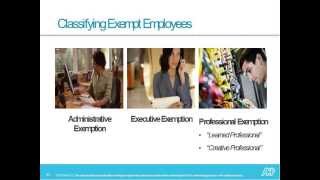
Thanks, Richard. Let's begin with an overview of the Fair Labor Standards Act. I'm sure many of you are asking, what is the Fair Labor Standards act, otherwise known as the flsa? Well, to set the stage for any discussion of wage and hour laws, we need to talk about the Fair Labor Standards act or flsa. The FLSA is a federal law governing minimum wage, overtime and other wage and hour issues. It applies to nearly every employer. And the Department of Labor and other government agencies are increasingly, increasingly focused on FLSA enforcement. It's very important to note that many states have minimum wage laws and some localities do as well. Where federal, state or local laws differ, the law that is more generous to the employee controls. Again, and very important, where federal, state or local laws differ, the law that is more more generous to the employee controls. For instance, the current federal minimum wage is $7.25 per hour. However, the minimum wage in Washington State is $9.47. So a business in Washington state must pay their employees at least $9.47 per hour. The Department of Labor provides a complete listing of minimum wage laws by state. Now you can access this information through their site and the link is shown above on the screen. Please take a minute to take note of that link. As we've discussed, nearly every business is covered by the flsa. A business is covered by the FLSA if it grosses the $500,000 or more dollars per year or operates a hospital or business that cares for the sick, elderly, or the mentally ill who reside on the premises. Schools are also covered, as are all public agencies. Even if your business is not covered under the flsa, the FLSA applies to your employees if they engage in interstate or foreign commerce, or if the work on goods or materials that have been moved in or produced for such commerce. This may include employees who work in communications or transportation, regularly use email, regular mail, or the telephone for interstate communications, keep records of interstate transactions, handle ship or receive goods crossing state lines, or regularly cross state lines in the course of their work. As you can see, it really is true. Virtually every business or its employees is covered by the flsa. The Department of Labor's Wage and Hour Division enforces the flsa. In recent years, we've seen the Department of Labor hiring hundreds of investigators to target certain industries and employees who may be at risk of unfair pay practices. Employers found to violate the FLSA may be required to pay fines, back pay, and even damages. To show how much of a focus the Department of Labor has put on wage and hour enforcement, let's look at recent stats. In the 2013 fiscal year, the Department of Labor collected more than 130 million in back overtime wages and $38 million in back wages for minimum wage violations. The focus on FLSA enforcement makes it very clear that employers need to take the time to implement policies and procedures that comply with the flsa. Now, a large part of the FLSA compliance hinges on properly classifying employees as exempt or non exempt from overtime requirements. The requirement to pay at least the minimum wage for each hour worked and overtime when due applies specifically to non exempt employees. Also, if you engage a worker on a 1099 or contractor basis, you need to ensure that the arrangement meets certain requirements. Let's look a little deeper at these classifications. We'll start with exempt and non exemption. Most employees are considered nonexempt. These employees must be paid for each hour that they work, and they must be paid overtime if they work more than 40 hours in a workweek. Some states, including California, have certain overtime requirements, such as daily overtime. So please make sure you're familiar with your state overtime laws and set up time tracking systems and policies to ensure complete Most nonexempt employees are paid on an hourly basis. In some cases, though, employers choose to pay nonexempt employees a salary. This is okay as long as you keep records of their hours worked and that they receive at least the minimum wage for every hour and overtime pay when it's due. Now let's discuss exempt employees. Exempt employees must be paid a set salary each week, regardless of how many hours they work. While there are a few narrow exceptions, this pay requirement applies to any week that the employee performs work, whether it's six hours or 60. To be classified as exempt, employees must meet very specific criteria. If you are unsure whether your employee falls under an exemption, it's best to err on the side of caution and classify an employee as nonexempt. As I just mentioned, to be classified as exempt, an employee must meet certain salary and duties criteria. When making this determination, you must evaluate the employee's actual job duties, not simply their job title. The most common types of exemptions under the FLSA are shown on this slide and the next. These six exemptions are sometimes referred to as white collar exemptions. Each has their own test that must be satisfied and the employee needs to meet all requirements of a particular test to be considered exempt. With the exception of the outside sales exemption, all exemptions require a minimum salary of $455 per week. It must also meet certain duty requirements which we'll outline at a very high level today. If you download the Wage and Hour ebook from the Resources folder of today's webcast, you can get more detail on these six exemptions, but let's start walking through each of them. Let's start with the Administrative exemption. It is typically cited as the most frequently misunderstood and unfortunately misused exemption. These employees must perform office or non manual work directly related to management or general business operations. The Executive exemption must supervise two or more employees and have the authority to hire, fire, and make other related decisions. Our third exemption listed here is the Professional exemption, which is divided into two subcategories, the Learned Professional and the Creative Professional. The Learned professional must perform work that requires advanced knowledge from prolonged specialized instruction. For the Creative exemption, the employee's primary duty must be recognized as invention, imagination, or talent in a recognized field. If we move on to the next slide, you'll see our next three exemptions, the Computer Employee Exemption, the Outside Sales Exemption, and the Highly Compensated Employees Exemption. On the Computer Employee Exemption to be considered exempt under this category, the employee must work as a computer system analyst, computer programmer, software engineer, or other similarly skilled worker in the computer field. Unlike the other exemptions we've covered, these employees can be paid on an hourly or salary basis, but they must be paid at least $27.63 per hour or the $455 per week. Employees that are considered exempt under the outside sales exemption must sell away from the employer's place of business. Sales made by phone, mail or the Internet are excluded from the definition of outside sales. There is no minimum salary requirement for this specific exemption, though Highly Compensated Employees Our final category is exactly how it sounds. An employee with total annual compensation of at least $100,000 can be classified as exempt without passing the full duties test if the employee regularly performs any one or more of the exempt duties of an executive, administrative or professional employee and has the primary duty of performing office or non manual work. Now, there's always some sort of state law impact that we want to be careful of and here please keep in mind that some states, such as California, have their own test for determining exempt status. Please be sure to check your state law before classifying an employee as exempt. It's critical. Sometimes wading through all those exemption tests can be very confusing and to complicate things even further, new FLSA proposed regulations are expected to be issued this year. The regulations will likely focus on revised criteria for the white collar exemptions we just covered. While the exact changes are still unknown to us, many expect a significant increase to the salary level test as well as changes to the duties tests, which could result in fewer workers qualifying for the exemption. Once the rules are proposed, the public will have an opportunity to review and comment on the proposals before the rules would become final. Keep in mind that the publicity surrounding any changes would likely increase attention on the issue and could result in more complaints both under the old rules and the new rules. Okay, so we talked about the exempt and non exempt classifications. Let's take a minute to talk about the difference between individual contractors and employees. Because independent contractors are not eligible for minimum wage, overtime or benefits, working with a contractor may seem pretty attractive, but this is an area where the government is seriously stepping up its enforcement. Misclassification could lead to fines, penalties, back taxes, and overtime. So what exactly is an independent contractor then? In general, independent contractors are self employed and offer their services to the general public under terms specified in a contract. Whether a person is classified as an independent contractor or employee depends on the amount of control exercised by the employer. The More control the business has over the worker, the more likely they'll be perceived as an employee and not a contractor. Keep in mind that there's no universal test for the contractor or employee decision. A number of factors need to be evaluated, and we recommend you seek guidance when making this evaluation. Even so, these tests have some common themes. They all look at the amount of control the business has over the worker, the permanency of the relationship, and whether the services performed are an integral part of the business. The IRS common law test is the most widely used and it evaluates factors related to behavioral control, financial control, and the type of relationship between the business and the worker. We've covered a lot, so I'm now going to hand over to Richard to start our discussion of the workplace scenarios.
Great. Thank you, Tara. Now that we have an understanding of the basics of the flsa, including how to classify workers, let's get into some scenarios. Since we just discussed independent contractors versus employees, we thought we'd start by going through some workplace scenarios in this area. Okay. In our first scenario, a graphic design firm hires Joe, a graphic designer, to complete a specialized project. The project was complete in three months, but then the company realized there was more work for him to do. He's been working at the firm for eight months now. Joe is paid a set salary each week, reports to the office Daily, working from 8:30 to 5, uses the company's computers, and even attends meetings. So is Joe an independent contractor or an employee? Let's use the IRS common law test to answer that question. Because Joe reports to the office daily, uses company computers and attends company meetings, this shows that the company has control over how, when and where the work is done. All of which is evidence of an employer employee relationship. Now let's look at financial control, in particular how the business pays Joe. An independent contractor is often paid a flat fee or on a time and materials basis. But because Joe is paid a SIP salary each week, this is evidence of an employer employee relationship. Also, because the company provided Joe with computer and regular workspace, the company has invested in the tools and facilities used in performing the work. Lastly, we'll look at the type of relationship between Joe and the firm. First, in terms of permanency, Joe is originally hired for a three month assignment to complete a specialized project. Once Joe completed the three months, the company should have reevaluated the assignment to appropriately evaluate his relationship with the company. Company. However, he's continued working for the firm indefinitely. Also evidence of an employer employee relationship. And because Joe is providing graphic design services A key aspect of the company's business, it's more likely that the business has the right to direct and control his work. So, using the IRS common law test, the information we reviewed suggests that Joe is probably an employee and not an independent contractor. As we've mentioned, nonexempt employees must be paid overtime for all hours worked in excess of 40 in a workweek. Keep in mind, certain state laws, including in California and Colorado, require overtime under other circumstances. Under federal law, overtime is calculated at a rate of one and a half times the employee's regular rate of pay. Calculating an employee's regular rate of pay for overtime purposes can sometimes be tricky. Sometimes there are complicating factors, like when an employee performs two different functions for the company at two different pay rates. Many states, including California, New Jersey and Massachusetts, require employers to use a weighted overtime calculation when an employee receives two or more rates of pay. Also, a common question to our HR help desk is whether unauthorized overtime can go unpaid. Even if you have a policy in place that requires employees to get approval before working overtime and an employee violates that policy, he's still entitled to overtime. You can discipline the employee for failing to get prior authorization, but in no case may you withhold pay. Okay, let's look at an example to help us understand the basics of overtime under the flsa. All right. In this scenario, Nick, a nonexempt employee at Chips Bakery located in Texas, gets paid a weekly salary of $400 since he consistently works 40 hours per week. Last week, the bakery was behind on inventory and Nick worked 43 hours. Chip realizes that Nick may be entitled to overtime, but isn't sure how to calculate the payment. First, Chip needs to calculate Nick's regular rate of pay for a salaried nonexempt employee. This is calculated by dividing their salary by the number of hours the salary is intended to compensate. So Nip's regular rate of pay would be 400 divided by 40 hours or $10 per hour. Overtime is paid at a rate of one and a half times an employee's regular rate of pay. Or in this case, $15 per hour. His total compensation for the week would be $445. It's important for employers to keep track of hours worked for all non exempt employees, even if they're paid on a salary basis. Okay, I'll hand things back to Tara to discuss off the clock work.
Great information. Thank you, Richard. Now we're going to look at whether time worked outside of the office needs to be paid. This is becoming more of A concern since so many employees use mobile devices for work. Which begs the question, do you have to pay employees for time spent making calls outside of work hours or checking their email? And if so, how can you account for that time? Let's take a look. Joan is the managing director of an accounting firm and has noticed that several non exempt administrative assistants are replying to her emails after they've punched out. Do these employees need to be paid for their time? For the time they spend replying to emails? What do you think? Believe it or not, the answer is yes. Nonexempt employees must be paid for all hours actually worked. This often surprises people. Please make sure employees are aware that they are responsible for reporting all time sampling spent working, including time they spend checking emails outside of work hours. Establish this in company policy and train both your employees and supervisors that off the clock work is absolutely prohibited. If your timekeeping system cannot be used to record after hours work. Employees should be instructed on how to properly report these hours. For example, you may want to provide them with written timesheets to record any after hours worked. Again, it's important to emphasize nonexempt employees must be paid for all hours worked. Let's look at another scenario together. Holly's Ice Cream Shop has a policy that prohibits employees from punching in before their scheduled shift. One employee has violated the policy by punching in half an hour early. Can Holly refuse to pay him for the time before the start of his shift? Again, the employee must be paid for any time worked even if they violated the company's policy and punched in early. Keep in mind that if the employee punches in early and then uses the time solely for personal reasons such as reading a book, this is not considered time worked and would not be subject to the payment. If it is your policy to prohibit employees from punching in until their scheduled shift starts, the employee must be free to use the time prior to their shift for personal reasons. Regardless of when the employee punches in, let the employee know that they are expected to begin work promptly after punching in and that they must account for all time spent working. This is really important. The two concepts brought in both scenarios. We see this time and time again in the workplace. Again, nonexempt employees must be paid for all hours worked on or off the clock and then they must be paid starting the time that they've even punched in even if it violates their schedule. Very, very important. Our next scenario will evaluate timekeeping practices. Some employees use time rounding to address instances where employees report to work either before or after their scheduled shift. At Sally's Hair Salon, typically, stylists arrive to work ready for their shift at 8am in order to prep their work space and start working with clients by 8:30am One of the stylists, though, was early and punched in at 7.55am for an 8am shift. Sally wants to round her start time to 8am Is this allowed? The best practice is to track time to the minute worked. Some employees, though, choose to round employees starting and stopping times to the nearest 5, 10, or 15. Under the FLSA, employers may round employees hours to a maximum of 15 minutes as long as it is shown that over time, the average resultant payment for all the time actually worked. Let's say that one more time. Under the FLSA, employees may round employees hours to a maximum of 15 minutes as long as it is shown that over time, the average results in payment for all the time actually worked. Your rounding policy cannot consistently round in the company's favor or result in the failure to count all the time an employee has actually worked. Note that some states may place limits on their rounding. Please check your state law before implementing a time rounding policy. Okay. Richard will now discuss pay issues related to working interviews and training.
Okay, as Tara mentioned, we're going to look at how to pay job candidates during working interviews and whether pay must be provided to employees during training. All right, in this scenario, Jamie is the office manager at a dentist's office. Because of high turnover, the head of the practice wants to start using working interviews before hiring new dental hygienists. Candidates would work for a few hours on the job so that the practice could evaluate whether they're a good fit. Jamie wonders if she should pay them even though they're not technically employees. Yet. Some employers think that they can bring candidates on as 1099 workers, but this isn't the case. They will generally be considered employees protected by relevant employment laws. So in this example, best practice is for Jamie to pay these workers at least the minimum wage per hour to withhold taxes and comply with all other applicable laws for the period that they work. Okay, next scenario. Michael is the owner of a tapas restaurant. He's decided to require all wait and kitchen staff to participate in sexual harassment training. The training is scheduled to take place before the restaurant opens. Does Michael have to pay employees for the time they spent in training? The answer is yes. Employees must be paid for the time since it's mandatory training. According to the flsa, training time must be paid unless it meets very specific criteria. First, to be unpaid, attendance must be voluntary and Outside of the employee's regular working hours, it must not be directly related to the employee's job and the employee cannot perform any productive work during the training. Now we're going to look at how to handle pay for the time employees spend putting on or taking off safety gear or other required equipment, also known as donning and doffing in this scenario. Priya owns a small manufacturing company. She requires her workers to wear safety equipment when working. It takes them about 10 minutes to put on and take off the equipment each day, and they have to do this while on the premises. Priya wants to know if she has to pay employees for this time. Okay. In general, if the gear is required by law, the employer, or the nature of the work, then the time an employee is required to spend putting it on and taking it off when on the premises must be paid. Note that time must be paid only when the company or the nature of the job requires that it take place on premises. If employees have the option and ability to change at home, there is no requirement for it to be paid even if the employee chooses to change at work. In this case, the equipment was required to be worn and employees didn't have the option of putting it on or taking it off at home. So the time must be paid. We'd like to discuss meal and break periods next. Tara will walk you through those scenarios.
Thank you, Richard. Let's switch gears a bit and turn our attention to breaks. We'll take a look at a few scenarios in the coming slides. Please keep in mind that we will discuss meal and break periods as they relate to federal law. As we've talked about in this deck, many states, including California specifically, have their own laws stipulating when and for how long you must provide both meal and break periods. Please, please, please remember to check state laws when establishing breaks for your employees. Let's look at a scenario around rest breaks. Violet is the owner of a thriving online business that makes custom cards and T shirts. She has five customer service employees who handle calls and emails. She gives them a 10 minute break twice per day, but two employees consistently extend those breaks to 20 minutes without permission. She has never advised employees before that there will be consequences for unauthorized extensions of breaks. Does Violet have to pay them for the extra time? The answer is yes. Generally, when employees take unauthorized extensions of rest breaks, the time must be paid if the rest period lasts 20 minutes or less. However, the FLSA permits employers to exclude unauthorized extensions from hours worked as long as the employer clearly and expressly informs employees that that breaks may only last for a specified duration, e.g. 10 minutes. Unauthorized extensions of breaks are prohibited and violations will be subject to discipline. Unless Violet meets all three requirements, she must pay for these unauthorized extensions. So like our scenarios prior, it's really important that you communicate these rules to your employees so they understand how breaks work. In our second scenario, Josh runs a boutique and offers employees a 30 minute lunch period. One of his employees was on her lunch break when Josh asked her to help a client. Does Josh have to pay her for the full meal period? What if he asked her to be prepared to help clients if necessary during her lunch break? To be unpaid, meal periods must be at least 30 minutes without interruption and the employee must be fully relieved of all duties for the purposes of eating a regular meal. If employees meals are interrupted to the extent that the time is predominantly for the benefit of the company, then Josh has a couple of options. He can either make sure she continues the meal period after the interruption so that it lasts the full 30 minutes, or consider paying her for the full 30 minutes. Also, if Josh requires employees to be prepared to help clients while on their lunch break, he would be required to pay employees for the entire 30 minutes regardless of whether or not they helped a client. Under the flsa, employees are not considered completely relieved of duty if they are not free to use the time however they wish. Now I'm going to turn it back over to Richard.
Great. Thank you Tara. Sometimes the nature of an employee's work makes their schedule or time spent working unpredictable. Let's say weather creates interruption to work performed outdoors or the tools an employee relies on to do their job fail. Would the employee have to be paid? Let's take a look. Melanie has just started her own roofing company. She has two roofing crews. Yesterday the weather was too cold so she sent both crews home before they started their shifts. Does Melanie have to pay them a certain number of hours since they showed up for work? There is no federal requirement to pay nonexempt employees a minimum number of hours if they report to work when there is no work available due to weather or related circumstances. However, those employees that report to work and must wait until a decision is made must generally be paid for the time spent waiting. Also remember that some jurisdictions such as California, Massachusetts, New Jersey, New York have report in pay requirements. Generally, these laws require employers to pay employees for a minimum number of hours for reporting to work even when there's no work available. Check your state law to ensure compliance. In this next scenario, Roger owned a welding company. One of his welding tools breaks and an employee is unable to work while he's waiting for repairs, he remains on the premises while he waits. So does Roger have to pay him for the time he spent waiting for his tools to be repaired? In this case, yes. Roger must pay the employee for all the time the employee spends waiting for repairs to be made while on duty. In this scenario, time spent waiting may be unpaid only if the employee is completely relieved from duty. The period is long enough to allow the employee to use the time effectively for their own purposes. The employee is told in advance that they can leave the job while they wait, and the employee is told what time to report back to work. Okay, so I'll hand things back to Tara to discuss Travel time scenarios.
Thank you Richard. Wow. We've covered a lot of information. This piece is really important though. As many of you are aware, sometimes employees have to travel for work. Whether it is to see a client in another city, to attend a conference or trade show, or just trying to traveling job site to job site throughout the workday. Let's take a closer look at some common travel time scenarios to gain a better understanding of how to handle this type of pay. And interestingly enough, this is an area where we receive a lot of questions and it can be confusing. We've tried our best to address some of these questions in the various scenarios that you'll hear. So our first one Elizabeth. She leads a financial consulting firm in Maine. She asks two employees who typically work in the office to attend a seminar in Boston, about two hours away by car. The travel will take place during their normal work hours. Their normal commute is 15 minutes. Does Elizabeth have to pay the employees for their travel time? The answer to the question is absolutely yes. If an employee regularly regularly works at a fixed location in one city, but is given a special one day assignment in another city, the time spent traveling to and from that assignment is considered hours worked. However, you are allowed to subtract the time it normally takes the employee to travel to and from their regular off site. In this example, Elizabeth must pay the employees for three and a half hours of travel, four hours of travel minus the 30 minutes of normal commuting time. I would just like to mention that there is no federal requirement to reimburse employees for the cost of operating their vehicles for work related travel. However, there are state laws that may require reimbursement under certain circumstances. For those employers that choose to reimburse employees, the IRS provides a standard mileage rate currently at 57.5 cents per mile. Let's look at another scenario. Thomas is the founder of an H Vac company. His technicians spend several hours during their workday traveling from worksite to worksite. Does Thomas have to pay the employees for time spent traveling to each work site? Here again, the answer is yes. The time employees spend traveling between job sites during the workday is considered hours worked under the flsa. Keep in mind that work time typically starts once the employee arrives for work. The employee's normal commuting time is not considered time worked. Here's another example. Abby is the executive director of a nonprofit. She asks an employee to take an overnight business trip. The employee's Regular hours are 8am to 5pm Monday through Friday. The employee goes on a business trip that begins with a 9am flight on Saturday. The flight takes one hour. Does Abby have to pay the employee for the time spent on the flight? What if the employee wants to drive instead? Does Abby have to pay the employee for the full six hours spent driving? It's a tough one. For overnight travel, pay is required for the time that cuts across the employee's regular working hours regardless of the day of the week. In this example, since the flight is at 9am, a time that the employee would normally be at work, the travel time on the flight is considered work time. Travel to and from the hotel and airport must also be paid if it falls during the employee's normal work hours. If your employee is offered transportation but requests permission to drive their car instead, you have the option of counting either the time spent driving in the car or the time you would have to count as hours worked if your employee had traveled by plane. Therefore, Abby has the option of paying the employee for the 2 hours round trip by plane or the 12 hours round trip by car of travel time. I'm going to turn things back over to Richard now.
Thanks, Tara. The SLSA can be confusing with far reaching implications and so ensuring employees are paid in accordance with the FSA requires that their time is accurately accounted for. We thought it would be helpful to review some timekeeping guidelines as well as key takeaways from our webcast today. Okay, Key takeaways Start by ensuring workers are properly classified as employees or independent contractors. Once you identify that a worker is an employee, make sure they're properly classified as exempt versus nonexempt. Remember that if employees do not meet the exemption criteria, then they must be classified as non exempt and are entitled to minimum wage and overtime. Nonexempt employees must be paid for each hour worked. Consider that hours worked applies to a variety of different activities, including depending on the circumstances, time spent in training, traveling and breaks to help you with timekeeping procedures, ensure you have an accurate and reliable timekeeping process in place and maintain records of hours worked and pay calculation. A time and attendance solution can help save you time and reduce errors okay, this concludes the presentation portion of the webcast. We've reserved some time for questions.
Thank you again for such resounding interest in this topic. I know it can be complicated. I hope our information helped you and hopefully we already answered some of your questions during the presentation and we'll highlight a few more here now for you. Okay, one of the first questions we received if an employee meets the test to be exempt from overtime, do I have to classify them as exempt? The answer to your question is no. You actually may classify an employee as non exempt and pay them overtime when due. By contrast, only employees who meet applicable exemption test may be classified as exempt. Great question. The next question we have here. What's considered a workweek? Very good question. Is it Monday to Sunday? Can it start on another day? A work week is a fixed and regularly reoccurring period of 168 hours or 37 consecutive 24 hour periods. The work week can begin on any day and at any hour. Another question we have for you is is overtime pay required for an employee who is paid biweekly if 1 week he works over 40 hours but his 2 week total is less than or equal to 80 hours? This is a great question. We see this a lot and the answer is yes, you must pay employee the overtime here. The FLSA requires overtime whenever a nonexempt employee works more than 40 hours in a work week. You can't combine them. And actually the FLSA prohibits employers from averaging two or more workweeks to determine whether that overtime payment is due. This is an interesting question. If an exempt employee only worked for two hours of an eight hour workday and then left due to personal reasons, can I deduct the six hours of missed work from her salary? Unfortunately, the answer is no. The FLSA generally prohibits deductions from exempt employees salaries for partial day absences, except in those cases in the first or last week of employment or when you have unpaid leave taken under the Family and Medical Leave Act. Additionally, in this scenario, full day deductions are restricted to a full limited limited situation. I'm sorry, I'm just reading through the questions. Here's another one. If we tell employees they must take half hour lunch and they don't, can we deduct for the half hour anyway Here you cannot, you must pay employees for all hours worked, regardless of whether the time was authorized or not. And that's really an important point, and I know we covered it throughout the deck, but I'm going to try and really clearly state that you have to pay employees whether you improved it or not, if they're supposed to be, if they're scheduled for those regular work hours. So please be, be careful of that. Another question states, I have multiple locations and have a meeting once a month at a centralized location. Do I have to pay my employees to travel to these meetings? Do I have to reimburse them for gas to get them to the meeting? This is a great question and we get it a lot. As I mentioned before, the travel portion of this can be confusing. Generally speaking speaking, employees must be paid when they travel from job site to job site during the workday. So if employees report to their regular work site and then must report to another work site for a meeting, all the time spent traveling to and from the meeting has to be paid as it relates to mileage. Some states require reimbursement, so be sure to check both state and local laws. I mean, it really is important to note that even if no state law except expressly requires it, reimbursement may be necessary to comply with minimum wage requirements too. For example, if the cost of traveling to the meeting would dip the employee's pay before the applicable minimum wage, employers must reimburse the employee enough to really ensure that the employee receives at least the minimum wage for all hours worked. So I'm going to take one more question, then I'm going to have Richard take a few. And that last question for me is, if an employee works an 8 hour day and has two 10 minute breaks in addition to a lunch break, can the two 10 minute paid breaks be combined into one 20 minute paid break? And this is an excellent question. Under the flsa, there's no requirement to provide breaks and people are confused about that. Often the only requirement is that if the breaks are provided, they must be paid if they are 20 minutes or less. So yes, generally you can combine those breaks to provide one 20 minute paid break. However, be aware that some states have specific meal and break laws that may require a certain number of breaks after working a certain number of hours. Again, you've heard us say it several times throughout the presentation. Please be sure to check the state and local laws prior to setting up any policies. Okay. Richard, want to take a couple more?
Sure.
Okay.
Another question that was submitted, when employees are exempt, how many Breaks are given with or without pay, so there is no federal requirement to provide breaks. But if you choose to offer short rest breaks, they do have to be paid. Also, because exempt employees must receive their set salary each week, you can't dock their pay for taking breaks. Again, check your state law to see if you're required to provide breaks. Another question what is the liability for unemployment payment regarding independent contractor versus Employee? So, generally speaking, if a worker is properly classified as an independent contractor, then there is no unemployment obligation. However, we want to remind everyone to be very careful here. As we mentioned earlier, classifying someone as a true independent contractor can be tricky. Some states even have a specific test for determining whether a worker is an independent contractor for unemployment purposes. Okay, and I think we have time for one final question. If I bring an employee with me to a trade show or an event, do I have to pay them for the time traveling to the event? What about the time? They are not at the trade show, but out of town. Okay, so under the flsa, attendance at meetings, training, and similar activities such as trade shows is generally viewed as working time, and so it has to be paid. If an employee attends the trade show, the time spent traveling to and from the event is also considered hours worked. To answer the second part of this question, pay is required for the time the employee actually spends working. So if the trade show requires overnight travel, pay is only required for the time spent at the event, as long as the employee is free to use time outside of the trade show for his or her own purposes. Okay, I think that's all the time we have. Thank you everyone for submitting some great questions. And thank you again for attending today's webcast. I hope you found it useful. Thank you.
Thank you.
More from Your







President Donald J. Trump and First Lady Melania Trump Visit Grieving Texas After Deadly Floods

💪 Thinking of starting a #biz? Go for it! — Kerry Boyle, Vermont #SmallBiz Person of the Year

President Trump Participates in a Bilateral Meeting with the Prime Minister of Canada, May 6, 2025

