Empowering Women Entrepreneurship | Archived Webinar
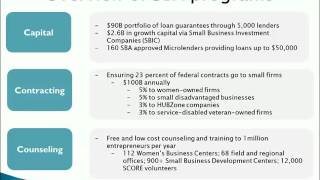
Webinar (Mar 28, 2017) by SBA Office of Women’s Business Ownership presenting SBA resources for women entrepreneurs: capital (loans, SBICs, microlenders), contracting goals and certification, counseling/training networks (Women’s Business Centers, SBDCs, SCORE), online tools (DreamBuilder, SBA Learning Center, SBA Link), and initiatives like InnovateHER. Key statistics shared: ~36% of U.S. businesses are women-owned (~9.8M), $1.4T receipts, ~8.4M employees from employer firms, 1,100 new women-owned businesses started per day (data cited from 2012). Program scale figures: $90B+ in SBA loan guarantee portfolio; $2.6B SBIC capital; 160+ microlenders (loans up to $50k); 112 WBCs, 900+ SBDCs, 12,000+ SCORE counselors; WBCs served ~145,000 clients and aided ~9,000 new businesses last year; training reached over 1M entrepreneurs last year. InnovateHER competition window noted (launched Dec 29 to June 3). Recording availability: 2–3 business days.
Questions this video answers
March 28, 2017
About 5% in 1970 and about 36% circa 2012
About 9.8 million women-owned businesses and over $1.4 trillion in receipts (data based on 2012 survey)
Over $90 billion in loan guarantees; about $2.6 billion in SBIC growth capital
About 112 Women’s Business Centers, 900+ Small Business Development Centers, and over 12,000 SCORE counselors
Chapters
Hello everyone and thank you for joining us today for our SBA Women's History Month webinar. Before we get started, we would like to mention for all of our guests joining that your phone lines are currently in a listen only mode. To minimize our background noise, we will be answering questions at the end of our presentation today. However, we would like to mention that you can submit note questions at any point throughout today's conference. And to do so you can go to the participants menu at the top of your screen and then select the Send Note to All Presenters option. Or if you are connected on our web based application, you can use the Note Chat function located at the bottom right corner of your screen. And again, please submit all of these note questions to all presenters. If you do experience any technical issues throughout today's conference, you may submit these via the Note Chat as well directly to myself@att CES operator. And with that, I'd like to end today's conference and hand the call over to Bruce Purdy, Deputy Assistant Administrator with the SBA Office of Women's Business Ownership.
Bruce, please go ahead. Thank you and thanks everyone for joining today's call. I'm sure we will have more people joining throughout the call, which is great. Happy Women's History Month to everyone and it's an honor to have the opportunity to speak with you today and be able to just present a little more information on SBH programs and how we can assist women entrepreneurs. So I'm here in the Office of Women's Business Ownership. We are the agency's primary office focusing on women's entrepreneurship. So I'll get started just giving you a little bit of background. And again we will be taking questions throughout. So if you have questions, go ahead and submit those to all of the presenters and I'll try to address those as I'm going through the presentation as well. And we'll certainly have more questions at the end. We'll try to get through as many questions as possible. I am certainly not an expert on everything, so if there are questions that I can't just jump off the top of my head, we will make sure to get answers back to you on all of those questions. So with that we will go ahead and get started. And just to give you a little bit of background on the state of women entrepreneurs. In 1970, there were only about 5% of small businesses were owned and operated by women. Today it's about 36. A little over 36% of the businesses here in the United States are owned and operated by women. There are approximately 9.8 almost 10 million women owned businesses in the U.S. and that's an increase of over 2 million businesses, or 26.8% from 2007. Now, this data is based on data that was in 2012. And we believe that there'll be another survey coming out this year. So we're excited to see where those increases are continuing to grow. The rate of growth is tremendous, but there's still a long way to go. Certainly it's clear that women's entrepreneurship is on the rise. And if you look at the receipts, we're up to over $1.4 trillion in receipts. While most of these businesses do not have employees other than the owners, those that do constitute over 8.4 million employees. Just as a note, women are starting businesses, over 1100 new businesses a day. That is tremendous growth. And we are here in this office to support them in doing so. SBA has a vast network of services to help all entrepreneurs, especially including women entrepreneurs. And I am going to walk you through those today just at a very high level. And as we get questions, we'll certainly try to answer those going through. I see that somebody asked if it will be recorded. It is being recorded and we'll have it available in the next couple of days. So we will be able to get this out to everyone afterwards. Let me just move on to the next slide here. So just a quick high level overview of SBA's programs. There's three here on the slide that I'm going to just touch on and there's a couple others that I'll add in as well. So certainly SBA has been known for our capital programs. We have over a 90 billion portfolio of loan guarantees through over 5,000 lenders and certified development companies. We have a huge investment in the small through the small business investment companies with over 2.6 billion in growth capital. And there are over 160 SBA approved microlenders that provide loans up to $50,000 each. Now, a lot of folks are interested in how you get access to those loans. Many of them are through our commercial lenders that you would normally use. Our micro lenders can be found on SBA's website. And we also have a program out here and it's called Link and the Link tool is on SBA's website. And this is an opportunity where you can come in and put in some information about your program and it will connect you with a Q and a community based lender in your community and those that are interested based on the information you submit can then reach out to you. And it's basically a matchmaking online. We've just launched this in the last couple of years. It seems to be growing really well. So certainly check that out when we talk about contracting. Contracting is a huge avenue. For the first time we had hit 5% to women owned firms. Currently there is a goal of 23% of all federal contracts should go to small businesses, 5% should go to women owned businesses. And you can see some of the breakouts to all of the various opportunities here. But if you think about the difference between 1 percentage point, move on. That and 5% certainly is a great goal. We'd love to see it much higher than that and have women have the opportunity to go past that. But the difference between 4% and 5% is about $4 billion. That has a tremendous impact on the opportunity. And so through our various programs that you can get access to the contracts, we have what we call the certify.sba.gov, which where you can get actually do the self certification process through sba. Now the area that I'm going to focus mostly on is on our counseling. This is the area that I'm most familiar with and have the most experience with because I run one of the major programs and one of the flagship programs here at SBA. So through our network of partners, we have over 112 women business centers, over 900 small business development centers, over 12,000 score counselors around the country that provide low cost and free counseling and training. Along with our 68 field offices and regional offices, we have an extensive network that really makes up a structure that is there to help entrepreneurs every day. Throughout this network, we trained over a million entrepreneurs last year. This is a great opportunity for folks to be able to get access to help in writing their business plans, help in understanding how they will actually market their business and so forth. So I would certainly check those out. We'll give you a link one of the pages here in the slide deck. We'll actually have a lot of links on how you can get to some of these resources. So we will go through that as well. We also have another resource online that is called Dream Builder. This is a partnership that SBA has with Thunderbird University. It's an online curriculum that focuses on women entrepreneurship and helping to write that business plan. It's available currently in both Spanish and English and so we encourage folks to check that out. Now I see there are a couple questions coming in, so I want to take a quick stop and see if I can Address a couple of these questions that have come through. Some of these we will be addressing afterwards. Give you a couple technical questions. One is, is the presentation going to be available? Yes, it will be available afterwards. Bear with us and we will make sure that we get that available online. So quite a few questions on that. The online tools that I mentioned already. First of all we have lyncing and you can find that through our Link program. I will get to the links in just a moment. But Link is one for accessing credit where you can be matched with lenders that are interested in making loans to you based on information you put. In the counseling side we have a couple different resources. I mentioned Dream Builder and I'll talk a little bit more about that in depth as well. But we also have SBA's learning center and this is an online tool. Just go to sba.gov it is a great resource for all of your needs where you can find information on all of our programs. So I want to dive a little bit more into our Women's Business center program and this is one of our counseling programs. As I said, this is the area that I am most familiar with. I'm the deputy here in the office and run this program. We have over 100 nonprofits, that's 112 organizations right now throughout the US and territories that provide counseling and training to women entrepreneurs around the country. Services are offered in over 38 different languages and our WBCS offer evening and weekend hours to meet needs of women entrepreneurs in their communities. So working women that have a 9 to 5 job still have an opportunity to take advantage of those services. Many of our women's business centers also have opportunities to take online counseling, training, et cetera. The WBCS provide a wide variety of services and that includes not just the training and counseling, but mentoring, networking and most have a focus on long term training programs to assist with business plan development. While most of our clients that come through the program are in the Startup or Preventure, WBCs help clients at all stages of the business grow. And again we will give you a link that will allow you to find those very quickly. And so that was one of the questions that comes up. Bear with me and I will get to that link page here in a moment where you can get all those links. Many of our WBCs also offer other types of programs. Some have incubators, some have in house financing like our Microloan program. Others have things like daycare or after school programs in order to meet the needs of the specific community. One of the Things that's very unique is a lot of the clients of our WBCS come back as teachers and mentors because they found such value in the program that they in turn as they started their business, want to come back and able to give back. So last year through the WBC program, we helped over 145,000 clients that came through the program. There were nearly 9,000 new businesses started last year based on the services provided by the program. And you can see it might be a little bit blurry here on the screen, but really the WBCS cover a wide range of industries, anywhere from professional services, high hospitality to manufacturing and a variety of different things. So they really cover a broad spectrum of services. And again, because they are community based organizations that they really try to focus on the needs of the communities. No, unfortunately there are not the WBCs in all cities. We try to cover the map as much as possible. But the WBC program, and we will get to the link on where to find them, covers a vast part of the country and even if it's not in your city, you can certainly reach out to the WBC that's nearest to you or reach out to any of our other resource partners, our Small Business development centers, our score counselors. Again, we have a vast network of WBCs and resource partners across the country to provide assistance. Let me move on to the next slide. I talked a little bit about Dream Builder and I'm going to just go into a little bit more on what Dream Builder is a Dream Builder is a free online business education certificate program offered in English and Spanish. It's 12 to 13 modules that cover the basics for starting and growing a business. It's an interactive tool and there are client stories throughout. There are also videos just to help put it in perspective of when somebody is going through and writing their business plan. The end of the tool. What's so unique about it is there is a business plan generator so that the idea that you enter in as you are going through the various courses allow you to then build a business plan at the end of the program. Just as part of International Women's Day this year they launched a new program that is tied to Dream Builder which is about financing your dream. So it is a financing course as well that compatible with this. Now one other thing I want to get to before I jump through and start doing more questions and going through some of the links is a great opportunity that we have here. We started a few years ago. It's called InnovateHER and we have just launched Innovateher this is an opportunity. When we get to the that slide. Bear with me a second launched on December 29th and it goes through June 3rd. It's an opportunity for not just universities, accelerators, resource partners and other organizations to host local competitions. These competitions are basically pitch competitions, business plan competitions where the clients that are going through these competitions have an opportunity to demonstrate and showcase their products and services that have a measurable impact on the lives of women and families, have a potential for commercialization and fill a need in the marketplace. We are right now in the process of just signing up many of those organizations. Currently we have over 100 organizations that have expressed an interest. We will be putting a map up on SBA's website that will have a list of those locations and where those competitions are at. So if you are in business and have a unique product or service that you would love to participate in this competition, you can certainly go to SBA's website. It's sba.govinnovateher and you can reach out through the womenbusinessba.gov to find out more information. Again, we don't have the current map up there yet. We'll be getting that up there probably by next week where you can find all the local competitions, the information about those competitions and find ways to compete. Go to A couple other questions here. So as far as specialized services, one of the things that makes the WBC program unique is that outside of some very basic fundamentals that the we focus on, they really do focus on the needs of their community. So for example, we have some WBCs that will focus more heavily on helping women get into contracting and getting into federal contracts. We have some that might focus more on exporting and helping women to export their products. We have some that are more focused on startups. There are a couple of great examples that are helping in the food industry with many of the food trucks that are really looking at helping folks move from an idea to a food truck and even into brick and mortar restaurant or catering business. So they really do specialize based on the needs of the communities that they serve and often that comes back from client feedback and responses that their clients have as far as unique needs for that specific community. So I did mention that I wanted to get onto some of the links and let me do that right now. So one of the things for capital you can go to sba.gov and there is a tab for loans and grants. You'll find a link there for the SBA link on my matching. Now it does say loans and grants, but I will caution that there is a notion out there about getting a grant to start a business. There are a few grants that are in the small business innovative research area, but there are no specific grants for an individual who wants to just start a business. If there were, I'm sure many of them folks around here might be interested in doing that as well. So before you start sending questions in about how do I get a small business grant from a federal level, there are none just specifically for that. There are some specifically in the small business innovative research, and we do have information on our website about those programs as well for contracting. Again, we have SBA.gov has a huge amount of information, but I've also included a link here for certify.sba.gov where you can get more information on the WSD and the small Mentor Protege programs. And then finally with some of the links for local assistance. This is really a key for everyone. This is often the place where we first tell folks to go to when you're looking for assistance. So you can find our district office along with all of our resource partners, whether it be our women's business centers, our Small Business Development centers, SCORE chapters, Veterans Business Outreach centers. If you go to the local assistance tab on SBA's website, it's right on the front page. You can find all those local contacts with their phone numbers, their addresses, websites, how you can actually get in touch with those directly. Also give you the link for SBA's online learning center. There are a lot of great courses there. I would certainly encourage folks to check those out. And then the course for dreambuilder.org SBA these online resources are all free and certainly there's not going to be a cost to you to take advantage of those. So let me go back here to a couple of questions. I see there's get over here on my other screen here. I've got a couple screens going, so I apologize for that. And there seem to be quite a few questions coming in, so I'm going to start focusing on some of the questions and if we don't get all the questions answered today, we will work to get answers directly to you. And we'll try to put together like an FAQ or something like that that will help address all of the specific questions. So we have a question on. Let's see, can you walk in or make an appointment to a wbc? That's a great question. So the first thing you need to do, and again, because each of these WBCs are unique, is call the WBC, many of them have walk in hours, some of them will have scheduled appointments. A lot of it will depend on the type of services they're providing. So if they have a long term training class, you may not be walking in directly into that. They can tell you when the next one is scheduled. But with all of our resource partners I would certainly give them a call, go to their website and it's going to vary by community based on the need. Many of our WBCs may have an alternate location where they are providing some of the training or counseling. So it may be in a local library or community center near you. So certainly I would reach out to them directly because some of them certainly have direct walk in hours, others will have more of a scheduled appointment time. Innovate. Her question on is this for existing businesses or only for startups? Nope, it's both. It can be an existing business or a start up. Again, the idea is that it's focused on products and services that are supportive of women and families, that are innovative, that can be commercialized. We've had a lot of great success over the last couple of years. So I would certainly check out, we have all of the rules on our page as far as how you would go about getting into one of the competitions and all of that. So please check that out. Now I see a couple questions that are specific here that might be specific to an individual business. Those I will address. Most of those I will address individually offline just so I'm not giving out information specifically on your business to everybody that's here. See. Bear with me one second. Just scrolling through some of these questions. So one of the questions, somebody said that they had been trying to get in touch with someone and they were not able to get in touch with them or they were not responses. And here's what I would suggest there. If you're reaching out to one of our resource partners and you're not getting a response, certainly from that list of local resources you can find access to our district offices. Our district offices work closely with our resource partners in the community. I would reach out to the district office as well. You can also reach out, we have a, a box here. It is owbo and it's a box that we use for general inquiries. So if you're having trouble getting in touch with somebody, you can certainly email them and we can point you to the right direction as well. There was another question about grants. Again, from a federal perspective, there are not grants just to start up a business. There are some that are the innovative Research grants, but these are not really going to be the types of grants that folks are looking for. There may be things on a local level and certainly connecting with our resource partners, they would have more access and knowledge of what's happening in their communities. So they could kind of point you into that direction as well. And there was a question about, can you send the presentation? We will have the presentation available on SBA's website afterwards, so it will be out there. And questions are coming in pretty fast and furious right now, so bear with me as I'm scrolling through some of these and trying to get to as many questions as we can. So one of the questions that came in, I like this question. What would you suggest for a new startup? So, for a new startup, I would firstly do a couple of things. One, I would go to SBA's website. We have a tab for getting started. There are a lot of resources there. Then I would look at the locations and find your nearest SBA district office or resource partner and reach out to them and tell them, you know, talk to them about what you're planning on doing. They'll probably have you come in for an appointment to meet with a counselor and figure out what stage of your business you're in. Often our partners will do an assessment to figure out what your needs are. So if you're just starting up a business, you may need help in writing your business plan. If you already have an established business, maybe you're looking for financing and they can help point you in the direction of financing, or maybe you're looking at challenges with cash flow. They can help you in all those different areas. These are folks who are experts in their field and just have an abundance of knowledge. So if you're starting up or you're already in existing business, these are what we often call some of the best kept secrets out there are all these resources that are available. Will there be an upcoming seminar on getting certified? I don't have that knowledge, but I will check that out and we'll be able to put that in some of the updates. Use question about help with any type of state regulations? That's a great question. A lot of our resource partners work closely with their communities and states, so they may be able to help you and guide you into the avenue of, you know, what you're looking at from a state perspective. Let's see here a couple more questions that are coming through. And again, they're coming through so fast, they're moving on my screen faster than I can actually read them. So I Apologize. Yeah. So one of the questions that came through, it said that someone was starting their business at home and they're with limited information for their state that they were able to find. Certainly, again, reach out to our resource partners. They definitely have connections with them throughout the community and can really help you find the information. That's one of the best things that I can suggest doing. If you think about the number of entrepreneurs and business owners here in the United States, there are approximately, given what number you look at, it's about 27, 20, 28 million business owners. And that doesn't include entrepreneurs who haven't formalized the business yet and are just thinking about going into business. That's a lot of folks starting businesses and we're helping a little over a million through our counseling programs. And so you see there's a lot of opportunity there. So these resources that we have through our women's business centers, Small Business Development centers, SCORE chapters, Veterans Business Outreach Centers, our microlenders, they are all there to support you. So definitely check them out. It's interesting, a question that just came up on franchises, and we just had a couple questions that came in recently about franchising. So we'll address that specifically in some of the FAQs. But franchising is another opportunity for folks as well, so we'll get you some information back on franchising. Are there resources to help in hiring? Yes, I believe we have some on our learning center as well, as I know many of our resource partners do help in in discussions with you about hiring practices. Specifically what might be needed in your community as you're looking to hire employees. Great question, and we're hoping that that means you're in a growth stage and looking to hire new employees. So there's a question on can specifically, can one of our research partners refer clients to an individual business? Generally, when we're looking at referrals, there are some things that we have to be careful of, particularly so that we're not providing preference and things like that. But often when one of our resources knows of services in the community that may be able to better provide specific types of services, they can connect clients of their centers to those other services. So referrals do happen quite frequently through our resource partners. They often refer back and forth to each other as well, because you may have a women's business center that specializes in one area, small business development center that has another level of expertise in a sports chapter that has something different. And so there are a number of clients that will go to all three based on what their needs are. And while some folks may look at that as having oh too much, which is the right counselor for you, it really comes down to making sure that the resources that you're looking for and the type of assistance you need that we can get you in touch with the person or the counselor who has that best information for you. Let's see, we still have quite a few questions coming through for an established woman owned professional company. Yeah, so again a lot of this comes down to where you're located in trying to find the resources. So if you're an established company and you're saying that you may think there's a little too much focus on startup through one of our resources, certainly look through our district office. Our district offices have a great team that really know the resources in the community as well and all of our resource partners and so they can probably guide you to the best resource, help you with your specific needs as well. Is it okay to go to multiple centers if you need to? Absolutely. We would certainly encourage you to find those resources, whether they are our resource partners in our centers or online that are going to help you with your business and your entrepreneurship. One of the things that's what we are here for as a Small Business Administration, we are here focused on on helping entrepreneurs to start, grow and expand their businesses. So all of these variety of resources are just ways that we can get you connected to them. One area that I didn't touch on that a lot of folks are always surprised about is that SBA also has, I Talked about the three Cs, the capital contracting and counseling, but we also have one that's called a D and that's disaster assistance. And so after a a disaster has happened, SBA comes in to help work with FEMA and we do all of the disaster lending across the country. So if a disaster happens, you may be a little bit surprised, but hopefully not. But SBA is there to help in those areas as well. And that's not just for businesses, that's also for homeowners too. We also have a lot of information on our disaster programs online. So I would encourage you to check that out as well. We'll have quite a few questions coming in. Question on the age of business to qualify for the eight program. We'll try to get a more specific answer for you on that one. I don't want to give you any misdirect you there. So scrolling through some of these questions here and again we probably won't get to everybody's questions here online but we will make sure we get responses, responses back to everybody after the fact. Somebody asked how to start a question, how you send it directly, how you asked that question. I keep trying to scroll up to some of the questions I missed. More questions keep coming in. So again, we'll try to get to as many of these as possible. There's a question asking about proactive risk assessment when it comes to disaster. If that's what your company does, I would certainly reach out to our district offices, try to get you in touch with our Office of Disaster Assistance as well. A lot of our centers will offer information on disaster preparedness because just as writing a business plan to figure out where you're going in your business for long term, having a disaster recovery plan can help you indicate that a disaster happens. Simple things such as knowing where your documents are, where you are, how to get access to your accounts, making sure that your staff are safe, how do you get in touch with the safe? So having a disaster plan for your business is extremely helpful. So this question as far as legal information for starting a business, that could probably go in a couple different ways. If you're looking at the type of business structure you want to set up, I believe we do have some resources online that will talk a little bit more about those different types of business structures. We're not going to necessarily tell you which one is the best for you because it's your business and you need to really kind of figure out what's going to be the best for you. But there are certainly some guides and many of our partners can help you with that as well in understanding the nuances of a different type of legal entity or legal structure for your business. Financial counseling for businesses? Absolutely. I mean, when you're talking about financing, such as understanding basic finance information, certainly we have those resources. Again, online we work with the fdic. There's something called the Money Smart toolkit that will help prepare folks to understand their finances. But also if you're looking at it from the financing on how to finance your business, where you're looking for a loan, that's an area where all of our resource partners really work with. Many of them work closely with the banks in their community. So they are familiar with this bank really does great with lending to these types of businesses or start up businesses or existing businesses. And because they have those partnerships, they can help you find not just the banks in the community that are really working with small businesses, but they can also help you with your loan package on how to prepare your loan package. So yes, they are. I hate to say that they do everything, but they do a lot. And again, these are such valuable resources that a lot of people just don't understand what's right there in front of them. Businesses Business Valuation and preparing to sell a business sure. Our resource partners again, they they can help you with that information. Again, our research partners go from cradle to grave on starting a business through exiting a business. If you're looking to sell a business buy a business, the level of expertise is going to vary depending on the expertise of the individual counselor. So if you get to one center and you're not able to get to your questions, certainly come back, try one of our other resource partners come to our district office to try to find the best resource that's available. Question on do we provide help with bookkeeping or accounting? If you're talking about do we do the bookkeeping or accounting for you, no, we don't. And most of our partners would not be doing that as either. But they can help you with understanding how to do the bookkeeping in your business. I know many of our women's business centers offer courses on QuickBooks and how to actually understand your business finances, so those resources are available as well. The help for those with Less than ideal Credit I want to talk a little bit about a couple of our programs specifically where some of our women's business centers and some of our microlenders have worked. So often if someone has had some challenges or in the words here, less than ideal credit, there are things that you may need to do from just understanding your finances on how to go through and get your credit into a better position. Many of our WBCs will work with you on those issues and then help to find some of those resources that can help you move along on your business plan. So for example, I know a couple of our WBCs will include in their curriculum if you are having some issues with your credit things on how to better establish your credit so that you can really establish your business and help get you into maybe a community based lender that while they're still looking at the credit decision, they're also looking at the work that you've done, the character of the business as well. So there are some resources there to help you with that. It's not certainly nothing in life is to going guaranteed, but there are resources to help you on that end. Let me scroll back to a few more questions. I know we're getting close to the end of the hour. We started a few minutes late just because there were so many people Jumping on. I've just pushed back to the top of the list here. This is a question I always love and I get asked quite a bit. Why isn't a woman giving this presentation? In the past, my boss is normally the one who would present this and my boss is a political appointee and that's still a position that is being filled right now. But I was asked to join this office and I was thrilled to join this office as the deputy because of our WBC program and my background in microenterprise development, thinking that bringing my expertise to the office, I could really help shape the WBC program and strengthen it. So while most folks would expect women to be giving a presentation for Women's History Month, I am certainly honored to be a part of a great team of women running a national program for women with women's business centers and love every day of it. So hopefully that will answer that question. There's another question here that centers that focus on specific industries like the food truck example. Yes. So many of them have various specialties based on their expertise. So. So the best way to find that again is to go to our district offices. So contact the district office. We have one, at least one in every state. Contact our district office and they can tell you a little bit more about the specific details of those services that are offered. I can tell you on some of the WBCs that have specific examples that I know of. For example, like the food food truck industry, I know a couple WTUs specifically that do that, some that help on childcare services as well. We don't have a master list of everybody's specialties because they do change based on the needs of the community, but certainly reach back out to the districts to do that. As far as accessing the webinar after today, let me see if our moderator might be able to jump in on that for a second just to let folks know how they might be able to get access to this after the fact.
Hi Bruce, jumping on here. This is Tony, your moderator.
Apologies.
I'm looking through all the notes chat that we had coming here, but for the recordings and everything that we'll have posted, we will be sending those back out to you once we record them. They're usually about two to three business days for the recording itself and that will include the audio and the transcript of the call itself. Then the presentation should already be available for all of the folks that pre registered for this event. So folks will be able to be given that presentation if they registered for that event. And if we do have Folks and you know that they were unable to join, but they pre registered for the event. They will also have access to that recording link as well as the materials for the conference today.
Great, thank you, Tony. There were quite a few questions on that and I figured you might be able to answer that better than me. Let's see, there's a question about again about finding the capital and what's the best way to do that. So again, I think there are a number of resources we have that will really help to get access to capital. So the Link program on SBA's website, if you go to our front page SBA.gov and navigate to the section that says loans and grants, you'll find a lot of information about our various loan programs. And you'll also find a link to SBA Link, which is this online matching tool as well. But I would also suggest that along with our commercial lenders, that we have over 5,000 commercial lenders across the country. Our microlenders are also listed online. So you can find the microlender that is closest to you and so certainly go through those resources and that will help you find the access to capital. So as far as mothers who are business owners, CEOs, absolutely. I'm not aware of a specific program, but many of the women entrepreneurs that come through our programs are mothers and business owners. So yes, we're here to help you as well. That's one of the things with the WBC program that focusing attention on the needs of women entrepreneurs, that balancing family and career can be a challenge. So that's one of the reasons why we offer evening and weekend classes. Many of our WBCs offer either childcare assistance or aftercare daycare type assistance during some of those classes to make it more convenient and accessible to reach some of those programs. So certainly check out the WBC closest to you on those. See here. Few more questions here. As far as nonprofit startups, there's a question about nonprofit startups. While we focus on for profit businesses, we are the Small Business Administration. Many of the resources that are available online, if you think about from a nonprofit perspective, it is a nonprofit business. So any of our resources certainly online are available to you. Again, the Dream Builder, the online training sections and I will check the see if there are any other resources that I can send to you on that as well. Here's a question. As far as resources to help with funding to grow a business, certainly that's an area that certainly when we look at our capital access programs, our loan programs range from very small loans to very large loans. So if you're looking for funding, I would definitely check out our lending page. If you do not have a relationship already with a bank that you're comfortable with coming to one of our resource partners, they can help you find lenders in your community that work with SB through our 7A or 504 programs, through our Microloan programs, et cetera. Again, the district office is your key and I'm sure I'm going to get several emails from our district offices for all the referrals. But our district office and our resource partners are there to help you with all of your needs. So here's a question that asked me. So I've got a variety of classifications for my business. Which do you suggest are the best resource partners? Now I have a particular bias since I run the Women's Business center program, but if you are starting a business, growing a business or already established as a business, I want to make sure that folks are aware that we have resources across the country. Score Again has over 12,000 volunteers that provide mentoring, specific one on one assistance, the webinars as well our Small Business Development Centers. We have over 900 locations. They often tend to focus a little more on established businesses, but again it varies on each individual unique location based on the community they serve and the needs of that community. And our Women's Business centers certainly help just from somebody who has an idea to well established businesses as well. So it's hard for me to give you a specific which one is the best for your business without actually understanding what your specific needs are. But based on going to some of those resources or just office, you can find the one that is going to meet your needs specifically. So just as an example for someone who is looking to export, there are some centers that are really focused on exporting, whether it be our WBCs, our small business Development Centers. We have actually another great resource which is the US Export Assistance Centers that we jointly work with Department of Commerce on to really help businesses that are trying to export. And so if you are already into exporting, definitely you should know about those. If you are just looking to start exporting, what I would suggest is coming through our district offices and our other resource partners so that they can help you find the best resource for you based on the stage of your business and your life cycle. So the question where does the WBC and SCORE come into play? Great question. They're there on the ground at the local level to help you with your business. Same thing as the Small Business Development Centers we As sba. Somebody asked about the hierarchy at sba, we form these partnerships with SCORE Small Business Development Centers, which are funded mostly through the hosts, are mostly through universities or WBCs, which are nonprofits. We establish these relationships with them to provide services. We in part fund a portion of the work that they do, and they also provide a portion of that funding to make sure that we can provide programs. So it's a great public private partnership between SBA and these partners to make sure that we can provide these valuable resources out there. And let's see other organizations on the local level. So I hate to sound like a broken record, but really at the local level, the best way to connect is through our district offices or one of our resource partners. They often are connected with many other local organizations that may not have a direct relationship with SBA on a national level, but may have a relationship with SBA on a local level. And whether it be local economic development organizations, chambers of commerce, our district offices often have partnerships with many other resources throughout the community, throughout the state. So if you're looking for ways to connect with other resources besides the Small Business Development Centers, Women's Business centers, SCORE and our Veterans Business Outreach Centers, I would certainly connect directly to our district office. Somebody asked if they have a specific question that they would like to ask me directly. Anything that's coming from the participants is only coming directly to the few presenters here. So you can certainly throw your question here and I'll be able to get back to you on that. And we have about two minutes left. And I can see I'm not going to get to all of the questions here because there are tons and tons of questions coming in. What I would like to say is probably as we get ready to end the call here in a few minutes and I can turn it back over to tomorrow toning is that first of all, I appreciate everyone asking all of the questions that folks have had. There are a lot of questions that we weren't able to get answered here directly, and I apologize for that. The number of questions coming in has been incredible, and I'm grateful for those. I will make sure that we can get. For those that have very special specific questions, we'll get answers out to you and we'll try to do something after the fact that will address some of the broader questions that you have. So if you didn't have a question answered or you may still have a question that would come specifically to me or to my office, you can send an email to owdosba.gov that's our general email box for all questions that come in for the Office of Women's Business Ownership. And those will get to me so I can address those as well. And again, the presentation will be available with the recording in a couple of days and we'll be able to get that back to folks. So someone asked about the email address. I'll give it to you one more time. It's owbo. Sorry, it was a little too fast. I tend to do a lot of talking, so I apologize for that. So with that, since we're about one minute left on the call, I'd like to turn it back over to our moderator Tony and see if you have anything that you want to wrap up with before we close the call today.
Well, thank you so much Bruce. And just another reminder for all of our guests that joined in today, if you did join our conference and pre registered for the event, you will have the availability of the slide deck from today and the recording which we'll be posting in the next coming days. So do keep an eye out for that. But again, we would like to thank all of our guests for joining us today on our conference. That does conclude our call at this time and you may now disconnect. Thank you.
More from Your







President Donald J. Trump and First Lady Melania Trump Visit Grieving Texas After Deadly Floods

💪 Thinking of starting a #biz? Go for it! — Kerry Boyle, Vermont #SmallBiz Person of the Year

President Trump Participates in a Bilateral Meeting with the Prime Minister of Canada, May 6, 2025

