EMV 101 Chip Card Technology - What Small Businesses Need to Know
Webinar (SBA + Square) explaining the U.S. transition from magnetic-stripe cards to EMV (chip) cards and what small businesses must do to prepare. Covers how EMV works and why it’s more secure, the October 1, 2015 liability shift for in-person transactions, hardware/options for accepting EMV and contactless payments, and an extensive merchant Q&A on costs, timelines, and edge cases.
Chapters
Hello everybody and thank you for joining us today for our new payment technology what Small Businesses need to Know webinar. My name is Tony and I will be moderating today's event and I would now like to begin today's conference and turn it over to Meredith from the SBA for opening remarks. Meredith, please go ahead.
Wonderful. Thank you so much. I'm thrilled to be here today. Thank you to @&t for hosting us and thank you so much for our.
T.
We're thrilled to be partnering with Square on this important education effort. It's a critical topic and we thank all of you on the line who joined us for today's presentation. Small businesses are the engine of our economy, creating two out of every three net new private sector jobs. Here at the Small Business Administration, we.
Advocate on behalf of America's 28 million.
Small businesses and make sure they have the tools and resources that they need to start and grow their business. Our core mission we describe with three Cs capital, counseling and contracts. We're best known for providing access to capital, but we also promote free or low cost counseling and business advice through our district offices nationwide and through our network of over 14,000 volunteer counselors as part of this education effort. We're here today to talk more about payment security. It's one of those issues where small businesses just can't afford to work, wait until it's too late. Larger competitors are moving forward with technology upgrades in the payment space and we want to make sure that you as business owners understand what the transition to new technologies means in the payment space for you. As you'll hear today, starting this October, if a business doesn't upgrade its technology to accept new chip cards, it's potentially the business and not the cardholders bank that may be liable for certain fraudulent transactions. So as a country, we're finally transitioning away from the magnetic strip cards which are so vulnerable to microchip embedded cards, which aren't. We know that small business owners don't have fraud departments, so it's really important that they invest in new technologies and readers that will help accept these chip card readers. So hoping that you all will find today's information helpful, we we're here to help as well. Visit sba.govemv to get more information in the coming weeks. And now it's my pleasure to turn it over to the Square team for today's presentation.
Great. Thank you so much for that introduction, Meredith. And thank you to everybody on the line for taking the time to join us today as we talk about New payment technology methods for small businesses. My name is Leah Ciodosio Pisanelli. I cover global policy and government affairs at at Square, and I'm joined by my colleague Owen Jennings, who is our business strategist here at Square. So we're here to discuss the imminent switch from magnetic stripe cards to chip cards and what that means for you. We're also going to talk a little bit about alternative payment methods that you will likely see more and more of from your customers. We're thrilled to be working so closely with the U.S. small Business Administration to to provide small businesses with more information on EMV and the upcoming liability shift. It's been a great partnership at Square. We serve millions of businesses, large and small, and work with small business owners in particular to provide the tools that you need to start, run and grow. One of our main goals is to level the playing field for small businesses by making sure that you have all of the information you need to compete and put your best foot forward. Too often, technology changes, such as those that we are experiencing now with credit cards, are easily adopted by large companies with deep pockets, but are out of reach for America's small businesses. That's why we're partnering with the SBA today to explain to you an upcoming transition in payment technology to make sure that you are prepared. Next slide, please. As small business owners, you need to be able to meet your customers where they are. That means you need to be able to accept payments in a way that is most convenient, safe and secure for them. If you look in the average American's wallet, you will likely see some cash, a few magnetic stripe cards, and maybe even a card or two with an embedded chip. In the coming months, those magnetic striped cards will be replaced by chip cards. And in the coming years, those wallets will likely be replaced by smartphones. Magnetic stripe cards are pretty outdated. They are made from the same technology that you would find in a cassette tape here in the United States. We learned that the hard way, from high fraud rates. The United States lost $5.3 billion to credit card fraud in 2013. That was up 14.5% from 2012. In order to ensure that our payments are more safe and secure and that our consumers information is safeguarded, we're making a transition. We, as in the United States, are making a transition from magnetic stripe card technology to the much more secure chip card technology, or EMV, that is already used in most developed countries throughout the world today. We will explain to you what exactly EMV is, what the transition will look like, what we think payments will look like in the near future and what small businesses like you need to know to be prepared. So first, we're going to show you a quick video giving an overview of what emv, or chip card technology is. And then we will go and explain it in more detail for you.
Most of the things we use every day, like phones and cars, have improved by leaps and bounds since their invention. Yet that magnetic stripe on the back of your credit card is the same technology you'd find in the tape in your Walkman. So our credit and debit cards are about to get an upgrade. This new technology is called EMV, after Europay, MasterCard and Visa who developed it. But it's sometimes referred to as chip cards or smart cards too. These new credit cards will look just like the ones we use now, except for the little chip embedded in the card itself. See, that little chip is actually a tiny computer card doc. And it makes counterfeiting much more difficult. Unlike magnetic stripe cards, chip cards create a unique transaction code. Every time they're used. The card is dipped and left in place as the chip and reader agree on a secret one time only password which can't say, be copied by a bad guy. Now, while the US Is first in a lot of things like moon landings and rollerblading, we're one of the last countries still using magnetic stripe cards, and it's costing us. The US Is home to roughly a quarter of the world's credit card sales, but nearly half of the world's credit card fraud. And credit card fraud isn't a pie we want the biggest slice of. So Americans will soon be issued chip cards, and if you're a business owner, you'll need a way to accept them.
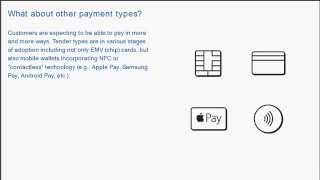
Great. So as the video explained, EMV is a global standard for credit and debit card payments. The standard was named after its original developers and Europay, mastercard and Visa. This standard uses a chip that is embedded in payment cards to authenticate payments. The chip is like a mini computer. It protects customer data and is very hard to counterfeit. Next slide, please. So how is EMV or chip card technology more secure? The reason why is that chip or EMV cards encrypt sensitive information, which makes it much harder to counterfeit than their magnetic stripe predecessors. While data on a magnetic stripe card is static, the data on a chip card is constantly changing, making it much harder for fraudsters to access or to copy it. For example, when a buyer puts a chip card in the card reader, the chip talks back and forth with the card reader in A secret language to authenticate the transaction. That language is different each time the card is entered into the reader. It's important to note that chip cards are only more secure when they are read through specific card readers that can speak this language to authenticate the card. If you were to key in a chip card's number or swipe a chip card in a magstripe reader, that card is no more secure than a magnetic stripe card. It's a chip when read in a chip reader that makes everything more secure. Next slide please. So who uses chip cards? In most developed economies, chip cards have been the norm for years. Most consumers there use chip cards and authenticate their cards with a unique PIN number, kind of like the PIN number that you use at the atm. Here in the United States, we will not use pins, at least not yet. We will still verify our payments through signature, just like we do with the magstripe cards. Today, the United States is among the last major markets to adopt emv. This is largely due to the cost of replacing card to replacing cards and terminals. It is also due to consumer behavior. In the United States we like to swipe cards. It's what we're used to. However, sticking with old technology has made us a target for fraudsters. As I mentioned already and you heard in the video, the United States only accounts for one fourth of the world's transactions, but half of the world's fraud. Next slide please. So when will we see chip cards in the United States? Some of you have already been receiving your chip cards in the mail or have probably seen some customers with them. We are seeing their penetration grow quickly on our systems. Currently, 25% of cards swiped by square merchants are chip enabled. That's up from 3.4% in January and expected to grow to about 40% by the end of the year. Next slide please. So the important thing here that small businesses need to be aware of is that there's a liability shift that happens in October. That means that starting on October 1st, you as a small business owner could be liable for certain types of fraudulent transactions which with the chip card if you process that transaction on a terminal or a reader that only reads mag stripe cards and cannot read a chip card. And one thing we want to be clear about is this is respect to in person credit card transactions. So the liability shift only affects that with respect to online payment fraud or stole IT cards that still all stays the same. So if a customer presents a chip card and you only have a mag stripe terminal, you could bear the fraud loss. As of October 1st, that is a loss that was previously covered by the bank. So one way we think about it is the liability is shifting to the party that has the less secure technology. So let's unpack this a little and explain all of the possible scenarios after October 1st. If a customer uses a chip card and you have a chip card reader, the liability is still on the bank because you've done your duty to upgrade your technology. Now if a customer uses a mag stripe card and you process it on either a magstripe terminal or an EMV terminal, the liability is on the bank because they didn't do their duty to upgrade the card. So again, the only time when a small business could be liable for fraud is if a customer presents a chip card and you have no ability to read it. So you have to process it as a magnetic stripe card. And if that card is fraudulent, then you could potentially bear that loss. Now this is a big change and that's part of why we're out here working to educate you on what this change means for you and your business. A lot of credit card processors and banks are handling this liability shift in different ways. There are some that are going to allow a grace period. There are some that are very strict about the Oct. 1 deadline. Square, for example, is covering this fraud loss for those that pre order the latest card reader. And that covered loss is only until you actually receive the order in the mail. But that's just one option. But there are a lot of different companies that are doing different things out there. Next slide please. Okay, so what does this mean for you? Bottom line, you need to be able to accept chip cards to ensure that your business is fully protected from all EMV related fraud liability. To do so, you're going to want to upgrade to an EMV or chip compatible terminal or a reader to accept chip cards. Now this is an opportunity. We want to make sure that we're not staring you or making you nervous about this liability that's coming. It's sort of an insurance policy. There's a way, a simple and affordable way that you can upgrade your technology and take advantage of this more secure way of taking payments and protecting your customers. So we want to make sure that you're aware of that and it's not just something for, for big businesses now from a sort of logistical perspective, something that you should be aware of, instead of swiping a card with EMV or chips, you're actually dipping that. So the card is being dipped for the entire sale. A lot of times that takes a little bit longer than a magnetic stripe transaction because you have encrypted data securely being sent back and forth between the reader and the card. Next slide, please. As you've probably all noticed, EMV or chip is not the end all, be all of payment methods. It has its pluses and minuses. That's why, as technology evolves, customers are going to want to pay with other payment types. Recently, we've all witnessed the development of other payment methods, especially contactless payments like Apple Pay, Samsung Pay, Android Pay, et cetera. You may already actually accept contactless payments in your store, or maybe you've used it somewhere already. Next slide, please. So how does that work? What is contactless? Contactless payments rely on a different form of technology. It's called near field communications, or nfc. What makes these transactions so attractive for businesses and customers alike is that they're fast, convenient and safe. Here's why. First, contactless payments are much faster than chip or even magstripe swiping. For businesses that value line speed, contactless is a very exciting option. Second, contactless payments can be much more convenient for customers, especially in a world where buyers can leave their wallets at home and they'll just need to tap their phone or watch at a checkout to pay. Third, contactless technologies like Apple Pay or the others we described before are very secure. They use tokenization to toggle cardholder information and biometrics like fingerprints to verify a customer's identity. Next slide please. So we've presented you with a lot of information today and we want to make sure that we have time to take questions from you and but wanted to kind of give a synopsis. The four key takeaways here are. First, new forms of technology are coming and as a small business owner, you will want to be in a position to accept them. Second, there is a liability shift happening in October, so at a minimum, you will need to prepare for that by being sure that your store can accept chip cards. Third, there are lots of other things coming down the pipe too, like contactless payments. Fourth, the SBA and Square are here to provide you with the factual information you need so that you can make informed business decisions. Now, with that, probably pass it back over to Tony to see if we got any questions during the presentation.
And Leah, we did receive a few notes coming through. So our first note that we actually did receive is asking, is there a charge for the new card readers?
Sure. So it depends on different companies and what they're offering, but I'm going to pass that off To Owen.
Sure. So we see a whole range of different options out there in the market. And so it depends on what payment processor you're using to actually take payments and what point of sale you're using. So on the low end of the spectrum in terms of very affordable for merchants, for instance, Square has several reader options that are well under $100. That said, VeriFone and Ingenico have EMV and NFT reader options that range from about 200 or 300 up to well over $1,000. And so it's just really a matter of what company process your payments. And you'll see a big variety out there in the market.
Okay, guys, so the question is asking, how do we know that we're getting the best software or hardware for our readers?
Sure. So that's a great question. EMV Co has set some pretty specific standards on what is required for a particular reader to be certified as an EMV compatible device. And so I think that the first step is looking and ensuring that the piece of hardware has been certified as EMV compatible by emvco. But in general, I think you can rest assured as a small business that the vast majority of solutions in market are going to be up to snuff from a technical standpoint in that there are very strict regulations around exactly how an EMV reader is built, exactly what the secure element is, and exactly how the data is being protected. So certainly if you're getting a reader from Square, it will be protected. But also all of the major brands that are putting EMV and NFC readers out there in market, whether it's PayPal, whether it's VeriFone, Ingenico, et cetera, these are all meeting the exact same standards of security. And I think the higher level point is that level of security is just orders and orders of magnitude more secure than a simple magstripe reader. Because the magstripe data when you swipe a magstripe card is static. And the data when you dip an EMV card and the chips talk back and forth is dynamic every single time. And so really it's just a step function in terms of the security level or the quality of security when you move to emv, no matter who is providing you with that EMV reader. All right, guys, perfect.
Our next question that we had come through the notes is asking, will the Square readers be able to accept nfc?
Great question. So we have a whole bunch of options that we're coming out with, and obviously we continue to innovate and we continue to come out with more and more reader options over time. So we have our first EMV reader was released this spring. It's called the Square Chip Reader. That reader connects to a device through the audio jack of a consumer device, a tablet or a phone. And that reader accepts contact EMV transactions as well as magstripe transactions. So it does not accept contactless transactions or NFC transactions such as Apple Pay or Android Pay. That said, we have two options that we are very excited about which accept emv, nfc, contactless and magstripe. One of which is in market and one of which is not. So the first one is we've partnered up with a third party hardware provider named Mira and we are currently offering a device on our website that works with Square Register, that connects wirelessly rather than through the audio jack and that does all three major tender types. It does nfc, it does EMV and it does magstripe. More exciting, we are coming out with our own square built reader later this fall in a couple of months called the Square Contact List and Chip Card Reader. Many small businesses are eligible to get this for free if you go onto our website and this reader will accept all major tender types. So we have an option for kind of whatever type of business you are. A lot of our retail customers and quick service restaurant customers are really excited about NFC technology and the growing of Apple Pay in America. Some of our customers, like for instance contractors who are doing high ticket size work, say on a house, say painting a house, are very, very excited about emv. But the convenience and line speed of NFC is not the most important thing to them. So we're providing our sellers with lots of different options and just letting them choose what works best depending on their particular situation.
Great. And Tony, as questions come in on specific Square products, feel free to go to our website to get more information on that. But as as you're looking through questions, if there are ones more kind of focused on liability shifts and information like that would be good to answer those to help with that.
All right, perfect guys, the next question.
That I have coming through is asking if we could, and we actually received a couple of these, asking if we could go back to the slide about liability shift and if you guys could go a little more in depth on the liability of where we will become liable.
Yeah, absolutely. Tony, if you could go back to that slide and then we'll walk everybody through it in more detail. I'm going to let Owen take the lead on that.
So I think one useful way to think about this is just to pretend what is happening. Like if I go and make a certain type of transaction, so pretend that I am and I am going to walk across the street and I have a fraudulent credit card right now. So it is August, whether that credit card is a chip card or it is a mag stripe only card or what have you. If I go across the street and I buy a pack of gum with that credit card, I will receive the gum and the seller who sold it to me will be made whole. They will get that money. And the reason that they'll get that money is because the issuing bank will cover that instance of fraud. Now, what's increasingly happening is that the mag stripe cards in market are being switched out for chip cards. And like Leah was saying, chip cards are way, way, way more secure than mag stripe cards. So they should really decrease the amount of fraud that we're seeing in the United States. So the switch that's happening is that the card issuing banks are saying, well, hey look, if we're doing our job and we're putting all these really, really secure credit cards out there in the market, then if you experience an instance of fraud as a seller that otherwise would have been prevented had you upgraded to a chip card terminal, well then that liability is going to be on you. We're not going to cover that anymore. So like Leah was saying, if a buyer comes into a store and has a mag stripe only card, which means the issuing bank has not done its job of providing all of its customers with more secure cards, then there is no change in the liability structure. Similarly, if there is some sort of keyed in transaction like a card not present transaction or an online transaction where the chip really couldn't help at all. There's no change in the liability structure. The only time that you're going to see a change after October 1 is if a buyer comes into your store. The buyer has a chip card that is fraudulent, so they have a counterfeit chip card. You are not able to read it as a chip card. If you were able to read it as a chip card, then it wouldn't go through because it would detect that it's fraudulent. But you're not able to read it as a chip card and so you therefore swipe that card, then the liability will be on you. And in that case, what the issuing banks are saying is, hey look, we've done our job. We've put a chip card out in the market. The buyer came into your store with a chip card and you only experienced that instance of fraud because you have not yet upgraded to an EMV chip card terminal. Hopefully that makes it clear.
So, guys, the next question I see coming through is asking, can you run magstrip cards through the chip reader?
Great question. There's a number of different implementations, but the answer by and large is yes. So we, when you go into a store like you go into Walgreens or Target or Walmart, the new readers that you'll see will generally accept both EMV and magstripe, as well as potentially NFC and contactless. So the reason that that is the case, and that's the case not only in the United States, but also if you've traveled to Europe, Europe or Canada, you might have used EMV before. If the chip is damaged on a card, then we still want to give the ability to kind of fall back to the legacy technology. So if somebody tries to dip their chip card several times and for whatever reason it's not working, then we can still process the payment as a magstripe payment. So the new terminals that you'll be getting that are EMV terminals or EMV and contactless terminals, some component of them will still have magstripe, which means that whether a buyer comes into your store with a magstripe only card, or they come into your store with a chip card, or they come in with a device and they want to use Apple Pay or Android Pay, you will be totally covered and able to take any type of transaction.
Wonderful, guys, thank you. The next question we actually had, and we've had a couple of these questions come through, is actually just asking where do we get these new card readers from?
So there's great question. There's tons of different ways in which sellers can get new card readers. So even just a simple Google search of EMV card readers, you can probably find some for Square sellers. Obviously, just going to the Square website, you can pretty easily find the new Square readers that are EMV compatible. But I would ask whoever your current payment provider is or payment terminal provider is whoever gave you your. Let's say you use an Ingenico term or a Verifone terminal, or maybe you're using PayPal or Shopkeep or some other provider to process your payments. Basically everybody is going to be coming out with EMV and increasing EMV and contactless readers in the coming months, if they haven't done so already.
And it's good when you're, you know, when you're evaluating the next steps that you want to take in terms of getting that EMV reader is to look at all the options that are out there because they're really, we want to make sure that small businesses are aware of the fact that you don't have to spend an arm and a leg on these readers. There are affordable ones out there.
Excellent guys.
And so another question that we've had come through a couple times here is asking if October is the hard date or, or is this still to be determined?
October is the hard date. And then in certain instances, certain payment processors may choose to, on their own, separate from the overall kind of EMV mandate, make it a little bit easier on customers. So in general, you will see, you will see a big switch between say now and post October 1st in terms of the number of transactions at businesses in the United States, which will be chip transactions versus mag stripe transactions, because the October 1st deadline is real. That said, there will be some kind of some nuances. Like for instance, Leah was saying at Square, if a seller pre orders one of our new chip contact list readers, we will cover the liability for a limited amount of time until you get that reader. So you may see particular payment processors do something like that or some sort of grace period for a couple of months. But unlike previous instances, I'm sure all of you small business owners have kind of seen this story before, and we've been talking about EMV in the United States for several years. This one, October 1, 2015, it really is a serious deadline and we really are going to stick to it. And I think part of that is because this is coming in the wake of some major data breaches that I'm sure you're aware of, such as the target breach or the Home Depot breach. So payment security is really top of mind in the world right now and in America in particular. So the October 1 deadline will be enforced pretty much by everybody. All right, perfect.
Guys. Another question that we did receive is actually asking, in stating that I am a convenience store operator, would I need to replace my fuel pumps or can I actually just replace the readers on the pumps?
That is a fantastic question and it's a little bit more nuanced. So I'll try to talk about this at a high level. You can think about two different types of points of sale or points of payment in the United States. One that involves a human behind the counter or some sort of cashier, and another that's automated. The EMV liability shift that we're talking about now, which is October 2015, is for the first type of payment terminal. The liability shift for automated checkout machines such as gas pumps Such as like train ticket machines at train stations or even vending machines. The liability shift for those is actually two years later, it's in 2017. And the reason for that is because it's much more costly to replace, for instance, all of your gas pumps or all of the vending machines in America or all of the ticket machines in America than it is just the payment terminal being used by a seller who has a point of sale. So in that kind of corner case for kind of an automated payment checkout machine, the liability shift is actually further out. All right, excellent, guys.
Another question I've had come through, and I've had it come through a couple times here, is actually just asking, how can you evaluate the different system options?
Great question. I think that when I think about it, there are a whole host of variables that I would take into account. I think, like, simplicity is important. So how easy is this for you to use as a specific business? You don't want this to take up more of your time. You want this to make your life easier. So I think getting your hands on a couple different types of readers or a couple different systems and trying them out on your own and seeing how easy they are to use, that's a great way. Also, like Leah and I have been talking about, we know that cost is hugely important for small business, small business in America. So don't just go with the first solution that you see that might cost $1,000 or $100 a month, because there are great solutions coming to America for $29, $39, $100, et cetera, particularly from some of the kind of newer payment processors out there. The other thing to keep in mind, we touched on the fact that EMV transactions take a bit longer than magstripe transactions. So we're talking about several seconds instead of maybe one or two seconds. And experiencing how quickly the processor is able to process a patient payment could also be important if it's really. If you own a coffee shop and you have a long line every morning, the difference between an EMV terminal that takes 5 seconds versus 20 seconds per transaction is going to be really, really meaningful for your business and also for how happy your customers are. So I think kind of understanding how simple it is to use, how much it costs, how quickly it can process transactions, those are some good variables to start with when you're thinking about what EMV terminal you want to go with.
All right, guys, the next question I see coming through here. Sorry, Leah, did you have a question?
I was just going to say another thing to think about. And you all know this better than anyone, but you want to make sure to meet your customer where they are and be able to take any sort of payment that they want. So, you know, we would suggest, and we would advocate for looking for a terminal that will allow multiple different types of payments, so not just emv, but also contactless, because, you know, as people have realized, technology is constantly changing. Right. And so if you're able to do so in an affordable and seamless way, we would advocate for that so that, you know, should contactless payments take off, then you're prepared and ready to do whatever your customers want.
Excellent. Thank you, Leah.
And so, guys, the next question I see coming through is asking, do you recommend that we reach out to our merchant services providers, or are they required to notify us of their plans for the 10:1 change?
I would recommend that you reach out to your merchant services provider for sure. The thing about the EMV liability shift is that there's no law going into place. There's not like a. There's no mandate coming down from the government saying every single business needs to accept emv. It really is just a shift in liability. And so it's a shift in the incentive structure that's meant to kind of catalyze this change. In the United States, I know a lot of merchant services providers are proactively reaching out to their seller base and getting them ready for the upgrade. To the extent that that has not happened yet, would really recommend getting in touch with them soon, because this change is coming and you want to make sure that you're prepared. And it could be the case that a particular merchant services provider did not yet have a solution. And in that case, you might want to change because you don't want to be on the hook for those instances of fraud. So I would recommend being proactive at this point because we're only, what, a month, a month and a half away. So, yeah, as much communication as you can have with the institution that's selling you your payment terminal, we would fully recommend having those conversations and getting the fabric that you need soon. All right, guys, excellent.
I do see another note that came through asking, will the new devices be able to run on analog phone lines like some of the old devices?
To be totally honest, this is a little bit embarrassing. I don't know. That's just not the way that the Square system is set up. So I know that for Square, the devices will continue to be able to run on 3G, 4G wireless, and I know that a lot of the new Ingenico Verifone, et cetera, terminals will continue to run on Ethernet. I'm really not sure whether the new devices will be able to run on analog phone lines. So we can add that to the FAQ and go do a little research on our end, but unfortunately, I do not have an answer that I'm confident in right now. Sorry about that.
All right, Another good question coming through, guys, is asking what happens if the customer has a smart card but chooses to swipe the mag strip instead of using the chip reader?
This is a fantastic, fantastic question. So what's going to happen? I know this is not happening yet, but what's going to happen starting after October 1st is that if a buyer presents with a chip card and tries to swipe it in the terminal, or you try to swipe it in your terminal, the terminal will prompt you to insert the card and read it as an EMV transaction. So a message will actually pop up and say, chip card needs to be inserted or chip card cannot be swiped. And so that behavior is actually actively prevented. So that really should not happen. And that's the case. That's not just a square thing or that's not a choice. Again, that's part of the EMV regulation. So that's why if you go to, you know, for instance, if you go to Europe and you have a chip card, you might not have even known it and you try to swipe your card, it, it will force you to dip the card.
All right, excellent. The next question I see is asking, are there any software or subscriptions required to make the shift, or is the reader the only thing that is necessary?
That's going to be dependent on who exactly your payment processor is. But generally there are software upgrades that are incorporated. But generally, if you're getting an EMV or EMV and NFC combined terminal, the merchant services provider or whomever will not sell that to you if the software and the drivers on the other end have not been upgraded so that it will actually work. So definitely make sure that you're not just getting a new EMV and NFC or contactless terminal. That's not going to work with your old point of sale. But for the most part, whoever is selling that to you should be making sure that you have software that is capable to work with EMV and nfc.
All right, Excellent, guys. Another good question I see coming through is asking, how will this affect gift cards?
That's a great question. Lee and I were looking at each other, so I think in the near term, gift cards will continue to be swiped and there's probably no change in the liability structure in the future. You may see gift cards adopt the EMV standard or potentially leapfrog EMV and just go to nfc. So you could say, load your Home Depot or Gap gift card onto Apple Pay or Android Pay, but I think this is another one where we could definitely get some more detail and some higher confidence in our answer and add that to the FAQs afterwards. I think one important thing that a lot of sellers have asked and I want to reiterate, is that the magstripe slot in these readers is not going anywhere. So all of the existing gift cards that are out there that have magstripe only will continue to be able to work and you can continue to use them. So the magstripe spot is not going anywhere. And we will get you more detail on exactly what is going to happen to gift cards in the U.S. all right, perfect.
Guys, another question coming through. That's a good question here. It's asking, is this for only the 50 states or will it include the territories as well?
I would imagine it will include the. I imagine it's all of the United States. We will confirm that. We haven't had that question before. Another great question, but I do think that it's all of the territories as well, including Washington, D.C.
All right, guys, I do see a couple questions coming through. Also asking about if you could explain a little more in detail how the process works with the EMV card actually being dipped in and the card readers working.
If you could just give a little.
More detail on how this transaction is taking place.
Sure, for sure. Great question. So everybody is used to swiping your card where either the buyer or the seller swipes the card card and then the transaction is processed. The primary difference. There are two primary differences for an EMV transaction. First, there's going to be a different slot. Instead of a slot where the card is swiped, there's a slot where the card is inserted or dipped. You might hear people making references to the chip and dip. But so you're basically inserting. Inserting the card into the reader. And when you insert the card, there are six points of contact on the chip that make contact with the microprocessor inside of the reader. And that is actually where the transfer of data is taking place. So instead of the magstripe on the back of the card and the magstripe reader in the magspot, it is the chip on the card making contact with the Microsoft microprocessor on the reader and you leave the card, the buyer or the seller leaves the card in that slot for the remainder of the transaction. Because the transaction is happening in a dynamic way, in real time, with the chip and the microprocessor talking back and forth to each other to verify that this is indeed an authentic card and not a counterfeit card. So you leave the card in there until the transaction has been processed and only at that point does the buyer or seller remove the card. So those are the primary two differences, is that it's a diff or an insertion and that it's left in the reader for the entire transaction, as opposed to just a quick swipe that you then take away. All right, guys, perfect.
The next question I have coming through is actually asking that there's a rumor out there that we will not have an option for the tip line on the new EMV readers for restaurants or service oriented businesses.
Is this true? That should not be true. So I'm not sure where the rumor is coming from. Or there might be like a specific corner case that not aware of. I know that I worked on the development of a couple of our EMV readers and we've had no problem incorporating tipping into the flow so that a business that's in whatever vertical, whether it's restaurant or services or retail, you will be able to tip. And so that should not be the case. In addition, in other markets where EMV is standard, you are able to tip. There may be instances where there's a limit on the tip. So for instance, If you were to process an EMV transaction at a restaurant and the buyer is sitting down at the table and, and then the card is taken into the back and it's inserted for the EMV transaction and then it's taken out and the receipt is brought to the table. There might be a maximum amount that the buyer is allowed to tip because basically the tip was just going to be added onto the transaction without the chip card being processed upwards. So you would definitely still be able to tip.
All right, perfect. Now we did just receive another question that is related, asking that we are actually just a restaurant that captures card information to open tabs. Would the chip technology prevent us from opening these tabs and then closing them on cards without the card presentation?
I think we'll have to, I think the process will probably change slightly. For sure we still will be able to do open tabs and we can, for instance, on the square platform. But let's add that to the list of questions that we're going to do more research on. We'll go and talk to our product team so we can get a really, really clear answer on that one. All right, perfect.
Guys, another question that just came through is asking how much will it cost for customers to change the old magnetic cards to the new chip cards?
Great question. So there are 1.2 billion payment cards in circulation being actively used in the United States. The cost of upgrading all of those cards is in the billions of dollars overall. But the great news is that it's not going to cost buyers anything. The issuers are taking it upon themselves to issue more secure cards, to issue these chip cards. And the reason that it makes sense for them to do it is because it's going to really significantly limit the number of dollars that they have to pay out in fraud liability. And so they're taking this cost upon themselves now to prevent fraud that they'll be liability they would otherwise be liable for in the future. So it is expensive, but the buyers don't have to worry about it.
Guys, the next question I actually see coming through is asking, does EMV transactions being in real time, affect funding, holds or refunds?
It should. You will still be able to refund a card in a similar way. I'm not sure on funding or holds. So we can add that to the list to get back to you.
Basically, the way that an EMV transaction works is the same way that a magstripe transaction would occur. It just takes a little bit longer and it's more secure. But we can look into that in more detail.
Some very new questions. And, guys, actually we did have a couple questions coming through asking if the presentation itself will be made available for the guests on the call.
Yes, absolutely. There will be a video recording. I think that the SBA will plan to put that on their website. And. And then we'll also make a PDF available as well. Not sure. Meredith, if you're still on the line.
Yeah, great question. We will have archived up@sba.gov emv and we also broadcast this webinar back in June. So there's an archived version of the June webinar available now as well. And then we'll be sure to add this one in the coming days. So again, that's sba.govemv.
Perfect, guys.
Another question we did receive a number of times was just asking if you guys had contact information that you could post for the folks where they could get in touch with you guys and ask more questions.
Yeah, I mean, we're happy to do that. I think, you know, the last slide of the slide show has our websites with more information. I know that AT&T will be collecting the information. I think when you logged in, if you originally checked a box that said, you know, we would be happy to have communication from Square or the sba, then we'll have the ability to reach out to you with your questions.
And certainly this is Meredith from sba. We've got a presence around the country through our district offices. It's the front door of sba, so you can definitely feel free if you go to SBA.gov local you can enter your zip code and get a list of our regional and district offices as well as resource partner counselors. So that's another way to get kind of of in person questions on a variety of topics, including this one.
And also on the square side, there are two other options for answering questions. We have square.com, but we also have a very thorough blog that really goes into a lot of good detail here on EMV and new payment technology and actually all kinds of things, things about running your business. So that's squareup.com townsquare so squareup.com townsquare and there, there's a lot of educational content and additionally, if you really want to get on the phone and get some more information, then you go to squareup.com and there will be, I think, a contact button and there's a phone number that you can call and get in direct contact with somebody you can also email and they should get back to you with any questions you have about this or anything else.
All right, perfect guys, thank you for that information. And do we have time for maybe one or two more questions?
Perfect.
Yeah, we're happy to take more.
Excellent.
Guys, I think there's another good question here that we have not asked yet. And it's actually asking, is there any other personal info that a merchant captures from your chip card?
No, there's no additional information that's being captured from the chip card. I know that there are folks who I talk to who are worried about like RFID, radio frequency identification just in that the chips look similar. But no, the data that's being collected from an EMV transaction is super similar to that being collected from a Mag Stripe transaction. Actually, the only difference is that the data that's collected from a Mag Stripe transaction is static and it's always the same. So everywhere you go, every time you swipe, it's the same exact data. And that's why it's easy to steal. That's why it's easy for me to copy the magstripe on your card and go and make a counterfeit card. Whereas that account number, the pan we call it, the account number is dynamic and changing every time for a chip card transaction. But there's no additional data or additional identifying metrics or anything like that in an EMV transaction as opposed to a mag stripe transaction.
Excellent, guys. And if we have time for one more question, we had a question come through asking if the new chip readers will be able to accept foreign cards.
Great, great, great question. This will be a good one to end on. I'll try to keep it a little bit high level, but it does get a little bit tricky. So there are two things going on with any EMV transaction. First, there's the the chip being read by the microprocessor and the chip card reader. And then second, there is something called the cvm, which is the customer verification method. And the cvm, the way that we verify a payment in the United States is through signature. So you'll hear very often people saying the United States is a chip and signature market, or maybe referring to it as chip. And now when you look at international cards and international markets, the chip element is the same. It's the EMV standard like we've been talking about. That's a global set of standards. However, the CVM can be different. The cardholder verification method, say in a country like France or Germany or Australia, may very well be pin. So you enter a three or four digit PIN instead of signing your name, much in the same way that we in America do at an ATM machine. So the answer is those cards, the international cards, they will work at EMV terminals in the United States. The buyer, however, might be a little bit surprised that the way in which they are asked to verify their identity is through a signature versus through pin. The vast majority of international cards prefer like they will default to PIN as the cardholder verification method over signature. However, if it's being read in a chip and signature reader, that's totally fine and the buyer will be able to just sign. And I think in a very, very small number of cases there are certain some cards in existence, some cards in existence that are chip and PIN only and will not work in a chip and signature reader. But for the most part all chip cards will work and it will be signature CVM in the United States and then just maybe a couple, like a very, very small percentage of cards are chip and PIN only in an absolute sense.
Thanks everyone for joining.
Thank you.
Thanks everybody.
More from Your







President Donald J. Trump and First Lady Melania Trump Visit Grieving Texas After Deadly Floods

💪 Thinking of starting a #biz? Go for it! — Kerry Boyle, Vermont #SmallBiz Person of the Year

President Trump Participates in a Bilateral Meeting with the Prime Minister of Canada, May 6, 2025

