How Women Entrepreneurs Can Get the Financing They Need to Grow
Meredith Wood and Erin Andrew explain why women entrepreneurs face a financing gap: they own 30% of small businesses but receive a disproportionate share of loan dollars. The webinar covers underwriting criteria like credit score and cash flow, reviews financing options from bank loans to crowdfunding, and shares practical rules like debt-service coverage ratios and how revenue limits loan size to 8-12%.
Questions this video answers
About 30% (spoken) (women own 30% of all small businesses).
4.4% of total dollars in small business loans (spoken).
16% of conventional loans and 17% of SBA-backed loans (spoken).
Cash flow divided by 1.5 (1.5–2.5) should be greater than total monthly debt payment (spoken).
Over 700: good options; 620+: some options; 550+: limited; below 550: tougher (spoken).
Chapters
I would now like to formally begin today's conference and introduce Meredith Wood.
Awesome.
Thank you, Colin. Thank you everybody for taking the time.
To attend this webinar this afternoon and.
Obviously to the SBA for having me.
My name is Meredith Wood. I am editor in chief at Honda. We are an online marketplace for small business loans. I spend most of my days finding ways to help entrepreneurs to actionable advice. I have a special focus on financial.
Management and an even further focus specifically on access to capital.
And I obviously have a special place in my heart for women entrepreneurs as a woman. But more importantly, I spend all day long looking at the data surrounding women entrepreneurs.
And of the many reasons that there is currently a disparity between women's access.
To capital and men's access to capital, I think that some of those could be solved through education. And so that's why I'm glad that.
You'Ve taken the time to join us today as we're able to sort of.
Provide some more transparency into the financing process for female entrepreneurs. So to dive right in, I talked.
A bit about the disparity between male.
Entrepreneurs access to capital and female entrepreneurs access to capital. But let's take a look at what.
Those numbers actually are. So right now, women own 30% of all small businesses, but they are receiving.
Only 4.4% of total dollars in small business loans made. This is for two reasons.
One, lower approval rate.
They are receiving only 16% of conventional.
Loans and only 17% of SBA backed loans.
And then when they are approved, they are receiving significant. So obviously these numbers are a little bit shocking, a bit discouraging.
But let's talk about why this could be happening.
So obviously there's a lot of opinions that surround why disparity exists. There's a lot of different studies on what the reasons could be.
An example is people say that women often have less collateral to offer banks.
And that's one of the reasons that they have a harder time finding funding.
And then along with that, banks just often consider women to be more of a risk.
There are studies that show that if.
A man and a woman with exactly the same qualifications and exactly the same experiences try to get funding from a financial institution, the man is more likely to walk away from the bank with a loan.
And unfortunately, there is no answer for this. It just goes back to historical and social reasons, biases against women in general.
And although we've made a lot of.
Strides on the equality movie, obviously not quite there yet. And along with this, there are other.
Studies that show that another reason that women have less access to capital is that they are more discouraged from applying for loans due to a fear of.
Denial or thinking they don't stand a chance. Which, as an entrepreneur, your biggest asset.
That you have is your time.
So I understand the sentiment of not.
Wanting to take the time to apply for a loan if you don't think you're going to get it. But it's this reason specific that I think we can address today through education.
Through some transparency into the process. And I do hope that you walk away feeling you've got more of an.
Understanding of what it takes to find.
Financing for your small business. And the reason I think this is.
So important is because women owned businesses right now, they're killing it.
They added 500,000 jobs between 97 and 2007, while the rest of privately held firms lost jobs. So women owned businesses. They're on the rise. And because of this, lending is going.
To have to catch up.
And to sort of pair with those.
Numbers that are a little bit discouraging. There are some ways of hope that's.
Currently happening places that women are starting to find success.
One is specifically with crowdfunding on Kickstarter.
Women have a higher success rate there.
And also with the SBA Microloan program.
So the micro loan program is specifically.
Making loans with amount $50,000 and less.
And this is somewhere that women are having more success than men. So taking some looks at these numbers, going back to what I said earlier, I think that a great way to be part of this solution is to.
Take the time to really educate yourself.
On the process, what your options are.
And how to be most successful.
And that's something that we're going to walk through today.
So the first place that I want to start, if you're in a position.
Where you're either starting a business and.
You need funding, or you're currently running a business and you want financing to grow, there are a lot of questions.
That you want to ask yourself. And the first question is going to be, and this is, why would your business need funding?
And obviously, if you're a start up.
You need it to get off the ground.
But for those of you that have.
Been in business and are currently looking.
For that financing to grow, the first.
Question I always tell business owners to ask themselves is what is the cost benefit analysis here? So you've got to operate with the mindset that a loan is an investment.
In your business, but at what cost?
So I don't just mean literally with.
Debt financing, where you're obviously paying interest.
To acquire this loan. But also with equity financing, when you're.
Having to give away a part of your company, or even with something like.
Crowdfunding, which is a huge time investment.
In order to have a successful campaign.
You have to constantly be asking yourself if you're thinking about approaching financing, do.
I certainly need this to go where I want to in my business?
And can I honestly say, by having this financing, I'll be able to get to a place in my business that.
Won'T outweigh any cost that was included with it.
So that's the first question you should ask yourself. And secondarily, I think it's really important.
To approach the process with perspective.
Perspective, having an idea of the amount.
That you would want to acquire and the amount you can qualify for.
So this right here is specific to anyone who would be considering debt financing.
And this is sort of an example of a debt service coverage ratio.
And this is something that lenders are.
Going to look at when they're considering.
The amount of funding that they want to make available to you and your business. So at the end of every month, after you've taken out all of your expenses, I'm talking payroll, rents, etc.
Etc.
And how much cash do you have on hand in your business? So this number specifically is what I.
Mean when I say cash flow.
You want to be able to divide.
That number by 1.5 or greater.
So 1.5 to 2.5, and that needs to be. That number needs to be greater than.
Whatever your total debt payment for that month would be. So whether you've got daily payments on a loan, weekly payments, monthly payments, the principal plus interest you're paying each month, the total of that needs to be.
Less than your cash flow divided by 1.5 or greater.
Now, there are some lenders where, if that number is below 1.5, if it's.
1.25, that states might possibly be able.
To make some funding available to you.
But if the number is one, there's.
No sign that you have cash to cover the debt payment.
So that doesn't speak very strongly to two lenders.
And obviously this is only for people that are currently running the business. If they start financing, this wouldn't be relevant.
But if you're thinking, I need this.
Much funding in order to do what I want to do, start by looking.
At what a potential debt service coverage ratio would be. Before I go to the next slide.
I just want to let everybody know that I am based out of New York City and I work right by a fire station.
So if you are hearing any sirens.
In the background, I do apologize.
They should quickly pass.
So, moving on to the next slide.
And operating in the same sort of trying to gain perspective on the situation of why you would need financing and.
What you can afford to take on as a business going back to cost benefit.
I just want to remind people that the reason you're taking out a loan.
Or your loan purpose is always a gray area.
It's never black or white. So I always recommend speaking to a third party that has very strong financial.
Sense to get their perspective.
Your accountant is a really good place.
To start as well as perhaps even just a friend you trust that you know that they've got a keen sense of finances.
But it's always nice to talk through.
It with someone else.
And these are just examples of some.
Good uses for a loan and some maybe not so great uses, but again, these are great.
It depends on the situation.
So as an example, if you have an opportunity to purchase inventory for your.
Business to take advantage of a huge discount, and you're certain you can move.
This inventory off your shelves, if the discount that you will receive outweighs the.
Fee of whatever it was to acquire that loan, then this definitely is considered a good use. And another very popular reason for needing financing is to cover a gap in time before you're paid by clients. This is a sentiment that many business owners understand.
So if you're doing business, especially with.
Larger clients that just naturally take a.
Longer time to pay and you've got.
To again, cover payroll, cover rent, etc. Etc. It is a good use to take up some financing to cover that gap.
In time because you know the money is coming in.
Yet on the other side of the equation, let's say you're looking at improving the decor of your retail space. This is kind of tough because in.
Some cases it can make a lot.
Of sense, especially if, let's say, upgrading your interior would allow you to appeal.
To a higher network market.
And you've done the market research and.
You can identify that there is that synergy there.
But overall, it's hard to say that.
Improving your decor really moves the needle on the amount of revenue that's coming into your business.
But again, like I said, I always recommend talking through with someone to help them give some outside perspective on what you could be using this loan for. So those are just a few things.
That I think it's always important to.
Ask yourself before you go down this journey and to jump into the next slide. I think it's really important to know what lenders are going to value in a loan application.
So if you are a business owner.
Who is just starting out, you have a start up.
You have to understand that these elements.
Won'T necessarily apply to you if you.
Are going to debt financing round because.
You don't have business history. And that's okay. There are some debt financing options available to start ups.
What's going to matter? A lot of these is going to be your personal credit score because that's.
Really the only sort of history that the lender has to go off of. And you also can possibly go the route of taking out a consumer loan and using it for business purposes. But other good options if you are.
Just starting out is to go the.
Equity financing route, talk to angel investors, talk to VCs, or even go the.
Friends and family route.
And there is also the crowdfunding route. So there are definitely options out there.
For people just starting out.
But the other portions of the loan application will not necessarily apply so much in those situations.
So it is hard to say what every lender is different.
Every lender has different underwriting algorithms. But if you're trying to self evaluate before you start the loan application, these six points are a great place to look. So the first element you want to consider is your credit score.
When I say credit score, I mean your personal credit score. Believe it or not, your business credit.
Score isn't going to matter quite as.
Much until you're a much bigger business.
Doing a couple million a year in revenue. Because the way that lenders see it.
Is that they're making loan to the business owner.
And that impact is true.
It is the business owner that will be paying it back.
So they want to know what sort.
Of financial history you have.
So if you've got a credit score.
Over 700, you're going to find some options available.
620 and above, you'll have a few, and then 550 and up, you'll have some options that may be a little.
Bit harder, but it depends on the other elements of the loan application, what's happening there, and anything below 550, it.
Will be a little bit tougher, but there are options.
And again, think of this as a formula. If your credit score is a little.
Bit lower, perhaps you've got higher revenues to help make up for that.
So that's something to keep in mind.
Before you start the loan application process. The second thing that lenders are going.
To look at is going to be your business's revenue and they're Going to.
Verify this, usually through your business tax return. Revenue's most important job is it helps lenders get a sense for the amount.
Of loan that you can afford. Generally speaking, you're not going to be able to qualify for a loan that's.
Higher than 8 to 12% of your total revenue, because it doesn't make sense in terms of the lender's eyes of.
You being able to afford the loan.
So that's revenue's most important role. If you've got six figures in revenue, you should have some options available to you.
But again, it sort of depends how the whole application looks.
Along with revenue going into step three.
What'S also going to be super important is your profitability. So you could be doing millions of.
Dollars a year in sales, but if.
You'Re not profitable, lenders are going to notice that and wonder, okay, where are.
They getting this cash to pay me back? Or if you have mediocre sales, very possible.
That speaks obviously strongly to cash management.
Shows that you've got a lot of cash able to service the debt. So that is a strong sign to lenders. So just be aware of your profitability.
Going into it and know that that is something that they'll be looking at.
The next thing that they're going to take a look at is your current debt. What I mean by this is that if you have a loan out now.
With another lender, other lenders are going to care about that.
And the reason is that if you've.
Taken out a loan for your business.
This creditor puts, most likely, I should.
Say puts a UCC lien on your business.
And what this means is that if.
You go bankrupt or you default on.
Your loan, when you liquidate, this lender.
Will be paid back until the debt is settled.
And so if there is another lender.
In second position, their debt won't even.
Be to be addressed until that first creditor is satisfied. So that's why it's not really in an appealing position for other lenders to take second position to other lenders. But if you're almost paid down on.
This other loan, that's a little bit.
Different position, because obviously these other lenders see that you don't have much more to go to complete those loan payments. And there are in fact some lenders.
That will take second position to another lender.
But if you currently have debt outstanding, that is one of the first questions I would ask any lender that you are speaking with or evaluating, because out.
The gate, that will help you identify.
Who you can work with and who you can't. And the next step is cash flow. And when I say cash flow, I'm specifically thinking about your business bank account. So most lenders are going to want.
To see your monthly bank statements.
They're going to want to get an.
Idea of how, how much cash on.
Hand you tend to keep and how.
Well you are at managing that.
Do you have a lot of nsf? A lot of non sufficient funds?
They want to make sure that you've got a habit of keeping cash in your business and obsolete cash that could.
Be used to pay them back. So very important something you want to keep in mind. And then the last thing that they're going to be looking at is your past history.
And this is something that will mostly be identified by pulling your credit report.
They're going to want to see, okay, do they have any collection proceedings? Do they have any roofing ceilings? Have they had a bankruptcy? You have had a bankruptcy, they may.
Want you to be a few years out from that.
Keep in mind that bankruptcies stay on.
Your credit report for about 10 years.
Some start moving off of a credit report at 7. But if you've gone through that, definitely understand that lenders will look at that, have questions about that outside of the credit report.
They'll want to know things like have.
You filed your taxes for this year?
Because that is something they use again.
Severe, both your revenue and your personal income.
So of all these things, for example.
Let'S say the credit report, before you.
Apply for a loan, you can do.
Some due diligence here you can go.
Pull your own credit report, take a look, see what creditors will be looking at.
Maybe there's something on your credit report that shouldn't be. For example, you may not know this, but you could have a UCC lien.
On your business from a lender that you simply applied with but never took a loan from.
So that is something that you could call and have removed probably. It could also be say a collection.
Proceeding that was settled, but it's still on there. So definitely before you apply, pull your credit report, take a look at what's on there, see if there's anything one, you should be aware of, two, anything that could potentially be removed as a mistake. And not only will that help from the credit report perspective, but some of those things could maybe give your credit.
Score a bit of a boost before you apply. So again, I would highly recommend screenshotting this, writing these six things down. And if you are thinking about going.
The debt financing route, do a self evaluation, see where you stand. See if you know where you can.
Stand to approve before you get started.
So before I move on to the next slide, I just want to sort of reiterate here that when going through the process, first evaluate do I even need this money?
Can I live without it?
What is it going to do for my business?
Get some advice and making sure you.
Are using it for the right. Get some perspective on how much your business can afford and then do a.
Self evaluation of where you can financially. And now I want to talk about where you go to get a loan. And like I said, there tends to.
Be three major types.
You've got your traditional financing route, so bank loans, you've got equity financing, so.
We'Re talking angel investment VCs, you've got.
Crowdfunding and you also have sort of a new industry which we would call alternative lending.
And I will walk through all these. The first group I want to focus.
On are people that have taken the time to focus specifically on women entrepreneurs, which I think is amazing. So these are various different funding programs and they all operate a little bit differently.
But again this is a slide. I highly recommend either screenshotting or jotting down the names of these places because.
They'Re looking at the women and that is awesome. So to give you kind of an.
Idea of how these differ, two of them are regionally based on one obviously.
Is the Wisconsin Women's Business Initiative which.
Are specifically for women business owners in Wisconsin and they are helping make loans up to $100,000.
Also the women's venture fund is for.
New Jersey, New York based entrepreneurs and.
They are doing small loans but also.
Providing other things like mentorship and education.
And then Elizabeth Street Capital is actually.
Tory Burch's foundation where she's working with.
Bank of America Entrepreneur with Secure Loans, but is also providing mentorship and education. And then the Eileen Fisher Women Owned.
Business Grant program is specifically that they're giving out grants. They tend to focus on business owners.
That are in the sort of social conscious space sustainability.
So if you are in one of those industries, they're definitely someone you would.
Want to check out.
Womensnet.net also does very small grants for sort of home based businesses.
So if you fall into that sector, I'd give them a look. And then the rest of these Women Capital Connection, 37 Angels, Golden Seeds, these are organizations that are matching women entrepreneurs with VCs and angel investors. And so if you think you want.
To go that route, especially if you.
Are a startup, I would definitely recommend checking those out. But Even if you are currently in.
Business and you like the idea of.
Bringing on an angel investor, which I.
Always like to remind, yes, you do.
Often give away some equity for that. But angel investors also come with a great resource in and of the angel that can provide mentorship to your business.
Which is really valuable.
It can be time intensive in a sense. You've got to make the connections, make the pitches.
But it can be a really good learning experience for you as a business.
Owner because it helps you perfect your pitch, helps you perfect your business plan.
And you often find through the process.
That you're getting advice along the way.
From people's perception of how you presented yourself.
So there's a lot that you can get from the experience of going the investment route. But let's say you're most interested in going the traditional debt financing route. Where do you start? I will always, always, always tell an entrepreneur to start with a bank. And the reason is that it is the lowest priced option available out there. And obviously from a debt financing perspective.
You'Re going to get the lowest interest.
On a term loan or a line.
Of credit from a bank.
But I also think of it in the grand scheme of things, in terms.
If you compare it to something like.
Equity financing or crowd financing, you don't.
Have to give up a part of your business and you don't have to take the time to invest in the crowdfunding campaign. So that's why I see it as the lowest cost option overall.
So obviously the biggest pro is the.
Price, but they do have the cons.
Which we are very familiar with. The first is obviously that they are difficult to secure. Right now, 85% of small businesses are getting denied by the banks when they go to apply for a loan. I will talk more about those numbers later.
But on top of that, they also have lengthier applications, which is never fun to think about. So you are going to invest a.
Bunch of time in something that you.
Don'T really have a huge chance of qualifying for.
And even more so if you're sort.
Of in a time sensitive cash crunch.
If you find that you'll find with banks that sometimes you have to wait.
A while to get approved and also.
To get your funds in your account. So if you're in, like I said.
A little bit of a time sensitive position, it may not be the best route for you.
But overall, I always recommend starting with a bank, especially if you think that.
You'Ve got a good chance of qualifying.
So jumping into those FAQs, how do.
I know if I'M a good candidate.
For a bank loan. This question is tough because I just.
I always recommend giving it a try and see.
But going back to those six things we talked about earlier, so your credit score, your revenue, your profitability, your cash flow, your past history and your current debt, you self evaluate and you feel.
Like you are in a pretty good financial position.
And chances are you could be a potentially good candidate for a bank.
It is just going to depend on a bank by bank basis.
Also, having something that you can use.
As collateral is very good with banks.
Because most banks will want to use something for collateral. So keep that in mind and jumping.
Into the next faq.
So this kind of seems like a silly question. Where do I find a bank loan? Obviously it's the bank, but I think.
This is important to touch on because.
I always say go to a community.
Bank before you go to a big bank because historically they have higher approval rates for small businesses.
Especially if you currently have a relationship with the community bank, try there first.
But if you're on this webinar because.
Maybe you don't need financing right now, but in a year or two you're considering possibly getting some to help grow.
Your business, if you're not currently banking with the community bank, I would recommend it just because you can build that relationship now, they can get to know you. And then a year or two from now, if you need a loan, it's always good to have a relationship going into it.
Brian said it may not change anything.
But you can do everything in your part to at least hopefully prepare yourself.
To be as best of a candidate as possible for a bank loan. And then the last question is, okay.
I've heard these horror stories about bank applications. What is the process like?
The fact of the matter is that they're going to require a lot of documentation and that's just because they're very.
Diligent about their underwriting and that's how they're able to offer those lower cost loans. Generally speaking, they could potentially ask for.
P&LS balance sheets, cash flow analysis. They will want to see tax returns, both personal and business, to verify income and to verify revenue. If you're going to put something up.
For collateral, they may want to audit it, obviously see that it's worth what.
You say it's worth. And they're going to probably want to.
See bank statements if you don't bank with them.
So there's a lot of documentation that goes into it.
But if you are somebody that generally keeps all your ducks in a row.
You'Re very diligent about organizing your documents, then you might find that the application isn't as intimidating as you've heard. But either way, it's good to go in with possibly talking to your accountant beforehand, having all your documentation ready to go, and then seeing what they do ask for.
So I do want to touch on.
The figure that I mentioned earlier, which.
What'S happening with bank lending, small businesses.
Right now and that denial rate I talked about being at around 85%. So to give you another insight into what is happening, there's 27 million small businesses. There are 5 million that need funding, but don't ask. And I'd be curious to know of those 5 million, how many are women speaking? Going back to the source earlier that said that many women are simply discouraged for applying for loans and don't go down that route because of fear of denial. And then the other 12 million that seek funding, and so that is 14 million unserved small businesses.
Only 3 million. Of those 17 million are getting funding from banks.
So obviously this number is large. It's overwhelming, it can be a little bit scary.
But instead of focusing just on these.
Figures, let's talk about why this is happening.
Because there is a reason and it makes sense when you stop and think about it.
The first is post recession, the banks have had tighter regulation, tighter restrictions, because.
Of obvious reasons, but they're making money with my money and your money, and.
So they have to be careful to protect that. So they've been tasked with decreasing the.
Risk in their portfolios.
And unfortunately, small businesses are inherently riskier than larger businesses. And so that's partially part of the.
Reason that some speculating. The. The second reason is that most small businesses, when they need financing, when they need working capital, they often just need a small amount to get them through a cash crunch, to get a small.
Project off the ground. To give you some perspective, the average loan size they see at Sunbera is around $40,000. But for banks, it costs them just as much to underwrite a $10,000 loan.
As it does a million dollar loan.
So they're a business, they're trying to be profitable.
So it's not profitable for them to.
Underwrite and service those smaller loans. So this is probably another huge reason that bank lending small businesses is declining. But as we often see, whenever there is a need, technology often springs up to help solve that. And that's exactly what is happening in small business lending right now. Alternative or non bank lenders right now.
Is an industry that is booming. When I say non bank lenders, I literally mean anybody that is not a.
Bank that is making loans to consumers or small businesses and they can often be found online. So there are a lot of pros with this industry. The first is they have faster time.
To funding than banks.
And so going back earlier, talking about if you are in sort of a time sensitive cash crunch, alt lending is.
A really good resource, but it just.
Sort of depends because part of the time the funding is the borrower. So how fast you get your documentation to the lender, et cetera, et cetera. Our fastest time to funding at Fundera.
Has been two hours.
So that certainly isn't the norm.
It can often take a week or so. But you can expect if you're in a position where you need cash back that you can get something from an.
Alt lender if you qualify in a couple of days. The next pro is there are shorter applications. And I do want to sort of explain this. So the best way to think about the debt financing process is that the.
Longer the term of the loan and.
The lower the cost, there will be more paperwork involved. The shorter the term of the loan and the higher the cost, there will be less paperwork.
So if you're applying for a lender and they're only asking to see three months bank statement, you should probably prepare yourself that that's going to be a very high cost loan.
High cost loan. But no matter what, you're not going.
To find the size of a bank loan application with an online lender.
So keep that in mind if you're.
In a position where you're short on time and you need funding.
Another good pro about alt lending is.
There'S more diversity of products.
So you go to a bank, you've.
Got your term loans and you've got your line of credit.
But with alt lending you have products that are a little more specialized. So you've got invoice financing where you can use invoices as collateral, you've got equipment financing, you have short term loans.
So you might be able to find a product that better suits the particular needs of your business.
And then lastly, the biggest pro is that there's options for those with bad credit.
A decade ago you had a poor.
Credit score and you needed financing. You really didn't have a lot of options. But with alternative lenders, their algorithms are very sophisticated. They are able to evaluate other things that that opens up options for those.
Who might still be building up their credit score.
But all this to be said, and I have this in red because it's.
Very important to know.
The biggest con with an online loan is that they will have higher fees and it will cost more than if you were to go to a bank. So some of these will be a couple points higher, but some of these.
Loans can be very, very, very expensive. So I can't say enough how important it is to do your research, and we'll talk about this a little bit more down the road.
But I would never sign anything with any lender without for sure verifying that you know exactly how much you're going.
To be paying any fees involved, because.
They can be very costly loans, especially.
If you're not careful.
And then the last con, which I.
Don'T think is one that people necessarily talk a lot about, but it's true.
Is this being a newer industry, it's.
Often very difficult to know where to go.
You have no idea which lender is.
Going to give you the best rates. You have no idea who is going to provide you the great customer support.
So as this industry is growing and maturing right now, if you were to.
Go onto Google and type in business loans, it can be a little tough.
To know where to click, where to.
Go, because it seems like everybody is.
Telling you that they offer the same thing.
And we will address that a little bit more on how you can get around that going forward. But before we go there, I do want to give you a little more.
Insight into the alternative lending space. And this is another slide that I highly recommend screenshotting, taking some notes on.
If you can get a chance, so you can kind of see the diversity of products that's out there online. So the first is SBA loans, and.
Actually, Erin Andrews, who works for the.
Sba, will be joining us at the end to talk a little bit more about their loan program.
This is interesting that I call an alternative loan, because at its core, it.
Is very much a bank loan, but it is partially guaranteed by the government.
So SBA loans are a fantastic product because you're going to see affordable fees with SBA loans. And the nice thing is that there.
Are now organizations that allow you to apply for SBA loans online.
So it helps with that sort of time to the shorter applications. It's helping streamline the process with technology.
So that's a really exciting thing to.
See happening with SBA loans because I think these are just a fantastic product for business owners that can qualify for them. And then beyond that, you will find your traditional term loans online as well.
But I think what's interesting is they also have term Loans that you may not be as used to seeing. So some that may only be a couple years in lease.
Then they have something called a short term loan, which terms are 3 to.
18 months and you pay them back.
With daily payments that are ached out of your account. And this can be nice if you.
Want to move debt quickly off your books.
You just need a shirt and you.
Want to have it, take it, pay it off and forget it.
However, the shorter term loans will be.
More expensive than you would see with a longer term loan.
We've also got invoice financing, which many of you might be familiar with through having heard of invoice factoring. But what's great is technology has come through and sort of streamlined this industry.
They've now got options available where with the click of a button in your.
Accounting software, you can send this to.
A lender who upfronts you cash and.
You pay them back when their customer pays you, or some that will even.
Use it just as collateral. And they give you an upfront amount.
Of cash that you paid off, let's say over a 12 week period. You've got equipment loans where the equipment itself serves as collateral, which helps to bring down the cost of the loan.
And this is great, particularly if the reason you need financing is to purchase equipment.
And you'll also find lines of credit.
Online, which is encouraging because they're such a great product because you only pay for what you use, they operate like a credit card.
So if you're currently financing your business.
With a credit card, you might want.
To check this out because they have.
Lower interest rates than credit cards.
And the other nice thing is you can get actual cash, which there are.
Just some things in business that you need cash for.
And then the last product is an MCA or merchant cash advance. And this is by far going to be the most expensive product out there. It's good if you have bad credit because there's less goes into it to qualify for. It's something you pay off through your.
Daily credit card statements.
But like I said, it can be.
A very expensive loan product.
I would definitely consult with your accountant or someone before you take on a.
Product like this to make sure your business can afford it.
And I would make sure that you.
Look at all your other options before you consider an mca.
So I know that was a very quick walkthrough of the product.
I didn't want to get too bogged down in the details, but feel free to ask any questions toward the end.
If you want a little more insight.
On any particular product or possibly even a reference on where to get more.
Information on these products specifically. So I want to address one more thing before I turn it over to Erin and that's the con I talked about earlier, which is where do I.
Figure out where to go to get an alternative loan.
And by far the best piece of.
Advice I can give the best place.
To start is to reach out to your personal networks, your friends, industry peers, people that you might be in an.
Industry trade group together and see if anyone has gone through the non bank.
Loan process even if maybe they applied.
And didn't get a loan.
Because you may think right now, oh.
I don't know anybody, but you may not know. Money is a funny topic that people are sometimes hesitant to talk about.
So it's definitely worth asking around to see if anyone has had an experience.
And then if you have no look there or maybe you only had one.
Or two references, definitely go online. The nice thing with this being a technology driven industry is that other websites have popped up to sort of self regulate the industry.
So there's a lot of review sites out there.
A great place to start is the company's Facebook page. Because to leave a review on Facebook.
You have to have a verified Facebook account.
You can check their reviews there. Also try a site called trustpilot.
They're very good about being as responsible about verifying reviews so that you can't.
Just go through and have a company.
Just leave reviews about themselves. I'd also just google the company's name.
Reviews and see what other sites pop up because there's a lot available right now.
And on top of that, this is why we started Fundera to make the.
Process of shopping for an alternative loan easy. With our marketplace you can take one application, you'll immediately see which lenders and.
Loan products you qualify for and then you can take that singular application and apply to your favorite lenders.
So it does provide an easy way to figure out where it's going to.
Offer the best option for your business.
So that is the end of my slides. I just wanted to make sure that everybody has my contact information.
I know that there's a lot of information we covered in those slides and I want to make sure you have.
Somebody to reach out to if you.
Don'T get a chance to have your.
Question answered at the end. This is my personal email, I will respond. You can also find me on social media. I'm happy to answer any question you might have. Like I said, I'm very passionate about helping entrepreneurs. So please do not Hesitate.
And now I'm going to hand it over to Erin to talk a bit more about SBA loan program.
Thank you so much, Meredith, and thank you to everyone on the phone. Access to capital is such an important thing for women owned businesses. We know that there's almost 8 million women in businesses in this country. And oftentimes, in order to grow, they need to figure out the best way to access capital, whether it's through debt, equity. There are a lot of options out there, I do want to say, especially when you're looking at where to go. SBA does have a robust counseling network. We have over 12,000 business counselors and trainers, 12,000 touch points across the country.
So if you go to sba.gov and.
You'Re interested in getting an SBA loan or understanding some the other products out there, if you want to talk to someone in person and walk into an.
Office, please, please look at the local.
Women'S business center, Small Business Development center, or SCORE chapter in your area. They're there and they're ready to help. And our SBA district offices, we have over 68 SBA district offices across the country. And part of their mission is to really build relationships with lenders in the community. So that's another resource that's out there if you're not sure where to begin, and you can find those on SBA.gov and Meredith, thank you so much. I think that was incredibly helpful for so many folks on the phone. Do you want to go ahead and go to the next slide? I'm just going to give a really basic overview of what SBA has to offer. And Meredith went over it a little BIT. SBA provides two types of programs. One, the loan guarantee program. So we have our 7A product and we have our 504 loans. And then we also have. And it's not exactly a direct loan program, but it's very similar. We provide funding to microloan intermediaries. So there are microloan intermediaries on the ground that provide funding to entrepreneurs. So for our seven products and our 504 loans, the max is 5 million and there is no floor. And our microloans, the maximum is 50,000. And on average, the loans for 7A, they're probably almost 400,000, around 350,000. And for our microloans, they're about 17,000. Just to give you an idea of the programs that we have out there, I wanted to kind of go over. Do you want to go to the next slide, please?
Great.
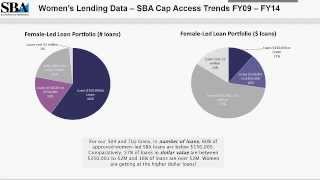
So we have a 90 billion portfolio of loan guarantees through almost 5,000 lenders. And it includes includes the 7A, the 504 and the microloans that I mentioned. The website sba.gov loans it's on the website can provide you kind of with an overview of some of the programs we have out there that are available. And I wanted to just point out SBA lending was expanded making about 16 billion available through over 60,000 SBA loans to women owned businesses between 2009 and 2014. So we are seeing more women accessing SBA loans. It was about a 66% increase during that same time. In our 7A, our microloan and our 504 products, we really have been focused I'm going to talk a little bit more about this on underwriting, on changing policies around underwriting loans for 350,000 and below. And it's actually made a big difference. And I think it's really important to point out during the economic downturn it was very difficult for a lot of small businesses to get loans. And I think there have been a lot of alternatives that have popped up since the recession. But for SBA specifically and for banks, it costs about the same amount of money. Not exactly, but just to give you an example, to do a $5 million loan as it might do $150,000 loan. So we wanted to find a way to incentivize lenders to do those lower dollar loans because we knew that it was really important to get that access of capital to women. But also women because of the industries they're in and knowing that women are trying to expand. A lot of them were having a hard time getting into the lending space because they were looking for loans under 350,000 or under 150,000. And obviously it's great and we want them eventually to grow and get larger loans. But they were having, there was a barrier to getting into that space. So we've made some real changes at SBA and I'm going to go over those in the next slide. Those include first the credit scoring tool that we announced last spring. It's been almost a year and so we've implemented and streamlined underwriting guidelines that include credit scoring for loans under 350,000 and especially is benefiting underserved communities. So that was one thing that made it easier for for community banks to actually use the SBA loan guarantee. Another is link that we just launched and you can go online sba.gov tools linc and we just launched this in February and it is an online platform that connects borrowers and lenders with SBA products. So you can go online to find a microlender. You can go online. We don't have our conventional banks online yet, but we eventually will. And it's just an opportunity for folks that are trying to understand and trying to get connected with lenders. You can put your profile online and then the lenders can look through and find out where there could be potential borrowers that they would like to connect with and they will follow up with the borrower. And I can say within the first two weeks, I mean, we've got so many more folks online now, but within the two first, first two weeks since its launch, we had over 14,000 people sign up and over 7,800 matches. So it's just an opportunity to kind of access SBA's loan product in a little bit more real time kind of way.
So it was a way we were.
Really modernizing what we have to offer small businesses. Another is SBAOne. And SBA One is a single online platform that streamlines our agency's core services and makes it easier for our lending partners to process loans. And so this spring we're launching, we're focusing on lending and R and D and lenders will be able to process SBA loans entirely online through an initiative like TurboTax, like Interface. So that's kind of, that was part of the SBA one and Link is sort of the tool that we were pushing with SBA1. And then finally I wanted to really point to the reductions that we focused on over the course of the last year. There is a fee associated with the loan guarantee, a fee for the bank, not for the borrower, but a fee for the bank on loans if they use the SBA loan guarantee in order to get more loans under $150,000 out to entrepreneurs. To incentivize banks to do that, we actually took the fee that's associated with the guarantee and put it to zero on loans under $150,000. So that was something that we've done.
Over the course of last year.
And we've actually seen an uptick in the number of individuals, especially women, accessing SBA 7, a product. I'm going to go ahead and go to the next slide and I'll kind of just run through these quickly because I definitely, I know we've seen a lot of questions and I want to make sure we have some time for questions. But in the last five years I mentioned sort of the numbers, we've seen around 60,000 loans approved, totaling almost 60 billion to women. And we're defining women owned businesses as more than 50% ownership of the business. And there are women owned businesses where they own less than or equal to 50% of the business that we're not accounting for in those numbers, but this is just a breakdown. So you can kind of see the size of the loan and the number of loans. And just to point out, there really is an opportunity. I mean, we've seen an increase in.
The number of loans since we've made.
Some of these changes in underwriting.
But we would love to see more.
Women getting bigger loans. And I think part of it was getting them into the pipeline and then it would be great to see them getting bigger loans as they grow and expand their business. We know that 88% of the women owned businesses in this country, so only 12 have employees. And so we'd like to see that number increase.
We'd like to see more than 12%.
Of women that own a business hire more people. And so sometimes, and a lot of times that means potentially taking on debt. So we would like to ensure that we're getting more access to capital from women. So, next slide. And you can just see by industry, the top 10 loan approval numbers by industry in this slide. I think it's very interesting. Healthcare and social assistance, obviously one of the biggest. We often say that women are kind of heavier in the service industries. And this is pretty apparent here. Sometimes that means they don't need capital.
Intensive.
Lending like through an SBA loan. And that's sometimes part of the potential reason we don't have as many women accessing the loan. But we're trying to look and dive a little bit deeper into looking at the industries to really figure out where some of the barriers are and challenges are for women who are trying to access SBA loans. And so if you want to go to the next slide, this is just the last slide. So we've seen consistent growth in the top 10 states and a number of loans, while the individual dollars of the loan may be fluctuating between different states. So it's kind of interesting if you look at California and Illinois. So I think, like I said, the changes in the underwriting of the smaller dollar loans, we've seen an increase in the number of loans, but the actual size of a loan varies from state to state. And sometimes that can depend on the industry focus of that specific state. It very much depends. But with that, I just want to go to the next slide.
That's the last I had.
Oh, it is.
Okay. Sorry.
Well, the final slide was just I'll give you some email or excuse me, I can give you my email address, but I also want to give you the SBA website. The SBA website is sba.gov and I mentioned where you can go for tools or forward slash loans. You can go to sba.gov loans if you want to find out more about our 78504 microlending products. And I just want to thank Meredith as well for being on. It was really helpful and educational. And then I finally just wanted to encourage everyone to please visit. I'm an SBA Resource partner. If you haven't already, go online and you can find out more about finding an SBA Resource Partner in your local area.
That's it. Do we want to go to questions?
Yes, we're going to go to Q and A now.
Hi, everybody. This is Julie Varady. I am also with the Small Business Administration, and I have been listening in the background and taking notes of all the questions that you've sent in. The first question that I have for both Meredith and Erin is can you please repeat your contact information slowly?
Sure, I'll go first. So my email is just Meredith M E R E d it hidera.com, so Fundera is F u n d e.
If you're on Twitter and you want.
To also our handle for Fundera just ondera.
And that message will also make its way to me.
Great.
And mine is Erin E R I n Andrew A n D R e W with no s. So Erin andrew.gov I also, if you email me, I'm happy to put you in touch with your local folks if you haven't reached out to them already. But I definitely, if you're looking for a loan, I would encourage you, encourage you to reach out to your district office, but let me know if I can be helpful in any way. And then I would also follow BAgov on Twitter and we have a weekly newsletter that comes out every Sunday.
So you can go onto our website.
Sba.Gov and sign up for that newsletter. And it highlights all the new programs, announcements and opportunities that are coming out of SBA on a weekly basis.
Thank you, guys. All right, the first question I'm actually going to lob over to you, Meredith.
Can you talk about.
I know you had a list of six things on the slide. What, in your opinion, is the single most important part of a loan application? And if you could answer that both from the perspective of a business that is already in business that's looking to get financing to expand and from the perspective of a start up business that hasn't even opened their doors yet.
Okay, so my answer to this question.
People will probably be frustrated with, but.
The most important thing you can do is complete a loan application.
I'm serious. You would be shocked how many people.
Are preventing themselves from finding funding by not actually going through and applying for a loan.
I felt like I reiterated that a lot throughout the presentation, but I want.
To say that again, but to give you a little more to work with.
There for start up, specifically, if you.
Want to go the debt financing route.
It'S going to be your personal credit score. So definitely invest some time in building that up.
And then from a business that has obviously been doing business for a couple of years, I would say it's tough because it's going to be an equation. And this is just my opinion. I'd like to preface that, but I would say your revenue and profitability.
Great, thank you. And then this question is for both of you. So Erin, why don't you go ahead and answer it first. How important is a business plan really when you're looking at getting financed financing?
Yeah, that's a great question. And I would encourage everyone to do a business plan especially, I mean, a bank's going to look for a business plan the majority of the time. So we have a business planning tool actually on our website@sba.gov that can help you start that business plan. I think it's not only helpful for the bank if you're going to get a loan. And yes, some people do get loans without a business plan. But I think the important thing, most people, and a lot of women don't think of their exit strategy when they start their business. And you could start your business to do it for the rest of your life. You could start your business to sell and make money. You could start your business to hand it down. But you really need to go through the planning process of putting out what you want to do and what your goals are. And a business plan really helps you do that. So I would encourage folks to have a business plan.
Julie, did you say you wanted me to add to that?
Please do.
Unless you don't have anything to add. No, I just was going to say, I definitely reiterate, Erin there, when you're.
Dealing with the bank loan.
So typically the lower the cost of the loan, what I was saying earlier about the more documentation involved, the lower.
The cost a business plan will be involved. It also involves, obviously if you are considering going the investment route And I.
Think it's completely impractical to run your business out of business plan. The FBA is a great tool. I also really love.
Cplans.com is another place to look at for help crafting an amazing business plan.
Great.
Okay, and this question is for you, Meredith. Can you please give a couple of quick tips, do's and don'ts, on all things crowdfunding? What are some good ideas to do and what are some bad ideas to do when doing crowdfunding?
Oh, that's great. So I think the best, most important.
Thing when you start a crowdfunding project is to have something to give people. Whether it's physical, it's sentimental.
At the end of the day, people need to be motivated and it's so hard to ask people for money.
And so if there is something, let's.
Say you are a product based business and you are able consider it like.
Upfront cash for inventory that you will essentially sell back to these people for that investment.
That's one example.
That's an absolute must do. And I think that don't approach it.
With 50% of effort. If you're going to do it, you've got to go all in.
It is such a competitive space, it's.
Such a saturated space. You've got to be ready to stand out amongst the crowd, literally.
And make sure you go in with.
A group of people that you can really trust will get behind you and be your champions and be your cheerleaders. For things not to do is really the flip side of that.
Don't treat it casually.
If you're going to do it, go all in. And don't walk in with the assumption that you're owed anything.
Because you have to understand how often people are asked to give money to.
Something, whether it's for a philanthropic reason or even I'm asked a lot for.
Artistic pursuits to give to crowdfunding campaigns. So don't walk in assuming that anybody.
Owes you anything, but instead try to.
Appeal to that nature and people that.
Will really motivate them to give.
So I hope that provides some perspective.
In both what to do and what not to do.
Great, thank you. And then one last question for you, Meredith, and I'm going to have you guys sum it up really quickly. The last question for you is how do companies that have business models that don't involve owning anything like collateral, how do they get debt financing?
So a great option there is going to be the alternative lending space. We actually have helped a lot of.
Service based businesses find funding. So these are going to be lenders.
That are going to look at your cash flow.
So, going back to sort of the.
Six things I mentioned earlier.
So how do you find funding?
Obviously, it goes back to having that strong personal credit score, having strong revenue.
Showing some profitability, having good cash flow in your bank, not having any crazy red flags. But there are certainly options. But you're probably going to find better success by going into the online lending space.
But like we said, you can try a bank first.
It's always worth it.
Great.
And in the last two minutes of this, I want each of you to give your number one piece of advice on all things access to capital, Please. Erin, why don't you go first?
Okay.
I have to say this because I work here, and I think it's important for folks to know. I often say that SBA people don't know about sba, and we're a wealth of knowledge, and we are the federal government, so we don't have a great advertising budget. So I would recommend that folks go to SBA.gov, find a counselor locally and go see that counselor, sit down with them, look at SBA lending opportunities, but visit SBA.gov and see what's available, because I just think it's very important for folks to know that SBA is there. And then I have one more, Julie, and I'm sorry, I have to, you know me. But I think, to Meredith's point, to ask. I do think, and she pointed out, there's an advocacy study that shows that women tend not to ask. Not out of fear or out of fear of not getting a loan, not because they're actually not going to get the loan because of their financial profile. So I think women out there, like, where are the opportunities there? Don't wait until everything is perfect. See an SBA resource partner, sit down, feel confident with it, and then go and make sure you do the ask. That's it on my end.
Yeah, that was great. That was very inspiring, too.
So I feel like it does echo Erin's sentiment a lot, which is he said something.
Find a champion.
That sounds kind of kitschy, but I mean it. So whether it's finding a lender that.
Perhaps it's getting yourself out there, putting.
Yourself out there, finding someone that is.
Willing to be transparent enough to evaluate your situation and provide advice that knows what they're talking about, that's a role.
That we live and die by here at Fundera.
But I think that Erin has mentioned that with the SBA as an option, there are people out there that exist solely to help you understand your financial.
Situation, where to improve it, and how.
To best achieve the goals you want.
And if you're in business and you want to grow, you're probably most likely at some point in time, going to need capital.
And so the sooner you can start that conversation with somebody, the better. I think you will be shocked at.
The insight that someone would be able to provide. And, I mean, you want to go.
To someone that's going to give you actionable insight, too.
And I think that's something to evaluate.
As you're sort of trying to find.
That champion and that partner in the process. Great.
Thank you both. So I guess we'll kick it over to Colin.
More from Your







President Donald J. Trump and First Lady Melania Trump Visit Grieving Texas After Deadly Floods

💪 Thinking of starting a #biz? Go for it! — Kerry Boyle, Vermont #SmallBiz Person of the Year

President Trump Participates in a Bilateral Meeting with the Prime Minister of Canada, May 6, 2025

