Making and Receiving Payments - ACH
Katie Jacob from the Federal Reserve explains how ACH payments work for small businesses, covering batch processing, operator roles, and why many still prefer checks. Setup costs $0 to $100, rejected payments run about $30, and typical small businesses process 250 to 275 payments yearly. ACH cuts fraud risk and improves cash flow, but requires account collection and accounting software integration.
Questions this video answers
June 5, 2014
Katie Jacob, Payments Information Consultant, Federal Reserve Bank of Minneapolis
Federal Reserve and the Electronic Payments Network (EPN)
60 days
About 250 to 275 payments per year
Chapters
Good afternoon everyone. My name is Steven Morris and I am the online Media coordinator for the U.S. small Business Administration. I'd like to welcome you to today's webinar with the Federal Reserve. Today we'll be talking about making and receiving ACH payments. Our expert today is Katie Jacob of the Federal Reserve bank in Minneapolis. Katie is going to walk us through the specifics of ach, including how it might impact your business's bottom line. As a reminder, this webinar is part one of a three part series that will cover in depth topics on making and receiving payments. On June 17th at 2:00pm Eastern, we will cover card payments. And on July 1st at 2:00pm Eastern, we'll talk about online and mobile payments. To register for those, make sure you're signed up for SBA's newsletter. You can sign up by visiting SBA.gov and clicking email Updates in the top right corner. We're going to cover a lot of material today, so if you want to watch the presentation again later, we will post it on SBA's YouTube channel in the coming days. You can find our YouTube channel@YouTube.com SBA and with that, I'd like to turn it over to Katie.
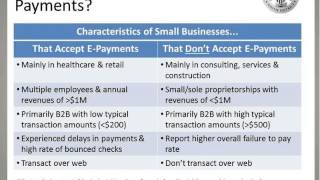
Katie, thank you for the introduction and I'm excited to be doing this presentation today. As Steve said, I am Katie Jacob. I'm a payments Information consultant with the Payments Information and Outreach Office for the Federal Reserve bank of Minneapolis. I need to give a disclaimer. Everyone in the Fed system always gives the same disclaimer that the opinions that you will hear me speak today are mine and do not represent the opinions of the Federal Reserve System or any specific Federal Reserve Bank. And normally this is the slide that I would just kind of pass over that just gives my information and a little bit of information about the Fed. But I think it's actually useful for me to say something here about the different roles that the Fed plays in regards to payments. So we see these four boxes here. The Federal Reserve is a little bit different than other central banks around the world. We actually are a service provider. We provide financial services to depository institutions and the government. The Fed does not provide any services directly to individuals. I think most people are aware of the Fed's role in monetary policy, that the Fed sets interest rates. We are also a well known bank regulator. We supervise and regulate financial institutions. And then finally, in the bottom right corner, the Fed has a general mission of maintaining a stable financial system and containing systemic risk. And as part of this role, we seek to ensure that the payment system is operating in an efficient and effective way. So just so you understand where I'm coming from, I'm coming from this bottom quadrant, this light blue, this light blue box. I am not a regulator. I am not someone who establishes financial policy. And I'm also not coming at this from the perspective of a financial service provider. This is really part of our mission to make sure that the payment system is operating smoothly. What I'm hoping that I'll be able to accomplish today is a couple of things. So I'm going to start with a little bit of a level set on how small business payment practices are operating today, and then from there give a general overview of how the ACH system works. @ that point, I will give a little bit more of the pros and cons of using ACH for your business. And then, although I know that the audience here is small businesses, we do a lot of work with financial institutions and trying to make these connections between corporations and banks. And so I want to talk about some of what we promote to financial institutions as far as how they can work with you to increase electronic payments and make that an easier process. So hopefully that's what we'll get through today. And then at the end, there's just a little bit of resources and where you can find more information about payments. So we'll get started. The reason that we're here today is to talk about small businesses using electronic payments. And the reason that we feel that that is a useful topic is that for the most part, small businesses have been fairly reliant on paper check payments. Now, that's actually true for business payments in general. As you can see, this is a survey that we actually conducted through the Federal Reserve bank of Minneapolis, a Corporation, and about 650 companies that we surveyed to ask how they make and receive payments. And we see this is businesses of all different sizes still about two thirds are making and receiving most of their payments with check. ACH shows up as the second most common payment method in our survey. However, as we kind of move down and look at this in a little bit more higher level of detail, we see the trend that as businesses get smaller, reliance on checks is greater. So while we still have usage of ACH and we still have larger businesses relying on checks, this is something that we know to be true in the small business market, especially as we get into very small businesses, where we see in our survey for businesses of under $2 million in annual revenue, almost complete reliance. So on the one hand, we know that there are relatively high costs Associated with making and accepting check payments. Paper payments in general are much more labor intensive than electronic payments. And so there are a lot of efficiencies that can be provided from electronic payments. On the other hand, when asked whether or not small businesses are happy with the current state of affairs, for the most part, especially very small businesses are saying that the check market is working well for them, so that the status quo has been working. And why is that? So what we know is that checks meet the needs of small businesses. Today, everyone kind of knows what a check is. The information that you need to know about your payment is all readily available on that piece of paper or on that image of that piece of paper. So you know who is sending you the money, how much money, what date the payment is coming from, there, the routing number and account number readily available. The check market is ubiquitous. You think about this from the consumer perspective. The I can write a check to anyone, regardless of whether or not that person even has a bank account, and they're going to be able to cash that check and use the money. So this is something that can be used at any time. But I think that some of the reasons that we want to get to today, that we think are some barriers to small businesses moving into electronic payments are echoed in this slide. And that is, you know, it can be intimidating to understand how to get started in that process. You know, for the most part, we know that even really, really large businesses are in business to do something other than payments. So this might not be at all a high priority, especially for a very small business where we are actually, you know, trying to, trying to provide a service as opposed to focus on payments. So we'll talk a little bit about fees as we go on because that's always a concern that folks have. But one thing I want to say here that is not directly on the slide is that as far as what we know about small businesses and payments, there's another survey that has shown that on average, small businesses receive about 250 to 275 payments and that the majority of those, the highest category of those payments is check. And this includes all kinds of payments, not just business to business payments. However, there is a lot of evidence that businesses are looking to increase the electronification of their payments. And we know, for example, that for business to business payments, while checks have more than half of the volume of those types of payments at about 56%, checks currently are only about 19% of the value. So payments such as ACH and wire can take up a lot more of the value of payments, even if there are a lot more checks coming in the door. Now I want to talk about ACH and how it works. What is the ach? ACH is a batch processing electronic payment system. The payments are cleared and settled normally in one day. And the way that this works is that payments are routed from the demand deposit account of a payer, which can be a government entity, a person or business, to a payee. So in the case of business payments, the business will send payment instructions to its bank. For example, I think that the type of ACH payment that almost everyone is very familiar with is direct deposit of payroll. So that's something that I think everyone, even if they don't know that they're using the ACH system, they have used that. So you can take that as an example. Once those payment instructions are sent, I want to pay my employee $1,000 on June 1st. The bank that the business has sent us instructions to groups those types of payments together. And this is what batch means. So those payments are batched together and then are transmitted to an electronic file to an ACH operator, such as the Federal Reserve System for editing and processing. The operator then delivers those payroll credits or supplier payments to the banks that are receiving the payment on behalf of their customers. And the next step of the process is that the person who gets paid is supposed to get paid. Gets paid. We have a little bit of a graphic here that can describe different types of ACH payments. I think even this level of description of ACH payments can be confusing at first for both consumers and businesses who aren't familiar with the system. Even the difference between an ACH credit and debit. And I'd like to give just examples. The example that I was just mentioning of a payroll direct deposit is an example of an ACH credit where there is an initiation of funds shifting from the payer to the payee. An example of an ACH debit would be, again, we can use a the consumer model for understanding this is your automatic mortgage payment. So the payee is initiating that payment on behalf of the payer. There are all different types of ACH payments in the market on the government side, commercial payments, as well as consumer. So in the case of an ACH debit, the payee initiates the debit transaction from the payer's bank account with the funds being moved into the payee's account. This is done with the express permission of the payer. So that's an example of how ACH works. And when we talk about who is involved in these transactions. This graphic hopefully should help you understand the different roles. We can think of this in some ways as a four or five legged stool. So that everything starts with the originator and that the originator sends information to what is called the odfi, or the originating depository financial institution, which then again sends information to the operator, such as the Fed, to process and edit payments. And that information is sent to the receiving bank or the receiving depository financial institution, or rdfi, just to make the acronym sound almost exactly the same and be kind of confusing. And then the last step of the process is for again, the receiver, the entity who is receiving the payment. I want to talk about these roles in a little bit more detail because it's very important to understanding how ACH works. There are other players that you might hear of that are not listed here. There can be third party processors or senders, correspondent banks, but those entities are not always involved in every ACH transaction. And these are the entities that we really need to understand. So again, the originator, which is where everything begins, as we saw in the previous slide, is the company that initiates ACH payment instructions. So everything begins with the originator. And the originator sends information to, again, the original the odfi, which is the financial institution that initiates the ACH payment file, consistent with the instructions that they have received in the first step. At that point, the ACH operator becomes involved. And there are two ACH operators, the Federal Reserve bank and the Electronic Payments Network. And the operator clear and settle these payments between the financial institutions. So that is the role of the operator to make sure that all of the instructions between the ODFI and the RDFI are met. So the RDFI is the financial institution that receives the ACH payment file and then applies those payments to the account of the receiver, who ultimately is the entity that is receiving the ACH payment. And a receiver, just like an originator, can be a variety of different entities. It can be a person, it can be a company, one of your trading partners, it can be a government entity, it can be a nonprofit organization. I'm going to step through the roles in a little bit more detail because some of the issues related to, for example, who is responsible for the ACH transaction are important to understand for these different roles. So an originator is always the entity in the transaction that initiates the transfer of funds, regardless of whether the transaction is a debit or credit. The originator must establish an account relationship with the ODFI or the originating financial institution and authorize that bank through an agreement to transmit the ACH entries on its behalf. So these relationship definitions are important. The originator is responsible for initiating payments based on valid authorizations from its receivers. It's responsible for securing and maintaining a copy of the authorization. And for business payments through the ACH system, the originator would have agreement with trading partners or suppliers in order to make these payments happen. The originating depository financial institution is the financial institution that receives payment instructions from the originator. And again, as we mentioned in the previous slide, the ODFI has an agreement with each originator that relates to how ACH payment and structures should be handled. There are exposure limits in place for the originators. The ODFI is the entity that transmits payment instructions into the network or ACH operator, such as the Fed. And it's important to understand that an ODFI or an RDFI is specific to that transaction that is taking place. In other words, it's not as if there are a list of banks who serve as ODFIs or RDFIs. They serve both functions, depending on what the transaction is that is taking place. And ACH rules designate the ODFI as having responsibility for the authorization of ACH payments. So, for the most part, liability lies here. And this is something that we could talk about in further detail, but something that I think is important for small businesses to understand that again, ultimately, the ODFI has this liability. There are general consumer protections that exist for ACH payments through Regulation E that stipulates that consumers are not responsible for fraudulent ACH transactions if they report those transactions in a reasonable time frame, 60 days. It's important to understand that those consumer protections exist for individual consumers, and no such regulation exists for businesses. So what we see is that the universal commercial code and private contract often come into play for understanding liability issues for corporate payments. As far as ACH fraud is concerned, however, ACH fraud is actually quite low. So that's not something that we want folks to worry too much about. But it is important to understand that nuance between consumer payments and business payments. So, as we said, there are two operators in the ACH system that serve as central clearing facilities for these types of payments. They, the Fed and EPN are responsible for editing and processing each ACH entry according to the rules that have been established. Another role that the operator plays is to establish the processing and exchange schedules for the network. In the very beginning, we talked about ACH payments as batch payments. And so this means that if I were to send continuously different instructions right now, five minutes later, five minutes after that, for different types of ACH payments. Those are all going to be bundled together. And there's actually a schedule of when those different types of payments get processed. And the operator plays that role. And the operator has agreements with each financial institution on both sides of the ACH transaction, the originating and receiving side, that outlines the instructions for how payments should be sent and received. So at this point, we are at the receiving end. The receiver is the party to an ACH transaction that is supposed to get paid. And this, this party can be, again, a company, a nonprofit, a government entity or consumer that authorizes the originator to initiate the entry. One big difference between ACH payments and check payments is that in order to receive an ACH payment, you have to have an account with the receiving financial institution, in other words, at the beginning, so that if you're making a check payment, you can make that payment to anyone, regardless of whether or not that person or entity has an account that has a designated financial institution. That's not the case with an ACH payment. So. What features of the ACH market do we think are relevant? Well, we could talk about this in a little bit further detail, but the ACH system is a very secure and reliable system. It's very useful for batch payments, such as payroll payments, or recurring payments, such as monthly bills like rent or utilities. The fees, after we discuss the. Some of the initial setups, are relatively modest, and the fraud risk of ACH payments are definitely lower. There's also the possibility of remittance data, which we know is very important, being included in the ACH file. One of the things that we hear quite a bit when talking to small businesses is that one of the nice things about using checks is how easily checks work with accounting software such as QuickBooks, that are readily used. And there are concerns about switching the type of payments that you are making or receiving and how that's going to integrate with other software, as well as making sure that you have the kind of information about the payments that you need. Again, this remittance data. So we know that one of the reasons for doing these types of educational seminars is that it can be complex to understand how to get started in moving into a system such as ach. There's a lot of sensitivity around needing to know bank account information or personal information from your suppliers, your trade partners, and this is understandable. Again, account information, when you're receiving a check, is readily available on that piece of paper or that image of that piece of paper. But there is a difference between that and storing that information within your system, needing to ask for that information. And we understand that that could be a barrier. There are also rules with ACH payments, again, around dealing with payments in a timely way and managing returns. While I think that the rules and procedures for ACH payments are very comprehensive, that is both a good thing and also can be very overwhelming, especially if a small business does not have someone designated on staff to understand these types of issues. So while ACH also, while ich is very ubiquitous in its way, it is somewhat more limited than checks, which we understand can also be a barrier to entry. We want to talk about small businesses and ACH getting started with this. Again, some of the pros and the cons and some of the things that we know about businesses that are currently making and receiving ACH payments. So while checks are still the predominant form of payment among small businesses, we know that there's a lot of success in using electronic payments in the small business market. This slide doesn't cover ACH specifically, but talks about what characteristics of small businesses there are for how for whether businesses will be willing to accept electronic payments. We see many more businesses in the healthcare and retail markets that accept electronic payments, the larger businesses, even within the small business categories, as well as businesses that have low transaction amount. So one of the issues with checks is that if you receive a lot of checks for small amounts of money, that is again, very labor intensive, something that the ACH is really well set up to handle. And I think about from my experience, this just happened to me recently, where I've seen the success of a very small business that really had no one on staff set up to understand payments, make a very successful and fairly painless transition into electronic payments. And this is my children's daycare, so my youngest child will be in kindergarten. They won't be dealing with this soon. But, you know, this is a situation where the business had 100 different families giving checks every month for daycare costs and for tuition. And that meant that someone had to go walk over, you know, walk the payments over to the bank and handle those and deal with everyone who was late and was extraordinarily costly for the business. And this transition into using electronic payments was a little bit scary at first, but really made a lot of difference for them from a cash flow perspective, which is something that we'll talk about in a little bit. So we know that there are some types of businesses that have more trouble with accepting electronic payments, particularly in the construction area or businesses that are seasonal. Very small businesses, particularly mom and Pop shops that often operate more in a way like consumer accounts. So we know that there are very small businesses that are using personal credit cards for lines of credit or that really have relationships with banks that are closer to consumer relationships than business relationships. It makes sense that if a business is not currently set up to do general online banking or transactions over the web, there's going to be less of a likelihood of accepting electronic payments. But it makes sense to talk about both the, you know, both the benefits and kind of barriers to accepting these type of payments. And it makes sense, particularly for ACH in the making of payments area, to use the ACH system for payroll. If you have more than a handful of employees. It greatly simplifies the labor intensity of making those payments. Recurring payments such as rent and utilities, as well as taxes. The ACH will kind of take the guesswork out of making those payments, making sure that they're made on time. That while there are a lot of different types of payments that a business needs to make, this is the same as as we would experience in any household, where there are certain payments that need to be made on time. And you could think of your rent, your mortgage, your utilities, your taxes as being those types of payments. And that it makes sense to have something set up to make sure that this happens in a timely fashion. To take the guesswork out of that, I gave the example of a child care facility as, As a great use case for receiving ACH payments. This is true for any business that bills on a recurring monthly basis. Particularly depending on how many entities, organizations, people, or trading partners you're billing, that could become a very onerous process that could be made much simpler through the use of electronic payments or specifically for ach. We see this as being very important in the healthcare industry, particularly because one of the things that we say to small businesses is that for small businesses that want to do business with the federal government, it's not just a matter of it being a good idea to get on board with electronic payments, but it's going to become a necessity. We see this already in health care. The federal government has mandated ACH as the payment method for Medicare, for example. If you're in the nonprofit world, which is the world that's near and dear to my heart, I work for nonprofits for many years. We know that nonprofits receive all kinds of different payments, sometimes on a recurring basis. As far as membership dues. The same is true for religious organizations that receive monthly donations. But there are other types of payments that are received through grants, through local State or federal government agencies that the ACH can be very useful for helping that type of company manage its resources. And then there's also the fact that not being in the electronic payments market, not being able to accept ACH payments could be limiting. So we could see this from the other direction, not just from how in which cases it could be useful for you, but that there might be some companies that are not willing to do business with a company that is going to be providing or requiring paper payments because, you know, the company on that end has decided that it's too onerous for them and they've gotten rid of all of their. They've gotten rid of all of their paper. So, you know, it's commonly accepted that one of the main reasons that businesses give for why they are moving from paper payments to electronic payments is cost savings. And in particular, ACH has shown up in study after study as being really a less costly form of payment than other electronic payment alternatives, particularly cards. We know that ACH is perceived as offering better data security and ease of integration with accounts payable system. We also know that ach, you know, has a lot of supplier acceptance and that that's very important to businesses. And one of the reasons for that relates to this slide on fees. This is a question that we often get, and while I can't specifically answer the question is what will it cost me to set up an ACH system system for payments? I can give some general guidelines for what those costs are. But one of the very attractive things to many businesses about the ACH system is that the ACH does not carry supplier side transaction fees, unlike in the case of cards and wires. So that's something that I think is very useful about the system. So we see here what some of the fees are for ach. And as I talk about financial institutions and how they can work with small businesses, I'll talk about what I think you should think about asking of your bank. But it seems obvious that one of the first questions is going to be what is this going to cost me? And we see a variety of different kinds of fees for ach, which again are usually on the very low side. I think these fees vary greatly by bank. So it's really a matter of being sure that you can shop around. But there will be initial setup fees or origination fees for, for setting up the infrastructure that can range from being free to about $100. And I think that those costs are usually well absorbed. The real issue is finding out more what is this going to cost on an Ongoing basis. Banks will have per batch fees, per item fees, as well as monthly service fees. Again, that is possible that that's bundled into a free service at your bank. There are also rejected item and change item fees, which I think are fairly commonly charged across the board at about $30 per item. There are other benefits of using ACH, other kinds of reporting mechanisms that would be available to you that depending on whether or not that is useful for you, you might have your bank charge you a small fee to provide some of this additional information. So there could be other charges associated with this. However, from a cost benefit analysis, we see that those are the costs of setting up an ACH system. And we understand that there are also things like switching costs, just transitioning from the system that you're currently using into a new system. That is, we can't just look at what the cost is of setting up the new system. There's also the cost of the transition. We do understand that. But we think that on the benefit side, there are many benefits of a business accepting ACH payments. And one of those, and we can think of this on the consumer side as well. Again, as I said before, there are some businesses as well as the government that will only do business electronically that are not interested in receiving any paper or in sending any paper. We also see something at the very beginning, whenever I talk about checks, I say, on the one hand, we can say that everyone knows what a check is. Everyone knows how the check system has been around for a long time. People know how it works, it's ubiquitous, it can be used anywhere. But I don't think we can any longer say that everyone knows how to write a check. We know that there are, from a demographic perspective, there are definitely people up into their 20s today who have never written a check. And that trend is just going to continue. So as businesses are run by younger administrators as well, we can see a shift in payments usage, particularly as mobile payments, which we will be talking about in our third webinar in this series as that takes off. But one of the great benefits to ACH is in strengthening business retention. And one of the things that we talk about in banking is the stickiness of a relationship between a customer and a bank or between a business in a bank. And we also again, talk about switching costs. So in other words, from your perspective, as people are paying you, there is a greater desire for that company, for that individual to stay with you than to move just because of the increased difficulty in a person's mind of having to make that phone Call to change an automatic debit or an automatic deposit from the ACH perspective, so it can strengthen business retention. There's also significant fraud reduction in ACH as opposed to check, which I'll talk about in a little bit more detail in a moment. I think that one of the main reasons that people are interested in doing this and the greatest benefit once this transition happens is just a bottom line money saving. This is again a very labor intensive process to deal with paper money. There is a reason from a Federal Reserve's perspective, as I was saying in the very first slide in our, in our interest in promoting an efficient and accessible payment system, the reason that electronic payments are beneficial there is that you can think about from the government's perspective, just the General Paperwork Reduction act that exists across all agencies. Paper is expensive to deal with and that is all the more true with money. And so I think businesses see great cost savings there. In addition, ACH payments, because they happen on a specific schedule, can help a business manage cash flow. So again, I can use my daycare example as being a great example of this. A company that before had had to deal with 100 different families who may or may not have paid on time and the company was offering on a fairly shoestring budget. If all of those payments didn't come in on the 1st of the month when they were supposed to, then you have a cash flow problem for the payments that you need to make. ACH can take a lot of that pain away from a business and ensure that your payments are received and made at the specific time that you've designated and can really help from a cash flow perspective, your company in the future. I already talked about this to some extent, but this is just a larger kind of more detail and another benefit of accepting electronic payments and ACH in particular, and that is that in some areas of the market, depending on what kind of business you run, you know, this has either happened or it's coming. The federal government has been promoting electronic payments with its trading partners for a long time. There's information about this on the pay.gov website. But for example, the federal government has mandated electronic payments for various types of payments, such as Social Security, Medicare reimbursements and wic. And I said that I had worked in the nonprofit sector for many years. One of the things that I did in that past life is I did a lot of work with consumers who were unbanked and providing access to financial services for those consumers. And there was a lot of hesitation around, around this happening from the government perspective. Of requiring that benefits payments, for example, be delivered electronically. How is that going to happen when people don't have bank accounts? What kind of fees are they going to be paying? And I think that those transitions have been in place now for some time and have actually worked quite well. And one of the reasons that that is beneficial, and I think one of the reasons also that the government was interested in moving to ACH payments in particular, is that the risk of fraud is significantly lower with electronic payments than with checks. So this slide shows the association for Financial Professionals does a survey of companies and asks those companies, here are a bunch of different types of payments. Has your company experienced actual or attempted fraud with these different types of payments? And if the answer is yes, we have experienced actual fraud in these types of payments. What payment type accounts for the greatest loss? So we see that checks are at the top of the heap for both of those questions. They sit as the greatest, the greatest category for actual or attempted fraud. And they also are responsible for the greatest loss we actually see on the ACH credit side of all different payment types. This is. It has a very low incidents of fraud. It does happen. I think it's important to just mention I don't have a slide on this specifically, but one thing that we often get questions about because it's been in the media quite a bit is the issue of corporate account takeover. This is something that exists when the account credentials at your business are compromised by hacker in some ways and payments are made that are not authorized. And that has been quoted in the media quite a bit as being an example of ACH fraud, which we say to some extent is a little bit of a misnomer because it is not really a weakness in the ACH system itself. It's not dedicated to that payment type that doesn't happen because because of that payment type. It's more about how those credentials are secured at the entity that is holding them, whether that's the corporation or the business. And there are a variety of things that I'll talk about that can be used to protect against this admittedly low level of fraud that we see in the ACH system. And next slide. One thing that we know because I mean conservative estimates would say that businesses experience probably hundreds of millions of dollars of check fraud every year. The reason that this happens is that check fraud is pretty easy to perpetrate, is a low tech operation. Check guiding forgery has been around for a long time. It's fairly easy to do compared to the sophistication that's required to commit fraud in electronic payments. However, if this does happen, for example, with the account takeover, one of the concerns that we hear is that because the information is stored electronically, that also means there's more of a central, you know, there's a central place for hacking to occur, and people have concerns about that. But we still would say that particularly for small businesses that are very vulnerable to check fraud, as they might have, you know, fewer protections in place that electronic payments can provide. A great. Here's where I want to talk about, you know, when this is written from the perspective of what we would like to see, what we would like to see banks doing when talking to small businesses about setting up these types of programs. But you can look at this as you're kind of shopping around what are some of the things that. That you might be looking for? So this slide just talks about a study that was done where 700 business owners were sent around to talk to banks about wanting to set up new relationships with new clients. And basically none of this was surprising to us that what was discovered is that the businesses felt that the banks were not necessarily working very hard to figure out how this relationship could go further. The banks might not ask about the size of the business and therefore might not have a lot of information about what the business might need. They might not even try to find out what the current relationships were with that business. And they might have felt that they weren't moving very far in the direction of trying to. Trying to encourage setting up an electronic payment system. What do small businesses face when talking to bankers about ach? We would give this advice, which is to be proactive and contact the banks yourself about payment needs, for example. One thing that we can think about is there might be a lot of marketing, for example, around things like new and exciting features with mobile payments or different things that can happen with cards. You don't see that level of marketing around ACH payments. So it's useful to really be proactive around this and shop around. If from a technical perspective it seems that this is going to be a difficult thing, figure out how to set up. One of the things that we would suggest shopping around is there are banks that are, you know, they're really good in this business and they understand how to walk very small businesses through the transition. And so it's useful to just ask about, you know, how can you help me to do this? In addition to talking about, you know, what the fees are and what the services are that you might get. Another issue is that, you know, all small businesses are going to have some relationship with banks that are, you know, are already established, but they might not be at this level. So they might have relationships with loan officers, again, be using cards as credit, utilities and kind of talking to the bank from that perspective. But in this case, you want to seek out the right person, someone in the small business area, if the bank hopefully has someone who deals with those kinds of accounts this specifically, or a cash management or treasury professional. So one of the things that we've heard is that when small businesses are seeking out these types of payments, they might be offered kind of a suite of services through online banking. And we would say just make clear that what you're looking for is something more sophisticated than that. So, in addition, one of the specific things I'm seeing, you know, a lot of questions that have come in about risk and fraud and security. And because we know that that's, you know, at the top of mind for businesses, both in trying to kind of rid themselves of this check fraud, but also making sure that in doing that, they're not incurring some new type of risk. There are services that you can ask the bank to provide to you with ACH payments that can greatly reduce this risk. Some of this is just.
Understanding.
What the risks are and asking the bank to explore some of this to you. Most banks offer alerts about fraudulent activity or risky transactions for free. So that's not always the case, but it's a good thing to ask. Then there are services such as ACH debit blocks and filters. The debit block is a product that this refers to the practice of disallowing a regular ACH debit without specific advance permission from the payer. And then there are other types of services such as ACH Positive Pay, which is a fraud detection service. The way that works, it lets customers safeguard against fraud by filtering or blocking unauthorized ACH transactions according to the criteria that the firm. Those are just kind of specific examples of the types of things that you might want to ask your bank about, whether or not banks can provide those types of services to you. So what we see, and part of the reason that we're engaged in this webinar series, is that depending again, on the size of the business and the type of business is possible. But there really isn't much orientation to understanding the ACH system. Kind of even on a basic level, we know that people understand ach, again, from a payroll perspective. I think even if people don't know they're using the ACH system, they've used it by Receiving or their payroll electronically. When talking about electronic payments, there's a tendency to really conflate different types of payments. We think of direct deposit, electronic payments, wires, eft, ACH as all being one and the same. And banks don't look at it that way. So it can be, you know, that can be a challenge. But what we tell banks and what we encourage you to look for is a bank partner that will help you leverage what you already know about ach, which includes the knowledge of direct deposit. And, you know, to look for a bank that has a specialized staff person available, not just to help small businesses, but to really talk in depth about ach. Because small businesses already have established relationships with different folks at the bank, for example, the loan officer or the branch manager. We encourage those who are working within the bank system on ACH and small business accounts to make sure that they partner with those folks who are already interfacing with small businesses on a regular basis. So these are just, again, some of the issues and opportunities related to access for ach. We know that one of the easiest ways for businesses to become involved in ACH is for it to be offered to them automatically as part of a new account, not for it to be something that they have to go seeking out. On the bank side, we know that the process can be challenging. So if there's any way that when shopping around, you can, you could find a bank that makes the process easier for you, that's what we would encourage. And finally, on the cost side of things, again, we get this question quite a bit. And we hear that for those companies that have made the transition, the number one reason to move in that direction, to be happy that the transition to ACH has been made is from cost reductions or cost benefit analysis. However, depending upon the volume of payments and the type of payments that you receive, it might be difficult to justify monthly costs. It might be difficult to justify setting up some additional security features within your system. There might be a misalignment between types of payments that you make and what the ACH fees are. But again, this is where we think shopping around for a good deal for your company can really be beneficial because they are very, very small businesses that are able to make this work from a cost perspective. And one of the ways that that happens most successfully is when banks are willing to offer incentives or bundle the costs and into base fees for online banking on a monthly basis. Another thing that the ACH can provide to you that might be useful to take off your hands is some, again, reporting mechanisms you might be able to get that information from the bank so that you can see where some of the gains have come to you. And this is probably the last bit of challenges and opportunities that I'll discuss here. One of the challenges goes back to the very beginning of the presentation, which is just to say that a lot of people feel, if it's not broken, don't fix it. The check market is working. Checks are easier. I don't have to understand these different rules for reconciliation and receipt and kind of understand all the different operating rules. However, particularly because of the comparative fraud risk of checks versus ach, as well as the opportunity for banks to help you with this transitory process, we think that from an operational perspective, this actually provides a great deal of efficiency. So I think I have a few minutes to look into questions. And one of the. I'm just looking at the different types of questions that we received, and a lot of them, again, surround this issue of fraud or liability. And I would say that, you know, that, again, it's important to understand from the perspective of ach that the way the rules are set up that the ODFI or that the originating bank, you know, bears ultimate responsibility for making sure ACH payments are authorized correctly. Because there is this issue where Regulation E, which says that if I were to. On the consumer side, it's just me, Katie Jacob said, hey, this is an unauthorized ACH payment that came out of my bank account. I don't recognize it, and I report that within a timely period. I would not be responsible for that. Such a protection doesn't exist on the business side. And so what we see is private contracts and in some cases, case law that can come in to explain liability issues for corporate ACH fraud. And where I would say we see this. Being particularly interesting in the ACH market and is something that, again, I think is confusing or concerning for businesses around the press around these corporate account takeover cases. You know, where someone hacks into a system and a company finds the, you know, the information about accounts so that fraudulent transactions can be made and money is lost from that company's account. And then the question is, who is liable for that loss? Is it the company or the bank? One of the things that I think has been concerning to many businesses is that case law has been divergent on this issue, and different judges have ruled in different ways. So we've seen some cases where it was decided that even though the case looked very much the same, that the bank was responsible for that loss. In other cases where the case was very similar and the company was ruled to be responsible for that loss. Now, while that can seem concerning, I think what's important to keep in mind as well. Again, this is an issue that has received a decent amount of press. This is something that happens much, much less often than what we see in check market. You know, this is not, I think, a reason to avoid at all moving into electronic payments. And also, as the case law kind of catches up with the marketplace, we'll see more clarity on what that means for companies in the future. But it's important to understand, again, that it's not really a flaw in the type of payment. It's just another reminder that it's important to have quality risk controls in place for the, you know, identifying information that you keep in your different system. So I saw many questions that were related to that issue. We also have had questions about, about the timeliness of funds and differences there. And I think, you know, one of the benefits again of ACH is that you have a, you know, you have a different situation, you know, surrounding float or as far as when the money comes into your account. There's much more clarity around that, you know, compared to checks. And in general, from a cash flow perspective, we see ACH payments taking some of, you know, some of the guesswork out of that. And so I think that we've reached our time. And I will take one more question. I'm looking here and seeing a few questions about payments such as PayPal and how that relates in the ACH market. So I think something that's important to understand about the intersection between PayPal and ACH, and I'll probably stop here after this question, is that depending on how you set up your PayPal system, you might be using the ACH system. I mean, that is essentially what PayPal is. PayPal is routing transactions either through ACH or through card payments. So if I were, again, on the consumer level, just to be trying to make a PayPal payment to a company or to another person, there are a couple ways that I can do that. I can just say I actually want this transaction to be processed as a card payment. I'll give you my card information, or I'm going to give routing and account number information, and that will be processed as an ACH transaction. And, you know, in the payments market, when we talk about what we might consider to be newer or emerging payment methods such as PayPal, though PayPal has now been around for a long time, one of the things that we point out is that most, you know, if not all of these newer payment methods rely on current Rails that already exist. So, again, they're leveraging the card network. They're leveraging the ACH network. And what that means is that, you know, depending on how you have set up your PayPal system, you know, you are following either the rules that are established under ACH payments or rules that have been established for card payments, and that, you know, PayPal is a company that is facilitating the exchange of those types of payments, but that the fundamental way that the payment is being made has not changed. So I see that I have a lot of other questions that I didn't get to, but I do understand that. I think I will be able to get a list of these questions afterwards, and hopefully I'll be able to answer some of those in greater depth. So thank.
More from Your







President Donald J. Trump and First Lady Melania Trump Visit Grieving Texas After Deadly Floods

💪 Thinking of starting a #biz? Go for it! — Kerry Boyle, Vermont #SmallBiz Person of the Year

President Trump Participates in a Bilateral Meeting with the Prime Minister of Canada, May 6, 2025

