Making and Receiving Payments - Credit and Debit Cards
Katie Jacob from the Federal Reserve Bank of Minneapolis explains how small businesses can adopt credit and debit card payments. Check fraud costs more than card fraud, but adoption barriers include interchange fees, setup costs, and fraud concerns. The Fed shifted liability to non-chip merchants in October 2015 to encourage safer payment systems.
Welcome to the live web conference Making and Receiving Payments for your Small Business. I would now like to turn the conference over to Stephen Morris. Please go ahead.
Good afternoon everyone. My name is Steven Morris and I am the online Media coordinator for the U.S. small Business Administration. I'd like to welcome you to today's webinar with the Federal Reserve. Today we'll be talking about making and receiving card payments. Our expert today is Katie Jacob of the Federal Reserve bank of Minneapolis. Katie is going to walk us through the specifics of various cards and including how it might impact your business's bottom line. As a reminder, this is part two of a three part series that will cover in depth topics on making and receiving payments. Last week we covered ACH payments. If you missed that presentation, you can find it now on SBA's YouTube channel@YouTube.com SBA. The last webinar in the series will be July 1st at 2:00pm Eastern and we'll talk about online and mobile payments. There are still a few spots available to register for the last webinar. Make sure you sign up for SBA's newsletter. You can sign up by visiting SBA.gov and clicking email Updates in the top right corner. We're going to cover a lot of material today, so if you want to watch the presentation again later, we will post it on SBA's YouTube channel in the coming days. And with that I'd like to turn it over to Katie. Katie.
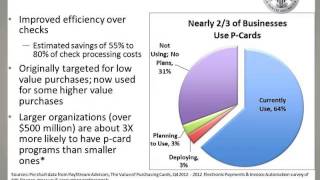
Thanks Steve. And I'm excited to do this presentation today. This has been a great opportunity for us to provide detailed information about receiving electronic payments for your small business. Go to the next slide. I just need to begin by making a disclaimer that the opinions that you hear are mine and do not necessarily represent the opinions of the Federal Reserve System or the Federal Reserve bank of Minneapolis. Next slide please. I normally would just gloss over this slide, but I think it's actually important to understand a little bit more about the Fed for those who might not work with the Fed on a regular basis. The Fed has many different roles in the payments market. So as many people know, the Fed is an operator. We actually operate payment systems ourselves. We also are a regulator. We supervise and regulate financial institutions and other non bank holding companies as well. I think everyone is familiar with the Fed's monetary policy role. If people know nothing else about the Fed, they understand the concept of interest rates and the Fed setting those. But here in the bottom right quadrant of this little square is another purpose of the Fed in the payment system. And that is to maintain a stable financial system and contain systemic risk. And part of this goal is to ensure the smooth functioning of an accessible and efficient payment system. So just so you understand where I'm coming from with my discussion today, I'm coming from this kind of bottom right corner of these different functions of the Fed with our overall goal of promoting efficiency and payments. So this is coming more from a policy angle than from the Fed's role as either a regulator or a system operator. So on the next slide, I'll attempt to get through all of these topics in the hour that we have today. My goal is to give you an overview of small business payment practices as they are today. In other words, kind of a lay of the land of how small businesses are making payments currently. And then do a little bit of a broad overview of the card payment market and not just specific to business payments, but overall trends in what we're seeing in the card market. From a bunch of different data sources that we have available now, I'll be getting a little bit further into small businesses and payment card usage, kind of what we see today, as well as the pros and cons of starting a card program at your small business. And then the end of the presentation, we have some resources that hopefully will be really helpful for you as you're thinking about this topic. And I'll be referring to a few of those in particular that I think will be especially useful throughout the presentation. So first we'll go into the small business payment practices slide. The first thing that we'll talk about here on the next slide is, is a little bit of a level set on what and what is happening today and why we're here today to talk to you about encouraging you to think about using card payments. So you know, check usage has been steadily declining among consumers for a long time. And yet I think something that we overlook is that there are still a lot of checks out there in the marketplace today. And, and business payments are one reason why there are so many checks. So in particular, small businesses have been very reliant on checks. And today small businesses write between 5 and 6 billion checks a year, which is a pretty expensive proposition. The reason that we're talking to you today is that writing checks isn't cheap. It's a labor intensive process. The government in particular has been pushing for paperless payments. This is kind of the direction that things are going, but it's been challenging for small businesses in particular to move away from that. We particularly know that there is a sizable or important minority of small Businesses that make almost all of their payments by paper check. There are others that have more of a mix of payments. But we know that for some folks, this is the primary way that they do business. And there's a good reason for this. Checks meet a lot of the needs of a small business. Checks are easy to use, they're ubiquitous. Everyone knows what a check is. I think one of the more important aspects of why checks are useful, besides how they integrate with a lot of the software that businesses use today, is that you can write a check in particular to anyone, including an entity that doesn't have a bank account. Even if you're writing a check to an entity that does have a bank account, you don't need to know that account number in order for that payment to be made. So there are a lot of positive attributes of checks, and we recognize that. We also recognize, which is why we're here today, that there aren't necessarily a lot of resources available to help small businesses figure out how to change this pattern of check usage. So that's what we're trying to attempt to provide today is a little more education. And finally, we know that businesses are not in the market for the most part to make payments. That's just a part of running the business, not the goal of the business. So on the next slide, we get into this a little bit further and we can see that this is information from a survey that asked about what the different priorities were for businesses when they're thinking about their top business challenges. And for the most part, payments actually shows up here. I think this is encouraging in the sense that it's recognized as an issue by a little less than a third of small businesses as one of their top challenges. But obviously folks minds are in other places. They're worried about cost, competition, sales, they're worried about their HR functions. And collecting payments is one of just all of these other things that folks need to think about with probably a fairly small staff devoted to doing that. However, on the next slide, we talk about what the benefits are to your business for electronic payments adoption. This is not specific to cards. I'll be getting into that further later. So this is just to say that although checks are very popular in the B2B world, it's clear that businesses do appreciate that electronic payments deliver important benefits. We know that small businesses, for example, receive about 260 payments per month. One that's not included on the slide. This is just some general information. You can think about this. There's about 40% of those payments by check 16% by credit card, 9% by PayPal. Those are just some examples of different types of payments. But we see here that in the most recent ASP payment survey, respondents were asked, what are the reasons that you might want to move to electronic payment production? What do you see as the benefits? And many, many studies bear this out, that the number one reason that businesses are looking to do this is from a cost savings perspective. There are a lot of other benefits here. We will talk more about things like fraud control later on in the presentation because I know that's something that is very important to folks and they're thinking about new types of payments, particularly cards. But we'll also talk about some kind of payments, timing issues, cash flow, you know, working capital improvement, things like that. So on the next slide, this is directly related to what I was just saying that if we know that cost savings is usually the reason that businesses are encouraged to move in this direction, you could think about how different types of electronic payments, because they are not all created equal, might compare to each other. So that's what we see here. We see the top factors driving electronic payment use by method. So you can compare ACH keycards, which is a procurement or purchasing card, and wire transfers. And so what we see is that in general, ach, which is what we talked about in the webinar two weeks ago, is viewed as less costly than other electronic payment alternatives. It's also perceived as offering better data security, ease of integration with AP systems, and has a positive outlook from a supplier acceptance. So one of the things that we'll be talking about is this issue of your supplier and whether or not there is an interest in moving towards these types of payments. For example, ACH does not carry supplier side transaction fees as cards do. So we can talk about what the issue is there. But you can see for payment cards or P cards here, there is kind of a high perception of the convenience factor of card payments. So we will be talking about that later in the presentation. So these are the positives that you can have from making this change. In the next slide, I go over a little bit about barriers to electronic payments for B2B transactions. And this information comes from a survey that we actually did through the Minneapolis Fed. We surveyed a bunch of corporate entities through our remittance coalition and asked them what are your biggest barriers to moving to electronic payments? And the number one response was that it's difficult to convince our customers and or suppliers to send or receive these payments and there's a reluctance to move towards a type of payment that's not going to be readily accepted. You can see that some of the other issues that I'll talk about a little bit more specifically later have to do with systems integration and IT resources. This is something that small businesses feel makes moving to E payments a challenge. The traditional way of doing business is working and there are costs or infrastructure issues associated with moving in a different direction. So next, now that we've talked about a little bit of the lay of the land, I want to do a different kind of level set on the card payments market. And some of this might seem a little bit basic since I think most of us use our credit cards and debit cards all the time, just as consumers. But there are important things to understand about besides the way we use cards in our lives, the way that card payments fit into the overall retail payment system. And I think sometimes when we show these statistics to folks, they're actually quite surprised by what they see. So on the next slide, one of the things that is great about cards, and this relates to what we just talked about, is that they are very convenient. So you can use your credit card or your debit card pretty much anywhere in the world. There are some newer differences between card payments in, in the US and the rest of the world that has moved more quickly towards chip based cards as opposed to our magnetic stripe cards. But for the most part, the history of cards over the years has been that they're some of the most recognizable brands in the world. Everyone knows what visa is, what MasterCard is, and we use these things all the time. And importantly, once cards came on the scene, starting with charge cards, then credit cards, then debit cards and prepaid cards, we saw some changes in the way that people were interested in using these cards. So debit cards are, as you can see from this pie chart on the left here, currently the most popular non cash way of making payments. And this information comes from a study that the Federal Reserve does every three years of trends in non cash payments. And this trend is actually relatively new over the last several years. Credit card had been equal with debit for a while, but we see a very high number of transactions occurring in the card market. So the majority was about 60%, not quite 2/3 of transactions. But if you think about what value, what the, the dollar denomination of those card payments is actually very small. So you know, a high number of transactions, but lower dollar amounts. The ACH system in particular is set up to handle much higher value transactions than are the card markets, right? So really cards are completely eclipsed From a value perspective by checks and ach. And that is still true today. However, when you think about how people who are interacting with your business make payments, they're not making extraordinarily high value transactions, Right? So that's a different type of payment. And cards are just going to continue to be more and more popular. So on the next slide, I go into a little bit about credit cards. Again, this might seem obvious about what credit cards are and how they work, but credit cards are extremely popular. The vast majority of people in this country have at least one. A lot of people have many more than one credit card. One thing that we always say that is very important for businesses to consider, and this is definitely true in the retail market. Obviously there are a lot of different types of businesses, but it can be a deterrent to customers if they can't use a card. People are so used to having that option that they want to be able to do that. Now, we've all been to places that don't accept cards that don't accept checks that are cash only. I mean, these places definitely exist. But this is again, a way to avoid losing a sale. Something that I think it's very important for small businesses, as well as the work that the SBA does as far as businesses financing, is that credit cards provide a payment and revolving credit function in a way that is different than other access to the loan utility that other payments don't necessarily have. So there's a line of credit opportunity that a lot of small businesses utilize with their credit cards. And in particular, I said I was going to refer to some of the resources we have. One of our sister banks, the Federal Reserve bank of Philadelphia, has a payment card center and they've done some really interesting work recently looking at what happened with small business use of credit cards as a loan utility as opposed to as a part of the financial crisis and how things changed. I would encourage you to look through that. There's a lot of interesting trend dynamics. And while I'm not here today to talk about loans, I'm here to talk about payments. I do think that that's a really beneficial component of credit cards for many small businesses. However, we know that there are some drawbacks. We'll talk about this more later. The number one thing that we hear is that they can be expensive to accept. There are a lot of different types of fees associated with card payments, fees that are charged to the cardholder, which is different if you think about you're not necessarily charged anything for making a different type of payment. Writing a check, except for your fees that you would pay to your bank, as far as a monthly fee, maybe upper check fee, as far as having the checks printed to you. But as opposed to other types of payments, there are fees charged to those who accept credit cards. This is where interchange comes in. While we could probably do an entire webinar on the interchange issue, we aren't doing that today. But I will go over that issue because I know that that will be something that folks have questions about. Another concern is that we talk a lot about finality with payments and that is something that you have to consider with card payments. Chargebacks are possible. You know, payment is not necessarily final. That's something that's very encouraging for businesses to know that the payment that I made or the payment that I received cannot be taken back or reversed. And so just an issue to consider as well as vulnerabilities to fraud. Though, as we will discuss later, we still see many more issues related to fraud in the check market. So just because something has a drawback related to unauthorized transactions in the card market, that doesn't mean that it's necessarily any worse than in the check market and in this case is significantly better. On the next slide, we talk a little bit more about debit cards. Obviously the difference here is this isn't a credit function. This is tied directly to your checking for savings account. The money comes out immediately. You aren't being granted any credit as a consumer or as a business. And basically, as we've seen the popularity of debit cards rise, the reason that we give for that is that basically what happened is that a new generation entered the market that had no pre existing payment, payment preferences or habits affecting how they pay. And there are attributes of debit cards that are very popular among younger consumers, including things like rewards, the possibility of getting cash back. And in particular we see this more following the crisis as well, that it isn't a credit function. This is seen as a very positive attribute that you can have the ease of payment without the problems related to debt. But you still have issues related to things like finality and fees, which we can discuss later. Another subset of cards on the next slide, excuse me, are prepaid cards. These cards, which sometimes are referred to as debit cards, but they're a special kind of debit card. They're pre funded by around a half of the cardholder. We all know about kind of the closed loop types of prepaid cards. These are gift cards that you can use in a single store location or a certain network. But There are also open loop reloadable cards. There are payroll cards where folks are having their entire payroll deposited onto a prepaid card that is not directly tied to their individual bank account. This is particularly important for some consumers who are unbanked but don't want to rely on cash exclusively for their transactions. We also see prepaid cards growing in the government markets as benefits are being distributed this way as well as through ach. So there are a variety of different ways you can talk about prepaid cards. Again, the open and closed loop reloadable cards, cards that can only be used with the funds that are put on them initially, payroll cards, government cards, et cetera. The next slide we get into a little bit more of the specifics and I'll spend a little time on talking about cards that are specific to the business market or commercial cards. These include corporate T and E cards, small business debit and credit. We talked about P cards and prepaid cards. And importantly, commercial cards account for nearly a fifth of the overall spend that takes place within the general purpose payment card market. And this we see continuous growth in those numbers over. And one of the main reasons for this again is the government. And so, for example, the gsa, the General Services Administration, currently operates the largest P card program in the world. And one of the reasons for this is, you know, a great deal of cost reduction over paper purchase orders. So we see that cards can reduce the procurement cycle by about 12 days. This is a great reason to move in this direction. And this is kind of what the GSA and other government is to talk about. So as we move into talking about what some specific benefits are to you for cards, you can think about the ability to capture information related to the purchase and the payment in an electronic format. I mean that can be a considerable benefit for your company as well as just improving these overall processes. The ability to interface automatically with accounts payable. This can be very beneficial if you don't have to try to coordinate with your general ledger system without re keying reducing time, expense and error. So in the next slide I'll talk a little bit about again the benefits that we see from companies that have chosen to use P cards. And in general, as opposed to comparing this product to another type of electronic payment method, think about this as an efficiency over the current practice of relying on checks. So this survey, this report shows an estimated savings of 55 to 80% of check handling costs by switching to P cards. These cards I think we know were originally targeted for low value purchases. We're seeing a change in that trend. And we also see that these cards are much more widely used among larger businesses than smaller businesses, which larger businesses are about three times as likely to use these cards as are our small businesses. And the top benefits that we see, again, convenience. I think that is a theme that we would like to drive home. That while there might be some drawbacks and some initial issues related to getting started with card payments, the reason that most companies we hear cost savings, but also the overwhelming convenience of being able to make and receive card payments. So purchasing cards include rebates and incentives. This is really popular. One of the reasons that folks love their cards so much is that they have access to rewards. The processing costs are lower, there's a reduction in a procure to pay cycle time, and there are efficiencies from the perspective of float. So those are the if we're going to bifurcate out what the different types of cards are in the general retail market, credit, debit, prepaid cards that are specific to the commercial market. A little bit of a deeper dive here into purchasing cards. But on the next slide, this is an overall overview of two key roles in the card market that everyone probably hears about when the interchange discussion comes about. We know that this has to do with the issuer and the acquirer. So what does that mean? The issuing bank or the issuing financial institution has the relationship with the cardholder. So my Visa card is associated with the credit union that I belong to. So that credit union is my issuing bank. Every time that I go to the grocery store to buy something, on the other hand, the grocery store also has a bank, and that is the acquiring bank that has a relationship with the seller. In this case, both have a set of laws, rules that they agree to abide by. The issuer is making the payment to the seller on behalf of the cardholder. The acquirer is submitting the payments for settlement to cardholder accounts. And the reason I want to just stop here for a minute and talk about something that isn't laid out here, but that I know from making these types of presentations is very important to merchants and businesses in particular, and that is this issue of liability. I'll talk a little bit about fraud later, but in essence of talking about fraud trends, the issue of who is liable for different types of payments is important so that you understand what your roles and responsibilities are. And in the law, this is fairly clearly laid out for card payments, the issuer is mostly liable for any kind of fraud that occurs in card payments. However, a lot of what really happens with how liability is ascertained happens through private contracts and network rules. So one of the things that we didn't discuss yet is that there are two different ways to think about card payments. That is a little bit of a different slice than what I've already said. There are card present and card not present transactions. And what does that mean? That means that literally the card is in my little hand when I go to the grocery store and and I'm either entering it into the pin pad or I'm handing it over and I'm signing a piece of paper and there's a person there who sees me with the card. Card not present transactions. Think about the explosion in Internet payments and mobile payments, which we'll be talking about in a couple of weeks. But there's no one who's looking at that card that's in my hand. From a liability perspective for card present transactions, issuers are liable. For card non present transactions, acquirers have been liable. And the reason that this is important is for two reasons. Acquirers normally pass on the liability for fraudulent card transactions to merchants or to their corporate customers. This is what happens through private contracts. And we have an important date coming up at the end of 2015. In October of 2015 there will be a network rule change as we're trying to move towards more chip based payments from MasterCard and Visa that there will be a shift for card present transactions that will move the liability to the entity that is not enabled for chip payments. This could be significant for your company as you're thinking about this. On the other hand, chip based payments have some benefits over the other types of card payments that we carry today and how folks have to comply with pci, for example. But I just wanted to sidetrack for a minute there because I think that's an issue that almost always comes up, the issue of liability. And I just wanted to make sure we covered that. So on the next slide, this is really just something for you to look at. Kind of as a point of reference, this compares different types of electronic payments and the features of those payments. And so here for cards, for example, you see that compared to some others, acceptance by the party being paid might be more limited. The fraud risk is moderate. We have different ways of incorporating remittance data and kind of a larger variety of fees. Something that might be a little bit more complex than with others. So, next slide please. Now I will be getting into talking about small businesses and car payments a little bit more specifically. On the next slide we talk about what types of payments comprise Most business to business transactions. And as I said at the very beginning, check is still the number one. A large piece of the pie here, followed by ach cards is actually a pretty small slice. But the card part of B2B transactions is definitely growing. If we think about business card spend in 2012, there were $214 billion of credit card spend within the business card market, $133 billion in the charge market, and $110 billion in the debit market. And all of These numbers for 2012 exhibit much higher rates, in some cases almost double over what was occurring in the business card market in 2006. So while we see a very small slice of the pie, we recognize that this is growing fairly rapidly. So next slide, please. And there are a variety of reasons for that. This chart talks about electronic payments in general and which types of small businesses are more likely to accept them. So we know that this is more common in the healthcare and retail markets for a variety of reasons for the larger businesses within the small business segment, as well as for businesses that have a lot of transactions with low transaction amounts, just because it can be very expensive to deal with a lot of checks. If you're talking about small amounts of money. But going to the top line here in particular, in the webinar we'll be doing in two weeks, we'll talk about some of the innovations that are occurring in the retail marketplace, in particular restaurants, for example, that are really pushing the overall payments innovation market as far as how payments are being accepted and received. So in the next slide, this goes back to what I talked about with the pie chart. Again, we're talking about a small piece of business payments. But one of the important trends to consider is that business card transactions are growing at faster rates than consumer card transactions. And again, this comes from the triennial payment study that the Federal Reserve has just completed for this year. And this is one of the most comprehensive studies of what's going on in the payments market over the years. And we can see this fairly significant change since 2009 for use of business cards transactions. And in a little bit more detail on the next slide, again going back to the purchasing card programs. This again goes back to why companies are interested in using these types of programs. But again, just about two thirds of businesses use these programs. We see different types of uses for them. We know that larger organizations are much more likely to use them. But from a trending perspective, we're just seeing an increase in overall business card transactions as well as in things that are specific to Commercial cards such as P cards. So the next thing that I will hope to get through on the next slide is what this means for you getting started with card payments. This is obviously a complex topic. We're not going to be able to say this is how it would be for every single business that is on the line today. But I'm going to go over some of the general pros and cons of getting started with card payments. So in the first slide in this section, which is a very. I always really like this slide. I think it's very colorful. This is a representation of what are the preferences for making business payments. If you again look at wires, PCards and ACH and you're able to compare these three types of payments, folks were asked what do you like about these payments? And from the perspective of, of wires, which is the highest number over here? The reason that those are preferred are because of the ease of making international payments. But cards are overwhelmingly preferred for their convenience over other types of electronic payments. And you can see that here. Ach, again, we talked about this at the beginning is seen as very useful as an electronic payment for businesses. And but in addition to convenience, that can mean a lot of different things. There's a lot held within this. I think the billing cycles and the grace periods that exist with card payments can be very beneficial for a small business's cash flow perspective. While you're waiting to receive the payments that you need to receive those billing cycles and grace periods can actually work in your favor. And, and that can be a part of what folks are talking about when they say that cards are convenient. So on the next slide, this goes a little bit deeper into the efficiencies offered by card programs. Again, faster funds availability. You don't have this issue that exists in the check market with kind of float and different waiting times. There's increased automation and accuracy. There's a potential fraud reduction. I'll talk about fraud a little bit more in a few slides. The elimination of collections issues, the possibility of rebates and rewards, again, which are very popular for consumers and businesses alike. We talked some about the credit utility function which again, I think you'll find some interesting information on that towards the end. But we know that there are challenges which I'll talk about on the next slide. But before we get into fees, one of the things that we hear is that there's this fear that if businesses move towards this and away from checks, there's this kind of fear of misuse or lost control over the purchase order process that you don't have as much kind of control over that in the card market. And a general issue with moving to electronic payments, not specific to cards, but that there's a high level of investment in the current system in accounting programs. And from what we know, these are working. So it's hard to convince a business to fix something that isn't broken. Right. So if this is working and you can't see the efficiencies yet, that can be a barrier. So wildcard programs allow for efficiencies on the next slide. We know and believe me, we hear that they can be expensive. There are monthly maintenance fees, there's the infrastructure costs of setup. So I think that depending on the type of business you have, this could be very variable. If you're talking about kind of in a retail environment and having to upgrade for all of your point of sale terminals to be able to accept chip cards, that's a much different type of infrastructure investment than a company that doesn't have a retail presence. And the initial cost of setup is going to be much more minimal than having to invest in hardware. For example, it can be difficult to integrate with current systems, depending on how your systems are set up. There are fraud issues, which we'll talk about a little bit more specifically. And interchange, again, I think we could do entire webinars on this. You know, the law has changed surrounding interchange and the Fed has been asked to set interchange rates for certain types of payments. So for example, I'm actually just looking here at Visa's interchange rates. You can actually get these. You can download this from Visa on MasterCard's website. They publish their interchange rates. So you see things like for purchasing cards, for Commercial Level 3 transactions, you have a 1.9% interchange fee plus $0.10 on the transaction. These are the types of fees that are levied that depending on again, your business model, how many transactions, what types of companies you're interfacing with can be a barrier to moving into cards. And I think that's well understood. There's also the expense of handling chargebacks. Again, this is not a final payment. And so chargebacks are an issue that everyone has to deal with. So on the next slide, this is related to chargebacks. While you have that issue, for the most part, businesses incur less fraud with cards compared to checks. We still see the greatest amount of fraud in the check market. Checks are just easy to counterfeit, to forge. It's just a very different process. It can be done by hand as opposed to having to have the sophistication of breaking into an electronic payment system. So what is a kind of card fraud? What are we talking about? This can literally be your card is lost or stolen and someone makes unauthorized transactions with it. That's one type of payment card fraud. But also payment card fraud can happen in absence of any card actually being lost. And this is what we think about with hacking and malware, where criminals are able to access information about payment card and personal data without actually having the card in their hands. But if you're looking at this, at this chart, what you'll see is still, this is a much smaller issue in the corporate card market than in the check market. This is a study that's regularly done by the association of Financial Professionals that's looking at payment or different types of payment fraud for businesses and corporations. And this trend continues over time. So, so we can see that, for example, nearly 7 in 10 corporations experienced the greatest fraud loss as a result of check fraud. And nearly nine in 10 reported that some kind of check fraud attempts had happened on their company. And those numbers are just much smaller in the card market. However, there's a lot of press around this, right? We all know about the data breaches that have happened recently. I don't probably need to name names, and this is something that folks think a lot about because the issue is if there is a success in breaching this type of information, the effect can be so large because of how the information is stored, and the number of records compromised can be fairly high. So just a little bit of a word on fraud here. I think another thing that that's always important for merchants and corporations to take into consideration is that with something like a data breach, for example, a data breach can occur at one merchant location, but then the information that was taken from that breach can be used to make a purchase elsewhere. And in those types of situations, there might not be chargeback rights where the card was used. So. So on the one hand, we know that this is a very scary issue and it's in the press quite a bit, but the actual numbers of this happening is much lower than in the status quo check. So the next slide, I think I'll just kind of bypass this slide because we've talked about some of the benefits of purchasing cars prior. So we'll go on to. This is an example, and it's not specific to purchasing cards, but cards in general for business payments. What some of the challenges are for implementing these programs, and we hear this really time and time again for different types of surveys that are done. If you Ask what is the reason that your business doesn't use these types of payment methods. We hear a lot about things like there are perception issues again about the security fraud. I'm not sure how that works. I feel like I have a handle on what happens now and I don't know how that's going to change if I move. There's a lot of internal resistance to change. I don't know how this is going to integrate. And a lot of this goes back to this kind of IT resources and getting kind of that internal buy in which will, which we'll talk about in a moment. And so I think that if you had set in on the ACH1, you'll have heard that some of these are similar for why folks haven't moved to ACH payments, for example. So this isn't necessarily just a problem in the card market. There are a lot of these internal issues to overcome. However, as the next slide shows, there are some, I think, exciting opportunities and reasons for small businesses to use card programs that is that they can really be tailored to your specific use. You could, you know, there are different ways to accept credit and debit cards at the point of sale via website. You know, you can kind of think about online payments in a way. You know, online is just kind of a vehicle to, except to receive different types of payments and increasingly via smartphones or tablets. And one of the things that I think is really great, really encouraging is that we see that there's a decent number of small businesses that are very interested in receiving and processing debit and credit cards via some kind of mobile device, which hopefully you'll hear more about in two weeks. If you come back to, to the webinar on that, I will talk about it a little bit on the next slide. Again, we're going to get into this in more detail in a few weeks. But it is one of the more kind of exciting innovations in card payments for businesses. That is really, if you think about it, it's really just brand new. We think about being able to pay even in Chicago. This is, this is an issue that was resolved several years ago. Definitely seems recent to me, just being able to pay with a credit card easily in a taxi. There are a lot of ways that card payment acceptance has just been kind of, if not revolutionized, kind of evolutionized for merchants and businesses because of the proliferation of apps that can do pretty amazing things. So this has kind of opened up the market for smaller merchants that want to be able to accept low value payments without having to deal with Cash. The software allows for card not present input, so that can be very valuable for merchants as well. And I think we've again, this is in the press, a decent amount. We hear about Square Pay mode, PayPal, which has its own fashion of kind of evolutionizing payments in general and their mobile applications. So these are some exciting innovations from our perspective. And on the next slide, I'm almost through this here and I'll be able to get through at least a few questions. What do you need to know about starting a card program? So again, thinking back a few slides to what we know are the benefits and challenges that are mentioned for accepting or for moving to purchasing cards. And we hear the number one problem is I can't convince folks that this is the right direction to. So if we had to pick one thing, which is hard to do, but if you had to pick one thing that's important into moving in this direction, it's getting a high level of across the board internal buy in. This is what we hear all the time. If you're moving to card payments, that has to come from kind of a senior leadership position. It doesn't necessarily have to be top down from that perspective, but you need to have the folks at the top on board and excited about doing this, involving it early as opposed to later. Because we've heard many interesting anecdotes about what happens when the card program is envisioned in someone's mind and then it's kind of a more last minute time. They say, oh well, let's do this. And then they find out that there's an IT challenge that they hadn't taken into consideration. But there are opportunities for making this internal buy in more successful. We're doing a cost benefit analysis related to that. Number one reason that folks want to move in this direction and that is for cost savings. Again, the convenience factor. I've worked in economic research for a long time and we know that there are things outside of hard costs. You know, time is money as well. And if there's a way that you can put some dollars behind what you're going to gain from efficiency and convenience, that can be really beneficial to not just your actual bottom line if you move in this direction, but from being able to move in this direction by making the case. Also not trying to, you know, as they say, kind of boil the ocean, staging the kind of gradual staging of change. This can include things like actively promoting the cards to your trading partners, offering early incentives and rewards for those trading partners to come on board with adopting card payments and cards as opposed to other types of payments, I think are really natural in this regard. Again, people understand kind of rewards and incentives with payment cards. And it can be easier to integrate those concepts when you're moving to a card program than to, you know, say, an ACH program where there's nothing. There's no kind of, you know, sexy marketing necessarily that people understand, you know, about ach, but that, you know, is not necessarily true for cars. The last slide here before I get to. I see I only have a few minutes. But, you know, the last thing that we really want to reiterate is that one of the things that we try and do at the Federal Reserve bank of Minneapolis, the Payments Information and Outreach office, which is where I work, we work not just in talking to small businesses. In fact, we probably talk to financial institutions much more often. And what we're trying to do on the other side is to say, look, particularly for small businesses, there are challenges. They haven't thought about this. This isn't a number one priority. We know that every small business has a banker somewhere, but that banker isn't necessarily talking to them about the kinds of things that I just mentioned. So we know this slide is kind of the flip side of what I do almost every day, which is in talking to banks and saying, here's how you can talk to small businesses and encourage them to do these things. But we know that that doesn't necessarily always happen in people's everyday lives. So we would encourage you to be proactive about contacting banks about your payment needs if the bank hasn't contacted you. And for cards, you might already have someone who you're in touch with about, again, your line of credit. But think about trying to find the right person at the bank who really understands the small business relationship can try and provide you with a suite of electronic payment services. These folks exist at banks. They're not necessarily the person that you're used to talking to every day. But what we know is that when we kind of sent. People get sent out in the marketplace to do these ghost runs of pretending to talk to bankers about, I'm a small business and here's what I need. What we found is that very few questions are necessarily asked of the specifics of what's needed. So if you come armed, here's the problem I'm trying to solve, here's what my business looks like, my needs as far as moving into electronic payments are payroll. I mean, there might be some folks on the phone who, from a payroll card could be a great alternative Depending on if your employees are largely unbanked, there's a lot of different situations where that could be great. It's always good to ask about the risk mitigation services because this is one of the number one things that the companies are concerned about. We really encourage them to put this out there at the very beginning because one thing that is encouraging is that there are a decent amount of alerts, for example, and other fraud mitigation techniques that banks offer, often for free. So we just encourage you to look for those, for those opportunities. And now I see it's almost 2 o', clock, but I'm, you know, I'm looking, I'm looking through some of the questions which in my next slide you'll see my question mark. So one of the things that you know that folks ask about is that, you know, again it's an issue and I was expecting this is the issue around kind of chargebacks, fraud, liability issues, unauthorized transactions. I mean one of the, I've actually done a lot of research in this area and one of the things that I think folks find to be frustrating and this is true on a policy basis. You know, we have a different way of structuring liability for some of our payments than exist in the rest of the world. And our laws, particularly for card payments, really work to kind of indemnify the consumer of any liability for unauthorized transactions, provided that they reported in a certain time frame. This is different for credit and debit. And one of the things that we've found while I think that that can be a frustration because that can cause some lack of efficiencies from an economic perspective, in other words, if cardholders are not incented to protect their information, there might be this imbalance of incentives in the marketplace. However, when we've talked to both merchants and banks, but you can imagine, particularly when you're talking about interchange liability from some of the more some of the bigger data breaches that have been out there in the press and everyone's watching what's happening with Tardier, what's happening with TJX and all the different things in, in the past several years. I think banks and merchants fall in opposite camps here. But when talking to folks separately, what we do here is that private contracts and network rules to some extent do help these liability charge back who's paying for, for fraud issues. They're resolved a little bit more fairly than they are just by the letter of the law, which really does not serve to think about the indemnity of anyone but the cardholder So I think as I'm looking through the different questions, many of them relate to this issue. So I think since we're at the end of the session, I might just end there. And on the end slides after my question mark here you'll find my contact information as well as these resources on payments in general. Some of the really interesting survey data that I went over is available, for example, at afp, IFO, and CRF or some other organizations that have some interesting stuff. But I would just particularly encourage you too, to look through some of the resources available from the Payment Card center through the Fed. This is a fairly objective resource. And in particular, while I was attempting to go through card payments, there are different aspects of card usage and small businesses that you can find there that again, are more kind of focused on loan, utility and things that are not specific to payments. So I think with that I look forward to it. Won't be myself, but a colleague of mine who will be presenting the last of this webinar series. And hopefully this is a series of webinars that can continue in the future. So thank you.
More from Your







President Donald J. Trump and First Lady Melania Trump Visit Grieving Texas After Deadly Floods

💪 Thinking of starting a #biz? Go for it! — Kerry Boyle, Vermont #SmallBiz Person of the Year

President Trump Participates in a Bilateral Meeting with the Prime Minister of Canada, May 6, 2025

