Making and Receiving Payments - Online and Mobile
Steven Morris from the SBA and Claudia Swenside from the Federal Reserve explain payment options for small businesses, from PayPal and Square to mobile wallets and Bitcoin. They cover why many businesses still rely on checks, how tokenization and encryption protect transactions, and what merchants need to know about PCI compliance and funds availability.
Chapters
Welcome to the live web conference, Making and Receiving Payments for your Small Businesses. I would now like to turn the conference over to Steven Morris from the sba.
Please go ahead. Good afternoon, everyone. My name is Steven Morris and I am the online Media coordinator for the U.S. small Business Administration. I'd like to welcome everyone to today's webinar with the Federal Reserve. Today we'll be talking about online and mobile payments. Our expert today is Claudia Swenside of the Federal Reserve bank in Minneapolis. We're very honored to have her today. Claudia is going to walk us through the specifics of various emerging payment types, including how it might impact your business's bottom line. As a reminder, this webinar is the conclusion of a three part series that covers in depth topics on making and receiving payments. Previously, we covered ACH payments and cards. If you missed any of those presentations, you can find them both on SBA's YouTube channel at www.YouTube.com SBA. We're going to be covering a lot of material today, so if you want to watch the presentation again later, we'll post on SBA's YouTube channel in the coming days. And again, you can find our YouTube channel@YouTube.com SBA and with that, I'd like to turn it over to Claudia. Claudia.
Thanks, Steve. This is Claudia, and I too am delighted to be here and pleased that there's so much interest in this particular. Let me just note at the outset that in an hour we can only get so far. And so if any of you listening want us to pursue any of the topics we touch on today in more depth, certainly let Steven know and your colleagues at the fda, and we'd be happy to work with them on providing additional information that's useful to you. So in terms of the next topic. All right, so in terms of the disclaimer, just note that I am not speaking formally for the Federal Reserve with respect to the information that I'm providing. That's just a traditional disclaimer that we use. And again, Steven has already provided information about me. But let me just point out at the bottom of this slide that one of the things that I do in addition to managing various operations and activities at the bank in Minneapolis, is I do a lot of outreach to the industry and in particular serve as a liaison to business organizations, which is why we have this relationship with the sba. So let me move to the next slide in terms of our topics today, and I'm on slide 4, and you'll see that we're going to start out by just very briefly reviewing aggregate small business practices. So keep in mind these are aggregate and not specific to any one of you who may be listening. Then we're going to talk about online in some detail, about mobile payments in some detail, and just some suggestions about how you might go forward with any of the ideas that you hear today in terms of changing your payment strategy in of terms in ways that may be beneficial. And then at the very end in the appendix, there will be some information about where you can find some more resources on topics that we touch on today. But as I say, if you think more webinars in this area would be beneficial, do let the SBA know. So into small business payment practices. And let me just make the key point on Slide 6, and that is as compared to businesses in general, so medium and large businesses, small businesses, still use more paper checks, both for sending payments, making payments and receiving payments, as compared to any other business category. Now, there's nothing necessarily wrong with that. Checks in many cases provide very useful benefits to all users of paper checks. But our view is we want to be sure that the small business community has information about other alternatives. So if in fact you do want to explore other alternatives, and today we're talking about online and mobile, you feel like you're having us in information to begin to explore that kind of a change. Because checks do have some downside. They can be in some cases comparatively expensive. They can have certain vulnerabilities to fraud. They may be less efficient in some regards. And so again, it's good to know what your alternatives are. Now, it's not surprising that for a small business that has limited resources and you're more focused on, hey, how can I reduce my cost? Hey, how can I increase my revenues? Paying attention to how you can change your collection strategy or your disbursement strategy may be low on your list. And we're going to get into that in a bit. But what I'd like to point out in this slide is keep in mind that your payment strategy can help you reduce costs and in some cases it can help you improve revenues. So if making a change to a more electronic approach can help you with some of your priorities in terms of cost and revenue, that's a reason to really look at your alternatives. And again, we'll try to get into some of those specifics. This slide, again, just identifies more from the perspective of businesses that have actually adopted electronic payments, the benefits that they have gained. So again, you see cost savings at the top. Cash forecasting. I mean, small businesses are often very concerned about cash flow. So if you know when you're going to receive a payment and you know when those funds will be available to you, which is often more predictable with electronic payments, that's a great benefit. If you look at the very bottom of that list, being able to take payment discounts, that can be very relevant. So in all of these cases, we just wanted to highlight for you why, again, you may want to think about electronic payments. And then the last slide in this group is some of the barriers that you may have run into, and particularly things like insufficient internal IT resources. I know this can be a very daunting issue for small businesses or for some of you, you may have encountered issues where maybe the cost of card acceptance is relatively high. So when we talk about some of your alternatives, we will try to reflect back I will try to reflect back on how they might be able to address these barriers that are listed here. So let's get into the meat of the presentation today, which is online and mobile payments, and begin by making the following point. So I'm on slide 11. And when we talk about mobile and online services, these are not payments payment methods in and of themselves. So a mobile technology is not a payment method in the sense that a check is a payment method or instrument or a card is a payment instrument. Online and mobile are technologies or tools that can make it easier for you to access and use electronic payments like cards, like ac. And they are also tools and technologies that can even make it more efficient for you to use longstanding payment instruments like the check. And we'll be talking about that in a minute. The other thing about online and mobile that's worth highlighting is in many cases, much of the business and back office work you do, you now do in the context of these technologies. So integrating your payments activities with technologies that you're using for a wide variety of other capabilities, like monitoring your bank balances or reconciling payments with online services, I think that just makes the overall process easier and more efficient. On our next slide, essentially what slide 12 is telling us is small businesses in aggregate make small significant use of online banking services and have been very rapid adopters of mobile banking services. And I think it's likely because they are very convenient. These are technologies that are relatively low cost. Many of you use them for multiple purposes. So that's good news. You're already using these technologies for other purposes in terms of financial services, so why not think about using them for payment services? So in the case of online and in particular bill pay which is a very common service offered by financial institutions. There are a couple of things that you can think about in terms of how you use online bill pay services. So as businesses, you are both a payor, right? So you dispersed payments, you pay other businesses, suppliers, et cetera, and you are also all payees. So you are receivers of payments from whoever your customers are, and they may be other businesses or they could be consumers. So with respect to bill pay, you can think about using bill pay services on either side of that equation. You could, if you're not already doing this, look at the banking services you have, including bill pay, and see whether or not some of the suppliers that you use can be paid through your online bill pay service. That may be a useful efficiency for you. You can also think about becoming available as a business that your customers can choose to pay, particularly if you offer services that have a recurring feature like a gym or a daycare or some sort of service along those lines where they could find you in a bill or directory and could choose to pay you online. And in that case, you clearly need to work with your financial institution and determine what the relevant biller directories would be that you might choose to enroll in with their help. And in that case you would instruct the directory as to what types of payments you are prepared to receive. So while I'm not encouraging you to enroll in online bill pay as a recipient of payments and say I want to be paid by check, that is still something you could choose to do. One thing that I want to highlight on the concern side, mainly because it's not always crystal clear the differences in the area of protections around electronic payments. But if you are making payment or receiving payment online and in an electronic form as opposed to a check, you do not receive the same protections that consumers receive under what we call reg E, where they can typically have a 60 day window in which they can return.
Authorized.
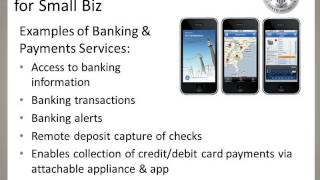
There are different rules that apply to businesses. And so all I'm suggesting is it's important that you understand what those particular protections are and aren't. And if you begin to receive payments in an electronic form, you need to make sure that you have the right processing in place to monitor them, to return them and so forth. The other thing that I would note about services like online bill pay, they don't have built in dual controls. So again, you just need to ensure that if you're going to use these sorts of services for your account in general, but for billing activities in particular, that you build in the right dual control so that you aren't vulnerable to employee fraud. So let's move to the next slide and on this particular website, and let me be very clear about this, I've identified a number of different themes, examples of solutions and or services that small businesses, particularly merchants, can take advantage of to perhaps improve the experience for your customer in terms of their online shopping and or make it easier for you to have a business that is leveraged online by your customers without you needing to invest a lot in kind of back end billing, invoicing or payment capabilities. I am not promoting any of these services, I am just using them as illustrations. So the first one is Amazon.com, amazon Pay, and they happen to offer services that tend to target small businesses, but they're leveraged by many sizes of businesses where you can integrate your website with essentially their back end capability. And so when your customer checks out, they're on your website and they buy cards, you offer stationery. And so they've completed their selection and now they're going to check out. Rather than having a little icon that shows a card that you accept, you could have a checkout process that essentially they can pick Amazon, if you will, and then their credentials that are already stored in Amazon, if they happen to be an Amazon shopper for other purposes, can be leveraged. So there may be an efficiency benefit from that perspective. So again, that's an example. If this is something you're interested in, you really need to do your research, find out more, look at what's available online and so forth. Authorize.net is a different kind of a service. It's what's called a gateway. And when you think about a gateway, you think about it as a third party provider or a service provider that sits between, in this case the business or the merchant and the back end payment system. So rather than connecting to various different card networks so that you can offer those or card networks and PayPal, or card networks and PayPal and Amazon, this would be a gateway and you would connect to them and they would have all of the payment methods sitting behind the scenes. So again, very short description of this. And in this case, authorize.net, they only accept credit cards, they only handle credit card payments. So again, that may work for you, it may not work. But I just wanted to give you this example of what's called a gateway service where they sort of do the integration for you. All of these have different costs, different security methods. And again, we'll talk about that a little bit. Now, one reason why you might wonder, well, Maybe I should do all of these things as opposed to just one. It depends on what the features and functions are of that particular service. For example, Amazon and Authorize.net are two different capabilities offering different features, whereas Amazon Payments is probably a little bit more like PayPal where you would have a PayPal icon on your website. So in that case, customers might like having choices, and often they do. They might like seeing credit cards, they might like seeing Amazon, they might like seeing PayPal. So if they're all what I would call a way in which the customer can just click on that icon and pay you easily, then you want to offer variety. But keep in mind all of that has pros and cons and there's always a cost in managing multiple service providers. Authorize.net is something different. It only offers cards and it's a gateway, so you don't have to do that integration directly to Merchant acquirer for MasterCard or Amex or Discover or Visa. Now, TracSpay is a completely different offering and this is pretty new and to be honest, I have limited experience with this. This is a B2B platform exclusively, so it is not something that would be a complement to Amazon Payments or Competitor. I should say it's a B2B solution where you would use this if you're trying to pay a supplier or receive payment from supplier, and it requires both business partners to be a part of the TraxPay solution. So you couldn't join and then just expect that whomever you want to pay this way or whomever you want to receive payment from is necessarily available within the tric. This isn't a ubiquitous solution like if you write a check or receive a check. So again, the reason I'm bringing up all of these different offerings is not to try to give you an in depth explanation of each of these, and not because I'm trying to promote any of these, but to give you a sense that there's a wide variety of options out there for you to think about and look into. Intuit based this is really where Intuit is trying to leverage the fairly large footprint that they already have with QuickBooks and offer you a way to bill your B2B customers and your consumer customers through their solution. And so this really isn't about electronic payments. In fact, you'd be most likely generating checks, but it's about making it easier for you to do the invoicing. And in this particular case, it does allow you online credit card payments, but not other kinds of electronic payments. So keep that in mind. Let's move on to a bit of information about online fraud. And first of all, something to think about with any service you use, whether it's Amazon or PayPal or Tracks, pay or Square, and we'll talk about some of those in a minute. They all offer different kinds of security. And so if you have concerns about what protections do you offer or what compliance do you offer, just ask them. So, so if you want to use one of these services for card acceptance, you can ask them, do you provide PCI compliance, or is that something I'm still going to have to do? Or you can ask them, do you provide layered security? And if so, what does it look like? Those are the kinds of questions you would want to ask these providers. What kind of security do they provide to you? That being said, what I'm identifying on this slide, slide 15, is really something that in many cases you are going. Well, in all cases you are going to have to pay attention to, regardless of services offered by providers. This is true in our home banking activities or our home Internet browsing activities. All computers are potentially vulnerable to a cyber attack, and we've identified here phishing as a broad term. So when you're doing online banking of any kind, whether it's just to manage your account or whether it's to do billing in terms of pushing bills or receiving payment, you need to protect that computer assets from cyber attacks. And in particular, there's this concern about a fraudster sending you or one of your employees some sort of email in which they might do one of two things. One is they would get you to respond because you would think it is an email that's legitimate and you would get them information like your bank account number or other kinds of things that aren't appropriate. Another issue that can occur with your computer assets is you could allow Internet browsing on your computer assets, you know, maybe for legitimate work, maybe you know, for work life balance. And someone is browsing the Internet and they inadvertently download a virus, you know, some sort of malware that gets onto the computer where you are doing your banking activities. And the fraudster in that process, you haven't responded to a particular email, but they deposited this malware on your computer and they then infect and seal information, including potentially your banking credentials, so that they are then able to, and this is called account takeover, which might warrant its own sessions where they are able to, using your credentials, make it look like to your bank that they have issued a legitimate electronic payment from your account, and in effect they see steal money from your account. So again, all online work and tools are great. They offer all sorts of conveniences and all sorts of benefits. But with any technology, whether it's online or mobile, we have to make sure that we're protecting those assets, just like we developed lots of controls to protect our paper assets. So keep that in mind as you explore any of these services. So I'm going to talk about PayPal for a minute. So PayPal offers a wide variety of online and for that matter, mobile services for small business. And just to give you some examples of this, they do allow or they do have an ability to facilitate online payment acceptance. So if you are a merchant, for example, allowing your account of customers, business or consumer customers to click on a PayPal icon, they don't have to have a PayPal account to pay this way. But that's something that PayPal has offered for a period of time. They also offer other business services. They offer invoicing services, they offer reporting services, they offer payroll services. So to the extent that you have an interest in exploring PayPal as a service provider, again, I am not promoting them over any other service provider, but I just want to point out that you could explore more than simply an online service. And when I talk in a minute about a square, I will compare a little bit, just to give you a flavor of it, the difference between the square credit card acceptance process and what PayPal offers, and for that matter, what Intuit offers in that area. So we're going to turn to mobile. And again, this is a high level presentation, which means I'm sure you will still have a lot of questions and we will try to answer some of them at the end. But we likely won't be able to answer all of the questions. So I encourage you to look for more resources to follow up with the sba, follow up with your bank on anything that interests you. So in the case of mobile payments and banking, I think it's fair to say that information services, banking information services are farther along in their development and availability than what I would call transaction services. And so payments would be a type of a transaction service. And the reason I think it's evolved this way is information services tend to have less risk associated with them than a transaction service where you actually might be making a decision that affects your bank account. So these are some of the relatively common common services now available through online. Through mobile banking, you can access information about your account. You may be able to see transaction activity. A great service that a lot of businesses use is alerts, and consumers use this too to alert you to any type of activity that you might then conclude include it's fraudulent to allow you to take proactive action. There are also services that I'll talk about in a bit more detail, allowing you to capture and deposit a paper check that you receive electronically. And then of course, many of you are familiar with this ability to attach an appliance and download an application that then allows you to process card transactions. And I'll give you some examples of that. So on slide 19, I think it's also fair to say that with respect to payments themselves, so mobile payments, the retailer has been at the forefront of this and has been most interested and has the highest expectations for mobile and or digital payments to grow rapidly. And one of the reasons why it's not just mobile, but it's as broad as what we might call digital is in some versions of this, particularly in a point of sale environment, a physical point of fail environment with cash register, there are examples where the supplier, in this case PayPal and Home Depot, I think is a prominent example of this, where they've enabled a cloud based digital payment. So where the consumer goes through the checkout line and if they already have a PayPal account, they can put in essentially a phone number or something like that and access that account and pay for their checkout through PayPal. So we use the term mobile, but. But what's emerging in this space doesn't always involve a mobile device as we usually think about it. On slide 20, these are some of the specific mobile services that we're beginning to feed small business leverage. So there is this mobile wallet payment at the point of sale. Which one could think about this as either using what I just described in a checkout or a situation where the customer has perhaps a Google Wallet or another kind of wallet that you have enabled, something that you are willing to accept for payment. And so your customer would bring that up on their cell phone and make payment in more of a remote environment. We talked a lot about having a device connected to your phone. So, you know, about 10% tracking purchases is a much more common activity on mobile. And the idea of websites that are set up for mobile, this is really the situation where you already have a web presence and you are simply pushing your web presence into a different form factor. And so the form factor you're using is mobile. An iPad, an iPhone, Android, whatever it might be. The only thing I would say about this is if you're going to basically redeploy your website into a mobile form factor, make sure that you are truly developing it for the mobile information environment because it's not just one and the same where you browse through your mobile device and get to your website. That's a lot less attractive to most consumers than redeveloping your web content for a mobile form factor. So, Moving to slide 21, this is remote deposit capture. And this, this has been very popular actually among businesses in general. We saw in our last survey that about 18% of all checks deposited for collection are now deposited using some sort of remote deposit capture technology. And the vast, vast, vast majority of that 18% is business deposits of checks, not consumer deposits. So this picture on slide 21 shows you basically a scanning device that you could rent or buy from your financial institution and have in your back office, so that if you receive a certain number of checks, you could then scan them and create a file which you would then send in electronically to your institution. And you can see a number of the benefits. Certainly you don't have to go to the bank as often. You can deposit your checks later in the day. You might get better availability. So this has been really popular. Generally speaking, if your check volume is small and you know less than five is a, you might choose to go with depositing them one by one. Where you use a smartphone and you actually do the photograph of the check, and then you use the bank mobile app to deposit that check image electronically. And if you have more than a few checks a day, that's where you would work with your financial institution to acquire a standard along the lines that I showed you in the prior picture, and you would create that batch file and transmit it electronically. But the benefits are going to be similar in both versions, though you do need to work with your bank. You need to enroll. They may need to do, if they haven't already done some sort of credit check because they're taking on a certain amount of credit risk in this kind of a clearance. But many of your colleagues have looked at this and found it useful for them. Again, if you're still receiving checks. Now we're turning to the topic of this appliance that you might attach to your smartphone. And there are a variety of service providers. So here too, if you have an interest in this, if you want to be able to accept this sort of way from your customers, whether you're a hairdresser and you're taking payments from customers, whether you're out and about, you do lawn care or home services, and you want to be able to accept payments this way, certainly it has a lot of Variety. But let me just talk about the kinds of things that you should look at. There are differences. Whether it's PayPal, Square, Intuit's Go Pay, there are differences and how these are priced. In some cases it's mainly a swipe fee. Most providers have a different fee if it's swiped versus manually entered. Some have a processing or a flat per cent in addition to the percentage they have a flat like $0.15 or $0.30 per. Some offer up to so many payments you have a fixed monthly fee. So you certainly want to look at the different fees. Some of these services only handle cars, some will also combine it with check processing that they may do. In some cases there may be a startup like, you know, $100 to get going. In other cases there are no startup. And there are going to be different types of customer service. In some cases it's all going to be online, can't contact anybody under any circumstances, no phone number. In other cases there is going to be a phone number and or chat help. So if you have strong feelings about customer service, that's something to think about. In some cases they may require a credit check, in other cases they may not. The payment channels that they support may be different. Where they offer credit and signature debit, where they offer checks or they don't offer checks, or they offer PayPal or they don't offer PayPal. You know, again, so if that matters to you, the payment channel, you should look at that. The funds availability is going to be different. So in some cases they may give you immediate availability of those funds. In some cases it may be next day or maybe it's two days for certain kinds of payments. So you want to understand that. You want to understand what fraud protection they provide. Is the card reader encrypted? Is the data transmitted encrypted? Are they PCI compliant, if that's a concern, or how do they propose that occur? So those are things you want to understand. And what devices do they support? Is it strictly the iPhone and the iPad? Is it also the Android? Is it also older devices? Is it only certain versions of those devices? So those would be things that you would want to look into. Is it only a US service or do they also support other markets like Canada? Or maybe you sell your product all over the world, so maybe you care about other markets? I would ask about that. So again, these are not. These are all services to consider, but I think you want to look at it and I would ask about their chargeback experience. Right? So I think there's a big difference when you use a service like this, when you are in the kind of business where you primarily have customers you know and that are repeat customers. So you know, a hairdresser or a home improvement service. But let's say you're a CATS team driver and so all of your customers are different from day to day. I would ask these service providers about the chargeback history because as you know, that can make a very big difference for merchants in the viability of these kinds of services. If you have high chargebacks, that may be problematic. So let's. I think we've already talked a lot about Square. This just shows you for Square what the answers are for some of the issues that I just noted you need to look into. And again, the same would be relevant for any other service provider you might want to check into. Now, the next example that I'm providing here is called, as it says, Level up. And this is a digital wallet, okay, With a mobile app that your customer might choose to download and you as a business or merchant could choose to join. So you could be a merchant within the Level up community. Then that your customer, if you have customers that like these kinds of innovations, would then find that you're available in the Level up digital wallet. And so they could use Level up when they use your service. And one of the differences in the Level up service as compared to some of the other mobile wallets is they have a bill built in reward system. So it might be a community reward system. So let's say all of the restaurants in Minneapolis join Level up and they offer a reward. Or 20 restaurants in Minneapolis join Level up and they offer a reward if you go to their restaurant and you use Level Up. So that might be a way in which you gain loyalty without offering a loyalty program of your own. So that's really what LevelUp is offering. They're trying to offer a service targeted more to the smaller business that has a mobile technology component for the customer to make payment, but a reward component for the smaller merchant who might not be able to afford their own reward or loyalty program like a larger business might. So again, it's another innovation, another example. I know I sort of harped on this, but I just want to say again, I'm not recommending any of these specifically. I just want you to get the sense of the breadth of innovation in this arena that might offer you options to explore. Now, on line 26, I've noted a number of different kinds of risk mitigants that you may want to think about that are relevant to the mobile environment. So dynamic data authentication, maybe the easiest example of this is not specific to the mobile channel, but rather when you think about our cards today, and they had that mag stripe on the back that you swipe, that's static data. It's the same data every time you swipe it effectively. And some of you may have begun to see cards being issued that have these sort of holograms on the front that are smart chips. And when those are inserted into enabled terminals, they generate dynamic data in the authentication process of the customer. Without getting into all the technical details, dynamic data is substantially harder to counterfeit or clone, and as such, they reduce fraud. And this sort of chip can also be pushed out to a mobile device. It can be used in that device just like it could be used in a phone. Something to explore. Encryption keys. Again, talking about any of these services, I think you need to understand how they encrypt transactions that might contain data from your business and what they offer. In that regard, token is something you may hear as well. Token is a word that is used in many, many, many different. For instances a, a token can be as simple as a pseudo bank account number that is a token for my actual bank account number, or it can be a lot more sophisticated and electronic and generated electronically in the process of a customer using a payment. So if you hear this word token, and if a service provider says to you, well, I provide tokenization services, what I would urge you to do is make them tell you in detail what that means, what they're masking or tokenizing, and what data it protects, what it would cost you to use that in the context of any of these services we've been talking about. If you hear the word siem, that's a secure element that is typically embedded in a mobile device or included in a mobile device inside the chip. So it's not going to be associated with every mobile device. But again, as you're looking at maybe expanding the use of your mobile services or some of the services we've talked about, I just wanted to give you a sense of what some of the security elements are that you might want to ask for more information. So, again, I know a lot to digest, but what we're really trying to do here is give you a teaser, an overview so that you are better armed to ask questions as you proceed. So, Last couple of slides 28. Slide 28 just names even more interesting emerging payment providers. And, and as I say, if this is a topic where you think we need to offer you more education, let your Small Business Administration folks know, and that's something we can work with them on. I thought it would be worthwhile to at least make a couple of comments about Bitcoin, I suspect. Well, I shouldn't say that Bitcoin isn't quite ready for lifetime, but I would say that at this point in time, as compared to US Currency, for example, there isn't a lot of Bitcoin out there. You see that fourth bullet that says in the world it is the largest current type of virtual currency. There are other types with a total value of about $6 billion, but compared to US currency, that pale. So another thing about Bitcoin is it's not backed by anything. So US Currency, most other currencies from most other countries are backed by the government. They're considered what's called fiat currency. And there is no such backing for Bitcoin, which is part of the reason why Bitcoin is extraordinarily volatile in terms of its value from day to day. And one of the ways that some merchants who have chosen, like overstock.com has chosen to accept Bitcoin, one of the ways that they address that volatility is they use a third party provider that basically says I'll guarantee this on any given day. So that if you accept Bitcoin then it's going to have that transfer value for that particular purchase. So if this is something you want to look at into, there are third party providers out there who can help you manage the risk. As I say, it's not regulated and it's not just a virtual currency, but it actually is a payment system. It's got what's called a public ledger. There are these organizations called minors that interact with the ledger. It has, it's sort of a point to point. It has these exchanges that issue Bitcoin. There are all these parties involved. So in that sense it's a system. It's not strictly quote a virtual currency. Again, this is extremely high level and this would warrant its own discussion. But in the scheme of things right now, the use of, of Bitcoin is not prominent certainly among businesses of any kind. It's relatively niche in its current characteristics. But we should be paying attention to it. We need to see how it develops and evolves over time and down the road. You know, who knows now some pros and cons in certain versions of Bitcoin. So the actual cryptography around Bitcoin is very strong. And it is. And the security around it, setting aside the exchanges and the fraud that can be associated with an Exchange, the security around the technology itself is strong. So in some sense you could argue that it can, can be a positive from that point of view. It can be a financial instrument for the unbanked since it doesn't require the banking system as such. It doesn't have transaction costs in the way that some of you have experienced. So it can be beneficial there. On the negative side, some of the exchanges have been subject to criminal activity and have been taken down as a result. It's not as easy as, you know, taking money out of a wallet and paying for something. You have to enroll, you have to take some action. You have to be reasonably sophisticated, in my view as a consumer or a customer to get involved in this community doesn't mean you can't do it, but it does take a bit of savvy and a little bit of homework. It isn't ubiquitous by a long shot. And that was something we said early on, is great for the check. And if you lose money due to fraud or exchange collapses, as happened a few months ago, you're out. You're out. Whatever money you had associated with Bitcoin, you had associated with that exchange. So there are definitely many risks at this point in time. But as I said, I think it's something that we need to be observing as it evolves. So as I said, if you want to explore anything we've talked about, obviously you should do your research. There's lots of information out there. Talk to people who are already using these services. Talk to your banker and talk to the right banker, not just whoever your loan officer is who can help you understand it may be something that you want to experiment with as opposed to doing in total. You likely need to make a case to your leadership, and I think you'd organize that like you would do any traditional business case. Would it attract more customers? Would it reduce cost? If IT resources is an issue, look for services that do the integration for you, that don't really require that you have much in the way of IT resources yourself and that are very easy to maintain and to use, so you don't need to be calling them up for help. And if this is something that you really want to use to either develop new customers or encourage loyalty. Do that kind of research and find out from your customers if you offered PayPal or if you offered some of the services we talked to, would they be more likely to use you because you're offering these options on the next slide? Again, you know, some of these service providers are much more business focused than small business Focused specifically, you can figure that out pretty quickly. We've talked about the importance of having them offer integration services. Almost every bank offers remote deposit capture. So if that's of interest to you, go to your financial institution. All of these service providers provide some type of fraud services, whether it's your financial institution or these others. Ask them about that. Ask them what they charge for it, if anything. I think the fee structure is critical, you know, and you know, whether you care mostly about, you know, one fee per month or you'd rather manage it at each little transaction level, or if you care more about chargebacks. You want to understand all of that and understand what their bias is. So what's in it for them? Are they really trying to meet your needs or simply tell you how you meet their solutions requirements? And as I said, throughout, your banker is available to you. I think sometimes bankers, particularly with small business, tend to focus more on their credit relationship with you, how they provide loans, perhaps to you. And the experts on the payment side are often not the loan officers. So I just urge you to be proactive in talking to your bank about your payment needs. Look for someone in particular who is a cash management expert, a small business expert, a payments expert, and can really answer your questions or bring the right people together from the institution to answer your questions. And you know, you'd be surprised at the amount of information and relatively low cost services many financial institutions provide. So that is the end of my prepared remarks. I know I have a variety of questions, so I'm just going to answer questions during the rest of the eight minutes that we have together. So one question is what is one high impact thing we can do right away to reduce our transaction costs? That is an excellent question. And let me put it this way. If you are currently receiving a fair amount of checks, I would definitely look into remote deposit capture as something that your financial institution can help you with. That's something that could very well reduce your total cost, especially because you might get faster availability and you might be able to reduce labor associated with getting those check substantial institutions. The second thing you might consider if you currently accept cards is make sure you have done a competitive analysis. So there are lots of service providers out there. And when there are lots of service providers out there, they're willing to sharpen their pencils if they think you might be considering other providers. So whether you're using a traditional merchant acquirer, whether you're doing this through your financial institution, whether you're thinking about one of the emerging providers, make sure you're doing some sort of. It doesn't have to be a formal rfp, but looking at the various options and see what they're doing in terms of how they can help you with your transaction costs. So another question was explain more about reg E and how does it help with online bill pay. So here's the main point that I wanted to make in this regard. If you are being paid or if you allow your account through an online bill pay service to be debited directly by say another business customer, consumers who like me, if my account is debited by a utility company for my monthly amount and I look at my bank account and I see this figure and I say to myself, well I didn't authorize that. I have effectively up to 60 days after I received my statement to return it and I don't even really have to go through approve it. I am just allowed under the rules to return it. If the similar situation works to occur in the case of a business, you don't have a 60 day right of return. You need to return an unauthorized item against your account within two days. So that's really a difference that I wanted to highlight. Doesn't mean it's bad. You just need to be managing your account vis a vis electronic payments that may hit in the form of a debit. Why does it take several days for the payee to get payment when human hands do not touch the transaction? So for an example is a payee's online bank floating the transaction so as to generate more money? Okay, so this is what I would put under the broad category of availability. When you form a relationship with a financial institution that is collecting payments and then depositing them in your account. And like this person is saying, it's basically practically straight through just hits your account. Why do you not get immediate availability from that financial institution? Well, there are a variety of reasons for that. One is they may, you should think about availability as one type of price that you're paying for those services. So if it's a check, they may charge you a certain fee for putting that check in your account, you know, handling that. And they may charge you another fee by giving you two day availability on those funds or three day availability on those funds. That may be a way in which the bank compensates themselves for their services to you. So it's a combination of fees and how quickly they give you availability. You can choose if you don't like that to renegotiate the availability, but you might end up paying a higher fee for that service and you're right. Banks are making money, quote unquote, on the float. PayPal, I think, is an example of this where they typically give availability on, I think, ACH related items, two or even three days to whoever. Like, if I'm being paid by PayPal and so I have an account with PayPal and I sell something to somebody else, I don't get availability on those funds right away. That's a service condition of my relationship as a consumer with PayPal or a user of PayPal. That's not right or wrong. That's how they're pricing their service to me. So my point is, if you want availability faster, you can certainly talk to whoever your service provider is and see if that's negotiable or not and make this point about, you know, you get the money right away. Why can't I have those funds available to me right away? Part of this may also have to do with whatever credit relationship you have with them in terms of their view of your credit risk. So let's see where we are with. With time, I think I can answer one more question within the allotted hour. So regardless of the online payment solution we choose, are we the small business responsible for providing a security method on our end outside of a merchant agreement requiring a PCI compliance standard? So I would say this. Ultimately, the merchant has the liability, right? You're liable for PCI compliance. Now, you may choose to use a third party provider to meet most of your obligations, but if they fail you in terms of the service they provide, you're still on the hook. So. So that's how I would describe it. You can outsource many aspects of the work, but you can't outsource your liability unless you do that by contract with a third party provider. And I'm not sure that they would accept that or that would even necessarily stand up. So let me thank everybody for being on the conference. I know that we are at the appointed hour. I really appreciate everybody's participation today, your excellent questions, and I hope you enjoyed the event. Thank you.
More from Your







President Donald J. Trump and First Lady Melania Trump Visit Grieving Texas After Deadly Floods

💪 Thinking of starting a #biz? Go for it! — Kerry Boyle, Vermont #SmallBiz Person of the Year

President Trump Participates in a Bilateral Meeting with the Prime Minister of Canada, May 6, 2025

