Making & Receiving Electronic Payments for Your Small Business
A webinar presentation (Federal Reserve / SBA) explaining electronic payment options for small businesses and practical tradeoffs. It covers paper checks (and remote deposit capture), wire transfers (Fedwire/CHIPS), ACH (batch processing, payroll and recurring debits/credits), card acceptance (credit, debit, prepaid; issuers vs acquirers; mobile readers), and online/mobile channels (QR, NFC, mobile wallets, POP Money), followed by a live Q&A addressing fraud, international transfers, EMV chips, and acceptance rules.
Chapters
Hello, everyone. My name is Fred Baldassaro and I am the assistant administrator for SBA's Office of Communication and Public Liaison. And I would like to welcome you to our first webinar with the Federal Reserve. The U.S. federal Reserve bank, through its 12 regional locations, works to assure the smooth movement of funds between banks, savings and loans, and credit unions through a nationwide electronic payment system. For today's webinar, Claudia Swinside, senior vice President of the Minneapolis Federal Reserve bank, will show us the ins and outs of making and receiving payments as a small business owner. But before I turn this over to Claudia, I want to share with you why we at the U.S. small Business Administration felt that this was an important topic. With electronic and mobile payments becoming increasingly more popular, it's time to consider whether these forms of payments are a good fit for your business. We understand that small businesses don't necessarily have the time or the employees to research the pros and cons of electronic methods of payment, and so oftentimes they miss out on opportunities to improve their bottom line. Knowing where to start is perhaps the number one obstacle holding many small business owners back. So in today's webinar, Claudia will walk you through the basics of electronic payments and remittance methods, as well as the pros and cons of accepting various forms of payments in your business. So I hope you enjoy this presentation. And with that, Claudia, I turn it over to you.
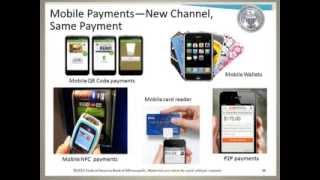
Thanks very much, Fred. I'm delighted to be here today with all of you who are listening in on this webinar. And as Eddie mentioned, your questions are certainly welcome. We'll be dealing with those at the end of the presentation. So if you hear something along the way that isn't clear to you or that is confusing or that you want more information about, by all means. And we are calling this session Electronic Payments Basics. So we only have about an hour and that means we're going to cover a lot of information fairly quickly and as a result we're going to try to point you to some resources and there may be areas where you will need to do some additional follow up based on what you hear. So it's important to start out by noting that I am speaking as a member of the Federal Reserve bank of Minneapolis, but but not on behalf of and thus my opinions are my own, although I certainly am going to provide as many factual bits of information as I can. But an important disclaimer. And many of you, I like to talk a little bit about the Federal Reserve Bank. Many of you, when you think of The Federal Reserve really think about the fact that we are the central bank of the United States. And so you are aware that we establish and execute monetary policy, we're involved in financial stability, regulating financial institutions, that sort of thing. But many of you probably don't know that we also play a really prominent role in our nation's financial and payment system. And so you see listed on this slide the fact that we are what we call a banker's bank. We provide a lot of wholesale payment to financial institutions, and we also serve as the bank in many respects for the federal government. So it's for these reasons that we have a lot of expertise and background in these topics. In terms of what I hope we accomplished today, I certainly want you to better understand some of the electronic alternatives that are available to you. Most organizations, most consumers, are very familiar with cash. We all use that. And many of us, particularly in the business community, very familiar with chat, but you may not be as familiar with some of the other options that you have available. And so that's what we'll be focusing on in particular. I want to start out though, by letting you know a little bit about the aggregate practices of businesses, including small businesses. So what you see on this particular slide is that businesses of all types in the US still make a lot of their payments, their disbursements, using the paper check. And that's a little surprising, perhaps, because we live in the Internet age and the electronics. But there are reasons why businesses still value the check, and we'll talk about that in a bit. Some of those are good reasons. Some of those, I would argue, aren't such good reasons and are more related to the fact that they may not understand what their alternatives are. So small businesses in particular are very large users of the paper check. They write many billions of checks. And even though some people will say, well, the check is really inexpensive, when you add up all of the costs associated with checks, the stock, the mail related costs, the production costs, some bank fees, et cetera, they aren't actually all that inexpensive compared again to some other alternatives. And as much as 1 in 5 of smaller businesses make as much as 90% of their payments by paper check. So that is a lot of paper. And again, there's nothing wrong with the check. It is easy to use, it's ubiquitous in terms of it being accepted for the most part. And so it's fine to use if that's what you want to use. But if you're using the check because that's what you've always done or you don't understand alternatives, then maybe it's not such a good situation. Now, in looking at small business, we've also tried to explore where we see some small businesses that use more electronic payments and some that use fewer. And keep in mind, when I am talking about electronic payments, I'm talking about something called the automated clearinghouse, what we call wires or fund transfers and card payments. So credit, debit, prepaid, et cetera. So what you see in terms of small business that already have adopted a fair amount of electronic payments, first of all, they tend to be more in what I would call the retail or consumer space, so that your customers tend to be more on the consumer side. And health care shows up because in that particular industry, the government has pushed the use of electronic payments. So sometimes there can be a regulatory push toward electronics. They also tend to have smaller transaction amounts and they tend to have had problems with things like bounce, so they want to avoid them. And they tend to use the Web for transactions. And in that case, then cards is the dominant payment method. On the other hand, businesses that are perhaps more in the wholesale or B2B business services arena, that maybe have fewer employees, be small or sole proprietorship, have larger average payments, and who have not had problems, say, with bounce checks or issues like that, then you find the reverse to be true, that they still use a lot of paper checks. Now, in this particular slide, I'm not going to get into these topics yet in a lot of detail, but I want to highlight now that these two areas, the automated clearinghouse and card acceptance, are areas that if you aren't for using these payment methods today, I hope that after this particular webinar, you have some interest in exploring the use of these alternatives, especially if you're in the group that primarily uses checks. So we'll be talking about both the automated clearinghouse and about cards in a lot more detail. I just wanted to highlight them now to get you thinking and interested in these particular categories. The other thing that's important to point out is right or wrong, it's been my experience and in talking to a lot of smaller businesses that they are not necessarily well served by their bankers and other financial services providers, at least in the area of payments. So they might get great service from their banks as far as maybe loans or lines of credit or that sort of thing. But in terms of reaching out to you and talking to you about, gosh, have you tried the ach, have you tried a different payment method? This has not been an area where bankers have done a lot of Outreach. And so, so I would encourage you, again, we touch on things that interest you for you to take the initiative and make sure that you reach out to your bank about your interest in say, pursuing an ACH or a FARD opportunity. And we'll talk more about that as we go through. So in terms of payment types, I'm going to be covering to some degree the check, although not in a lot of detail, and then electronic options such as wire transfers, the automated clearinghouse card, and we'll touch on newer and emerging payment channels as well, online and mobile. So that's what we're going to be covering here in some depth. So in the case of the paper check, again, the definition of a check is as stated on this particular slide. It's a written, dated, signed instrument. And basically you as the payor, if you are the check writer, you are telling your financial institution to pay a definite sum and a particular amount, again, a definite sum to whoever you are seeking to pay. That's the receiver of the check, the payee. So I've also listed on this slide some of the concerns in particular about using a check and what I would say there is. Fraud in particular is a source of concern for businesses as well as returns and in that respect, certainty of receipt. So let me talk a little bit more about fraud. So in many surveys of businesses, and this is just one example, the check shows up over and over again in terms of where the business has the most fraud attempts and the most of losses. And that's also true with small business. So it's not just something that is of concern to larger organizations. In some of the studies that we've looked at, the paper check actually saw 10 times the amount of fraud incidents as electronic alternatives. And the numbers can be relatively high in terms of losses that small businesses may take in this arena. So that in itself can be a reason for you at least to consider electronic payment alternatives where the issue here may be somewhat less. Although fraud is a concern of course, with any kind of payment method. So I guess that would not be the case. So why, you might ask, is check fraud still an issue? Well, first of all, it's relatively easy if you're a criminal to get into this line of fraudulent activity. It's a relatively low tech endeavor. But there are also lots of fairly low cost pieces of equipment where it makes it fairly easy to produce counterfeit checks. And because checks are paper inform, they can be relatively easy to counterfeit and relatively easy to alter. Part of it may not even require that somebody steal your Check stock. But if they happen to get a copy of a check, or if they happen to be recipient of a check that you have sent and they have elicit ideas in mind, these can all be ways where they can get information about your organization and create fraudulent items. One other topic in the check arena that I want to make sure you're aware of, if you're not already, is something called remote deposit capture. And this is a way in which the check can be made more electronic and easier to deposit. So this is a situation where you are the recipient of the check. So, so someone is paying you. One of your customers, for example, is paying you. And obviously for you to get access to those funds, you have to deposit that check with your bank. And you can do that in person. Certainly many organizations still do that. But another thing that you can do is you can get what's called a scanner, which is pictured on this slide, from your bank, and you can scan the. And your bank can provide you with software that allows you to create an electronic file of those checked images, and you can send that electronically to your bank. And this can save you time, it can save you money. You may get your funds in terms of availability to those funds faster. So there are lots of reasons to consider this in terms of your business operation and your financial arrangements. There are really two ways in which you can do what's called remote deposit capture. The first one shown on this slide is really focused on, frankly, the consumer market because you're dealing with checks one by one. And this is where a number of consumers now can download a mobile application from their bank and use that to take a photo of the front and back of a check and then again deposit it electronically. But what is primarily used with businesses is, as I mentioned earlier, a scanner. And this is something you would want to get from your bank. Often the bank will rent or sell it to you. And then once you set that up, the cost is very small to use this method to deposit your checks with your financial institution. And I'm sure if you're interested in that again, you can talk to your banker and make it clear what you are interested in, having them discuss with you. There will certainly be some paperwork involved, perhaps some credit evaluation, et cetera, but it may be well worth it in terms of the convenience, the benefits. So I'm now going to turn to wire transfers. And let me start out by noting that the term wire is often used by folks who may not be intimately familiar with payments to cover any type of an electronic payment. When I'm talking about wire. I'm talking about a specific type of payment. I'm not talking about the automated clearinghouse, for example. So I'll continue to reinforce that distinction. The two ways in which banks talk about this particular service is shown here on the second bullet. It's either called the FedWire Network, which is a network that the Federal Reserve provides, or chips, which is a private sector alternative. And essentially what happens here is the business lets your bank know and you can do this in person. But often you would do this online, perhaps through your online banking relationship. You would let your bank know that you want to make a credit payment to a supplier, for example, and you want to send it by the wire system. And so you provide them with particular instructions to do that. And the bank makes the appropriate arrangements and makes that payment on your behalf. And what is key about the wire and what makes it different and importantly different from other forms of electronic payments? First of all, it's very fast. If you're doing it in the U.S. those payments are going to clear and settle on that day. So both in terms of debiting your account if you're the one sending the wire, or crediting your account if you're the one receiving the wire, we refer to these as basically real time, and that's real time between financial institutions. So if we receive a wire transaction from a financial institution that we then send to the receiving financial institution, that happens on our books within seconds. So in that sense, it's very much real time in terms of the interbank nature of the payment. But usually for the actual sender and the actual receiver, it'll happen within that day, depending again on the services that your financial institution provides to you. Very secure, very reliable, and it's typically used because it's so fast for time critical payments. And the other piece that's important is when you send a wire and receive a wire, the funds are finally, they cannot be revoked, they cannot be returned. So it has a lot of value because of the finality of funds, which is not true for, say, a check for a card payment or for the automated clearinghouse. So that's a really important distinction. It's also used a lot internationally because for many organizations it may be one of the few options, although cards are becoming more and more of an option here. But the downside is they tend to be relatively expensive. So you might be talking about $25 to send a wire to make payment, for example. So we're going to move on now to the automated clearinghouse. And again, as I Said at the beginning, you can see that I am moving through this incident information relatively quickly. One of the issues that often comes up with electronic payments is that the check, you like the check because you may have the copy of the check that was deposited or the check that was cleared, and that might be a good way for you to validate payment. And in the case of electronic payments, you may not have an exact substitute, but you can typically get similar information confirming the instructions. Basically a notification or an advice from your financial institution on the disbursement side that proves, if you will, that the payment was sent. And the same thing can occur on the receipt side. So there are ways of ensuring that you have the right kind of documentation that you may need for audit purposes, et cetera. So now I'm going to turn to the automated clearinghouse. And this is a. It's an electronic altogether electronic payment system. But as it describes here, we call it batch processing. And the reason it's batch processing, it's with a wire payment, typically a wire is sent, instructions are sent to a bank. The bank may send that single wire or a few wires in a file immediately to an interbank clearing mechanism like the Fed. And we handle those immediately and one by one with the ach, this tends to be many more millions of payments on any given day. For example, in the Fed, we handle the maybe 50, 60 million ACH payments on a daily basis. And so what happens is the payments are collected by banks throughout the day from various businesses that are, quote, originating instructions. And then once, maybe two, three, up to four times a day, the financial institution sends an electronic file to an intermediary like the Fed. We then reroute those payments that come into us with indie big files and send them to all the appropriate receiving institutions who then credit the appropriate account. So it's batch in that sense. It doesn't flow through as each payment or each file comes to the bank, the bank collects them and sends them on at a particular time during the day. So this picture shows this again. And if I were to give you the example of payroll, let's say you use the ACH to pay your employees. Many of you have probably received what's called direct deposit, and that's using the ach. So in this particular case, the originator is the business. And let's say you pay your employees twice a month. So you put together an electronic file and the bank would work with you to get the software in place or find a vendor for you. With the right kind of software, you would format that information, and you would then send a file to your financial institution. And keep in mind, if you do something like this, you would have gone through a process with your employees where they have authorized you to have their bank account information so that you can provide that to your financial institution so those payroll payments can go to the right account. So you would put that particular electronic file together and you would send it to your financial institution over a secure. Your financial institution then, as I mentioned earlier, is going to be collecting a lot of payroll files from a lot of different businesses, and they're going to put that all together into a single file that has various batches in it for different businesses. And they're going to send it on to an ACH operator and that is either the Fed or there's one private sector operator called the Electronic Payments Network. And we're then going to to ingest all of those files. And at specific times during the day, we are going to send files out with that information reorganized. So each receiving institution in this example would get the information only for those employees at your organization who uses that particular bank. So let's say you use bank of America and your employee uses XYZ Credit Union. Through this process that I just described, XYZ Credit Union gets the payment information through the ACH for that particular employee. The receiving financial institution then credits that account and that becomes available typically the next day to your employee through their financial institution. And if you're using this to make trade payments or pay suppliers, it might also be credited to a business account. So that's the general idea. What are some of the features here? Again, very secure, very reliable. It works especially well for batches of payments, recurring payments. We'll talk a little bit more about that from a business perspective once you have set it up. And there will be some costs and some challenges related to that setup because you have to get certain software in place, you have to work with your bank to establish this particular service. So there is going to be a process up front that's going to take some time, some effort, but once that's in place, the ongoing process cost is really quite reasonable, relatively low. It tends to be one of the lowest cost payment methods available for these kinds of. And often if you do some sort of have an online banking relationship, this can be an expansion of those particular services that you have with your financial institution. You do, though, have to be. You do have to pay attention to returns, especially on the debit side. So ACH payments can be credits or they can be debits against where you are sending a debit against, say, a customer's account or your account is being debited for, say, taxes. And in that particular case, there's also the return process, especially if you're debiting a consumer customer's account. So you need to understand how that works and be paying attention to it in terms of managing this particular system. So why would you want to think about doing something like this instead of, say, the check, which it might work well already? Well, if you have more than a few employees, it can be a benefit to them. It can be very easy to continue to do once you have it set up. So it may involve less fraud for your employees, potentially, or loss of the payroll, check in the mail kind of thing if you want to use it on behalf of customers. For example, let's say you're in the business of, say, offering child care, or you run a gym, or you're a nonprofit organization. You can set up monthly recurring, what are called debits. And this can be a great way for your customers to pay you. And in many cases, you don't then have to worry about billing process every month or collections because it's set up in this automated. And frankly, to do business with some governments and with some large organizations, you have to, as a small business, be able to engage in electronic payments for, say, a large supplier like potentially a Target or a Walmart or Costco, do business with you. So it may be a business growth opportunity. All right, so we're going to move on to cards and talk a little bit about this arena. Cards, of course, credit, debit, prepaid, et cetera. But credit and debit in particular are very popular, especially with consumers. And so any of you who are in a business where consumers. Consumers are your customers, being able to accept cards may be an important way to grow your business. I think one of the main concerns, though, in terms of cards is they tend to have fees associated with them, and many of those fees are charged by the accepting organization. So if you are the one accepting a credit card, or for that matter, a debit card from a customer, you will likely have to pay a percentage of the value of the sale, say 2.5% kind of thing. And that can be, depending on your business, a fairly large cost to absorb. So you just need to be aware of that and you need to build that into your business model if you're going to use a card approach. So a credit card, as you know, is where someone doesn't have to. To pay the bill right away, but they can pay it later. And in the case of small businesses, this is often used as a funding source, frankly, because of that ability to leverage 20 days of funds, so to speak. It also can be used in terms of what are called a purchasing or procurement card program, where if you purchase a lot of relatively low cost items they supplies, you can use a pcard approach to aggregate those smaller purchases. So you're only making a single monthly payment to the biters through the P card issuer. So if that's something that interests you, many financial institutions have programs involving providing P cards and would be happy to talk to you and make that kind of an arrangement with you. And again, while the cost of a card in terms of acceptance can be somewhat high, there are a lot of savings in terms of labor processes. And if you are the one paying with a card, you also get the benefit, especially in most C card programs, of what's considered a rebate. So the benefits of cards often depends on whether you're making the payment versus whether you're accepting the card for payment. Now, in the case of debit cards, debit cards are where you pay now essentially, and that's why they're tied to an underlying account, most often a checking account. They are more popular than credit cards among younger people. And so again, if you are serving largely a consumer market, you may want to think about, if you're not already, whether or not you want to accept debit cards. And this point about debit card fraud, it is a serious and growing problem. But what's also very relevant here is the, the issuing bank, the issuing financial institutions, the issuing credit union, they absorb the liability for the most part. So that's not good in the sense that it's not. One shouldn't say, oh well then I don't care about fraud. But the liability in most instances do not. The liability does not flow to the. The business where that changes is when the card is accepted in an online or remote for a remote transaction, say over the phone or an online transaction. In those cases, the liability rules often change. And so these are the kinds of details that if you're going to get into card acceptance, you simply need to understand the costs, the liabilities and the rules. Prepaid card is when the card has funds that are loaded onto the card in advance, so you pay before, if you will. And these can be either one time gift cards like you might see this time of year as we get into the holidays, or they can be reloadable. So businesses that might want to use prepaid cards for Payroll purposes would work with the issuer and would be implementing what would be considered a reloadable card. And in this particular case, the balances are also linked to an account. They could be a bank account, or they are often in altogether separate system and are not associated with specifically an underlying bank account, which is why they're often used with unbanked populations. But they still are relatively small in terms of use. And if someone has a prepaid card in many cases on the acceptance side, they act and function much like a debit card. So from that perspective, you might see them as pretty similar. Although the interchange rates that I mentioned earlier, the fees that you pay for acceptance will likely vary. A couple of terms that I've been using, issuer and acquirer, are worth at least describing. The issuer is typically but not always the financial institution. It could also be American Express. You know, there are non banks, so to speak, or non financial institutions as such, that can serve as issuers. And they have the relationship with whoever is holding the card, the consumer or business that would be using the card to make payment. And they agree to abide by various laws that are established by the card network. So American Express, Visa, MasterCard, Discover. The issuer typically underwrites and takes the liability on that card. But as I said, the liability can vary depending on whether it's an in person transaction or something you're doing remotely or online. And then the issuer then makes payment to whoever the business or seller of the goods and services are on behalf of that cardholder. The acquirer is someone that if you're the business accepting the card, you will have a relationship with the acquirer. You will work if you're the seller of the service, the goods, you will have an acquirer relationship. They're the one that underwrites your risk, that basically takes on that liability. They're the ones who that will then charge you various fees, often called a discount rate. They will submit payments for settlement to the cardholder account. So there are a variety of actors in this mix and again, we're touching on a lot of topics quickly, but we at least wanted to introduce you to these terms so that if you want to explore these, you have some sense of what these different terms mean and who the players are in these arrangements. So one of the things that has really become prominent in the last few years is this ability either with a smartphone or a tablet, to accept cards. So the person in text my hair, it has Square, which is one of these service providers. There's GoPay, which is an Intuit example. PayPal has an example of one of these kind of what are called Gogles. So this is where you have a small appliance and you attach it to your phone or your tablet and you use it essentially to swipe the card, the mag stripe on the back of the card. And the reason this is popular with smaller merchants is because you don't have to have expensive equipment to accept cards. You can just leverage what everybody has these days, your smartphone or your tablet, and that can turn into a cash register. And especially on the smart or the tablet, there can be software associated with it that can really make this function essentially like a cash register. It does allow both card present and card not present payments. And in most cases the vendors have pretty straightforward fees where they're, you know, 2.5% kind of thing of the sale amount. So that's an another reason why small businesses tend to like them, because the feed tend to be fairly straightforward and simplified and easy to understand. All right, so the last topic is online and mobile. We'll spend a little bit of time on this as well and then we'll get to some of your questions. So online and mobile banking is certainly an area of growth in terms of disuse by small and medium sized businesses. And that makes a lot of sense because small businesses are very focused, tend to be resource deprived, if you will, and they need to use every opportunity to use efficient technology. And so as this slide points out out, half of banking business activities, a lot of businesses do half of that or more than half of that online. And many, many, many businesses now are using mobile devices for some aspect of their banking services, their financial services, not a lot of transactions activities, but perhaps for alerts, for instructions, for information, that sort of thing. So with online bill pay, this can offer lots of different services that your bank can tailor to your particular needs. And banks also will work closely with you to ensure that you have the right kind of security around these particular services. And it's very important to understand fully what your bank offers you on the security side and to use those particular services, including practices to make sure you are defending and or protecting any kind of of online activity. So online bill take can be done through your banking service. Online information can be sent, as I talked about earlier, or received from your bank. There are many other kinds of services that can be conducted through an online relationship. So again, I would urge you to explore more than just bill pay. Of course there are concerns about hackers, there are concerns about fraud. I mentioned earlier about documentation and you know, how can you prove these sorts of payments? And in all of these cases, your bank should have services available, should be able to answer your questions and, and provide you with ways to address each of these concerns. But it tends to be a two way street because in many cases your banker is going to suggest actions as well that you need to take either on a daily, weekly or monthly basis. Now, mobile payments, and not just payments, but these are all examples of how the mobile device is becoming part of the payment environment. So the top example is Starbucks and this is something called QR code payments and it acts a lot like when you go to the grocery store and the barcode is scanned. So the QR code enables a recognition between say the prepaid instrument that is in, that is associated with a particular user's phone and a reader in that particular merchant establishment. And that's something that we could see more and more of and certainly would be something that potentially small businesses could avail themselves of. A mobile wallet is effectively what it's suggesting where the consumer, consumer would have a wallet application. Google has been promoting this and within that wallet they could hold a multiplicity of different cards that they could then use at a particular point in time to make payment. NFC is near frequency communication and that's basically a radio frequency where there's a chip in the phone and a reader that has to be enabled to read that chip and that process enables a payment transaction to occur. We've talked already about the mobile card reader and there are also examples of software available where you can use your mobile device to make payment to another person. This happens to to be something called POP Money, which is a service that is available through a variety of financial institutions. And I would be able to send a birthday gift using POP Money to another consumer. So as I say, I covered a lot of information very quickly and we do have about 10 minutes or so left for questions. You have my information here and also in your deck which will be made available to you. I've summarized in this particular form some of the information that I just described in terms of the features of various payments, what the fees would be attached to them, what some of the issues are, what some of the risks are. And then also in your deck is a variety of information about where you might go for additional reading, additional resources, because as I said at the outset, we've gone through information pretty quickly. So let me stop there and speak to your particular questions that you may have. And I believe Eddie is going to be reading questions, questions for me to respond to that is correct, Claudia.
Before I proceed to read some of the questions that have come in via chat, I would like to simply remind our participants that if you would like to submit a question, you may use the Send Note button at the top of your screen or the chat box and address your questions to all moderators or presenters. Again, if you would like to submit a question, you may use the Send Note button at the top of your screen or or the chat box and address your questions to all moderators or presenters. Now, the first question that we have here, Claudia how susceptible to fraud or mobile payments like NFT or P2P?
Excellent question. So many of you have heard about malware and about viruses that can infect computers and compromise personally identifiable information. Information can compromise or access your bank account information, your credit card information. The same thing is true, frankly, of mobile devices and mobile payments. So one of the big concerns here is that you could, when you're surfing the web through your mobile device, just like you could if you were doing this in this computer, you could download malware or a virus that would potentially infect and or collect information that you don't want to have available to a criminal. Another issue that you might have with a mobile device is most mobile devices allow you to secure them with a password so that if you lose them, the if someone steals your device, for example, they would not be able to access information you might have available or open apps that you might have through your device. But if you're not doing that, you may be susceptible to that kind of an issue. Another issue is whether or not with your mobile device, if you were to lose it or if it were to be stolen, you can have that device wiped out. So, for example, in my company, with my phone that I use for business purposes, if I were to lose it, I would immediately call a particular phone number and they would remotely wipe my phone. So no information of any value could be accessed by a potential criminal. So definitely there are fraud risks associated with phones, but there are also ways to protect yourself and your company from those risks. Great.
Thank you, Claudio. The next question asks what are the best payment methods for international payments? What about international payments by APH or wire transfer?
So if you are making a payment, so this is a payment where you're trying to pay somebody or a company in, in another country, your best options are depending on the size of the payment. Your best option is probably still the wire, if it's a relatively large payment, or the ach. And in the case of the ach, keep in mind that if you do say an international payment once in a long time, once you year, maybe once a month, if you don't already have ACH set up with your bank, it's not the kind of thing where you would call your bank up or go online and issue an instruction to your bank and say hey, pay this company in another country via ach. That all has to be established in advance and you have to have those systems operating and working. And you also, you also need to find out whether or not your particular bank provides international ach. Not all financial institutions do, although many do and certainly most of the large financial institutions do. More financial institutions offer international wires as it relates to making payments. There are also a number of notes, non bank providers that will, you know, Western Union for that matter, that will help you and accommodate an international wire. PayPal. If you have a PayPal account and or a PayPal relationship, they offer some international payment services that you might want to look into. And certainly paying by credit card is an option you. But again all of these have pros and cons. And if you want to do something that's more systematic and lower cost, it's certainly well worth talking to your bank about again establishing ACH as a service, including if you do international transfers for that kind of activity.
I'll take the next question here. In regards to mobile payments, is the small size of the screen going to be an optical to adoption?
You know, that's a really good question and I think that's why tablets have also become popular in this particular space. However, in terms of, you know, we've done some research at the Fed on mobile payments adoption and thus far it's really still pretty small. So there is much more use of what I would call information or banking information through mobile devices. But keep in mind that on the adoption side, to the extent that the means for doing this, like the Starbucks example, if all I have to do is open up an app and bring up the relevant QR code, remember the code that looks like a barcode and wave that in front of a reader, it doesn't really matter that the screen is small. So I think it will depend a lot on the way in which the payment applications are designed. So readability of a lot of detail is really not important for the transactions to move forward.
All right, the next question asks what are the chips and some payment cards that we see sometimes here and that are widely available in Europe.
So chips and cards, it's referred to as EMV and EMV if I recall, stands for Euro Pay MasterCard and Visa. And that's because when this particular technical specification was first rolled out about 20 plus years ago, they were the organizations that got together and collaborated on the specification. So the United States is the last marketplace around the world, major marketplace yet to implement EMV chips in cards, or for that matter, in a phone. And there are lots of reasons for that. Perhaps the best, simplest reason is that across the issuers, the merchants, et cetera, there hasn't been a sufficient business case. And the fraud levels that chip cards prevents have not been that high, at least historically. In the US What a chip does is it basically prevents counterfeit fraud and it prevents counterfeit fraud on in person transactions. So it's not an end all type of security improvement, but it does improve security for in person transactions where the card has been counterfeited. So I think we will see adoption over time. In the US There's a fairly significant effort underway with dates that have been put out there where the various brands like Visa, MasterCard, American Express, Discover have said that if you merchant or if you issue or don't offer chip cards by this particular date, certain month liabilities that currently we absorb are going to flow to you. That sort of carrot and stick approach is being used to that direction. The reason some of you have received cards with chips in them is these are typically where the bank, the financial institution has decided that for maybe customers that they have, that they can travel a fair amount, they're putting the chip in the card to accommodate perhaps that requirement. Or they may just have decided as an organization that they want to kind of get ahead of the game and start issuing chip cards, because they're assuming that that's going to be in the way of the future in the US but that's still coming and I think we'll see more chip cards deployed over the next few years.
All right, the next question, Claudio, can you tell us more about the legality of passing on the cost of exacting credit or debit to the consumer? Also, is it legal to set a minimum purchase price for accepting a card?
So, yes, it is legal or it is okay under the rules, particularly as it relates to debit cards. Now, to set a minimum for a debit card transaction, and in many cases the rules don't allow you typically to set a minimum on credit cards. But that's a situation where depending on the industry you're in, the size of your business, there may be. It's something to look into because it's not a blanket rule, so to speak. But on the debit card side, given retirement and changes in regulations, you can in fact set a minimum as far as passing fees back. The answer there is also a little mixed. So if you are, if you are, if you're in, say for example, a utility or government or a tuition type of institution, there are industries that are allowed to charge those fees in the form of a service fee if it's the only tender that you use. So in other words, you only accept cards and you don't differentiate in terms of, say, check, then you can add a fee because you aren't quote, discriminating against cards vis a vis checks. The other way that some businesses do this is you are allowed in most cases to offer a discount for a preferred payment method. So rather than surcharging, you might say, well, if you pay by cash or if you pay by check or if you pay by x, you get $0.03 back, or that sort of thing. So that is a more common practice and is something you can do under the rule. Keep in mind though, that a lot of these things are continuing to evolve and change. So while I might describe something now that could very well change over time, because this is a dynamic area. And so as you explore these options, be sure when you talk to your acquirer or your financial institution to ask those very good questions for your specific circumstances.
Thank you, Claudia. I think with that we have hit the top of the hour here, although there are a few more questions in the queue. We will log them, possibly follow up afterwards. But that was the last of our questions in the queue given the time constraints.
Thank you so much and I want to thank everybody who has been on the call today. Appreciate your interest and I hope you continue to explore this area.
More from Your







President Donald J. Trump and First Lady Melania Trump Visit Grieving Texas After Deadly Floods

💪 Thinking of starting a #biz? Go for it! — Kerry Boyle, Vermont #SmallBiz Person of the Year

President Trump Participates in a Bilateral Meeting with the Prime Minister of Canada, May 6, 2025

