National Small Business Week 2015 Awards Ceremony
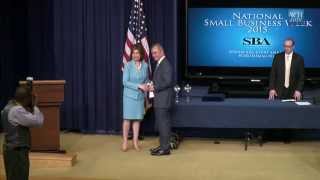
Transcript of the National Small Business Week 2015 Awards Ceremony (June 2, 2015). Senior administration officials (Jeff Zients, Sarah Bloom Raskin, Maria Contreras-Sweet), guests (Rachel Roy, Mayor Muriel Bowser, others) praise small-business-driven job creation and competitiveness, outline policy priorities (trade agreements, tax reform, infrastructure, credit programs like SSBCI and the Small Business Lending Fund, retirement tool MYRA), and present multiple SBA awards (counseling/mentoring, SBIC, exporter, community builders, disaster recovery, contracting, Small Business Person/Company of the Year). The transcript includes winners' names and short winner vignettes (e.g., Missouri Star Quilt Company as 2015 National Small Business of the Year).
Chapters
Good afternoon, everybody, and welcome to the National Small Business Week awards Ceremony. I'm Doug Kramer, counselor to the administrator at sba, and I'm happy that all of you could be here today as we recognize our national and state small business winners. To start our program today, I'd like to welcome to the podium Jeff Saenz, who is an assistant to the President and Chair of the President's National Economic Council.
I want to thank everybody for being here. Before I walked in this building about six and a half years ago, I had never stepped foot in government. I have been in the private sector that whole period of time, working to help grow small businesses to medium sized businesses and really enjoy being here. But do miss doing what all of you do every day. And it's what makes our country so unique and so special and so competitive is the fact that all of you are out there innovating, hiring and competing. So thank you for carving out time and I know it is a very busy schedule for being here. And I want to congratulate all the people who are here because you wouldn't be here unless you were doing a remarkable job in what is, you know, one of our country's most important attributes, which is competing and creating businesses and innovating. So to be at the top of that field in small businesses is an extraordinary accomplishment. So maybe we can give a round of applause for everybody who's here. So again, thanks to all of you because the economy is driven by all of you and small businesses. We got some good news on the job front. The storm morning. It's 230,000 jobs in April. That's actually 63 straight months, which is a record of job creation, positive job growth. 63 straight months. 12.3 million jobs created. Thank you. Small businesses create two out of every three new jobs. So the majority of new jobs created by small businesses. Our unemployment rate now is down to 5.4%. So we still have work to do, but that's the lowest it's been since 2008. And our position in the global economy is really strong. It starts with our worldwide lead in innovation. We have 15 of the top 25 research universities are here in the US more than a third of worldwide research and development is here in the US More than a third of patents come out of the US and again, all of you are front and center in that innovating and being entrepreneurs. So it's that entrepreneurial culture that creates that lead and innovation. Second source of competitive advantage is our workforce. We have the most productive workforce in the World by a large lead, 40% more productive than Germany, three times more productive than China. So our workforce is another source of competitive advantage. If we were here a decade or so ago, we would have been talking about the vulnerability that we have in energy. Now that's a new source of competitive advantage as the US is the number one producer of oil and natural gas in the world. So quite a change across the last decade in terms of energy. And that translates to tens of billions of dollars of cost advantage for manufacturing manufacturers and players in other segments. So that's a real source of competitive advantage. The President talks about us being in the fourth quarter, given that we're now in the final two years of his presidency. But he reminds us all the time that a lot of important things happen in the fourth quarter. And the role of the nec, my team is to help prioritize what's most important to get done for the economy. And we work across the Cabinet with Treasury, the sba, Labor, Transportation, United States Trade Rep, and other economic agencies to prioritize for the President the same way you do every day, what matters most and to ensure that we're executing against those priorities. And top of the list is trade. And that's why the President is at Nike today. Nike headquarters in Portland, along with small and medium sized businesses in Nike's supply chain and small and medium sized businesses that are independent in Portland outside of the supply chain or outside of Nike, talking about the potential for high standard trade agreements. And this is all about boosting exports to grow the economy and strengthen the middle class. On average, companies that export pay 18% more than companies that don't export. And last year we actually had a record for exports, $2.3 trillion. That's an all time high. Over 300,000 companies export and 98% of those are small, medium sized businesses. So people think of trade and exports as big businesses. It's really the small businesses that are driving our growth in exports. Trade agreements, we believe the President believes strongly have the potential to really create more Export opportunities as 95% of the world's consumers now live outside of the US and billions, I think over 3 billion are joining the middle class outside of the US across the next decade. Less than 5% of US companies now export. And when companies do export, on average they only export to one country. So there's huge potential to get more small and medium sized businesses to export. And for those of you who are already exporting, to expand to additional markets. So there's a huge opportunity and this opportunity is front and center as the President works with Congress or as Congress works to pass trade promotion authority. So that's the next several weeks that you'll hear a lot about trade and Congress. And for those of you who are interested in exporting more and having strong trade agreements, now is the time to really be paying attention and leaning forward into that debate. Another area that we're focused on is business tax reform. This is a difficult terrain. We have the highest statutory rate, corporate rate in the world at 35%. And it's really complicated, as all of you know, and it requires a lot of accounting and accountants. And we believe that there's an opportunity to simplify lower rates, benefit small businesses through simpler rules, cash accounting, ability to write off investments more in a simple way. So business tax reform has the potential to really make us more competitive in a global economy. And it also has the potential to fund what is, I think, all of us, for all of us, a really high priority, which is infrastructure. You sense this when you land at an airport or ship your goods through a port or drive to work and dodge potholes every day. We are really behind on infrastructure. We used to think of it as a source of competitive advantage and increasingly it's a source of vulnerability. And there's a huge opportunity to invest in our infrastructure, which is really a twofer. It's a twofer in that it creates good middle class jobs and at the same time it sets us up for long term competitiveness. So business tax reform and infrastructure we think of as a package because the one time revenue from business tax reform can be used to fund infrastructure. And that combination of getting trade agreements in place, strong trade agreements, reforming our tax code, making us more competitive, and funding infrastructure, we believe is a very important set of actions to increase our competitiveness in this global economy. The last thing I'll touch on because you'll start to hear more about the federal budget again. And there's an opportunity here to turn off the sequester, which as you know, were the across the board automatic spending cuts that went in place a few years ago. They were never intended to be policy, but unfortunately that is the budget regime that we're currently under. And the President has been very clear that he will not sign a budget that doesn't turn off the sequester. So that debate will kick into high gear in Congress sometime in the next couple of months. And we believe it's a strong opportunity to invest in R and D and education again, consistent with making American businesses the best in the world. The other thing that we need to avoid here is if you look at business and consumer confidence across the last few years, we've had nice increases recently. But going back a few years, all the dips or most of the dips were related to these self inflicted wounds in Congress. So we need to avoid these unnecessary debates and fiscal dramas that we've had in the past. So hopefully we'll have a rational process here and we'll actually get good investment in R and D and education and other areas that are so important to the future of our country. So that's a quick rundown. There's a lot of bipartisan support for these priorities. It's going to be a lot of hard work ahead. But we think there's real progress and there's real opportunity to build on the progress we've already made and get more done. You all are right on the front lines every day. Small businesses, as I said, are the lifeblood of our economy. You drive innovation and job creation. And I would just ask all of you to pay attention here and weigh in because people look to you as leaders and to understand what matters most. And you're on the front line and you can communicate that. So please look for the opportunity to be involved as these priorities are front and center. But rather than ending on an ask, let me end on a congratulations and a thanks. Thank you for what you're doing. Congratulations on being here. It's a big deal and I really appreciate the opportunity to be able to address the group. With that, let me introduce Sarah Bloom Raskin, who's our Deputy Secretary of the Treasury. Sarah Bloom Raskin. Good.
Well, thank you, Jeff, for that introduction. And good afternoon, everyone. I'd like to welcome all of you to Washington and to this afternoon's awards ceremony. It's great to have everybody here and I'm glad to have the opportunity to join you and to congratulate today's honorees. I'm going to cut to the chase with one simple message, and that is that your businesses are a vital part of our country's growth and prosperity. There are approximately 28 million small businesses in the United States and they create nearly two thirds of all new jobs in our country. When small businesses are positioned to succeed, our economy and our country are positioned to succeed. Your businesses are the economy's backbone and the source of our country's innovation, global competitiveness and growth. And this is why we honor you today. I'm proud that the administration has focused attention on small businesses and I want to talk about a couple of these initiatives. One being The State Small Business Credit Initiative and. And the other being the Small Business Lending Fund, now the State Small Business Credit Initiative. What this does is it combines federal resources with local state expertise to deliver capital to small businesses in a way that's highly responsive to the needs in the local economy. Through 2014, participating states reported expending $864 million through the state Small Business Credit Initiative, which resulted in new loans and investments to more than 12,400 businesses, and their owners have reported creating or retaining more than 140,000 jobs. Likewise, the Small Business Lending Fund uses a powerful rate incentive structure to encourage banks to make good, sound loans to small businesses. Since its inception, banks that tap into the Small Business Lending Fund have increased their loans to small businesses by $15.1 billion by enhancing access to credit. Initiatives like these help propel small businesses and in so doing, economic prosperity forward. The administration has also developed a tool to help entrepreneurs who start businesses plan for their retirement and the retirement of the people that they employ. Now, this new tool is called myra, or My Retirement Account, and it was developed to help the millions of Americans who don't have access to workplace retirement plans or who are ineligible to participate in them. MYRA offers individuals a type of Roth ira, which is invested in a new treasury savings bond. The accounts cost nothing to open, have no fees, and the balances do not go down. This is an ideal resource for small businesses and their employees. So these initiatives, in concert with ongoing work across the government and in particular the Small Business Administration, are designed so that small businesses can thrive and encourage the best traits underlying American prosperity. Ingenuity, rigorous business analysis, and a determination that identifies consumer demand and creates business models that, when marketed and scaled, meet this demand. Today's awardees embody these traits completely. Those of you being honored today stand out in our communities. You are microlenders, business counselors, business development and outreach centers, manufacturers and service providers. You were nominated by local SBA offices, chambers of commerce, elected officials, and members of the public for excellence across several criteria. And from there, you made it through a selection process which incorporated analysis of application packets, financial makeup, and business plan plans to show soundness, forward thinking, and sustained ingenuity. I'd like to thank Administrator Contreras Sweet for bringing this impressive group together. Her visionary leadership has fueled many important initiatives for our nation's small businesses, the most recent of which are outreach events this week, and, of course, today's ceremony. So, in closing, on behalf of the United States Department of the treasury, congratulations to this year's awardees and thank you to all in the small business community here today for your continued vision, innovation, and contribution to our nation's prosperity. Thank you.
I'd like to thank both Jeff and Sarah for coming and sharing some of their time with us today. At this point in the program, we're going to move to our keynote discussion for today's ceremony featuring SBA administrator Maria Contrera Sweet. And fashion designer, entrepreneur, and philanthropist Rachel Roy. So I'd invite them to the stage at this point.
How fun is this? I'm so excited back there.
Hi, everyone.
Wonderful. Well, thank you so much for giving us the pleasure of your company. We have. And I mean that twice over, right? Company and company. Okay.
Very cute. Thank you. I appreciate that. Congratulations, everyone. I'm excited to meet the small business winners and already inspired by them.
Indeed. We want to help welcome a fellow Californian out here to Washington, D.C. it's my first season here, so I just experienced a real winter. I want to share with you.
Oh, well, I'm sure you're getting a lot more back than the weather with experience you're going through, right?
But anyway, we all know, everybody here knows that you have outfitted everybody that we admire, from our first lady, Michelle Obama to everybody else that you can imagine. Listen to this list. Jennifer Gardner, Kim Kardashian, Sharon Stone, Tyra Banks, Penelope Cruz, and on and on and on. So we want to know, we understand that your collections are available at Saks Fifth Avenue and Nordstrom, Neiman Marcus, all of this great stuff. So everybody admires what you have done. Could you tell us about the power of building a brand?
The power of building a brand. So for me, when I started my business, I did not know I was starting a business. I didn't have any intent to start a business. I had been working for about 16, 17 years in fashion. Already 12 of those were in retail. So folding clothes, steaming clothes, things that weren't really that fun. And when I finally got to New York and started working on the other side of fashion, I again worked for a company that was not quite my aesthetic, but because I worked really hard and I was the first to arrive and sometimes the last to leave, I got promoted. And while I was there, I started making clothes that I actually wanted to wear. And so I started wearing them. And a buyer at Bergdorf happened to see one of the tops, and that was my first order. So had I started something that perhaps wasn't A, a passion or B, that I didn't want to work on? From the time that I woke up to the time I went to sleep, I probably wouldn't have a business. And so when I go to talk to young people in particular, that's the sticking point that I hope that they leave with. Choose what your passion is, first of all. Find what your passion is and then work on that. Make that a lifetime career.
We have a group of entrepreneurs in this room. Some of them are going to be really big winners, but all of them are winners because they're creating jobs, they're doing incredible work. But we all know I started three businesses that there's a lot of high. You know, you get a big high, and then there are days where you have a really low low. Could you tell us about, like, one of your lows and how you came, how you overcame it?
Sure. So the lows happen all the time, as you know. So either you can't cover your overhead or you can't ship, or, you know, lots of things. But day to day, you kind of get through those the more you go along. But just less than a year ago, my partners, which at the time were a $4 billion huge American corporation, they were being bought out. And that new company decided they did not want their designer divisions. And I was among those, one of those three that they decided they did not want. And when I went to look at the companies that they were offering to sell me off to, I didn't like my options. And so what I did know about 10 years prior when I was signing with them, was to ask for 100% creative control. Because when you are creative, which I do think small business owners are, you have to be to have the initiative to start your own business. What we have that's most valuable is our creativity. And so I said no. And I took them to see a judge, simple little thing. And the judge decided that, yes, indeed, creativity means you may decide who you sell your name to. And so that win was huge for me. The thing was, once I won my name back, I couldn't afford it. So I had to go and find partners that could. But by then, I knew that I needed partners with shared values, people that believed in what I wanted to put out there. And fortunately, I found that. So, yeah, that wasn't an easy decision. The decision was made from something very difficult that was put onto my plate. And then you have an option to go the other way or to run into it, dive into it. And anytime you do that, anytime there's fear and you go through it, there's major success, at least for me.
That's wonderful. Now I know Everybody here wants to know what was the best advice you ever got, and who was it from?
So I don't come from a family of entrepreneurs necessarily. I didn't have a lot of people to watch, business wise. And so it's not like I was handed out business advice on a daily basis growing up, but I observed. And so Andre Leontale, who is a Vogue editor, once said to me, you have a point of view, and that's why I'm supporting you. And what I noticed is the people that I support are people that have points of view, people that are not afraid to speak their mind, people that are not afraid to say what their opinion truly is.
And.
And when you can apply that to your business, I also think that you'll be blessed tenfold.
That's beautiful. That's beautiful. One of the things that we're seeing at SBA across the country is that entrepreneurs want to be successful financially. They want to provide for their families, but they also want to change the world and have an impact on society. And so I'd be curious to know how you think about the double bottom line, both just as an example of the sense of. Of character that you have, but also just the idea for a marketing story, because we see that more and more companies are carrying a cause. Could you speak to that?
Sure.
So my father is an immigrant, and I traveled to India a lot as a child and just realized that I was blessed to be here. So we grew up in a poor neighborhood, but I still had so much more than family members. And so for me, it's like breathing. It's not even a choice. I must have help other, particularly women. But anyone that is displaced, find employment. For me, employment means freedom. And so what do I do? I make product. So I can make product in third world the same. I could make it in China, although it is a little bit easier there. So you have to have a fighting spirit, and you have to push people to do it. But I can employ people to make product for me seamlessly. And so, again, when I talk to young people, I encourage them. Do you work at the library? Do you work at a pizza shop? Well, why don't you ask your boss every day, Friday, if you can give away a few pies or if you could offer to read some books if you work at a library. But just think seamlessly how you can bring charity into what you do anyway to make it easy on yourself, because we have so much that we have to do in a day.
That's beautiful. Looking at this room, you see this incredible amount of diversity. Men, women, colors, regions, industries. And so they're all eager to hear from you what it took. What is it in your nature? What did you summon up when you were a kid? When did you realize that this was the route for you? Could you just sort of give us your sense of perspective and how you were motivated to be such a successful entrepreneur? It's not easy. You have to summon a lot up.
You have to be okay with people not liking you. You have to be confident enough in who you are to know that you're coming from a good place with good intent. You have to be okay taking a risk. And you eventually have to realize that without taking a risk, you will not have success. And I truly, truly believe that. And it can't be risk for risk sake. It has to be risk for the sake of making a difference in people's lives. And you know how many people can say that they're a small business owner? I mean, how cool is that? You're your own boss. You can walk into any room with any powerful person and hold your head up high. Many of those powerful people have bosses. And the great thing about being a small business owner is you can affect change today, tomorrow we can decide to change our font. We can decide to help a charity that we want to help. Big business can't do that. There's so many different strings to cut through tapes to cut through emails to send to get another email. We can actually make a difference and change the world, I think, much quicker than big business.
And finally, my last question is, if you were Talking to your 10 year old self, what would you be saying to her about preparing her for the future? For the young people, all of us who have family members, what would you say to your 10 year old self today?
That's a great question. What I would have loved to learn years ago, decades ago, is that every single time you're faced with a hardship, it's there for a reason. It's been put into your path so that you'll learn and you'll grow and that you'll face it. And once you do, that's when enormous freedom comes.
Ladies and gentlemen, please give it up for Ms. Rachel Roy. Thank you so much. Thank you.
Well, thank you. Now we're going to move to the part of the program where we hand out awards to our small business men and women. And to do the first, to introduce the first set of awards, I'd like to introduce Wendy Gillis, who is the president and CEO of the Kauffman Foundation.
Thank you, Doug. Good afternoon. First, I want to thank the Small Business Administration for the invitation to be here today. It's an honor to have the opportunity to recognize the achievements of small businesses in America and those who do so much to help them succeed. As we all know, and as what has been confirmed here today, small business fuels the growth of the US Economy, and Kauffman research shows that new and young companies create most of the net new jobs in America as well as the lion's share of innovation. And they're powered by Entrepreneurs Today, entrepreneurship is looking great on the surface. State and regional startup initiatives are abundant, and venture and angel investing are at heights we haven't seen since the dot com era. But the flip side is that the rate of new business creation in America has been falling even before the recession. This slowdown in entrepreneurship is a drag on the economy. It contributes to wage stagnation, lower levels of innovation, and reduced mobility among skilled workers. From our hometown in Kansas City, the Kauffman foundation is working alongside and in partnership with organizations like the SBA to help reverse these trends. By offering our own programs such as One Million Cups, Kauffman Fast Track and Founder School, and by supporting other organizations, we aim to provide the resources, information and networks that equip entrepreneurs with what they need to start and grow their firms. Through all of this, we understand the important role that mentoring and business counseling plays in helping entrepreneurs prosper. From what we've seen in our work, we believe there's every reason to be optimistic. We see renewed appreciation for the nexus between entrepreneurs and expanded economic opportunity across this country. This is evident in the award recipients. Today I'm honored to join SBA administrator Maria Contreras Sweet and presenting the awards for Outstanding Business Counseling and Mentoring. These awards honor the top resource partners in SBA's network across the country that are in the field and on the ground every day counseling and training America's entrepreneurs. Our winners today are chosen from more than 14,000 business counselors, mentors and trainers, many of them volunteers who represent our Small Business Development Centers, women's business centers, score chapters or veterans business outreach centers. The experts in SBA's broad and diverse network strive to reach underserved populations and help small businesses in all industries to develop strategic plans, conduct market studies, implement new technologies, access needed capital, develop plans for exporting, understand their financials, and perhaps most important, providing much needed personal touch and shoulder to lean on for the more than 1 million entrepreneurs who visit them every year. I'd like to note some milestones that SBA is celebrating. Score celebrated its 80th anniversary last year. The SBDC program is celebrating its 35th anniversary this year. Today, there is one women's business center in almost every state. And SBA's Boots to Business program has now trained over 25,000 transitioning service members in its first two years of operations. SBA supported counseling and training does make a difference. Those who receive these services are more likely to start their businesses, their businesses are more likely to survive in the ensuing years, and they're better prepared to seek financing and to plan effectively for future business growth. Please join me in giving them all a hand.
And now we invite the recipients to come on up. And may I just acknowledge Tameka Montgomery, who heads up the Office of Educational Development for the sba. Thank you, Tameka, for leading such an incredible effort. Thank you so much.
And so our recipients for the Business Counseling and Mentoring awards for the score chapter of the year is Hugh McMaster and Jim Cain, accepting on behalf of George Edwards for the Chester and Delaware County SCORE. For the Veterans Business Outreach center of the Year, Darcella Craven, the Executive director of the St. Louis Veterans Business Resource center. For the 2015 sbdc of the year, william joubert, director of the louisiana small business development center. And for the Women's Business center of Excellence Award, Lamaris Aponte, Director of Instituto Empresarial para La Mujer.
There we go. Okay, now we got it right here. Thank you so much. Congratulations.
Thank you. And to help us with the Business Counseling and Innovation Awards, I'm happy to introduce Deputy United States Trade Representative Ambassador Robert Holloman.
Thank you, Doug, for that introduction. And I'm particularly delighted to have an opportunity to join you today in honoring the recipients of the 2015 Small Business Administration Innovation Award. And as Jeff and Sarah explained before me, the Obama administration recognizes the critical role that small and medium sized enterprises have played and that they continue to play in our economic recovery. And given this fact, the Obama administration has designed our trade agenda to ensure that small companies can take advantage of the market opening opportunities in trade agreements that we're currently negotiating. And as many of you may well know, we're currently negotiating trade agreements with 11 countries in the Asia Pacific region called the Trans Pacific Partnership, or tpp. And we're also negotiating a trade agreement with the European Union called the Transatlantic Trade and Investment Partnership, or ttip. When concluded, these agreements will ensure that the United States has free trade with nearly two thirds of the global economy. Now, many people assume that international trade and exports are the province of big companies. However, Sawyer Manufacturing Company, this year's Exporter of the Year, will tell you a different story. Sawyer Manufacturing is a global provider of pipeline and welding equipment headquartered in Tulsa, Oklahoma. Sawyer has been exporting its product overseas since its founding. But in recent years, its international sales and business transactions have grown to account for nearly 50% of the company's total revenue. Its products are now sold in over 50 countries. In reality, 98% of US companies that export are companies like Sawyer Manufacturing small and medium enterprises with tremendous potential for growth if given the right opportunities in the right markets. The trade agreements, like the ones that President Obama and our team are currently negotiating, are designed to ensure that companies like Sawyer Manufacturing can compete on a truly global scale. And given that 95% of the world's consumers now live outside of US borders, our trade agreements will be critical in helping our companies reach those consumers and those markets. So today we are also honoring two small business investment companies, or SBIcs, that have played a significant role in in helping finance our economic recovery. Our small fund recipient, Newspring Capital has invested heavily in underserved communities, and its portfolio companies currently employ over 7,000 workers. Our large fund recipient, Monroe Capital, has invested $2.5 billion in funds in more than 500 middle market companies, 30% of which are minority owned. A key component of our comparative advantage as Americans is our commitment to innovation and our shared sense of entrepreneurial spirit. The role that New Spring Capital and Monroe Capital have played in identifying, backing, and enabling our innovative entrepreneurs to expand and grow cannot be overstated. So with that, I will turn the floor over to Maria, who will present this year's awards.
Fantastic. And again, I want to acknowledge Javier Sa'deh who handles our Office of Investment and Innovation. And thank you for your leadership in executing so effectively across the country on this program. Javier Sa'deh, our Associate administrator over the Office of Innovation and Investment. Thank you. Thank you, Avi.
Our first recipient for sbic of the year is theodore koenig. For managing member of monroe capital partners fund.
Thank you so much. Okay, we're going to just turn it right here. I think we should be a little more over so that the push.
And also receiving an award for sbic of the year is michael dipiano, managing director of new spring capital. And finally, the award for Exporter of the Year, Andrew Martins. On behalf of Dave Hembury for Sawyer Manufacturing Company. And then to help us with our Building Strong Communities awards, I'd like to welcome to the stage the mayor of Washington, D.C. muriel Bowser.
Well, Good afternoon everybody. I am delighted to be here and it is certainly an honor to be with the Administrator. Madam Administrator Contreras Suite and certainly to be here to support President Obama's initiatives around small businesses. I so admire the work that you do and we try every day to support those initiatives in the District of Columbia as well. We have been focused in the Bowser Administration and your nation's capital on how small businesses can help us protect and preserve pathways to the middle class. As part of National Small Business Week, we kicked off a month of a focus on innovation in the District of Columbia during the month of May. We call it Innomation, which this month long initiative is focused all across the District of Columbia on how innovative programs will create jobs, engage residents and underserved communities and position the District as a hub of innovation. The District is committed to doing all we can to buttress these efforts in our city and identify best practices from around our nation. It's my pleasure today to introduce the Community Builders Awards category. This award category was created to honor individuals, businesses and organizations whose leadership strengthened and helped usher in recovery efforts after communities suffered from a natural or man made disaster. We can all recall the day Hurricane Sandy hit. The storm devastated the shores of New York and New Jersey. We also remembered the landslides that crippled parts of Washington State and its residents in 2014. Lives were forever changed but the people and businesses of those communities, communities rallied. It was the business owners, it was the entrepreneurs and volunteers who are being honored today that turned these disasters into opportunities to rebuild and revitalize communities in need. The businesses honored here took action at a time when their communities needed them the most. Also notable this year in this category are lenders who have been instrumental in the small business recovery efforts in Ferguson, Missouri and Albany, New York. This is the first year the Small Business Administration will recognize a Micro Lender of the Year and a Community Advantage Lender of the Year. These mission based lenders work in underserved communities and help expand diversity and inclusivity in the small business landscape. These are the small business stories that make us proud. Owners who unselfishly give their time and talent back to their communities and that's what makes America strong. I'm so pleased to be with the administrator today to introduce this category and congratulate these business owners.
And now I just want to take a moment to acknowledge the leader of one of the most important banks in our country. That is our Office of Capital Access, a strong banker who gave up her career to come and to serve her country, Ann Marie Mello. And I am so pleased also to introduce you to. We always talk about three Cs that we are, about counseling, contracting and. And capital. But we mustn't forget that when you find yourself in harm's way after a sudden or natural disaster, that we do have. The Office of Disaster Assistance. James Rivera.
The recipient of the jody c. Raskind microlender of the year award is robert boyle, founder and CEO of the justine peterson housing and reinvestment corporation.
Okay, now we're going to step forward so that we can get you on.
The community advantage lender of the year. Patrick mccrell, founder and CEO of the empire state certified development corporation.
Long time no seat. We were together yesterday in New York. Okay. Get you here. You take it.
Thank you very much.
Okay. There you go. Thank you. You know, for those of you who aren't familiar, I wanted the mayor to know this while she's still with us, and that is that we have this very special award that you just heard, the Jody Raskind Award. And we wanted you to know that the reason we established this is because in our Office of Microloans, we had an extraordinary employee who. Who made her career the sba. And we just recently lost her to cancer. And so this is in her honor. Thank you.
The 2015 phoenix award for outstanding small business disaster recovery. Conrad kruiter, president of moritz inlet marine incorporated. And then the 2015 Phoenix Award for outstanding contribution to Disaster risk Recovery by a public official. Mayor Dan Rankin of Darrington, Washington.
Thank you so much. Thank you again. For those of you who don't know, I had the pleasure of meeting the mayor. It was as soon as I was sworn in. A couple of days later, I headed over to the horrific situation that we found ourselves in. The Oso Darrington Arlington community around the mudslides and the people who were succumbed to them. So we want to thank you for your leadership. We know that you have served that community so ardently. Thank you so much, sir.
And the 2015 Phoenix Award for Outstanding Contribution to Disaster Recovery by volunteer Christian Spears of State Island, New York.
Here you go. Okay. We're going to get the mayor.
The other side.
Thank you very much.
Thank you so much. My pleasure.
Please.
Thank you.
Okay.
And now we're going to introduce the Contracting award. It's hard to underestimate the importance of federal procurement to our small business economy. Small businesses that secure federal contracts average annual sales nearly double that of small firms that don't. The federal government is the largest procurer of goods and services in the world. The single most important thing that Uncle Sam can do is to help America's entrepreneurs succeed and to give them more business. Last summer at natsa, we had the Sports Special opportunity to announce that the federal government had, for its first time in eight years, reached yes, we attained the 23% small business contracting goal for 2013. We're expecting even better results when we release our 14 fiscal scorecard in the coming weeks. I'm pleased to share with you that President Obama and Vice President Biden and Valerie Jarrett have all convened high level meetings throughout the administration to emphasize the importance of small business procurement to our recovery. Meanwhile, SBA has implemented the most robust procurement training and education program of our agency's history. In fact, our GC classroom teaches entrepreneurs the differences between selling to the commercial sector and selling to the government. We launched a new program that we call Destination Hub to make sure that we attracted federal contractors and buyers from the federal government to certain destinations that had been historically underutilized. We launched a program that we call challengeher with an her at the end in cooperation with American Express and Women in Public Policy so that we could help encourage more women to get into the game. So that we could reach our 5% goal. We launched online free webinars for applicants and participants in our 8 program. The result has been stronger applications to the 8 program and more contracts to certified small businesses looking to grow. Finally, just last year, the President and I launched a program that we called the American Supplier Initiative, which has hosted hosted matchmaking events across the nation, bringing entrepreneurs, buyers and prime contractors together. The President also committed to pay small businesses in 15 days once that invoice is reconciled. And then when corporations heard about it, we said only if you pay small businesses in 15 days and you do business with the federal government, we'll consider doing the same for you. And so today we're here to to recognize several small businesses for their excellence. The first honoree is our graduate firm of the year of the eight program for the year 2015. Please welcome up a family that I went to a visit and saw their program and was so impressed at their story. You have to read their story. Here's a person who served us in our armed forces, stood in harm's way, and now has come back to continue to protect our people. By now building gear, he learned to sew through a correspondence course and then now is building gear to protect our troops around the world. Ladies and gentlemen, our winners, Cher and Eli Valenzuela from First State Manufacturing. Here you go. Congratulations to you and to Hubby Nice to see you. There we go. Okay, we're going to turn this way. Congratulations. Nice to see you waking up. Our next honoree is the winner of our Dwight Eisenhower Award for Excellence in Construction. Ladies and gentlemen, let me just say to you that we are so delighted to have Thomas Logan, President of AMEC Environment and Infrastructure Incorporated. Now we present the 2015 Dwight Eisenhower Award for Excellence in Manufacturing. Please say hello and congratulate Sherman Dupree, Director of Small Diverse Business and Strategic Alliances for the Boeing Company. Thank you so much. Next is our 2015 Dwight Eisenhower Award for Excellence in Research and Development. And this goes to Cassandra Stewart, the director of Small Business programs for UT Battelle. And now it's my pleasure to present our 2015 Dwight Eisenhower Award for Excellence for Services to Kathy Lynn Livinggood, the sector vice president for supply chain at Northrop Grumman Information Systems. Fantastic. And now it's time to recognize the 2015 Prime Contractor of the Year. Ladies and gentlemen, please give it up for John Hammock, the president and CEO of Key Logic Systems. There we go. Do that again. Thank you so much. Thank you. Finally, our 2015 subcontractor of the year is Richard Hansell, president of RTH Mechanical Contractors. Thank you so much. And I also want to do the same and acknowledge that our buying contracting officers that we deploy around the government at these key buying activity centers are doing the Lord's work. They go in there to make sure at every opportunity that we can redirect an appropriate contract to the small if it is so qualified for the small business community. And I'm telling you, these guys are out there and gals doing guerrilla marketing sometimes and warfare out there to make sure that we get to our 23% goal. And they've done so many things to make sure that that happens. And that's why we're so proud to have John Shiraka leading our Office of Contracting and Procurement. Thank you so much, John Shir. Okay, now we're going to get into the Small Business Persons of the Year, which is always a lot of fun. Before we announce the winners of our top award, let me take an opportunity to congratulate all of our state and national winners as we wrap up what is our celebration of National Small Business Week. It's been a whirlwind week for us at sba. We are the small organization that can do a big lift every day. We make a big deal out of small businesses. We have celebrated the entrepreneurs that have led America's comeback from the recession and into our Recovery. Just to share with you how this week has gone, on Monday, I started off in Miami, welcoming thousands of entrepreneurs that were there to learn about our SBIR programs, our Office of Innovation and Investment office. And I'm so grateful to Javier Sa' Adei again for helping us to convene that effort. It was a wonderful turnout to see so many people from throughout the Americas that wanted to learn about what was taking place here. And so we also celebrated many immigrant entrepreneurs and the contributions that they're making to our country. They're twice as likely to start a business. They employ one of the out of every 10 employees, and they're filing patents at twice the national rate. So we're pleased to say that in that regard, we wanted to honor those people who have come here who are helping to lift America and to make sure that while they are learning English, because we all know that English is the language of business, we wanted to make certain that as they're going on their journey, that they would have resources. And so I was able to announce while there that we had just launched SBA's first bilingual website. We're now in English and in Spanish. Thank you. On Tuesday, I headed across the country and headed over to Los Angeles. It just so happened that our second day was their first day of what they call World Trade Week. And so there we were able to celebrate all of the contributions and the role that the SBA plays in international trade. Again, with our 90% guarantee loans and all the products and good things that are happening there, we're able to discuss how we can open new markets for our small business exporters. On San Antonio, headed over to. Excuse me. On Wednesday, I headed over to San Antonio to focus on our access to capital programs, where I met with all of our lending partners. When people talk about SBA loans, we know that we aren't making the loans, that it is our financial lending partners, partners who are. And so we are the guarantor. But it's important to have the network of lending partners. So I was there to meet with them at their conference where I announced that SBA launched a new program called Link. Now, I know many of you are familiar with match.com where you go online and you find the love of your life. And so what we wanted to do is take that same technology, have you answer a few questions, and now the borrower is put in the driver's seat because the banks compete for their business. It's called LINC. So I hope that you will go to the SBA.gov website to look for the link called Linc, we're so creative. And yesterday, then I darted off over to New York City, where I was able to announce a very powerful relationship that we've launched with PBS television. I was able to witness from. Can you imagine Wikipedians, people who know Wikipedia go on Wikipedia and they were having an edit a thon where they were going in to find important people whose story had not been fully told, to make sure that we told the story about their service to their nation in the armed forces. So it was really wonderful to be there with them and to see that happen there with pbs. And also while I was there, we made sure that we focused in the evening. In the evening, we. We pulled together all the millennial entrepreneurs to talk to them about the resources and the toolkit that we've launched recently for them. This morning, I wish you could have joined us all because it was such an incredible opportunity for us to witness a program that we just launched this year very, very late, and it's called Challenge Her. The last three letters are H, E, R. Where we were celebrating women and their opportunity to also get in the game and to make sure that they're also coding and creating solutions for women and for their families. And so we announced some big prizes, and we were so proud to have so many partners in that initiative. I want to acknowledge again, Tameka's Shop, and in particular, Erin Andrews for that enormous lift. So congratulations to that team. And now we're here. We're here because we picked National Small Business Week to be this week, because we wanted to make sure that we encouraged you to for Mother's Day, Father's and graduation ceremonies, that you would shop for mom, dads, and grads small, that you would shop local to create more local jobs, to create that beautiful sensation that happens when you go into an actual community that has unique stores and craft beers and restaurants and just all sorts of exciting things that entrepreneurs bring to the game. So that's what SBA is all about. It's about helping entrepreneurs pursue big dreams one step at a time. The small businesses that we financed have come into some of the most successful companies in the history of mankind. Some of you may have heard of a little company in our nascent stage that we helped now called Apple, the inventor of the iPhone. Some of you may have heard of a little company in their nascent stage now called FedEx that's become the world's largest shipping company, or another store that became the sports apparel company that made Air Jordan a shoe that convinced athletes that they could fly, called Nike. The SBA's helped finance these companies and so many others. I could go on aol, Ben and Jerry's, Chobani's. It's so wonderful to travel across the country and to see. In fact, just a couple of months ago, I met another young man named Kevin Plankton. And he came over to me and he said I would tell the SBA story anywhere because he said he'd been turned down and turned down over and over again until he finally reached a little bank here in Maryland that gave him his very first $250,000 loan. And now that company is called Under Armour. I love traveling the country and learning about the stories that have changed in the arc of people's lives as a result of the sba. We've helped so many small businesses to succeed and more importantly, to create jobs in their communities. In fact, I hope that you all looked at your news this morning to hear that the Department of Labor announced that just this morning that we added another 223,000 jobs. Last month. A survey by ADP found that small businesses added a majority of those jobs. Imagine being able to sit a cabinet and say after. Tom Perez boasts the numbers that I get to say. But two thirds, Mr. President, are coming from the small. And so it's our economy now that has added jobs over 62 straight months. That's a record in American history. Ladies and gentlemen. It's the longest growth streak we have ever seen. We're still packed because this is your accomplishment. It is your accomplishment to know that we have now dropped the unemployment rate to 5.4%, the lowest we have seen since 2008. The President, the day that he took office, he was inaugurated. The Dow Jones was at 7,948. Today it's hovering around 18,000. We've come so far and I'm just so pleased that you have all had an important role in that regard. We have six outstanding finalists who have been that story, who have helped move those numbers and move the dial. So now I'm going to announce our first runner up. Ladies and gentlemen, from Cape Canaveral, Florida, please welcome up a veteran of the US Navy, Carol Craig. While she's up here, I want you to hear her story. Please stand with me. In 1999, she founded Craig Technologies as a woman owned service disabled veteran, owned eight certified firm specializing in engineering, avionics and software design. What began as a one woman business today has 400 associates, over 20 students, states and contracts. She contracts with over 20 government agencies. And she's now experiencing $45 million in revenue. Ladies and gentlemen, again, Carol Craig and Craig Technolog. Powerful stories. Powerful. Okay, our next runner up is from North. No, New Jersey. If you've ever enjoyed a clementine or a kiwi in New York metro area, it was probably Michael Milken's small business that may have helped move those products from a port to your local store. Michael, a Cuban American, started his company in 1996 with a little old used truck and a credit card that would max out if he got close to $2,000. In 2011, Hurricane Sandy caused them to lose to lose three weeks of business. But Michael did not regardless shut down or lay off one single employee. Today his company has 40 vehicles. With more than 55 employees and $8 million in annual revenues. Inc. Magazine in fact calls him one of the America's fastest growing companies. Congratulations again to Michael. Our next runner up is right here. Locally from Washington D.C. as a woman owned business in the construction industry, this woman works hard to gain equal respect and equal opportunities in a male dominated industry. Her firm delivers client solutions for new construction, renovations and information technology integration. Since the company received its 8 certification, they've received multimillion dollar contracts for from the National Science foundation, the Food and Drug administration and the U.S. department of Education. Few question anymore whether her firm can compete and win against the big boys. Ladies and gentlemen, please say hello in a round of applause to Nicole Parker and Elosin Group. Wonderful. And our next finalist is from Bronx, New York. He founded a solar development company that finances and designs, engineers and installs and maintains solar energy systems. Under his leadership, his small business has become New York City's largest solar energy provider. Today the company has 100 employees and hired a full time recruiter to fill another 50 that he's seeking. He has partnered with Bronx Community College as part of Governor Cuomo's startup and New York program for doing well and doing good. Let's acknowledge and applause and applaud Charles Feet and On Force Solar. Our final runner up is from Las Cr Cruces, New Mexico. This is a U.S. army veteran with high level security experience in the military and a wealth of private sector experience in banking. In 2002 he rented a 3,000 square foot space and started a company with a single shredder and truck. He secured three SBA loans to build a full service records management company. Rick added franchises in Albuquerque, Richmond, Houston and Phoenix. He's created nine full time jobs and employs two part time workers with developmental delay and disabilities. Ladies and gentlemen, another finalist Big round of applause to Rick Jackson and his company ads for their success. Which brings us to one family left. So now they've figured out who they are. No surprise to them. Okay, but let's share with you. Like many towns in rural America, employment was scarce in Hamilton, Missouri following the market crash in 2008. When their father lost his retirement savings, Alan and his sister Sarah started a business. To recover that nest egg, they took out a loan and they bought a little quilting machine and a small binding, excuse me, a small building to house it in. They quickly recognized that quilting talents of Sarah and her mother Jenny were kind of special. They decided to do what they knew and to propel their business through online marketing. They produced quilting tutorials on a YouTube which became a big hit. Jenny's passion for her longtime hobby shined through the camera as she taught quilting. Soon, the channel had a worldwide following of 220,000 subscribers. It's now the most popular quilting channel on the Internet. Missouri Star Quilt Company has brought new life to a town called Hamilton. With the success of the business, the owners have invested money back into the community. They went back in with their profits to rehabilitate buildings on Main Street. They helped reopen the local chamber of commerce. And they spurred other business startups, went out and helped every other business that they could to create revitalization efforts in their community. In fact, to date, the company has attracted so many visitors, including international guests, that this rural town full of vacant buildings has been transformed into a popular tourist destination. Hamilton now has its own bed and breakfast, a winery outlet and so many other sprouting retail stores. Free Saturday movies at the parks. 5,000 tourists a month come to Hamilton because of this family. This small business has become a prolific exporter, shipping hundreds of packages every day to customers all over the globe. This small business is exporting its products to Great Britain, Russia, India, Canada, Australia, Saudi Arabia, France and many other nations. They're keeping the postal service in Hamilton very busy and people flowing into their community to shop. They're exporting success in their decision to look beyond our borders for customers and has helped Missouri Star Quilt Company employ 180 people after just seven years. That's important in a small community like Hamilton. It's also important to our country where they're strengthening our nation's economy and reducing our trade deficit. In 2013, Allen and Sarah received a 504 SBA504 loan to construct a 45,000 square foot facility for warehousing, shipping, customer service and catalog creation. Today, Missouri Stark Quilt Company owns 15 buildings. They are considered the largest employer in their county, and their company earns over close to $18 million in annual sales for exporting globally. They're reviving a proud rural town and putting Missourians back to work. Ladies and gentlemen, Alan and Sarah Galbraithone are SBA's 2015 National Small Business of the Year.
Thank you again.
Thank you. Thank you. Congratulations. We're both teary here now. It's very nice. Let me just thank each and every one of you. President Obama has said that entrepreneurship is the most important and powerful force the world has ever seen to promote people out of poverty and to promote social mobility. It allows anybody to start a business, share their talents. Talents and create a better life for themselves and for their family. So to all of you today and for those watching on our livestream at home, I invite each of you to join the movement to champion entrepreneurship in America. I hope that you'll continue the conversation with the hashtag that we established Dream small Biz, and join the conversation. In fact, my staff even got me to start tweeting. And so I really enjoy reviewing it. Just before I go to bed, I sit there and sort of converse with those who are. Who are tweeting with me. My address is my handle, as my son calls it, is MCS for the number four biz. But the truth is, again, that you don't have to be a small business owner to support small businesses. We really do hope that as you go out and you begin to celebrate this beautiful weekend with a mother, a sister, a daughter, a grandmother, that you will think about shopping small to get that card or that special little gift that you may have for them. We hope that you'll remember always that in America, we weren't all given an equal talent, but through entrepreneurship, as John F. Kennedy said, we can have people pursue their own talents, have an equal opportunity to pursue their talents. And that's why we framed the SBA to now stand for smart, Bold and accessible. Because I want to make certain that we remain relevant, that we have, in fact, smart systems that we can deploy to make your lives easier and more efficient. That we have bolder strategies about helping you engage in the international trade, and that we make certain that our programs are more accessible to everybody. And indeed, they have. I'll just close with a quote I like to end most of my talks with because I think it's so empowering, because it reminds me of Martin Luther King. I got here at the age of five. I want you to know for those of you who don't know my story, I didn't speak a word of English, and I certainly didn't know the language of business. But my grandmother always said to bring others along. And she said, it's not the titles you have. It's what you do with the titles that you have. And so I've always carried my grandmother. I know each of you has one, just like my Amelia. And she said that although we had been a family of migrant workers, that someday I might be able to work in an office and be a secretary. The good Lord heard her and allowed me to hold office and to be a cabinet secretary. Thank you.
Thank you.
And so with that, I close out the program with my favorite quote, when Martin Luther King said. Said, what good is it to be able to sit at an integrated counter if we can't afford to buy the hamburger? Ladies and gentlemen, understanding what's taking place in the world and the importance of America's role in it, to know that we have the power to stamp out despotism and tyranny and the egregious crimes that are taking place around the world by reinforcing our middle class, by grant, growing our freedom and freedom around the world, and that we're doing it through entrepreneurship that changes the arc of people's lives. And so I say to Martin Luther King, no, we're not going to go back to buy that hamburger. We're going to go back to help people buy the restaurant. We're going to build ownership. God bless you. Thank you so much. And God bless America.
More from Your







President Donald J. Trump and First Lady Melania Trump Visit Grieving Texas After Deadly Floods

💪 Thinking of starting a #biz? Go for it! — Kerry Boyle, Vermont #SmallBiz Person of the Year

President Trump Participates in a Bilateral Meeting with the Prime Minister of Canada, May 6, 2025

