National Veterans Small Business Week Workshop: Get Lender Ready
SBA workshop teaching veteran entrepreneurs how to secure business loans. Learn the five C's of credit, required financial documents, and what lenders actually look for. Presenters cover personal vs. business credit, DSCR ratios, and a lender panel shares real-world application tips.
Chapters
Thank you for joining us for our celebration of National Veterans Small Business Week. We're happy to celebrate this 11th year of the celebration of Veteran owned small businesses and veterans in our community. I'm happy to introduce that our first speaker will be Jen Jennifer Kim, who serves as the Associate Administrator for the Office of Field Operations. She oversees all of our district offices and our regional offices throughout the country and leads the charge for us as far as our marketing and outreach efforts and our compliance efforts in the field. So, Jen, I'll send it over to you.
Thank you so much, Janelle. And hello everybody. Welcome to today's event and Happy National Veterans Small Business Week. I'm thrilled to be celebrating with you all and so happy for all of you to join. And you know, thank you for all your service to the country. And you know, we at the S. SBA hope to help you in your journey as you continue to serve your communities across the country. This week there's a lot of great events happening all across the country. As Janelle said, We have 68 district offices. I hope you've come into contact with one of them already, but if you haven't, encourage folks to reach out to them to get even more service and products from the SBA after this. I think I heard this week there's an average of over 30 events happening every day across the country in support of National Veterans Small Business Week. And there's a lot of events like this one happening in communities all over the country. Under the leadership of our administrator, Isabel Casillas Guzman, the SBA has really worked to kind of stretch its efforts to support veteran owned businesses and entrepreneurs over the last couple years under President Biden. In the last fiscal year, the SBA supported over 3,000 loans to veteran owned businesses, which totaled over a billion dollars. And total loans to veteran owned businesses are up about 50% under the Biden Harris administration. So, you know, we hope that by you attending this event, we will help to increase that number even farther as you work to expand your businesses. I also want to mention, under this administration, we have expanded our Veteran Business Outreach centers as well. In fact, we're celebrating openings of two more today like as we speak in Ohio and Pennsylvania. But we have expanded those VBoCs, those veteran business outreach centers, to over 30 centers across the country this year and, you know, just want to continue to try and do our best to support the millions of veteran owned small businesses across the country that help to support millions of jobs and contribute over a trillion dollars to the US Economy every year. And just A note about this particular program. This is part of the SBA's effort to help not only provide more access to capital, but to make sure that entrepreneurs like you are best prepared as you go to interact with a lender in your community to get that support for your businesses. So I'm really excited for all of you to go through this program today and thank you to our great team that has put this work together. But you know, really, you are a vital segment of the U.S. economy and you know, wish you the best of luck in your small business business journ and encourage you to come to more SBA events, learn more about other resources that could be helpful to your business. So thank you so much. Whether you are a seasoned business owner or just starting out, we're here to support you and so thank you for your commitment to your country, but also to your community. So I'll turn it back over to the group and thank you so much.
Thank you for those words, Jen. We appreciate that. I wanted to offer a couple of local remarks since we are the North Florida District Office and we in collaboration with our Office of Field Operations are actually hosting this event. The SBA tips our hats to veteran owned small businesses who make significant contributions to the US Economy and add immense value to our local communities. Your military experience, which includes thinking strategically, meticulous discipline and the will to win, all have proven to serve veterans well as they transition from service to to business ownership. We have programs, as Jennifer said, to help you and assist you with starting your journey as an entrepreneur, which include things such as counseling, training and mentorship. And we all know that veterans serve a vital part of the economic engine that is the small business ownership here in the United States. In fact, veteran owned businesses constitute contributing over $1 trillion in annual sales to the national economy. And these businesses span diverse sectors with a notable presence in professional services, construction, health care, retail trade and more. During the program, we will focus on preparing small business owners to ask for a small business loan. The series is designed to help our entrepreneurs stand out and will cover everything from business credit, understanding business financials and pitching to a lender. And we'll follow up the workshop with a lender panel of local and national lenders that actually are processing SBA loans daily. As Jen said, today's presentation is actually part of a larger series currently being piloted throughout our agency. We need you to stay connected with our district offices to hear when similar courses will be done in your area and also to allow you to connect with resources and and have updates on when the Full version of the series will be available across all of our district offices. We're excited to support your journey and help you to set to set you up for success in every way possible. So now we'll go over the agenda again. The walking part is being done right now. We'll go straight into the understanding your credit, how to prepare your financials again to make you better suited to take your application to a lender. We're going to follow that and tie it all up with the Putting it All Together Together which is actually working on the pitch with a financial institution. And then we'll segue after that after a short break into our lending panel. And now I'm going to turn it over to Nina Ramone.
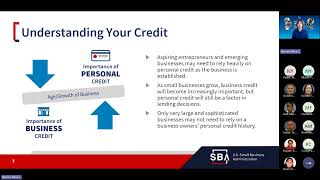
Hi everybody, my name is Nina Ramone. I am a Operations Liaison with the Office of Field Operations. A little bit about me Before I came up to the OFO, I was the Region 6 Regional Communications Director and before that I was at the San Antonio District office and one of my primary duties there was the Business Veteran Development Officer and I worked mostly doing the Boots to Business programs for all the vets out there. If you haven't heard of Boots to Business, it was done through your TAP or your Transition Assistance program and it is an eight module, two day course that kind of does the introduction of small businesses. There is a shorter version called Boots to Business Reboot where it condenses everything down into one day and that's for active duty veterans and the spouses to attend. And the really cool thing about that is that it allows you to to transition into the follow on course which is called Revenue Readiness done in partnership of the Mississippi State University. So enough about all of that, let's get into understanding your credit. So understanding how lenders use different credit scores can empower small business owners, giving them more control over over their financial decisions. There are two types of credit scores and they are used by lenders to assess the risk of lending to an individual and a business. To manage your credit effectively, you need to know this information so that you can make more informed and strategic financial decisions. Often the distinction between personal credit and business credit can be a little overwhelming. However, understanding the distinctions can be very helpful when navigating your funding options. So what is personal credit? It refers to the individual's creditworthiness based on financial behavior, payment history, credit card usage, loan repayments, etc. And on the other hand, business credit refers to the creditworthiness of a company and is independent of the owner's personal credit. So like personal credit, which Reflects again the individual's financial behavior. Companies are scored based on the business's financial behavior, such as their ability to pay their bills on time, the amount available, credit, which can be a little bit more comprehensive than loans, and as you'll see that when we get a little bit further on into this slide deck. So as businesses starts, grows and matures, the importance of relying on personal credit versus business credit will start to change over time, offering a gradual and reassuring transition that can benefit the business in the long run. For new and young businesses, the lack of historical data often necessitates reliance on personal credit, which as we discussed, is based on the owner's personal financial history. Once a business has established a solid credit history and accumulated at least two years of of financial information with strong account balances, lenders may start to shift their focus onto the business's creditworthiness, which again is based on the business's financial performance and payment history. So an individual's creditworthiness, like I said, is based on their personal financial history, which can include your credit card usage, your loan repayments, your payment history, your credit utilization, and so on. Each of these activities is weighted and distilled into a three digit credit score ranging from 300 to 850 using credit modules such as FICO and VantageScore. It's important to note that your personal credit scores are maintained by three credit bureaus and that's Equifax, Experian and TransUnion and they play a crucial role in this process. However, it's also important to remember that lenders have their own scoring modules too. Well, we'll focus on the three traditional credit bureaus and their modules for today's conversation. So both the FICO and Vantage score uses the same numerical scoring system. Again it ranges from 300 to 850. However, each uses different criteria to weigh different financial behaviors and assess potential credit risk as illustrated in this chart. So as you can see, the FICO score uses five key factors and things are like payment history, outstanding debt or your credit balance, the length of your credit history and so on. And it shows. The chart on here shows how it is weighted. The Vantage score uses six factors to create a consumer score and it is very similar as you can see as the fico such as like payment history, credit utilization and so on. And it shows more of like which ones are a little bit more influential than the others. So have you ever wondered how lenders size you up when you're looking for a loan or what a good credit score is when you're shopping for a loan. Scores are based on risk level. The bottom line is that the higher the score, the better. The higher the score means that there is less risk, there's less risk for a lender, and the more accessible the path is to approval for the borrower. The higher score also means more favorable loan term rates and lower interest rates, which in turn reduces the overall cost of borrowing. So a quick question for everybody on the call. In which range do you think most Americans fall? If you said anywhere between 670 and 739, you are correct. That is considered a good score. In fact, in 2023 the average credit score in the US was 715. You so we've talked a little bit about the personal credit score and now we're going to go into the business credit score or the business credit report. Just like experian, Equifax and TransUnion, Dun & Bradstreet or D and B, Experian Business and Equifax are crucial in assessing a business's creditworthiness. These three entities gather data on the businesses, reflecting its financial reliability and ability to meet its obligations. Each bureau has a slightly different methodology for assessing the business's financial health. So looking at this chart we have first Dun and Bradstreet or D and B, and they focus solely on business credit with an emphasis on how your business interacts with its vendors and suppliers. This is known as trade credit performance. Then we have the Equifax business which compiles business credit reports with a focus on small businesses experience with business lines of credit and loans from banks and non banks. And lastly we have the Experian business which focuses on bank and non bank lender data, vendor and supplier data, and information in public records. I know that we have covered quite a bit so far and I know that this slide right here in particular has a lot of information on there. But I just want to take a quick break and a reminder that for those that aren't familiar with working with the sba, the SBA has a lot of resource partners to support you on your business journey. Resource partners that were mentioned such as the Veteran Business Outreach center or vboc, but we also have score, the Women's Business center and Small Business Development Centers across the country to support you with small business advice and mentorship. So let's get into this slide. Small business credit delves deep into business specific activities. While there are some overlap compared to a personal credit report which includes different information specific to a business entity such as the companies that have granted credit to the business and how much incorporation data, financial reports, contracts, grants, federal debarments, any UCC filings, and so on. In addition, instead of your Social Security number like on your personal credit, the business credit report uses what they call what they call a DUNS number, which is a unique identifier assigned to the business. And you can check to see if your business has a DUNS number by using the D and B Lookup tool. And you can just go on to Google or whatever Internet browser search preference that you have and type in DNB Delta November Bravo lookup tool and it should be one of the first things that pops up. If your business does not have one, you can register for free on their website and it usually takes about two weeks. To start the process of building credit history for a business. A business must have an Employer Identification Number or an ein. If you don't have an ein, your first step is to obtain one from the IRS or the Internal Revenue Service. You may need an EIN to do business with different entities, and if you wish to do business with the US Government in federal contracting, you should also obtain a DUNS number through the dnb. And for those that are interested in federal contracting tomorrow at this time we also have a Certification Advantage workshop for the veteran community, so stay tuned or be on the lookout for information about that. Next, if you have any open credit accounts or trade credit for your business, find out if you already have a business credit history by searching for your company name and the websites of each of these business credit reporting agencies. It's kind of similar to what you would do for your personal credit history and if your business is listed, request a report to see what information has been reported and making sure everything on there is accurate. If your business is not listed on any of these business credit reporting agencies, ask your lenders, your suppliers and your vendors if they will start reporting to the business credit reporting agencies or consider establishing relationships with those that you know already do. So once you have records established at one or more of the business reporting agencies, then you can start building your credit history by updating or correcting any of the information, including figures from your annual financial statements. Again, this is very similar on how you would do it for your personal credit. So how can you build a strong personal or strong business credit? I have a couple of tips here for you. First is pay your bills on time, pay your loans on time, and pay your taxes on time. A strong payment history shows lenders that your business can be trusted to manage credit well. Paying taxes on time helps you avoid liens, judgments, interest and penalties and late payments can be an indicator that businesses that a business is having cash flow issues. Second, make sure that your business is visible. Lenders, customers and other businesses want to be assured that you are known and trusted in your community. You may become visible by having that EIN number, having a phone number, a legal address and a digital presence. And third is to maintain good relationships with suppliers and vendors. Having a good track record of paying other businesses that you work with on time will strengthen your business credit history. And lastly, separate your personal finances and your business finances. Do not commingle the two. Seek advice from professionals such as insurance agents, accountants and lawyers to limit personal liability for your business activity. Obtain credit accounts when needed in the name of your business. Monitor your personal and business credit histories and know what is being reported to the consumer and business credit reporting agencies and dispute anything that is inaccurate. And again, if you need any assistance with building your credit or understanding, doing your financial documents or just mentorship in general, remember that SBA does have resource partners and those are again are score, the Women's Business Center, Small Business Development Centers, and the Veteran Business Outreach Center. Additionally, District Offices and all of our resource partners has a strong network of of an entrepreneurial ecosystem that is here to support you on your business journey. All right, and the last slide of this section is the five Cs of credit. Lenders will evaluate your application critically and look for an applicant who thoroughly addresses what are commonly known as the five Cs of credit. And that's character, capacity, capital, collateral and conditions. Another quick question for.
Y'.
All. Which of these five Cs is the biggest challenge for small businesses? Actually, this is a trick question because there isn't a single biggest challenge. Because each business is unique, what might be a top hurdle for one business could be less of an issue for another. Each business faces its own combination of these challenges and their impact varies. So let's look at what the five C's of credit are. First off is character, and that is the overall impression that you make on a lender. Specifically, your ability to manage money, your background and your experience. To determine or evaluate character, a lender will typically request historical financial documents, resumes, business plans, and most importantly, credit reports. There is also value in the relationship that you have with your lender. Next, we have capacity. This refers to financial capacity. This is sometimes seen as one of the most important of the five Cs because it measures whether or not you can promptly and consistently repay the loan, a factor that lenders Consider with utmost significance. This is where a lender will evaluate financial documents to determine the cash flow of your business. And then the next portion of this workshop will go into preparing your financials. Next, we have capital. This is simply cash contributions by owners and partners. This is often referred to as an equity injection. Most lenders will request 10 to 30% contribution. So for an example, if you're looking for $100,000 in funding, you may be required to provide anywhere between $10,000 and $30,000 in cash. And from a bank's perspective, collateral provides a secondary source of repayment just in case the business fails or defaults on the loan. A bank will first look for real estate and business assets, machinery and equipment, inventory, accounts receivable, furnitures and fixtures. And then lastly we have conditions which refers to the specific factors related to the loan and its context, such as the purpose of the loan, prevailing rates, etc. However, industry market forces will be considered as well and the impact to the industry. So think about a business during the pandemic. There was some things that they had to consider. So those are something that you would consider with conditions. And that is all I have for understanding your credit. I'm going to now take it. Let Patrick do preparing your finances or for.
Financials. Welcome everybody. Thank you for joining us today. I'm so excited to be here for maybe not the most exciting part of it, but inevitably an essential piece. So I'm glad you could join us. Just a little background about myself. I work here for the Office of Field Operations at SBA in dc. I'm a former small business owner and we're gonna do our best today to work through some of these, give you a nice high level overview and kind of talk about how some of these documents can help you understand the health of your business financially and how these can really help you be lender ready when you go to talk to an actual lender. So as we transition to the next slide here, we will see a list of a lot of documents that you need to bring. One of the first questions is what do I need to talk to a lender with? And this list helps us know what those items need to be. So you'll see a rule of thumb of three years on here. A lot of times they're going to ask for three years. That way they can get a really good idea of what the historical success is of the business. So three years of business financial statements and analysis and this has a preference towards accountant prepared or accountant level prepared. That gives it a little extra Weight and knows that it was prepared by a professional or somebody that really understands the finances of the business. Three years of business tax documents, those tax returns that you file for the business really show where the business is at and where it's been over those last three years. A sources and uses document or a project budget. It's important to note here that it's a really good idea when you go to a lender to have a project in mind and have a budget idea in mind. And so this document will help us understand what that project looks like and what the money involved in that looks like. A business plan is always a good thing to have on hand. It doesn't necessarily always have to be an extraordinarily robust document. It can also be a business growth strategy. But this is an important visioning item so that the lender can see that you have a plan for the business, you know how you're going to grow, and you have a real clear idea of how you're going to get there. Personal financial statements and tax returns. This is going to be really important, especially for the newer businesses that are reliant on those personal credit pieces and have a little less of that business credit built up so that the lender can see where you're at personally, financially. They're not going to want a loan to you if it's going to harm you. So that's an important piece in this puzzle. It can also help us show that you've got, you can put some skin in the game and that helps them a ton with their decisions. Finally, cash flow statements. This can be an optional piece depending on your relationship with the lender that you're talking to or some of the other documents that you provide because some of this will overlap. So now we're going to try and do a high level overview on some of these pieces and stay with me. Some of these, some of these slides are a little bit intensive on information, so you're going to hear my voice a lot and I apologize for that in advance. So as we move to the next slide, we're going to get into our first set of documents here, the business financial statements and analysis. So these include things like your balance sheet, your income statement, which is also known as a profit and loss statement, or a P and L. And then we've also included in the documents package for this a ratios page so that we can walk through a little bit of the pieces that are involved in breaking this down and seeing some of the health of the business based on these financial documents and Reports that are generated. So first of all, let's talk about the balance sheet. A lot of these documents you've probably seen before, you're probably familiar with. And I'm just going to give a brief overview of what they look like. The balance sheet provides a snapshot of a company's financial standing at a particular moment in time. And this is oftentimes done over a year's timeframe, but it can be done over multiple timeframes. What it looks at are your assets, your liabilities and your equity. So your assets are the positives, right? The money coming in especially from your operations. The liabilities are the minuses, the money going out, the things that you owe. And the equity is your profits. What the owner and the stockholders have put in to the business in order to help fund it or sub or supplement operations. The income statement or the P and L, that profit and loss statement, this is the most common one that you're likely to see. And a lot of that is just because it's very easy to understand through that document whether or not the business is generating a profit and whether or not it can. It also talks about how much in and out at a specific time. The money is the money that it has coming in and out at a specific time. And this is also usually over a one year period. And it really focuses in on operations. It does have some non operating components to it. So some of that money that doesn't necessarily come from you being open and you're selling the stuff, but it really focuses that money on that money that is coming into the business from operations and going out from operations and really gives us a vision into that profitability. So let's talk about some of the ratios that we can derive from these. So we'll have three that we're going to cover on this slide. I'm going to cover two of them. And then we have a separate slide that's dedicated to just one. So the first one is the debt equity ratio. So this is really your debt over your equity. So your debt to net worth is another way to think about this. And it also explains how reliant the business is on debt financing to support its operations rather than the money that it has on hand or from its equity shareholders. So the important thing to remember about this ratio is that the higher that number is when you do it because it's debt over equity, the bigger that number is, the more the business is reliant on debt financing, the lower it is, the more the business can rely on its own Cash reserves, its ability to generate profit and its ownership and stockholders to supplement sales growth is the next ratio that we want to talk about here. And this is a really common one. A lot of you have probably seen this one before. Lenders really like to see it because it's a very easy thing to see. Hey, are we going up or are we going down or are we staying flat? Helps us to really understand how much we're bringing in from sales during a fixed period of time. This can be done over short periods of time and then averaged into bigger numbers so that we can see as a trend over a year, a number of years, how much fluctuation the business has and whether that number is trending in the upwards direction. And this is typically something that we pull from the income statement. So as we move to the third one, we'll transition to the next slide to talk about the debt service coverage ratio. This is probably the most important one that the lender is going to look at when evaluating your business. So this is one to really try to think through. It's a little, it can be a little complicated, but we're going to give you a short overview here of how it kind of works. So essentially what we do is we take the net operating income and divide that by your total debt service. And what do those things mean? Net operating income is your basically your net profits plus any of those current and future maybe non cash real expenditures such as depreciation, amortization or interest that's going away because of the new loan. We can factor that back in because we're not going to be paying it anymore or we're not really paying the depreciation or amortization. We're using that as a devaluation tool. So that's our overall top piece to this equation of how much money do we kind of have in that net operating income bucket. The other piece is the total debt service. This is any new and existing loan payments that you have out there. I do want to note that any kind of non book loans that you have on there, say if you've gotten money from family and friends, doesn't necessarily, isn't necessarily going to show up for the lender in this situation. But anything that you do have on the books, they're going to want to look at and factor into this. Once we have those two pieces, we can take that net operating income divided by that debt service coverage of whatever the new loan is and whatever outstanding loans are going to be factored in there and then we get a nice Easy number to digest. The threshold really is that 1.2. So if you're hitting 1.2 or above, the lender's probably going to have a little less heartburn when it comes to thinking about your loan. If it's going to be below that, we might want to rethink some things and we might have to have to make some different justifications as we go through it. So I know that was a lot of information and I'm going to try to keep going forward. If we ever have any questions, feel free to drop those in the chat and let us know. We'll do our best to answer those as we go through this or get you some answers as we close. But as we transition to the next slide, we're going to move to the next financial document. Sources and uses. So this can also be referred to as a cash schedule. It's really where we summarize the project and where the money is going to come from and what it's used for. We can also really think about timing with this document, and I'll get into that in just a second. But this helps us understand the project. It helps you understand what money you have to be able to put towards the project from the owner standpoint or the business standpoint, what kind of loan proceeds you might need in order to help do, do the things that you want to do with the project. And then it helps us understand the timing of. Are we able to do this right now? Do we need to break this up over a longer period of time so that way we can have smaller chunks of money coming in to help fund this endeavor? So the other thing that I do want to note that this really helps you understand is that if the business has enough money on its own, it's always a consideration to think about funding it yourself rather than necessarily always going out for funding. And this, this document can help you understand that. So on the next slide, we're going to talk about the cash flow statement. Now, this is kind of that optional one that we were talking about earlier. But what this does is it focuses more narrowly on the money in and money out from operations and pretty much solely from that. This can be done on a weekly, monthly, daily basis over a longer period of time with lots of options with it, and it's usually locked into whatever that given period of time is. So that way we can look at it over a span. So our example here on the screen is a month to month, so we can really see how that fluctuates. So what this document does Is it creates a couple of things for us or allows us to create a couple of things. One, Historical cash flows. How is our business done over time in the past, over the last 12 months, over the last two years? What does it look like for our business and how have we done bringing in money and spending money for our operations? And are we in the in the positive or are we on the line? So once we have those historical ideas, we can use that to make projections. And this is a really important thing to think about when you're making cash flow projections is that they really need to be realistic and grounded in your business's cash flow history. So as you're doing that, think about what it is. Reach out to some of our resource partners and talk to them about how maybe they can help you understand some of these things and build a good projection for your project upcoming and how you can help make those realistic. So one thing to note about it though is the annual versus monthly idea of how you structure your cash flow statement if you are going to be presenting one of these. An annual cash flow statement is a really great tool for businesses that have been open for a longer period of time. They have that annual history to rely on. It's also really helpful for those businesses that have extreme seasonal swings. Say you're closed in the winter and you do most of your business during the summer. A month to month will make it look like you're not doing anything during the winter. And that maybe doesn't quite look as good at first glance. So it might be better to structure that in an annual way so that your business really has that healthy financial look to the lender. Whereas the monthly statement, if you're a little bit more stable in your month to month income, as far as showing consistent growth and not having as many of those really big dip months, that might be an easier way and a better way to present this. It's also really helpful for newer businesses that don't have that financial history to rely on so that they can show, hey, over the last six months I've really shown some, some great growth and a little bit of financing can help me get to the next level. So as we transition to our last financial statement, the personal budget analysis, this really helps us understand our personal finances and how both we affect the business and how the business is going to affect us when we bring on these types of projects and these types of debt services, these loans and this finance. So the one that we provided you with really breaks down a monthly budget. And this is an important thing to consider whenever doing some financing. As a small business owner, it can really affect your repayment strategy. And we have to kind of be aware as small business owners when the debt service is going to be called in and how we're going to make those payments each time. You may need to consider putting in some of your own money into the project. And this helps us understand how much can I actually put in comfortably and still maintain my normal expenses. This also helps us understand what happens if I have to forego part or all of my salary to make sure that I can make that debt service payment. So this both helps us understand how we as business owners affect the business and how the business might affect us when doing new projects and bringing on those new financing options. Lenders may also want to see this just to ensure the the fact that you've got comfortable skin in the game and they're not going to be putting you in any kind of jeopardy as they move through. So these are our financial documents. I want to say thank you so much for attending the presentation again today and for surviving the financial piece of this and my presentation. Hopefully we made it a little interesting for you and you got some good pieces out of it. Again, feel free to drop any questions. We're happy to help as much as we can throughout this. And now I'm going to go ahead and pass it over to Natalie hall, who works with our veteran businesses in the North Florida District.
Office. Hi. Thank you, Patrick. So, as Patrick mentioned, I'm Natalie Hall, Economic Development Specialist and also the Veterans Business Development Officer. So now we come to the part of this presentation of putting it all together. I know all of those financial documents were a lot for our seasoned small business owners. You guys may be familiar with that. And for maybe our newer businesses, a lot of that might have went over your head, but that's okay. And the reason why is, as Patrick mentioned and Nina mentioned, we have the four SBA resource partners that are here to assist you. And I always say, you know, your tax dollars pay for it. Why not come in and let SCORE sbdc, the Veterans Business Development Office or the Small Business Development center, the Women's Business Center. I know I mixed that up a little bit. Why not let any of the four SBA resource partners assist you with it? This is a lot of great information and also a lot of information. And a lot of times small business owners hit a roadblock when it comes to this. All of these financial documents, where do they go? How do I plug my information in it based on the industry that I'm in or the industry that I'm looking to get into. So now this segment right here just covers putting it all together. So we're going to move on to the next slide. So this slide right here, you know, just goes back to show you guys about the importance of the five Cs that Nina shared with you guys. Understanding your personal and what your business 5C's can help, you know, to do next. And a lot of times individuals feel like if I'm in a business or my business is two years or more, why am my personal side of it is still being factored into that deal? Again, it's key to build that relationship with that lending institution. So that way beforehand you can ask all the questions and concerns that may play a factor when it comes time for someone to receive financing. Okay? The stronger your five Cs, the easier it is to access traditional lending. Okay? If your five Cs are weak and your business may still qualify for SBA loans or need to go to an SBA resource partner for counseling, that's fine, okay? What we don't want someone to do is step into a London institution and be told that they're not ready and just give up on their dream. Okay? That's not the case at all. We're here to assist you. And like I mentioned, you have SCORE sbdc, the Women's Business center, and a Veterans Business Outreach center that can provide that support. And the last one I'm here, the five Cs which tell us which of these places the business current financial health will take us. So it's so important to understand the five Cs. And for those individuals, again, that's not familiar with it, the five Cs, everything that's involved in it. Again, you have access to the resource partners. So based on the financials, where does the numbers take you? Okay. To a traditional lender, SBA lender, or to an SBA resource partner. And like I mentioned, if all of this information is going over your head, you're looking to take that business to the next level, please don't hesitate to reach out to us. So that way we can begin to assist you to better understand what those financials should look like. Okay? Because once you start to better understand your financials, it's going to be better for you to be able to talk about your.
Business.
Business. Okay. Because that area in your business is so key. A lot of times individuals may have a product or service that they are selling and feel like because it's moving their business is doing great. But you know, when they go to look at the financials, the financials tell a different story. Okay. Even if someone has a CPA that does the financials, you as a small business owner should understand what you are signing. Okay, let's move on to the next screen. Okay, so with those financials, that's going to help you to develop a business plan. And I'm sure some of your business owners are sitting here two years plus without a business plan because you have everything here, remember? I'm sorry, I get wine. The four resource partners that we have that you guys are paying for can assist you to help to take those that information from here to create a business plan. A business plan is basically going to be your roadmap. Okay, you started the business with this idea, moving your product to service. But if things are not going that way, how would you know if you don't have that business plan to go back to look at that business plan can be used to help you to navigate within your business. Not only just for financing, but again as a roadmap. Okay? So on the slide you see a lender may require a written plan. Free counseling is available to help strategize and develop a strong growth plan. And your plan should include key elements. Okay, where do I get these key elements from? I know on the screen you see this information, but our resource partners on their website, sba, we have a template of a business plan that individuals can go and download. So that way they can have a starting point on how to put a business plan together. So just a couple of the key elements that's listed in the business plan. The executive summary, the company description, product or service, operations manager, bios, marketing analysis, marketing strategy and financial information. Okay, again, it's a lot of information. Templates are on the resource partners website, score, sbdc, the Women's Business center and vboc, and also sba. And again, you don't have to come to us with a full written out business plan. Even if you have a template and there are some areas that you can plug in key information, that is fine. The resource partners will not write the business plan for you, but they are there to assist you to write that business plan. Some we have, I'm sure we have business owners on this event that are successful without a business plan. But if there's an opportunity that comes their way and a business plan is needed now, they have to go back and pull that business plan together. So I challenge you guys moving forward, if you don't have that business plan in place. Find out which resource partner you are going to align yourself up with. Schedule that appointment so they can begin to help you to pull that business plan together. If you're a newer business, same thing for you. Find out will it be score, sbdc, the bebop or the Women's Business center that's going to help you to pull those business plans together, which will also help you to understand those financials in the meantime. Next slide. So once that business plan is pulled together, and I know a lot of individuals sometimes think, oh my goodness, I have to pull the business plan together has to be a thousand pages. That's not always the case. Okay. And remember, someone has to read that business plan and I want to say within the first maybe seven to 10 pages, if that individual does not understand your business concept, you can lose them. Okay? I mean, you can put in all the great information pertaining to your business, but that individual that's reading that business plan should know what, what, how the path that your business is going within those first seven to ten pages. And again, we can assist you with that. Okay? And the only thing it costs you is your time. Okay, again, I will say it again and I will continue to say it. You are already paying for the service. Why not come to us, work with one of our resource partners to let them assist you. So now you have that business plan pulled together. Now you want to pitch that business plan, business plan to a lender. And this helps inform the lender on as to why they want to have you as a customer, why they're going to lend you that money. Because anyone can sit across from a lender and just talk about their business, but a lot of times they want to see that business plan, financials as well as projection. Okay? So when you're pitching to a lender, this sort of gives you an idea of what that pitch should look like. 10 to 15 seconds, introduction of your name. Be brief and describe what it is that you're doing. Okay. Identify the problem and a solution based on why you are looking for funding. And then impress the lender by mentioning your business growth and your debt service coverage ratio. Okay? Again, if any of that information, if you don't understand that information, again, come in and sitting down and working one on one with one of our resource partners can assist you with that. And one of the key things is also building a relationship with your lender. Okay. You know, asking those questions up front because you want to make sure that that lender that you're going to pitch to that you're going to submit documents to that they have an appetite for what it is that you're looking to do. Okay, I know for some individuals that may not, you know, want to stand and talk, but if you're trying to secure funding, you have to have these conversations. So let's go to the next slide. So this is a template of what your pitch should look like. Okay. And again, this is another challenge. I challenge any of you guys, you know, take a screenshot of this and when you have some free time, some, you know, fill that in. So that way, if you're looking to talk about your business, you join a pitch for your business, you're at a networking event, this can be your conversation. Because sometimes individuals don't know how to network, don't know where to start, what to say or who to talk to. But a lot of times small business owners, this information here, you know, you're doing it on a daily basis. But when it comes time for so want to actually put it out there, some individuals are nervous or feel like, I don't know if I said that right, should I have put this before that or whatever. But again, this is a challenge for yourself to actually fill out this information. So it will help those that so uncomfortable to talk about their business, to talk about their future business. This will give you an idea of, of how to pitch your business to a lender or maybe there's someone that's looking to maybe invest in your business or you want to tie in a business partner. This will give you a template on some of the key things that you want to say to start that conversation. Okay, so again, you know, take a picture of this and when you again have some downtime, just fill it in and you see in the red, it kind of give you a cheat sheet. So of course you're going to say, hey, my name is Natalie Hall. I'm the owner of what company. Let's say, for instance, if I was selling shoes, it would be Catrice Shoes. We provide women shoes to those women that like cute shoes but at a reasonable price. And customers rely on me because that I can help them take their shoe game to the next level. And I'm looking to take advantage of. Now what am I looking to take advantage of? This is the reason for funding. I'm looking to take advantage of creating a brick and mortar. You know, I might sell shoes basically now online, but now I want a brick and mortar and need additional funding. And now this comes to the piece where you have to understand those financials. So my company's gross revenue is, you know, whatever your. The company's gross revenue is. Just to sort of give you an idea, okay? Because you're the owner of the business, you know what those financials look like. A lot of times, again, as I mentioned, small business owners are already doing this. But a lot of times when it comes time to actually just put it together, it's like, wait, I don't know if I can do that. So again, if you. Once you have some downtime, you don't fill this in. And like I said, in the red, it highlights the key information that goes into that pitch. Okay? Start by doing a pitch in the mirror with yourself. You know, bring in a family member or, you know, maybe, you know, one of your employees or whatever. But familiarize yourself with this pitch. Get comfortable with this pitch, because if you should happen to need financing and you want to go in and sit and speak to a lender, now, you are familiarized with your business a lot more and will be comfortable enough to pitch this information to them. Okay? So again, I challenge you within the next couple of months, weeks, or whatever, to plug in those key areas and practice your pitch. So that way you're more comfortable when it comes time to talk about you and your business. Next slide. So, as you see on this slide, they have one already filled out, of course, and this one has already filled out can kind of help those individuals that might struggle when it comes time to, you know, add in those financials and things like that. Even though, you know, this is just an example, but this is a great example. So now that small business owner knows the direction that they should go in when they're doing a pitch, there may be some things that you may want to leave out or just a little things to add in. You know, a pitch, you know, elevator pitch or whatever you want to say. Just enough to get someone's attention to what it is that you're doing, looking to do, especially if you're looking to gain access to capital. So this one right here. Hi, my name is Kia Williams. I'm the owner of the Midwest Widget Emporium. We provide customized widgets to boutiques, toy manufacturers across the globe. And customers rely on me because we provide customized solutions for real business.
Needs.
Needs. I'm looking to take advantage of process improvements, technology, and need additional funding. My company's gross revenue is 650,000 and on an upward trend for the past three years. I have a 750 credit score and our cash flow was strong based on a 1.37 debt service coverage ratio on a 250,000 commercial loan with a $40,000 line of credit. I like to explore how your institution can help me capitalize on this opportunity. Now, based on this information right here, if someone is pitching this to a lending institution, this is enough information for that lender to know whether or not if this is a deal that they're looking to do based on this little information that was provided and by me reading it and having it, you know, and it's already filled in, it's a comfortable feel. So again, I challenge you guys, fill in that pitch practice and should you need funding, use that as your tool. Again, we have the resource partners, SBDC Score, the Women's Business center, and the Veterans Business Outreach center that can assist you. And again, I'm Natalie and I guess that's my time and I'm going to pass it.
On. Natalie, thank you so much. Wow, have we been drinking from a fire hose? From, you know, understanding credit to preparing financial statements and then pitching the business, y' all have been really getting a lot of great information. And just like our training in the military, we got the fundamentals first and then we went out in the field or the sea for your Navy, folks and learned how to practice.
It.
It. We're going to take a short five minute break and then we're going to bring on the experts to learn how to practice and put these ideas into motion and hear from lenders on what they're looking for. Hopefully that'll be some great intel for you to take your business to the next level. And Natalie, I love the shoe idea.
Fantastic. Again, folks, we've got a five.
Minute break on the agenda. Please take this opportunity to grab a sip of water and we'll see you right back here at 1:25, it looks like. Thank you so.
Much. And as we go into this break, we're going to take the time to play a short message from a member of the President's cabinet who also serves as the administrator of the SBA. Ms. Administrator Isabel.
Guzman. Nina, we can't hear when you share the video. You have to click the box that says that you're sharing the sound as.
Well. One moment as I fix this technical.
Difficulty. Welcome and happy national veterans small business week. I'm SBA Administrator Isabel Casillas.
Guzman.
And proud to celebrate this week with you all as we honor our veterans who continue on their mission by serving our nation's economy through entrepreneurship. There's no greater way to value your contributions as small business owners in this country than to help you start and grow. So welcome to today's webinar. Are youe Lynder Ready? At the sba, we're proud to support the incredible veterans entrepreneurs who make our country run. This week in particular, we honor the veterans, service members and military families who serve across communities around the country. Through entrepreneurship, veteran owned small businesses create more than 5 million jobs and produce more than $1.3 trillion for our economy. So no matter when, where, or how our veterans have served our nation, heroes all have one thing in common. They are trained to persevere regardless of the challenges. However, we also recognize there are challenges that we can help our veteran entrepreneurs overcome. Veterans have made an enormous sacrifice to serve the nation, and their earning potential and wealth building are often put on hold while serving in the military, which then makes it harder to access capital. So under the Biden Heritage Harris administration, the SBA has been working hard to expand access to capital for our underserved communities, particularly for veterans. And in fiscal year 24, we saw results. The SBA backed 3,200 loans to veteran owned small businesses totaling $1.3 billion. The number of veteran businesses funded by SBA in fiscal year 24 represents a 40% increase over fiscal year 20. We want to keep that momentum going. And at today's event, you'll learn what lenders look for in a strong application, how to prepare financially, and the best ways to connect with potential small business lenders. Our mission today is clear. To provide expert financial preparation and give you the opportunity to hear directly from the people who can help you get the funding you need to start and grow your businesses wherever you are on your entrepreneurial journey. Thank you for trusting the SBA to support you and your American Dream of business ownership. And may this National Veterans Small Business Week help you take your business to the next.
Level. Hi and welcome back.
Again. My name is Jeff.
Sulz. I'm the Deputy District Director for.
The North Florida District Office. I hope you enjoy the message from the administrator and the quick break. I'm excited to pitch it to Rosalind Bryant, who was a Lender Relations.
Specialist at the North Florida District Office. To kick off this next section with the lender panel. Rosalind, please take it.
Away. Good afternoon. Thanks, Jeff. And thanks to you all for joining in. I am Rosalind Bryant, the Lender Relations Specialist for the North Florida District Office. So we hope that you found the workshop informative and that it was helpful to you and to help you prepare to approach the lending process. So the SBA's loan programs and services that we have out there. We have a strong track record of leveraging billions of dollars in credit to help small businesses, business owners and entrepreneurs to start grow their business and to create jobs. So SBA guarantees support loans to small businesses and have challenges obtaining credit in the conventional loan market. Our core loans are our seven day loan program which can be used for working capital, lines of credit and many other business purposes. And we have our 504 program which helps small businesses acquire fixed assets to promote economic development in the form of long term fixed rate financing to fix assets on reasonable terms up to $5.5 million. And then we also have our non 7A loans which are our Microloan program which specifically helps businesses in the underserved community with loans ranges from 500 up to $50,000. Also, when you can't find a lender, we do have a lending tool which we call Lender Match. To simplify the process of finding the right lender, SBA has created Lender Match, which is a free online tool that connects small businesses with SBA approved lenders. So now we are excited to transition into our Lender Panel where you will have a chance to hear directly from a few of our lenders who are here to share their insights. This is a unique opportunity to gain firsthand knowledge about the lending landscape. So first I will introduce today's lending panelists. Panelists, once I give your brief intro, please follow by providing the attendees with a quick minute overview of your institution. Amory Murphy, Senior Executive Vice President, Chief Lending Officer with First bank of the Lake. Amory is a responsible for strategic, excuse me, strategic planning, product definition, training and team leadership. With more than two decades of multiple roles within the government guarantee industry, she is an expert in driving positive outcomes and business banking operations and more. As part of her role, Murphy successfully launched a Veteran Initiative team to target lending activities to our nation's veterans and tripled the volume in this space within the first.
Year. AnnMarie, thank you so.
Much. So I do come from a military family. We've had someone every generation served since the 1760s. Currently it is my daughter, my brother and my nephew who are active duty and my husband, my father and my son in law are now retired. But speaking about veterans, as I've always considered myself, I'm the home support and that's what we do here at my institution is we focus our efforts not only on lending to veterans but hiring veterans to work with us so that they can also work with veterans and supporting our local veteran organizations. People want to work with other people that they feel they have a commonality with and we have found that to be very successful. Back over to you.
Roslyn. Thank you Anne Marie. We have Patrick Carey, Vice President Lending in Florida with Synovus Bank. Patrick is a well qualified and results oriented SBA lender with 10 years of SBA experience and over 20 years of banking experience. He works to provide lending guidance while building a solid relationship with his borrowers based on trust and.
Understanding. Patrick thank you Rosalind for the introduction. Thank you to the SBA for inviting me to this panel today and thank you to those in attendance who have served our country. I'm an Orlando based SBA lender for Synovus Bank. I've helped hundreds of borrowers, including many veterans, acquire the capital they needed to start, buy or grow a business. I work hard to determine in a timely manner if my bank can assist you. Back to you.
Rosalind. Thank you Patrick. We also have Kalina Shirley, North Florida Regional Director with Black with the Blight Business Investment Fund. Kalina is responsible for developing an ecosystem consisting of community partnerships, capital resources and financial, excuse me, financial technical assistance for the purpose of growing underserved businesses. Since opening the North Florida Region office In Jacksonville in 2019, BBIF has deployed over 6 million in capital to small businesses in the region. Kalina brings 18 years of community and economic development experience working with local governments, small businesses and nonprofit organizations.
Kalina thank you so much Ms. Raulston for having us on today. We are very proud to be micromillander with SBA and we thank all of you for coming on and we thank you, each veteran that is on this call for your service that is so important to our community. Bbif we hyper specialize in supporting minority and underserved communities but we no way shape, form or fashion discriminate at all and we are open to all that are in need of our services. We consider ourselves more than just a lender and while we do have various lending products that support small businesses in every level of business growth, what we think is our secret sauce is the technical assistance that goes along with those access to lending financial opportunities, but also that that one on one that we're able to provide to really sit with you and help you grow your business. And so we're very very happy to be a part of this panel today and we look forward to being able to meet with each of you that are in need of our services. But hyper specifically your veterans, we have a Veterans Roundtable group that meets on a monthly basis so that you can speak with those of you that are growing in this small business space together. Thank you so much for having.
Us. Thank you, Kalina. Next is the panel discussion. This panel discussion will be moderated by Beth Goldberg. In August 2023, Ms. Goldberg was appointed by the SBA as the Director of Ecosystem for the Office of Field Operations. Her responsibilities include working with six with all 68 district offices across the country, making it easier for our nation's 34 billion small businesses to access SBA's 50 billion of capital, as well as private investment capital, government contracting opportunities, and educational development. Prior, Ms. Goldberg served as District Director of the Metro New York district office. Ms. Goldberg joined SBA after more than 30 years as an accomplished entrepreneur and an executive leader with invaluable experience in both the private sector and government sector. Ms.
Beth thank you, Rosalind, and welcome everyone. And I'm very happy to be here with you. Thank you all for your service. And when you hear me talk today, I'd like you to think about the fact that I am third generation entrepreneur. My grandparents were immigrants here to this country and ran bodega in the borough of Brooklyn and my parents were union printers and publishers in New York. And my brother and I are now third generation entrepreneurs. And I like to say I learned to say debit and credit before I ever learned to say mom and dad. So I hope to lead you in a very interesting discussion. You learned from our experts about the finances of, you know, what you should do. And I hope what you learn from this session is the practical application of that. People have preconceived notions about what they should, how they should speak and what they should speak to their lenders about. And I specifically use the term lenders because we at SBA not only talk about our traditional banks, but we talk about our credit unions and our not for profit lending partners. So they're all our lenders and they all focus on different aspects of the market. And I'd like to remind people, women and their significant partners in the audience today, a woman would never go to one store to buy a pair of black shoes and they would comparison shop. And you need to take that example and know that not every lender is interested necessarily in your business. So you have to learn how to comparison shop your programs. And Janelle has put in the SBA lender match for those of you that are not in markets where there are a lot of lenders, but you can reach them through that SBA lending tool. So with that, my first question to our lenders is what should I as a Business owner prepare before speaking to you, the lender, about my loan request. Who'd like to go.
First? I can do.
It.
Okay. So ideally, our borrowers will have good personal character. Character is always number one. Know your financial position. Nina and Patrick did a great job. That's a lot of the stuff that we do. And I know that's a lot that the SBDCs, the VBoC, the WBC, all of them, the SBDCs are sitting and explaining, what are these forms? What does this mean? It's a part of our job as a lender also. So if you've got a lender who's not even willing to sit down and tell you that, then you need to look at another lender. The projections, the assumptions, how are you going to pay this loan back? Like we said, we can't help you as a lender do that, but you can get assistance. There's also score that's out there that can help you do that. But we are looking for equity and skin in the game because it is in statute that the borrower must show the ability to repay. Nobody has done a favor to be given a loan that they can't pay back. So we'll sit down with you and figure it.
Out. Thank you. Patrick, do you want to add anything to.
That? Yes, I would. Thank you. I always like to state that, you know, the best time to prepare to borrow is before you need to borrow. And so I think, you know, it's important from day one of starting your business that you start preparing for the future capital needs you may need. Keep great books and records. Have your records, including business returns, personal returns, personal financial statement, your resume, have those saved in an electronic file on your desk for easy accessibility and to get those out to your potential lenders when they're requesting those.
Items. And Kalina, yes, I would say.
To mimicking the other presenters, that information is key. But also I would love for you to all come to any lender having done a little bit of homework about the lender to make sure that you're able to ask the questions of that institution, of their products. And so you may need to do a little pre work or go online and see what that lender's offerings are so that when you are engaging in the conversation, we're not just engaging about your business, but you're learning about the lending institution as well and then more aligning to what you may be trying to tap into. So do a little pre work first before coming to the.
Session. Thank you. So Colleen is saying know what pair of black shoes the lender is selling you if you need heels, don't go if she only has flats and sneakers. And Patrick said, no. Think about what you may need as you're growing your business before you actually need the money. And that is really key. No one wants to lend you money after you've incurred the debt and you don't know how to pay it back. So we at SBA would like you to learn to work on your business, not only in your business. So when I owned my consulting firm in New York, I knew that I had to spend four to eight hours a month working on my business, which hurt because I couldn't do my billable hours, but they were important for the growth of my business business. The next question is, what are some important aspects of the balance sheet that you as a lender look at when evaluating a loan request? Let's start with Kalina this.
Time. So we, we look at the. The balance sheet in, in total. But what I would say is, is I don't want for this conversation to get too caught up on just the balance sheet, because I think a lot of folks don't come into this process as even having that. And so what I really need folks to do before getting into line items on the balance sheet is make sure that you understand what a balance sheet is and make sure that if you do have a policy, you've used the correct documents to create it. We're finding a lot of folks are going out and trying to create these documents just because they've been told or see on our list that they need it. But when we're looking at the information, it's not lining up to the information that we need to assess on the balance. Balance sheet. So I'll just start there because I think that's for this group is maybe something we need to really key in on. But I'll let the other bankers kind of deep dive, maybe a little sooner deeper than.
That. Okay. And.
Patrick. Yeah. I'd just like to add, I mean, we're going to look at it. We're going to make sure we understand your current, current cash position, what, what your accounts receivable balance is looking like. Also looking at the owner equity, how much is it positive or negative based on where you are in your business today. And then of course, I'm going to cross reference any potential liabilities on there and see if there's already any other exposure out there that either we can help you through a refinance or just understand what other debt you've already taken on to get to this point of your.
Business. Okay. And Ann.
Marie. Sure. So the first thing is, and I know it sounds very basic, make sure it actually balances. We see a lot where it doesn't even balance. The other thing is, and I believe Nina was the one who mentioned it earlier, do not combine your personal and your business on the balance sheet. You really need to keep those separate because starting with those commingled already just made it a little harder for.
You.
You. Thank you. So I'm going to say when I'm looking at someone's information and people ask, since you're not most, most of you will not be at the stage yet of preparing certified financial statements. The reason we look at your personal financial statements is to see if they're meshing. And my trick as a lender is I always look to see how many cars are you declaring, what are your vacations, are your travel and entertainment expenses, where are you living. You see the lenders here. I'm breaking open. I'm cracking the eggs here to make some omelets. These are the things that are our tricks of the trade to see whether it's meshing. One of the other things is, and we just learned from going through the pandemic, is that some of your financial advisors are in the business of telling you not to pay taxes, shelter your income. The more you shelter your income and the less you show growth in net profit, there's less money available to take out a loan. So think about that. Think about the impact that you're having on your own business by sheltering that income and have a discussion with your financial advisor saying, I want to be in the position to grow my company. And once again, we see the lenders shaking their heads. Yes. So that omelet's on the way. The next question is, can you share from your experience what some of the most common mistakes business owners make when they come to see you. Patrick, would you like to lead us off on.
That? Yes. Thank you. So I kind of mentioned it earlier, but preparation. So coming to a lender and looking for capital, but not really understanding what those capital purposes are going to be. For as an SBA lender, we are trying to earmark dollar for dollar what we're going to lend you and where that's going to turn around and be used. Also incomplete documentation. So not having your financial package ready, including future projections and most notably the personal financial statement, a lot of those are not filled out accurately or completely. And then finally, just being on the forefront on any Personal or business credit issues that you may be experiencing at the moment or in the past. Those are questions that will come up down the road while we do a loan for you. And so I like to try to address those early on to make sure it's something that we can.
Overcome. Thank you, Ann.
Marie. I was gonna say, I'll echo a lot of what Patrick said of put everything out there. Do not hide something. We will find it. And once that trust is broken, lending is a trust business, so make sure you've got that out there. You know, coming to the lender and saying, I need 500,000 in working capital to grow your company. And then we say, okay, what are you going to use that for? And we get a blank stare. That's not a way to get your loan request moving forward. It's a, I need $100,000 to hire a marketing director. I need, you know, this and earmark it out. Because, as Patrick mentioned, as an SBA lender, and that's all my bank does, and we lend nationwide is SBA requires us to say, exactly where are these dollars going and what are they being used for? And a lot of the times we can't just take that half million dollars and drop it in your bank account and call it good. The SBA will absolutely criticize us all if we did that. So we need to know what it's for. Do you have invoices? Have you done any research at that point? It doesn't have to be final, but do the.
Research. Thank.
You. And, Kalina, my biggest pet peeve, and I really need to express this to folks, is that that if you're waiting to the time that you need financing to speak to a lender, you're already too late. You've really got to understand where you are in your business growth and what your needs are to make sure that you're teeing yourself up ahead of time. Because the lending process is not a quick turnaround process, and it's not one that can be done under distress or haste. And so what we're finding is a lot of folks are coming to the space when they're in need of lending Friday, and today is Wednesday. And so you really have to make sure that you're monitoring your finances, you're monitoring your revenues, and you have a true growth plan to know at what point in time you're going to need to get to lending before you're at that. At that space of emergency or I need it right now. And that is something that we're seeing especially in the economic climate of things. But it's just so important that you have that you're in a consistent cycle of monitoring your finances as a whole, and not just your bank account statements of what's coming in, but truly understanding your financial picture so that you can sit down in advance and plan for moving into this lending space and not needing to hyper. Be reactive to a.
Situation. Thank.
You.
Wow. We heard a lot of things just now. We heard that lending is a trust business from Ann Marie. Right. That. Think about it. You're going to ask people for anything from $500 to a couple of million dollars. They become your partner, and they don't want your firstborn. They don't want your collateral. They want to know that you can pay the loan back and you can think about breaking down that loan request. You may think over longer term, you need a million dollars or a half a million dollars, but maybe $150,000 can help you get started. And your lender becomes your partner in your growth, and they will understand when you need another capital injection. We heard from Patrick that incomplete documents create issues. Everybody always says how long the lender takes to review your loan, but time it from the point that they say, yes, we have everything we need, you'll probably find that time is a very short time to review your loan. Don't hide anything. You want people to lend you money. You have to be upfront and honest. We live in a wonderful country where bankruptcy even is not a problem to future lending. But you have to be honest. People have life circumstances, deaths, divorce. Things happen that interrupt our journey. Share that and say how you've taken corrective action and how you're ready to move on. And Kalina told us her pet peeve is you can't lend quickly. You have to be prepared, and lending is not done in haste. So we learned a lot of things today from our lenders that they're sharing with you. What they're hearing your story from the other side of the desk. Okay. So I think we could do this by show of hands. Do you lend to companies that have been in business less than two years.
Kalina? Yes, we.
Actually.
Yes. Okay, go ahead. Yes. All right, Patrick. Less than two.
Years.
Yes. Yes. Okay. All right, everybody. That's, like, wonderful. I never really have a lending panel that does that, so that's great. And do you require a banking relationship in order to get a loan with your institution? Yes, by showing of.
Hands. We highly recommend.
It. We highly recommend it. Okay, so now I want to go into the credit score part of the program. And I'd like you to also talk about the credit scores. And since you all lend to businesses less than two years and I saw from our participants questions, there are people here that are in that new either startup or the early years of their business. So can you address some specific issues about lending to businesses in business less than two years what you're looking for and do, do you use credit scoring or some method in your loan evaluation? And Patrick, why don't you start us off on.
That? Yeah. Thank you. So we absolutely look at personal credit, not necessarily score driven. I've seen credit as we all have with no blemishes be 640 and people who have two lates in the last 60 days be at 720. So again just want to understand your credit that you're repaying your personal obligations will pull a business credit as well. If you have any business debt, make sure that that's in good standing. And you know, if you've been under two years for business, you know, it's very important again for that preparation. So business plan A projection sources and uses what's the capital for? The more detail you bring to me on the front end to have a review and discussion with you to be able to essentially what I do is take your story and I put it into a write up and I present it to our credit committee and I'm kind of the liaison between you and your story and what your capital is going to do to change your business and getting my bank to say yes. And so I really want to understand the whole picture as clearly as.
Possible. Do you have a minimum credit score.
Patrick? We try to stay above 660, but it's, there's, there's exceptions to.
Everything. Okay, thank you. And, and we'll go to Ann Marie.
Next. Sure. So we're very similar in that and I think, Patrick, I can speak for both of us on this of when you go to lenders who are more in the community bank space or the regional bank space that there's a lot more of sit down with the borrower, figure out what's going on. And I'll take it even a step further from what Patrick said. I may have a borrower that came in with an 850 credit score but by the way, they had three bankruptcies and it's like, well wait a minute, that's a higher risk to me than somebody with a 620 credit score who laid out to me and said I went through this horrible thing, everybody was paid back it took me time and here's the block of time since that happened and my credit has been on time as agreed since. And I'm sure Patrick's, he's nodding his head. Those are the stories that as lenders we can get around. It's not just that number and that, and I think there was a, in the chat about going to lender match, if you've gone to your local bank where you have your account or credit union or wherever and they turned you down, don't give up because sometimes it may not just be a fit for that particular.
Lender.
Great. And Kalina, can you tell us a little bit about your use of credit scores? Oh, Anne Marie, do you have a minimum credit.
Score? We generally try to stay 670 or higher, but like I said, it's, Patrick said it too. There's exceptions. It's just. Does this make sense and is there a good reason.
Why. Okay, 660, 670. Kalina, can you talk about use of credit scoring? And since you're a not for profit, a microlender, can you talk about a little, you know, how you're different from those traditional.
Bankers?
Sure. Thank.
You. So we are cdfi, our community development financial institution and we're a mission based lender. And so that simply means, is that our approach to lending is a little bit different than traditional lending in that we understand that we're working with folks that may not have the, have been able to meet the appetite of larger banks as it relates to the type of business or the number of years in business or even the revenue scale of that business. And so our underwriting reflects that as well. So our credit score is also. Requirements are also in that space as well. We typically right now, especially with the credit score scale shifting the way it has, we try not to go anything below 620, but that is also balanced by having strong financials. And so what people need to understand is that we're looking at a total financial picture that is made up of this credit score as the business owner and also those business financials as to how well that business is operating and generating revenue. And so if you're on the lower end of their credit score, then you really need to be looking at how you're operating around your business and that, that your financials need to show the strength that maybe your personal credit score is not. So that there is a, a balancing. And so where a lot of people run into issues is that they have weaker financials, they're not really bringing the revenues or they're they're, they're not as profitable as they would need to be and they have the lower credit score as well. And that's where the trouble space is at. And so we're, we're looking at a holistic approach to listening. We're trying to look at every factor we can that says there's strength in growth and profit generating in this business. And so we're factoring the credit score as a component of that and not a standalone. That's going to be the automatic no.
Go. Some follow up questions for you Kalina. What is the minimum dollar amount of a loan you will do and do you do credit repair services to your clients or help with.
That? Sure. So we, our minimum loan amount is 10,000 and so that is the smallest loan that we do is 10,000 to businesses that have been in business at least one year. And that's important because while you may be a startup, we have to be able to see some level of financials over time that helps us assess how you're growing your business and that you have the ability to support the loan request that you're asking asking for. We do not in house provide credit repair services. We do have general technical assistance where we can look at what you have going on and talk you through some things in general. But we lose a lot of our community partners, especially here in North Florida. We have some great organizations that will directly work with you. Hud, HUD Certified Credit Counseling Agencies. And so we have a resource of those type of, of community resource providers that we will refer you to for additional drill down support in that credit.
Space. Okay, thank you. So not all microlenders are the same in New York. There are seven in the metro New York district office and two or three of them do do credit repair and we'll lend as low as $500. Some will go as low as 50. So each again each everybody's different. Everybody has you know, those black shoes. Again, everybody's selling a different pair of black shoes. So if you are in need of that perhaps lender match could help you or you know, contacting some of the larger district offices in Florida does a great deal of lending. There may be somebody else within the district that can help you do that or your resource partners. Small business development centers. There are a thousand of them located at community at colleges across the country. There are 160 women business centers and tens of thousands of square volunteers. So we're all here to help you. And as Natalie I believe said your p when she says you're paying for it. We're paid for by your Uncle Sam. So your tax dollars are paying for it. So it's not, it's free to you, but it's an expense that our government since the, since President Eisenhower has believed in help to the small business community. We just finished celebrating our 71st anniversary of continuous funding from the federal government. So see how we're doing on time. So I know lending always seems a little negative and if you were a baseball player, right, if you batted.300, you'd be doing great. So 20% of all businesses can walk into a bank and get a loan and have an existing relationship with their lender. And 20%, another 20% may need help from the SBA in the form of a guarantee or a loan from a non partner. And that would mean you're batting.400, which would be pretty good. And if you don't fit into those parameters, it's always good to contact your local district office, find out who your resource partners are that may be able to help you to get to that point that you'll be batting in the.400 range. So I, I'd like to ask each of you a three part question. What is your sweet spot for lending? If you have one, who's a good candidate for business loan from your institution? And can you tell us of a favorite borrower that you consider a success story? So Ann Marie, I'll let you go first. Sweet spot, who's a good candidate? And share with us one of your success.
Stories.
Sure. So our sweet spot really has turned out to be franchise lending. We have found that our veteran borrowers really gravitate towards franchise because there's a plan, there's a standard operating procedure. It's similar more towards your military experience. Our sweet spot really has been the franchise. We went. We've done 55 loans year to date that are in franchise to veterans and that number through the balance of the year. Ideal borrower is what we talked about earlier. It's the big things are good character. And one of the other things we haven't talked about yet is that ability to communicate with the lender. And even if something goes sideways later, you have to communicate with the lender. Don't dodge the lender. It's that grit as they'd call it. You got to have the grit. And most, pretty much almost all of our veterans do. It doesn't mean we don't do anything outside of franchise because I tell you my a positive, one of our positive borrower experiences, I had a military service Member who was getting ready to separate and they were going to buy a dental practice that the seller had Ms. So declining trends. There's a story. Not an easy deal to do. But to what Kalina said earlier, the. The trends in repayment that the seller had because of his Ms. Were bad. However, our borrower was coming out of the military, had cash to put in. We sat down and we figured it out. And one of the biggest things in his business plan that he had put in there with his assumptions was sellers, not military sellers, not taking Tricare. There are over 50,000 service members on this base. I'm gonna. I'm gonna offer Tricare. He paid us off in three and a half years because he did so.
Well. And how much did he borrow? Do you.
Remember? It was 890. Was on. So.
Larger. But.
We'Ve. Yeah, but we've done loans from 105,000 to over 5 million for our.
Veterans. Terrific. Okay, Patrick, would you like to talk about your sweet, sweet spot again? Who's a good candidate and share a favorite success story with.
Us? Yeah. Thank you, Beth. So we do like the franchise space, and we are really excellent at the business acquisition space. And I have a story in a moment where I helped a veteran buy a business, but we also do some contract financing. So sometimes a business is growing quickly, and they secure a large contract and they don't have the capital to fulfill it. Through the sba, there's a program where there's potential to borrow towards that contract to help fulfill it. Ideal borrower. Kind of said it a few times, but they come prepared and have a clear plan. That's really key. Number one, I can do my best to help you and put your loan request and package together for my credit team when I best know what we're trying to accomplish. So. So if you come prepared and we have some consultative conversations, we can get there together. And then I did help a veteran a few years ago that from the time he left service, he was working for a specialty auto repair shop. And the owner of that shop was getting ready to retire. And this gentleman was his number one tech, and it was really a good opportunity for him to succeed the seller who was retiring because he had a lot of the relationships with the car owners. Being a specialty car owner shop, it serviced cars from all over the country. They would be transported in to be worked on. And so I worked with both the buyer early on to help them understand the process and get prepared, and the seller as well, who in this particular instance, was willing to hold seller Note to help reduce some of the expense for the SBA loan for our borrower. And we made a very nice transaction happen for him and his business over the last four years has continued to grow. So it's a good.
Story. Thank you. And.
Kalina. Yes. So our sweet spot for business has has really been in the space of professional services as well as government contract financing spaces. We also see that our, our clients that we really are able to to work with and scale and grow are those with revenues that are between 75,000 and 250,000. And so it's in those businesses that have been in business at least two years seem to be the type of business that we're really able to work with and like I said, be with them to help them scale and grow. I would say that one of my favorite businesses that I love to always push and talk about is Kindred Care EMS service. It's because it's not a typical business service that you hear of, but it's an essential service to our community and we have been supporting and with them since they started here in Jacksonville and we've just been really able to see that them through Covid as well as dealing with the economy currently. But what has made them such a viable business is how in tune they've stayed into the technical assistance. They show up every month and they they participate in the the owner roundtables. But they also are very diligent about learning and understanding the financials of their business and that's really been a part of their key success. And so whenever I can give them a nod because of how diligent they are in their business, I always try to make sure that I say hello to them by way of these airways. So Kendrick Care EMS service is that business. That's a true success.
Story. Thank you. If anyone I see that the North Florida team has been doing great in answering questions and summarizing if anyone has a question that they want to put into the chat chat. We're going to be ending in a few minutes. I just want to share with you. I believe that Ann Marie said, communicate with your lender. And when I was an entrepreneur, my mom got sick and she passed away on the 3rd of the month, which for entrepreneurs you'll understand I was not able to do any billing nor was I able to pay my bills. And so about two weeks after she passed away, I made a long list of everybody that I owed money to first before I tried to collect money and I called everybody and a few people did ask for a death certificate. But most people said, oh, you've been paying your bills on time for years, and we're sorry. And how much time do you need? Do you think you need to pay us back and catch up? And some people offered me 30 days, and some people offered me 90 days. And some people said, well, see where you are in 90 days and let us know how you're doing if you haven't paid us back. And I made an agreement with every person that I owed money to, and I want to say not one person reported me to on the credit, on my credit score. And I maintained constant contact with everybody, and I took care of that all before I went and billed my clients who owed me money so that I could pay those bills. But that communication is really key. And I've actually had people come up to me at webinars after they've heard this and tell me their stories about how they outreach reach to the people that they owed money to and how if you have a good track record and you have a good story and you're open and honest, people will extend some credit to you. And so I share that with you. And I'm going to ask Janelle if there or Nina if there are any questions in the chat that we need to answer at this point or directed to any of our lenders. Okay, Rosalind, thank.
You. You're welcome. Well, as you stated, we actually have been answering the majority of the questions in there, but I have a question for the lending panel, just because this is a question that we usually get from some of our applicants coming in. So how should an entrepreneur prepare to meet with you? What is required? What should they bring to the table when they're coming to meet with that, with you as a lender? And Patrick, can you start.
Off? Yeah. Thank you, Rosalind. So, yeah, preparation has definitely been a key word in this discussion today. I think if you're going to have the first meeting, you know, come prepared with what, what we're trying to accomplish. So are you growing your business? Are you targeting new equipment? Are you buying a business? Just again, we really want to understand what the loan purpose is for. I think that'll allow you and your lender to know very early on if there's going to be a good fit with that institution to help you. But if you come, you know, if you're meeting in person, you're probably not going to drag around your tax returns with you. But if you bring a recent financial statement, a PFS brief, business plan, some tangible information that after the discussion the lender can go back to their office and dig in a little deeper, formulate some more questions to circle back with you on. That would be a great starting.
Point. Okay, Anne Marie.
Sure. So I'm going to jump off of what Patrick said also because agree with all of that, but when we talk about the business plan, please remember, as everybody said, SBA offers resources that are free to you. You do not have to pay somebody hundreds of dollars to write you a business plan. And really, as a lender, what I want to know is who you are. The who, what, what are you doing? When are you looking to open? When are you looking to do this? Where is it going to be? Why do you want to do this? And the how, how are you going to pay me back? The who, what, when, when, where, why and how. It does not have to be 500 pages. It could be five. And just lay that out for us because the pretty graphs are great, but we tend to just skip over them. We want to see the meat of what really is going to tell.
Us if this business could be.
Successful. Thank you.
Kalina. And so for me, our application process is 100% online. So that a lot of times when I'm interfacing with clients is after they've submitted an application. And so I found that that tends to be the good start point is when someone has gotten a chance to see all those documents. Taking the time to go through and gather their documents and then upload them into our portal and have completed application is at the time that we really have our first true sit down to really have some context in those financials to go over and carry the conversation. But if you haven't applied yet and you're just trying to kind of get to know our agency institution and sit down and learn in general, I mimic everything the, the other panelists have said, but hyper specifically. What I key in on is your why, why are you looking for funding? Do you truly understand why your business needs funding right now that is not able to come out of you growing your revenues or your what, what is it going to help you accomplish in getting to additional lending that's going to help you generate more revenues. That's, that's the biggest, biggest part of the conversation is that why? And the more you understand that and can communicate that and articulate that to us lenders, the easier it's going to be for us to truly take that conversation into consideration as we're looking at those numbers and helping build out that.
Picture. Thank.
You. I just want to say, Rosalind just Kalina said something important. She takes an online application. I don't know whether Anne Marie does or Patrick, but if you go on Google and you're searching, be very careful of who you're submitting an application to. The SBA logo is at the bottom of this page. A lot of people will say they're SBA or small business lenders. We're SBA.gov and know that there are predatory lenders out there that will lend you money very quickly at high interest rates and be in your bank account every day taking payments out. So please either use the lender match to know who's a verified SBA lender or contact your resource partner or your district office. And anytime you authorize a lender to do a credit report on you, your credit score is going down by seven or eight points. So you should have the discussion with your bank and know that this is where you're buying your black shoes and then let them authorize your credit report. So and with that, Rosalind, I will turn the session back to you. And thank you.
Everybody. Thank you. Thank you for that, Ms. Bell. I do believe this presentation will be shared with the attendees. So with that being said, some of the questions in the chat, one of them, I'm interested in contract financing, any resources and they would like for Mr. Patrick to reach out to them. So you will actually all the attendees, you will have the information for the lending pan, the lender, Linda, the panel lift that were on the Lenda panel and you could be able to reach out to them so they can provide you a more overview of the programs and services that they provide. The SBA lending institution that SBA works with, we work with them because they participate with our loan programs. We always tell folks, reach out and start building that relationship with the lending institution because they have hands in a whole lot of other resources that can assist issue with growing your business. Next, we are looking to buy a business. So what are some of some good questions a business owner can ask the lender when they present it to them? I mean, or the seller? So what they need to ask as they're buying a business when they're going out, say, I'm selling a business and I would like to sell it to Natalie. What questions Natalie should ask me about that business before taking it.
Over? Kaleena so the most important question is understanding if they understand the difference between their revenues and their profit. A lot of people will tell you we grossed X amount last year and will not talk about profitability. And so you really need to have an understanding of how, how profitable the business is to understand the sales point and all those things. But and also, do they have up to date financials? Have they been keeping and do they have up to date financials? Would be two of the things that I start with before I get real deep into assessing and having deeper conversation that for me would tell me out the gate is this is a serious conversation or.
Not. Okay, I'm jump at and. Oh, I'm.
Sorry. Go ahead, Go ahead, go ahead, Anne Marie, go.
Ahead. I was just going to go off of something that Kalina and Beth both have mentioned is the first thing you need to know is, number one, is this a set of books that the IRS actually has a copy of? Because we will be verifying it. Number two, how did you get to that purchase price? Because if it's because you've added back every personal expense you've been running through that business, as Beth said earlier, you can't have the lower tax tax bill and think, now you can borrow money, the seller cannot have the lower tax bill and now maximize and over leverage a business on your.
Dollar. Yeah, I was going to add that as well. I mean, the first step, I always tell a potential borrower looking to buy a business is I need to see the financials of the target company. It's got to be a healthy business that we're trying to finance them to acquire. I also want to know that my borrower has some relatable or transferable experience to run that business. So, you know, somebody that's been maybe a professional and now they want to, you know, run a restaurant. You know, we want to understand the transition and something in their background can support them to take on this new business and then, you know, understand where's the seller going? Is he retiring? What's his plan? And, you know, what kind of, what kind of business do they have? If there's contracts, are the contracts going to follow the new buyer? So there's a lot of questions I'll ask early on, but that in hindsight, that is to help our potential borrower get into a business that's going to be successful for.
Them.
Right. Because if we protect the borrower, we've protected the SBA and we've protected the.
Lender. Yes, yes, yes. Thank you. Thank you. So those are all the questions that we do have that that's in the panel that's in the chat right now. I look forward to working with sba, but in some of the questions are just, basically, I would like to Start a business. How do I do that? If you were on this website throughout this the two hours that we were on, you will see first you would need to start with our resource partners. They mentioned our resource partners that we have out there. We have score, we have the Small Business Development center, we have the Women's Business center and we have the Veteran vboc. And they all can help you with with the counseling session, help you with your business plan. They can help you develop their business plan. So you can what we call bank ready. So are you ready for lending? Our resource partners can help you get bank ready with that. They can help you with building relationship with your lending institution so you can know what to ask the lending institutions and how to present your business plan to them. So if there, if there are no more.
Questions, I just want to add one thing. Since this is a veteran audience. Many banks will charge a fee called a packaging fee. Many of those banks will also waive that packaging fee for our veterans when they present their DD214. So I just want to make sure that the veterans are aware of that. And it's a question to ask your lender if they can waive that packaging fee by presenting a.
DD214. Thank.
You. And with that as well, we specifically have a veterans loan fund that is specific to veterans as well as the technical assistance aspect with having a veterans based roundtable group. And so those are no charge to participate in those monthly roundtables. So just come get information, talk to other veterans that are in the business building space. It's a great first start. But we do also offer our services to veterans and spouses of veterans as.
Well. And I'll finish it off with we also waive the packaging fee and most lenders do risk based pricing. But I know quite a few lenders are also discounting rate and fees if it's not a 7A loan on them, if it's on a 500, if it is a veteran. But we do have to have the DD214 to have.
That. Right? And the last thing I'll say is the local resources. If you haven't heard it enough.
Sba.Gov.
Local assistance and put in your zip code and you'll get a whole bunch of partners and the district office to call who knows everyone in their district. Thank you, Roslyn. Thank.
You. Thank you. Well, thank you. Yes, I'm going to shoot it on over to.
Janelle. Yeah, thank you, Roslyn. Thank you for all of our speakers. I think that it was an excellent panel I think the training portion of it was also great. I hope you also feel the same way. As we come to the close of our workshop, we hope that you've gained some valuable insight into what our lenders are looking for and steps that you can take to support you in seeking funding on your small business journey. Now, I want to remind everybody that the SBA is available to everybody. I know there were some questions about funding for startups. I know that's a little bit harder to find but not impossible. Again, it's about telling your story, making sure your documents are complete, making sure that you put your best foot forward when going for funding. Since this is in fact an event for our National Veterans Small Business Week and focused on our veterans veterans, I wanted to remind everybody that we do have programs like our Boots to Business, which is an introduction to entrepreneurship course and a follow on course that's called Revenue Readiness that is supported through the Mississippi State University and that that program actually provides additional tools to help veteran owned businesses thrive. We also offer which you may not know is the Pathway to Business, which is a tailored course for military spouses interested in business ownership. Participants can learn key steps for evaluating business concepts and receive foundational knowledge required to develop a business plan. Like many of our courses, including the one that you're at right now, we offer this at no cost. I think you heard everybody on the call say that we have lots of resources that are available free of charge. That's because your taxpayer dollars have.
Already paid for them.
Them. Whether it's virtual in person or online through our my SBA lending portal we have courses available. I think Jen Kim said at the very beginning that this week we'll have 30 plus events every day to support National Veterans Small Business Week. We have ongoing support not only from our resource partners but from our district offices and on a variety of topics that you can choose from. The online learning platform is obviously available 24,7 as those are pre recorded courses and again reach out to your local district office. We have 68 district offices located around the country. The people here on on this call, Rosalind, Natalie, Jeff and myself, we're representing the North Florida District Office. But I want to say thank you to Beth Goldberg who is one of our headquarters employees in the Office of Field Operations along with Nina and Patrick and Brian who helped to bring this all to fruition. In our district offices we have an extensive network of not only our paid resource partners, but other connections that we can help you tap into. And that's what we do. We thrive on the fact that we can make connections in our local communities to help get an answer for you. Obviously, this particular training was also a part of what we do on a normal course of basis, whether it's about federal contracting, disaster assistance here in Florida. We've been blessed by Mother Nature this year and last year and the year before. So we're always in a disaster mode, it seems like. But we also like to talk about our traditional programs, which are access to capital, the consulting and mentoring that are available in our resource partner network. So, again, wrapping up, just thanking you for joining us today. And we look forward to being a part of your journey to success. Thank.
More from Your







President Donald J. Trump and First Lady Melania Trump Visit Grieving Texas After Deadly Floods

💪 Thinking of starting a #biz? Go for it! — Kerry Boyle, Vermont #SmallBiz Person of the Year

President Trump Participates in a Bilateral Meeting with the Prime Minister of Canada, May 6, 2025

