President Trump Gaggles with Press on Air Force One, Oct. 30, 2025
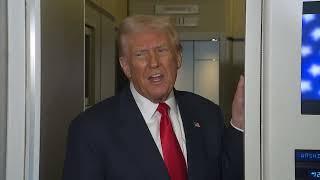
Transcript of a press gaggle aboard Air Force One (Oct 30, 2025) in which President Trump and aides discuss outcomes of a meeting with China (trade purchases of soybeans, tariff adjustments, rare earth export controls), fentanyl precursor enforcement, chip export discussions (mentions of Nvidia and "Blackwell" chips), and geopolitical topics (Ukraine, Taiwan, nuclear testing). President Trump characterizes the meeting as highly successful and cites prospective investments into the U.S. (e.g., Toyota plants). The transcript contains multiple specific claims about tariff changes, a one-year pause on proposed rare earth controls, a planned China visit in April, and large investment figures.
Questions this video answers
He said he reduced a 20% tariff on China by 10 percentage points (stating it is now 10% instead of 40% in his remarks).
He stated it is a one-year agreement ("One year. It's a one year agreement").
He said, "I'll be going to China in April."
$150 billion in shipbuilding investment (agreed to by "the cranes" per the transcript).
Toyota is said to be "going to build plants, $10 billion worth of plants."
Chapters
Hello, everybody. I thought it was an amazing meeting. He's a great leader, great leader of a very powerful, very strong country, China. And we, what can I say? We have. It was an outstanding group of decisions, I think that was made. A lot of decisions were made, too. There wasn't too, too much left out there. And we've come to conclusion, many very important points, and we'll be handing that to you in a little while. You know, we're having. Because there's a lot of. A lot of different things, many of them very important. We're, we're in agreement on so many elements. Large amounts, tremendous amounts of the soybeans and other farm products are going to be purchased immediately, starting immediately. If you notice. President Xi authorized yesterday China to start. Did you know that? Right. China to start buying in very large quantities of soybeans and other things, which I appreciated. That was a very nice gesture. And many other things like that. We. On fentanyl, we agreed that he was going to work very hard to stop the flow. You know, it's a very complex subject because it's used for lots of different reasons, including anesthetics and things, but he's going to work very hard on it, precursors, and I think you're going to see some real action taken. I've agreed, as you know, I put a 20% tariff on China because of the fentanyl coming in, which is a big tariff, and based on his statements today, I reduced it by 10%. So it's 10% instead of 40%, effective immediately. I believe he's going to work very hard to stop the death that's coming in. But again, it's complex because of what fentanyl is, what the precursors do. So I think you're going to see a big difference. We've had discussions on many of the elements that you're talking about. All the time you're asking me questions, and most of those things were, I think, agreed to, for the most part. I think we agreed to almost everything in a very acceptable form. I wouldn't say everything was discussed because of the things that probably in retrospect we could have discussed or we didn't for some reason didn't come up. But if you have any questions, let me know. Go ahead.
What about chips, sir? Did, did he agree? Did you agree to sell any more jobs?
We did discuss chips and he's going to be. They're going to be talking to Nvidia and others about taking chips. We make great chips. Nvidia is the leader and I'll be speaking to Jense from Nvidia, but they're going to be discussing that with Nvidia to see whether or not they can do. I said that's really between you and Nvidia, but we're sort of the arbitrator of the referee. It's a little rough up here. The skies. The skies are a little rough.
And just to clarify, sir, that is the downgraded Blackwell chips. You would authorize those to be exported, not the Blackwell.
We're not talking about the Blackwell. That just came out yesterday. But a lot of chips, you know, a lot of the chips. And that's good for us.
How soon do you think you'd be able to sign an action, Please?
Come on. You know what you do. Yeah, come on. Let me stand right over here.
Yeah. Hey, everybody. Thanks. Let me just make a point on the chips. As the President was saying, there's so many chips we already sent to China, a lot of advanced chips, et cetera. And as he said, you know, Nvidia will talk to China and see what's possible. The Blackwell chips, of course, weren't discussed. We focused on export controls of China on rare earth, and they're going to keep those going, which is quite important.
What are the major stumbling blocks that are left now to work through? And how soon do you think you could sign a trade deal with China?
Well, I think pretty soon we have not too many major stumbling blocks. We were. We have a deal now. Every year we'll renegotiate the deal. But I think the deal will go on for a long time, long beyond the year. We'll negotiate at the end of the year, but all of the rare earth has been settled, and that's for the world. I mean, you know, worldwide, I guess you could really say this was a worldwide situation, not just the situation. So we continue to produce the rare earths and buy the rare earths and everything else, you know, when you see. From other countries. But China is. That whole situation, that roadblock is gone now. They won't. There's no roadblock at all on rare earth. That will hopefully disappear from our vocabulary for a little while.
So is that a one year pause on the policy they announced?
One year. It's a one year agreement and we'll extend it after a year like we do. It's a one year deal will, I think, be very routinely extended as time goes by.
To be totally clear, we're not. They're not going to impose the rare earth controls that they propose. President Trump and President Xi came to an understanding of that.
What will your new tariff rate on China's goods be once you say other than what we.
There's tariffs remain exactly the same, 55%. It's about. No, it's. It was 57, now it's 47, because we reduced. We reduced it by the fentanyl because I believe they are really taking strong action. We've already seen the action on fentanyl and they're taking very strong action. So reduced to 10%.
Number eight is gone. When it was going to go up again?
Yeah, okay, that's right.
On fentanyl, they've agreed there are a variety of precursors. You may recall that actual fentanyl was scheduled by China in the President's first term successfully. There are certain precursors where they take whatever actions they need to control that. If they can control rare earths, we know they can control the precursors. And President Xi, I think, was very strong in saying he was going to enforce those laws internally. And of course, we'll launch that and.
We'Ll work to be very strong in enforcing the fentanyl. Everything having to do with fentanyl and regulations internally, including taking very strong measures against those that don't obey.
And a variety of other tariffs still remain. Section 301 tariffs from the original variety of section 232 tariffs. Some of these tariffs are, as the president mentioned, around 40%. For some individual products, it may go up to 100%, but as a general matter, it's about 45, 47%.
So, sir, it sounds like you might be going to China, then, after the successful.
That's another thing. We agreed. I'll be going to China in April and he'll be coming here sometime after that, whether it's in Florida, Palm beach or Washington, D.C. did you read anything.
On the shipping fees, the 301 shipping investigation?
Well, that's been. That's been.
We're going to postpone that while we negotiate with them about that issue. We're trying to rebuild shipbuilding. The cranes just agreed to invest $150 billion in shipbuilding. So we, we have a good path.
Forward, but that's no longer an issue.
The war in Ukraine or Taiwan, we discussed that.
And we discussed, basically, these are rough wins in Asia. I must tell you, this is a rough flight. We could have waited an hour. Maybe this a little tough. These are tough conditions for interviews. You know, they're going to be watching Trump. They're going to say he didn't look too good. He's got the shakes. I Don't have the shakes, but people wouldn't think I do.
You're pretty solid. So Ukraine, it came up.
Yeah, it did come up. They came up very strongly. We talked about it for a long time, and we're both going to work together to see if we can get something done. We agree that the sides are, you know, locked in and fighting, and sometimes you have to let them fight. I guess crazy, but he's going to help us and we're going to work together on Ukraine. There's not a lot more we can do. You know, he's been buying oil from Russia for a long time. He takes care of a big part of China and, you know, I can say India's been very good on that front, but we didn't really discuss the oil. We discussed working together to see if we could get that war finished. You know, it doesn't affect China, it doesn't affect us. And I'd like to see it done on the basis I don't like to see 6, 7, 8,000 young people, mostly young people, for the most part, soldiers be killed. It's not costing us anything. In fact, we make money, and I don't even want to talk about making money. I don't care about making money in that. But, you know, we send weapons to NATO, they buy full price. They buy the weapons, they give them to whoever. But I think they give them probably to Ukraine for the most part. And we discussed it. We discussed all that. We're going to work together to try and get the war with Russia and Ukraine solved.
What about the Taiwan issue, sir?
It never came up. Taiwan never came up. It's not discussed, actually.
What else didn't come up that you.
Thought might come up?
You had mentioned you didn't get to every.
I mean, we had a long meeting, as you know, but a lot of things we discussed in great detail. A lot of things we brought to finalization. A lot of finalization. I thought it was a great meeting. I think it was a very friendly meeting. It was a good meeting for two very large, powerful countries. And that's the way we should get along with the large, powerful.
Why did you write your True social about nuclear testing, about resuming nuclear testing?
What prompted you to do that right.
Before the meeting had to do with others. They seem to all be nuclear testing. We have more nuclear weapons than anybody. We don't do testing. We've halted it years, many years ago. But with others doing testing, I think it's appropriate that we do also.
Any details around the testing, sir? Like where, when it'll be announced?
You know, we have test sites. It'll be announced.
Did Israel give you a heads up before they bombed Gaza? And is it still a ceasefire if they're stopping?
No, they had a sniper and one of their soldiers were killed and they did retribution. So we'll see. But yeah, it is ceasefire. It's back to ceasefire.
But is that thinking behind reducing troops in Romania, the drawdown of US Troops in Romania?
I have to ask. I mean, I could tell you about it, but it's not very significant. It's not a big deal on nuclear weapons.
Sir, which countries do you have in mind when you say you want to send a signal?
What a rough ride this is. This is. The interviews are tough enough without, you know, without your life being threatened. You guys okay?
Yes, sir.
That camera guy's very steady. We're going to look real bad today on television, I'll tell you. I think that, you know, it's pretty much. I think we've discussed mostly what we said, pretty comprehensive. We're going to issue a statement on some of the details. But overall, I guess on the scale from 0 to 10, with 10 being the best, I would say the meeting was a 12. I think it was a 12. I think very importantly, you know, just the whole relationship is very, very important and I think it was really good.
Especially coming on the heels of the successful trip. We're in Malaysia. You signed a peace deal for Cambodia and Thailand, critical mineral deals with all our allies.
So many successful meetings and so many meetings great for our country with literally hundred hundreds of billions, trillions of dollars have come into our country over the last four days, represented by this meeting. But trillions of dollars where Toyota is going to build plants, $10 billion worth of plants. And, you know, I could go over so many different companies coming in, they're pouring money into the United States. So beyond even this meeting, this was an unbelievable trip and I hope you're glad you were a part of it. It was big. Every country. Japan, I mean, you look at South Korea, Japan, and so countries that we met there, they're investing tremendous amounts of money in the United States, like money that we've never seen before.
All these investments from China, in the U.S. additional investments, anything like they have.
Investments and they will invest. And China, you know, I think they feel very strongly. They congratulated me on the tremendous success that we've had because there's never been a country that has had so much money come into it for purposes of investment, for building, for auto plans for AI, etc. So he was very strong on congratulating me for that.
But he didn't commit to any additional investment or outflow.
He didn't really discuss it.
He would ever get through to Kim Jong Un about setting up a meeting. Does he have a phone?
We never were able to talk because, look, I was so busy and really this is why we came. I think it would have been maybe disrespectful to the importance of this meeting if we did that. So I'd come back with respect to Kim Jong Un. I'd come back. It was, what do you want to.
Talk about with Kim?
I had a great relationship with Kim Jong Un. I think if I didn't get elected, you would have had. If Hillary Clinton came in at the time. He doesn't like. He doesn't like too many people other than me, if you want to know the truth. I think he would have had a big war. Could have been a very bad war, too.
With the nuclear announcement. Just one more on the nuclear announcement. Do you worry that we're entering a more risky environment when it comes to nuclear issues?
I don't think so. I think. I think we have it pretty well locked up. But we, you know, we have more than anybody. But I see them testing. I say, well, they're going to test. I guess we have to test. I'd like to see a denuclearization because we have so many, and Russia has suffered. Russia's second and China's third, and China will catch up within four or five years. I think de. Escalation would be. They would call it. Denuclearization would be a tremendous thing. And it's something. We are actually talking to Russia about that. And China would be added to that if we do something. Thank you all. It was a great success. It was a great honor. I mean, he's a tremendous leader of a very powerful country, and I give great respect to him and we appreciate the fact that he came for this meeting. Thank you very much.
Anything on Canada? Anything on Canada.
We had a very nice conversation with him last night. We really thank you.
More from Your







President Donald J. Trump and First Lady Melania Trump Visit Grieving Texas After Deadly Floods

💪 Thinking of starting a #biz? Go for it! — Kerry Boyle, Vermont #SmallBiz Person of the Year

President Trump Participates in a Bilateral Meeting with the Prime Minister of Canada, May 6, 2025

