President Trump Meets with the President of the European Commission
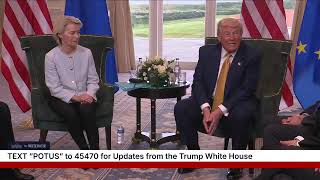
This is a press-wrap transcript of a July 27, 2025 meeting between President Trump and European Commission President Ursula von der Leyen at Turnberry where they discuss bilateral trade (tariffs, market access, possibility of a major US–EU deal), and take reporter questions covering Gaza humanitarian aid, migration, wind energy, NATO defense spending, and regional diplomatic efforts (Cambodia/Thailand). Trump emphasizes tariffs and ‘‘fairness’’/rebalancing; von der Leyen frames the goal as sustainable rebalancing of a $1.7 trillion trade relationship.
Chapters
Well, thank you very much. It's a beautiful Sunday in Scotland and we thought we could cut things short by and certainly travel distance by having our meeting here. So we discuss options. And I just. It's an honor to have the President of the European Union with us. Ursula has been really done a terrific job for them, not for us, but she's done a great job and she's highly respected by us also. And we look forward to talking to see if we can do something. We've had a very good relationship over the years, but it's been a very one sided transaction, very unfair to the United States. And I think both sides want to see fairness, but it's been a very, very one sided deal and it shouldn't be. And so we're here with her very brilliant staff and hopefully we'll resolve a few issues. But it's a great honor, you know, we just built this ballroom and we're building a great ballroom at the White House. The White House has wanted a ballroom for 150 years, but they never had a real estate person. You know, nobody, no president knew how to build a ballroom. But this just opened, you know, a relatively short time ago and it's been quite the success. And I think I was just saying I could take this one, drop it right down there and it would be beautiful. This is exactly what they've wanted. But it's an honor to have you at the new ballroom at Turnberry. And thank you very much. Thank you.
Thank you very much, Mr. President. Thank you very much for inviting me here. Indeed it is today about trade between the European Union and the United States. We're together the two largest economies worldwide.
Right.
If you look at the trade volume, it's the biggest trade volume globally with $1.7 trillion among us. And if you look at our markets, it's a huge market, 800 million people if you take the United States and the European Union. So I'm very much looking forward to the discussions we will have now. Our staff have done some of the heavy lifting, but now it's on us. And you're known as a tough negotiator and deal maker. What is in front and fair and what is in front of us, much less important if we are successful, I think it would be the biggest deal each of us has ever struck.
So I'm very much looking forward ever struck by anybody. That's true. That's true. Right now we have that. That honor goes to Japan. We just struck a deal with Japan, as you know, and we're very close to a deal with China. We really sort of made a deal with China, but we'll see how that goes. And we have numerous other deals, and mostly I'm just going to charge tariffs. And, you know, it's not a deal per se, but people are going to pay tariffs, and we're doing them at the low end, not the high end, because we don't want to hurt anybody and pretty well. But you and I both figured this is. This is really the biggest trading partnership in the world, so we should give it a shot. Right?
Yeah, Very much. Looking forward to that.
Thank you very much. I do, too. Any questions, please? On a Friday.
But the chances of a deal at 50%, maybe less. It seems like you're in quite a good mood. How would you rate those chances now?
I'm actually not in a good mood, but I will tell you, I think the chances are. Yeah, I think Ursula would say probably 50, 50 of making a deal, I hope. You know, I'd like to make a deal. I think it's good for both, but, you know, yeah, I'd say 50, 50.
And what would you say the main sticking points are?
We have three or four sticking points. I'd rather not get in. We'll be discussing them, but I think the main sticking point is fairness. Please.
While you're in a bad mood, is it a bad morning of golf or.
Why you're not in a good mood?
No, the golf was. The golf was beautiful. Golf can never be bad. Even if you play badly, it's still good. If you had a bad day on the golf course, it's okay. It's better than other days. But no, I think I look forward to this meeting. You know, we've had a hard time with trade with Europe. Very hard time. And I'd like to see it resolved. But if it isn't, we'll, you know, have tariffs and they'll do what they have to do. But we have a good chance of getting it resolved. We'll probably know in about an hour. It shouldn't take that long. You know, it's complicated, but not really complicated when you get right down to it. Right.
Is there any chance that that gets.
No, no. The. August 1st is there for everyone. The deals all start on August 1st. Most of the deals, other than steel and aluminum, which we've been getting 50% tariffs from, I guess just about everybody. And those have come in and. And we've taken in, you know, hundreds of billions of dollars just on steel and aluminum. You've seen the numbers we had a tremendous amount of money come in over the last month, and it's coming in, you know, very rapidly, which is fair. We have a lot of steel mills and plants, aluminum mills and plants being built. We have a lot of AI being built, and we have a lot of auto plants being built or going to be built because they don't want to pay tariffs. So, you know, if they don't want to pay tariffs, the best way to do it is just build your plant in the United States. Yes, please, sir.
What do you expect from the Europeans in terms of opening the markets for American products?
Well, they have to open up to American products. You know, we're open to European products, and we have been for forever. I don't think we have. We just about don't have any. I don't think we have any product that we say you can't sell. I guess you could get a little bit cute with chips, but that's, you know, a little bit different category, too. No, you know, Europe is very close. We don't sell cars into Europe. We don't sell, essentially agriculture of any great degree. They want to have their farmers do it and they want to have their car companies do it. I'm just. I'm not saying anything that nobody knows. We have a rough situation. If we want to sell cars in Europe, we're not allowed to. And as you know, they sell millions and millions of cars. Mercedes, BMW, so many different. Volkswagen, so many different cars and so many millions of cars. I would imagine, number one, I didn't look at that, but I would imagine, number one, by far more so than even Japan. Japan sells a lot of cars, too, but the Japan deal worked out very favorable, you know, very good, I think. I hope for them, too. And that's what we want to do, make everybody happy. Yes, please, Mr. President, should Israel be.
Doing more to allow food into Gaza?
Say it.
Should Israel be doing more to allow food into Gaza?
What did you say to Israel? Should Israel be doing more to allow food into Gaza? Well, you know, we gave $60 million two weeks ago and nobody even acknowledged it for food. And it's terrible. You know, you really at least want to have somebody say, thank you. No other country gave anything. We gave $60 million two weeks ago for food for Gaza, and nobody acknowledged it, nobody talks about it. And it makes you feel a little bad when you do that. And, you know, you have other countries not giving anything. None of the European countries, by the way, gave. I mean, nobody gave but us. And nobody said, gee, thank you Very much. And it would be nice to have at least a thank you. And I took a lot of heat. You know, when I. When I do that, a lot of people aren't happy about that because they say, well, why are we doing it? And nobody else. But I think we had a humanitarian reason for doing it. What's going to happen? I don't know. I can tell you that Hamas, as I said, would happen at the end. You know, we've gotten back a lot of hostages, a tremendous number of hostages, most of them now we have dead hostages, and the mothers want them back. And we have 20 people approximately, but that are living, but we have a lot of bodies. And the parents want those bodies as much as they would want their child, if that child were alive. I was. I met with parents that were. It was so sad. Sir, please get my son back. How is your son doing? Well, he's dead, but they have his body. And it's so important. It's more important. It's almost like more, but it's as important as if the child were living. These people were. I mean, they're devastated. And I said, when you get it down to a certain number, you're not going to be able to make a deal with Hamas, because once they give them up, then they feel that that's going to be the end of them. And what I said is exactly true. You know, they had a routine discussion the other day, and all of a sudden they hardened up. They don't want to give them back. And so Israel is going to have to make a decision. I know what I do, but I don't think it's appropriate that I say, but Israel is going to have to make a decision.
Mr. President, when you were in the Middle east, you talked about the images coming out of Gaza and the Starling kids. Those images are still going. Many of them are much worse, thinner children starving. What do you see or feel when you look at those images?
Well, it's terrible, you know, when I see the children and when I see. Especially over the last couple of weeks, and people are stealing the food, they're stealing the money, they're stealing the money for the food, they're stealing weapons, they're stealing everything. It's a mess. That whole place is a mess. The Gaza Strip, you know, was given many years ago so that they could have peace. That didn't work out too well when Israel gave that up. Whoever was the prime minister at the time, who. I know who it was, but it was not exactly a very clever thing to do, because that was given so that they finally have peace. And it's actually made the situation worse. But we'll see what happens. I think Iran is acting up. I think that we have a lot of people acting. We have Venezuela acting up in a different way. They're sending. They continue to send people that we rebuff to our border. They continue to send drugs into our country, Venezuela. They've been very nasty, and we can't let that happen. But. And we have other countries, too. We do have. And this is just getting a little off subject, but we have now the safest border we've ever had. And I think in many respects, we probably have the most successful. And I say it all the time. Every leader, when I went to NATO the other day, every leader said, you have the hottest country in the world. We have the hottest country in the world. Now. We're taking in hundreds of billions of dollars. We have the highest stock market we've ever had. We have the best numbers we've ever had. But we have hundreds of billions of dollars pouring into our country. And I think it's the hardest. And by the way, one year ago, our country was dead. We had a dead country because of an incompetent president and incompetent Democrats. All they know how to do is talk and think about conspiracy theories and nonsense. If they'd waste their time talking about America being great again, it would be so much nicer, so much easier be very successful. But we were a dead country, and now we have the hottest country anywhere in the world. Yes. Any other questions?
President Trump, on this particular deal, if you manage to do a deal today, will that be the end of the matter, or could there be more tariffs coming, particularly on faris?
No, when we do a deal today with the European Union, that will be the end of it. Yeah, we're not. Won't. We'll go, I guess, a number of years at least before we have to even discuss it again. No, that would be the end of it. And this is the biggest deal. People don't realize this is bigger than any other deal. We have great countries, great countries. I'm familiar with many of them. So are you. And this is really the biggest deal. This is the. I guess we're the biggest out there, and they're the second. And when we come together, this will be the biggest deal. If that happens, then it could happen, should happen. Okay. Thank you.
Will pharmaceuticals, Will pharmaceuticals be part of today's.
No, it won't. Pharmaceuticals will be. I mean, could be. We'll do something, but basically pharmaceuticals won't be part of it because we have to have them built, made in the United States and we want them made in the United States. And I think it's easy to say, and I think it's important to say pharmaceuticals are very special. We can't be in a position where we don't have, where we're relying on other countries. Now, Europe is going to make pharmaceuticals, drugs and everything else for us, too, a lot, but we're going to have also our own.
A question for President.
Yes.
Can you give your assessment of what you feel the chances are of dealing? The president just talked about a 50, 50 chance and the biggest obstacle being fairness. What would you say are those things for you?
I think the president is right. We have a 50 to 50% chance to strike a deal and indeed it is about rebalancing. So you can call it fairness, you can call it rebalancing. We have a surplus. The United States has a deficit and we have to rebalance it. We have an excellent trade relation. It's a huge volume of trade that we have together. So we will make it more sustainable.
Mr. Trump, can you do better than 15% tariff rate for the EU?
Better meaning lower? No.
Mr. President, to return to Gaza, you're going to meet the British prime minister tomorrow. He's going to ask you to consider again peace talks being Israel and Mas. Are you now saying there is no point in trying to respond?
Well, we're meeting about a lot of things. We have our trade deal and it's been a great deal. It's going to, it's good for, it's good for them and good for us. I think, you know, the UK is very happy. They've been trying for 12 years to get it and they got it. And it's, it's a great trade deal for both, works out very well. But we are discussing, we'll be discussing that. I think we're going to be discussing a lot about Israel. They're very much involved in terms of wanting something to happen. He's doing a very good job, by the way.
Also in Gaza. Sir, did you speak with Prime Minister Netanyahu this weekend about getting more aid under Gaza?
I talked to him, yeah, I did. I talked to him about a lot of things. I talked to him about Iran. I think Iran has been very nasty with their words, with their mouth. I think they've been very nasty. They got the hell knocked out of them and they, I don't think they know it. You know, I actually don't think they know it. They really do. The whole thing is a con job. We have a lot of con jobs going on. But Iran was. Was beaten up very badly for good reason. We cannot have them have a nuclear weapon. But they still talk about enrichment. I mean, who would do that? You just come out of something that's so bad and they talk about, we want to continue enrichment. Who would say that? How stupid can you be to say that? So we're not going to allow that to happen. We're not allowing that to happen.
More aid into Gaza?
Will I do more aid? Yeah, the us. The US is going to do more aid for Gaza, but we'd like to have other countries participate. We're going to mention that to the European Union today. You know, that's an international problem. It's not a US problem. It's an international problem. And we're giving a lot of money and a lot of food and a lot of everything. If we weren't there, I think people would have starved, frankly. They would have starved. And it's not like they're eating well, but a lot of that food is getting stolen by Hamas. You know, they're stealing the food, they're stealing a lot of things. You ship it in and they steal it, then they sell it.
You said that Europe is being crushed by mass migration, and I wonder whether your friends on the other side of the room agree with you on that.
Well, I'd let you respond to that if you'd like.
So we have been working intensively on the topic of regular migration, and we have from the very beginning said that migration is a European challenge that needs a European answer. As Europeans, we will fulfill our international obligations, as we've done in the past, also in the future. But we, as Europeans are the ones who decide who comes to the European Union and under what circumstances, and not the smugglers and traffickers. That's the principle in which we are working.
I will say this. You know, they did ask me when I got off the plane, immigration. Europe has a tremendous problem, and we do, too. But we've sealed our borders. We have nobody coming in, and we have hundreds of thousands of people being taken out and the bad ones first. And I think we're doing a very good job of that. But we have, I mean, it literally registered zero people last month. You probably saw that. Nobody. And Europe has a very similar problem. I think they're going to end up in the same place. You might as well go there quicker. And the other thing I say to Europe, we will not allow a windmill to be built in the United States. They're killing us. They're killing the beauty of our scenery, our valleys, our beautiful planes. And I'm not talking about airplanes. I'm talking about beautiful plains, beautiful areas in the United States. And you look up and you see windmills all over the place. It's a horrible thing. It's the most expensive form of energy. It's no good. They're made in China, almost all of them. When they start to rust and rot in eight years, you can't really turn them off. You can't bury them. They won't let you bury the propellers, you know, the props, because there are a certain type of fiber that doesn't go well with the land. That's what they say. The environmentalists say you can't bury them because the fiber doesn't go well with the land. In other words, if you bury it, it will harm our soil. The whole thing is a conjob. It's very expensive. And in all fairness, Germany tried it, and wind doesn't work. It's. You need subsidy for wind, and energy should not need subsidy. With energy, you make money, you don't lose money. But more important than that is it ruins the landscape. It kills the birds. They're noisy. You know, you have a certain place in the Massachusetts area that over the last 20 years had one or two whales wash ashore. And over the last short period of time, they had 18. Okay? Because it's driving them loco. It's driving them crazy. Now, windmills will not come. It's not going to happen in the United States. And it's a very expensive. And I would love to see. I mean, today I'm playing the best course, I think, in the world. Turnberry. Even though I own it, it's probably the best course in the world, right? And I look over the horizon and I see nine windmills, like, right at the end of the 18th. I said, isn't that a shame? What a shame. You have the same thing all over. All over Europe in particular, you have windmills all over the place. Some of the countries prohibit it, but people ought to know. These windmills are very destructive. They're environmentally unsound, just the exact opposite. Because the environmentalists, they're not really environmentalists. They are political hacks. They're. These are people that. They almost want to harm the country. But you look at these beautiful landscapes all over. All over the, you know, the world. Many countries have gotten smart. They will not allow it. They will not. It's the worst form of energy, the most expensive form of energy. But windmills should not be allowed.
Okay, Cambodia and Thailand, you spoke to leaders of those countries?
I did.
Are they doing enough to stop the fight?
I hope so. You're talking about Cambodia and Thailand. So I had an interesting time. We're dealing with Thailand, and we do a lot of trade with Thailand and with Cambodia, and yet I'm reading that they're killing each other. You know, they're fighting, they're in a war. And I say this should be an easy one for me because I've settled with India and Pakistan and Serbia and Kosovo was going at it, you know, but they have for a long time, in all fairness, you know about that and others. The Congo and you know, what's going on. That's been a horrible thing with Rwanda. That's been a horrible thing. 31 years. 7 million. 8 million people killed. Machetes. Machetes all over the place. It's a terrible thing. We got that one solved. We did five of them. And I was saying, you know, we have a trade deal. We were working on another. We finalized another trade deal yesterday. And I asked my people, I said, how are we doing with Cambodia and how are we doing with Thailand? And they say they're going to be coming in at some point to talk. I said, well, let's call them right now. So I called the prime ministers of each, and I said, we're not going to make a trade deal unless you settle the war. A lot of people are killed, you know that in a short period of time. The border, they're fighting pretty, like, wild. And I spoke to both of the prime ministers, and I think by the time I got off, I think they want to settle. Now, I know they're meeting today or tomorrow, and we're going to work with them. Marco Rubio is working with him, also his people and him. I think we're going to get that. That would be a great thing, but that would have turned out to be a bad one. And I will tell you, India, Pakistan, they were really getting ready to go at it. So getting those things settled, if I can do it and if I can use trade to do that, it's, you know, it's my honor, but I had great talks with two very good people that they both really would like to make a deal. So we'll see what happens. Okay. How about one more? Two more? Mr. President, Europe's now spending a lot more on defense, thanks to you. Does that. They are.
Should they get a fairer deal?
On Drake and Exchange.
Well, they're spending a lot on defense, but we're spending a lot more, you know, and we've been very generous to NATO for many, many years. And no, but we had a terrific meeting with NATO. I'd love to do as well. We had a meeting where they put up 5% instead of 2% and they're going to pay it instead of not paying because, as you know, many people didn't pay the 2% or anywhere near it, and the 2% was too low. And we're going to be sending now military equipment and other equipment to NATO and they'll be doing what they want, but I guess for the most part, working with Ukraine. But we, we had a fantastic meeting. I guess it's now almost four weeks ago, one of the best meetings they've ever had at NATO. And the spirit and the coming together was incredible. And I stood and I listened to almost 30 speeches. That was a lot. And I was really late and I had to leave, but I didn't want to leave before those last 10 spoke because they'd go home and they'd tell their wife, Trump left and they were so nice to the United States. They were all mentioning the United States and me, but they were mentioning the United States to be here. It's such an honor, you know, et cetera. And I thought it would have been irrepocable, but I did stay. It was very hard because I was extremely late for something else that was, you know, pretty important. And we had a tremendous NATO meeting. I'm sure you heard that, too. It was great. There's some great people that you deal with on two fronts. Right. But you deal with on primarily the trade front. But I will tell you, they came together and the relationship is really good. That was a great. An interesting question because you probably have reported it that way. It really. We came together and they went from 2% to 5%, which nobody would have thought that was even. Who would even think that, because they didn't want to be at 2%. All of a sudden they're at 5%, and that's the right number. And so it was a great honor. I got to know the heads of those countries really very well at that meeting almost a month ago. Okay, thank you very much, everybody. We'll let you know what's happening.
Will you be visiting your Irish golf course anytime soon?
June will. I love Doonbeg. I. I'll go. Not in this trip, but I'll go soon. Okay, thank you very much. Thank. You.
More from Your







President Donald J. Trump and First Lady Melania Trump Visit Grieving Texas After Deadly Floods

💪 Thinking of starting a #biz? Go for it! — Kerry Boyle, Vermont #SmallBiz Person of the Year

President Trump Participates in a Bilateral Meeting with the Prime Minister of Canada, May 6, 2025

