President Trump Participates in a Bilateral Lunch with the Prime Minister of Australia
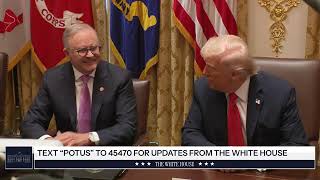
This is a verbatim transcript of a White House bilateral lunch between U.S. President Donald Trump and Australian Prime Minister Anthony Albanese. The event centers on announcing and signing a U.S.–Australia agreement on critical minerals and rare earths (described as negotiated over four–five months) and an $8.5 billion investment pipeline including a $1 billion near-term contribution. Major themes include defence cooperation (AUKUS, nuclear-powered submarines, shipbuilding), trade and tariffs (multiple tariff rates cited by speakers), China relations, and regional security (Middle East ceasefires, Ukraine). The transcript includes an extended press Q&A touching on processing of rare earths, tariff leverage versus China, and timelines for submarine work.
Questions this video answers
$8.5 billion
$1 billion
Four or five months
55% (with claims of a potential higher rate—155% or 157%—mentioned)
Chapters
Well, thank you very much. It's great to have the Prime Minister of Australia. Fantastic place. A lot of friends over there and this is one of them right here. The Prime Minister is, as you know, Anthony Albanese and he's highly respected, done very well in his election and I hear you're very popular today. It varies from day today, but with all of us. But he's done a fantastic job as the Prime Minister. We're here to talk about trade, submarines, lots of other military equipment. They're big orderers of our great military equipment. We have the best equipment anywhere in the world by far. And, oh, you got to watch that. You're not allowed to break that. That mirror is 400 years old. The camera just hit the mirror. I just moved it up here. Special from the vaults and first thing that happens, a camera hits it. Hard to believe, isn't it? Hard to believe, but these are the problems in life. So we're going to be here to talk about lots of different things and we might take a few questions before, but we are discussing critical minerals and rare earths and we're going to be signing an agreement that's been negotiated over a period of four or five months. And it was sort of good timing that we got it done just in time for the visit. And we worked together very much on rare earths, critical minerals and lots of other things. And we've had a very good relationship. We've been working on that for quite a while. In about a year from now, we'll have so much critical mineral and rare earths that you won't know what to do with them. They'll be worth about $2. But in the meantime, we're working with Australia and other countries. They're working with us too, but other countries also on that. But we're really working on anything having to do with military, military protection, military ships, vehicles, guns, ammunition, everything. The whole thing. We've been long term, longtime allies and I would say there's never been anybody better. We fought wars together, we never had any doubts. And it's a great honor to have you as my friend. It's a great honor to have you in the United States of America. Please, would you like to say something?
Well, thank you so much, Mr. President, for the invitation here to the White House and for showing us around the improved Oval Office and for what you're doing around here as well. And for the great honour as well of my delegation staying just across the road. We could have walked, but they didn't let us. We drove all of 20 metres there from Blair House. But it's a great honour to be able to stay there. We are great friends and we're great allies and this is a relationship that's been forged in the battlefields of the world. We have stood side by side for freedom and democracy. And congratulations, I must say, Mr. President, on the work that you've done with the Middle East. It's an extraordinary achievement. And on defence, we've already had a discussion about taking it to the next level. Our defence and security partnership with Aukus is so important for us. And I thank you for the support that the administration has giving as well. You've had the Chief of the Navy here as well, which will play obviously a very critical role with the subs and increasing the security for the region and the world. And our economic relationship is so important. The US has a trade surplus with Australia, as you know, and we can continue to take what is every opportunity to improve the relationship even further and make it even stronger. And today's agreement on critical minerals and rare earths is just taking it to the next level, seizing those opportunities which are before us to take our relationship to that next level. And it's been fantastic, the contact that we've had together, the friendship that we've developed. And Australians love America and I think Americans kind of like Australia too.
We do.
And as we go forward, I think that today will be seen as a really significant day in our relationship. So thank you very much, Mr. President.
Well, thank you very much, Anthony. It's an honor to sign this and we'll do it now and then we'll take some questions, some good ones. I think.
This is a eight and a half billion dollar pipeline that we have ready to go.
That's right. It's all ready to go. Just getting started and we're doing a real job on rare Earth. Many other things. Perhaps I could ask John to say a few words and then we'll exchange papers. But just how are we doing on your naval purchases and all of the submarines that we're working on with Australia? How's that going?
Thank you, Mr. President. Obviously, Australia is a very important ally of ours in the Indo Pacific and in everybody fought with us since World War I and have always been side by side. The facility that they're building, surfwest, is critical and very important to our ability to project power in the Indo Pacific and work with our allies. So we're working very closely. I think what we're really trying to do is take the original Aukus framework and prove it for all three parties and make it better and clarify some of the ambiguity that was in the prior agreement. So it should be a win win for everybody.
And the submarines that we're building for Australia are starting to really move along. Right. The process is, is getting very exciting, isn't it?
Getting better.
That's good, Very good.
Gonna be great.
Thank you very much. Maybe we'll hold this up.
The August defence pact that the Prime Minister just mentioned, it is a critical issue for Australia. You haven't really spoken much about it publicly. It was a deal that was done under Joe Biden to sell submarines to Australia at a time when you're not really making enough for your own needs. So can you tell us, have you gotten across the details of the deal? Do you support it and will you honor it?
It was made a while ago and nobody did anything about it and it was going too slowly. We do actually have a lot of submarines. We have the best submarines in the world, anywhere in the world. And we're building a few more currently under construction. And now we're starting. We have it all set with Anthony. We've worked on this long and hard and we're starting that process right now. And I think it's really moving along very rapidly, very well.
At least 32 people have been killed.
Excuse me. You're next.
Thank you.
Go ahead.
China's bad behavior has really only gotten worse since the office partnership was formed. With that in mind, is the door open for Australia to get additional nuclear power, submarines, or other military capabilities? Not already in the.
I think China has been very respectful of us. They're paying tremendous amounts of money to us as in the form of tariffs. As you know, they're paying 55%. That's a lot of money. They never were paying anything over years and years and years, but they were like anybody else. A lot of countries took advantage of the US they're not taking advantage anymore. China's paying 55% and a potential 155% come November 1st, unless we make a deal. And I'm meeting with President Xi. We have a very good relationship. We're going to be meeting in South Korea in a couple of weeks and we'll see what we can do. We have a very good relationship with China, but, you know, it's been. It's been probably a little bit like your relationship with China. They try and take advantage, but most countries do. I mean, I can say the European Union took advantage and, but not anymore. We worked out a very fair trade deal. Japan, we worked out a very fair deal. South Korea, where I'll be meeting President Xi. We worked out a very fair deal and I expect we'll probably work out a very fair deal with President Xi of China. So most of you will be with us. It's going to be very exciting and I think we're going to work on something that's good for both countries.
Interested in expediting the nuclear powered subs to Australia?
Well, we are doing that. Yeah, we're doing that. We have them moving very, very quickly.
Mr. President, I don't think you've ever been to Australia. Have you thought about coming to Australia and trying out some of the golf courses?
I would and I actually have been to Australia and I did play one of your great golf courses, have great golf courses there. But I have been to Australia.
Would you come again?
Oh, I would. In fact, I've been invited to go and I'll have to give it serious consideration. No, it's a real possibility.
Did the Prime Minister invite you today?
He did.
And perhaps we could time. It must be said with the President's cut that Australia hosts as well.
So.
We'Ll organize a time suitable for you. Mr. President.
Please, in the back please. Yeah, in the back, please.
Mr. President, the prime Minister mentioned that there's a trade imbalance that's very heavily in America's favour. Why does America slap such heavy tariffs on a friend and allies?
Well, we don't. Yeah, well we do in some cases. We do in many cases because we've been treated unfairly. But actually the tariffs are very light. The one thing is you buy a lot of airplanes, so that helps because you buy a lot of the beautiful Boeings, the best of the Boeings, Boeing and. And by the way, Boeing is really doing well. They have lots of orders and they're really doing a great job. They make a great plane. But Australia, because of its location, which is great, but one of the things dictated by that location is you have to order a lot of airplanes. So I guess we have that advantage. They need a lot of airplanes in Australia and that gives us a little bit of a.
Secretary of War Pete Hegseth in his Shangri La speech in I think it was May warned about the potential likelihood or threat of President Xi ordering an invasion of Taiwan. 2027 is also the year that fleet based west is supposed to start rotating those US and UK submarines. Do you see Aukus as a deterrent for China in the Indo this year?
Yeah, I do. I think it is. But I don't think we're going to need it. I think we'll be just fine with China. China doesn't want to do that. First of all, the United States is the strongest military power in the world by far. It's not even close. Not even close. We have the best equipment. We have the best of everything. And nobody is going to mess with that. And I don't see that at all with President Xi. I think we're going to get along very well as it pertains to Taiwan and others. Now, that doesn't mean it's not the apple of his eye, because probably it is, but I don't see anything happening. We have a very good trade relationship. We're going to have a very good. I think when we leave South Korea, it could be wrong, but I think we'll end up with a very strong trade deal. Both of us will be happy. I don't see that happening. Now.
Given the trade surplus that the US Enjoys with Australia, would you consider lifting the tariffs that even close on Australia? And can you give us any details about the critical.
Yeah, well, the tariffs have been amazing because, you know, tariffs have been really a reason that I was able to settle almost all of the. You know, I've settled eight wars in eight months. Not bad. I have one more to go. It's Russia, Ukraine, and I think we'll get there. But it's turned out to be nasty because you have two leaders that truly hate each other. You know, can't. You can't have it all, right? They. They hate each other beyond all else, and it makes it actually a little bit difficult. But we. Of the eight deals, I would say because of tariffs, four or five of them were settled. It's an amazing thing, the power of tariffs in terms of our country. But tariffs have always been used against us. We never use them against anywhere else. And now you have a president that, for national security reasons and other reasons, is using them. And we're. We've become a very rich nation again and a very secure nation again. But we've also become a nation that used that power of tariffs and the power of trade to settle five of the eight wars that I said I settled eight. I'm very proud of that. Nobody else has settled one. I don't think there's been an American president that settled one. I think there probably hasn't been outside of the two countries involved or however many are at war. I don't think there's ever been an outside country that settled the war, period. So I settled eight in eight months. I'M proud of that. Now, in the meantime, I'm running a country that's right. Now we're the hottest country anywhere in the world. We were dead a year and a half ago. We were a dead country and now we're the hottest country in the world, economically and otherwise. So. But I will say Australia pays very low tariffs. Very, very low tariffs. In fact, Australia pays among the lowest tariffs.
Mr. President has been concerned in Australia that it's taken nine months to get this meeting. Have you had any concern, concerns with this administration, with a stance on Palestine, climate change, or even things the ambassador said about you in the past? The Australian ambassador?
I don't know anything about him. I mean, if he said bad, then maybe he'll like to apologize. I really don't know. Did an ambassador say something bad about him? Don't tell me. Where is he? Is he still working for you?
Yeah.
Yeah.
You said bad before I took this position, Mr. President. I don't like you either. I don't. And it probably never will. Go ahead. You went. Go ahead.
Mr. President, your secretary of the Navy said there will be some clarifications around, some ambiguities on Orcas.
Can you tell us? Well, he'll get that taken. These are just minor details, John. You're going to get that taken care of it. There shouldn't be any more clarifications because we're just. We're just going now, full steam ahead. Buildings? Yeah, please.
Thank you. Mr. President, are you now satisfied with Australia's defence investment or do you want Australia to invest more in defence?
Well, I'd always like more, but they have to do what they have to do, you know, you can only do so much. I think they've been great. They're building magnificent holding pads for the submarines. It's going to be expensive, too, you know. You wouldn't believe the level of complexity. Right. And how expensive it is. They're building tremendous docking because they have a lot of ships and a lot of things happening. And I think their military has been very strong. Very, very strong.
Mr. President, on the war that you haven't solved yet, the Ukraine, Russia situation, have you not locked in a meeting and can you explain? Just a few weeks ago, Unga, you said that Ukraine could possibly win the war and keep territory, but now they.
Could still win it.
I don't think they will, but they could still win it. I never said they would win it. I said they could win. Anything can happen. You know, war is a very strange thing. A lot of bad things happen. A lot of good things happen. If you look at the Middle East, I would say prior to us hitting Iran so hard, we could have never made that deal because you would have had a dark cloud over the Middle East. When we took out their nuclear capability, which was one of the great military maneuvers of all time, it was flawless. You saw that, those magnificent B2s. I mean, that was a flawless move that was done by some very talented people headed up by Pete and everybody else, and our great generals and General in particular, Raisin Cain. We did a. We did a great job. And when that happened, everything was different. And we were able to get a deal. If we didn't do that, if it wasn't, you know, they wanted to do that. For 22 years, Mr. Prime Minister, for 22 years, I had the pilots here, the B2 pilots, and they came to the Oval Office and I thought they deserved it. They flew 37 hours back and forth. We had 52 tankers up there. We had a lot of planes up there with them, but they were the primary plane. But we had a lot of planes, F22s and F35s and F16. We had a lot of planes, but we had 52 tankers. Can you believe that? And it was just like a flawless mission. And when it was finished, the Middle east just opened up. Amazing. And they wanted to do it for 22 years. The pilots came up to me, they said, you know, for 22 years, we practiced this maneuver three times a year for 22 years. Our predecessors and us, these are now young pilots, you know, but they're older now, predecessors, practice. And they said, we never had a president that would let us do it, but I let him do it. And it totally opened up the Middle East. It took the cloud over the. We had a dark cloud over the Middle east. And now it's all. I mean, we have a little situation relatively, with Hamas, and that will be taken care of very quickly if they don't straighten it out themselves because you're in violation of their.
President.
Thank you, Mr. President.
On radar, minerals.
Australia is one of the only places in the world that processes rare earth minerals. Could there be an agreement. China has 90% of the processing. Could there be an agreement over processing rare earth minerals with Australia?
Sure, that's what we're doing. And it's part of. It's part of the agreement.
Can you say go ahead, please, just. Sorry. On a follow up from Taiwan, there are reports that you will come up or China is pressuring you to not support independence for Taiwan in exchange for a trade deal.
Well, I'm not going to talk about that. What I'll talk about you and I will have that discussion in a couple of weeks when I'm in South Korea with President Xi. We're going to be talking about a lot of things. I assume that's going to be one of the things, but I'm not going to talk about that.
Now, Mr. President, you just alluded to the violence in the Middle East. What steps is the administration taking to maintain the cease fire?
Well, a lot of. A lot of steps. And right now it's in the hands of others. You know, we have 59 countries that agree to the deal. We have peace in the Middle East. For the first time ever, we made a deal with Hamas that, you know, they're going to be very good, they're going to behave, they're going to be nice, and if they're not, we're going to go and we're going to eradicate them if we have to. They'll be eradicated and they know that. So they, they went in. They went in and I don't believe it was a leadership. They had some rebellion in there among themselves and they killed some people, you know, pretty, a lot of people. But this is a violent group. You know, you probably noticed over the last hundred years this is a very violent group of people. And they got very rambunctious and they did things that they shouldn't be doing. And if they keep doing it, then we're going to go in and straighten it out and it'll happen very quickly and pretty violently, unfortunately.
Yeah, just following up on that question. When you say we are going to eradicate Hamas, who is we? Does that include American boots on the ground?
No, it won't be on the ground at all. We don't need to because we have many countries, as you know, signed on to this deal. The way I view it, 59 countries and unanimous. There's never been, nobody ever believed us. Right. Countries that four months ago didn't like each other and now they're all aligned together. I mean, we've had countries calling me when they saw the, some of the killing with Hamas saying we'd love to go in and take care of the situation ourselves. In addition, you have Israel would go in in two minutes. If I asked him to go in, I could tell them go in and take care of it. But right now we haven't said that we're going to give it a little chance and hopefully there will be a little less violence. But Right now, you know, the violent people, people, Hamas has been very violent, but they don't have the backing of Iran anymore. They don't have the backing of really anybody anymore. They have to be good. And if they're not good, they'll be eradicated.
Could the Prime Minister weigh in more on the processing?
Can Australia expand the process of rear.
Absolutely, we can and we have the capacity to do so. And part of this deal is very specific $8.5 billion pipeline. There'll be a billion dollars contributed from Australia and the United States over the next six months with projects that are immediately available. There's three groups of projects, ones that are joint activities between Australia and the United States, such as Alcoa. Secondly is projects that will be US investment that the US will undertake in Australia, including processing and then ones that Australia will undertake some as well. One of them is Australia, the US and Japan as well. So what we're trying to do here is to take the opportunities which are there. Australia has had a view for some time bit similar to putting America first. Our plan is called A future Made in Australia, which is about not just digging things up and exporting them, but how do we make sure that we have across the supply chains with our friends being able to benefit, seize those opportunities. So we certainly see part of what this is about isn't just digging things up. It's also about processing, including the joint ventures between Australia and the United States.
How did the US and Australia really compete with China? Aren't we decades behind in terms of development?
No, no, you've been reading the wrong newspapers. We're not decades. We are way ahead of China militarily, the United States. We're way ahead of them in every form of military other than they're building a lot of ships. And we'll have that started. We'll be catching them on that when it comes to. But we will when it comes to weaponry. When it comes to. I'll go right now, AI the big thing is AI, they're building more plants in this country than anybody ever imagined. We're going to have over $20 trillion of investment for this year. The most we ever had was a tiny fraction of that. As an example, Biden, who is, you know, the worst president in the history of our country by far, by the way. But they were less than a trillion for four years. We're already now breaking $18 trillion of investment in eight months. 18 trillion. No country in history has ever done that. We're way ahead of China in AI and we're Way ahead of China militarily from the standpoint of the sophisticated weapons. We have weapons that a lot of people don't even know about it. I got them started four years ago. I rebuilt the military four years ago. Fortunately, because Biden didn't do anything but give a piece of it away to Afghanistan. Fortunately, as much as it sounded like it was a small part of what I built, but the Afghanistan giveaway was one of the worst. That was probably the most embarrassing day in the period in the history of our country. But we have the greatest military, we have the best equipment, we have the best manufacturers of equipment, we have the best weapons. When you look at our weapons, I've been talking a lot about our weapons. Everybody wants our weapons. But it's just, it's great to be working with Anthony. It's great to be working with the people of Australia because they also. I mean, it's a smaller country, but you have done a fantastic job in weaponry and the kind of things that we do a lot of joint work together. Our military's work very, very closely together. We've been really an amazing ally. When you think of it, right. There's never been any games. We just. We're strongly committed and they're strongly committed. There are some games with other countries, but there haven't been games with Australia. Who do you. Who do. Where do you come from? Australia. What? Who you with? Nasty guy. Go ahead.
Oh, sorry, I was just going to ask.
All right, go ahead.
Your first time you work with two Australian Prime Ministers, Scott Morrison and Malcolm Turnbull. You might remember they're from same side of politics as you, Mr. Albanese. Different side. Can you tell us a bit more about how it's what it's like to work with Mr. Albanese compared to those two?
Well, I got along. I mean, that wouldn't be fair because, you know, the man on my right has a big advantage. You know that, Right. But I think he's doing a really. I think he's doing a really good job and we've had a very good relationship. I don't want to compare one with other. The other. But I'll tell you, this one is they've got a great. They really have a great Prime Minister.
Thank you. I use it in my ads in 2018.
President Putin on Thursday. Did you discuss his ongoing attacks on civilian areas in Ukraine? Yeah. Did you talk. Did you say cut it out? Did you say show an article of.
Good faith to me?
I did, I did. But as you know, most of the people dying are soldiers. The Soldiers that are dying in Russia and Ukraine. It's unbelievable. Five to seven thousand a week. Can you believe it? And I look at that and I say it's pretty amazing. But in addition to that, there are attacks on Kiev and some of the other places. And it's human lives. But the big number of human lives are soldiers that are being killed in the battlefield. Anywhere from 5 to 7,000, sometimes more than that, every single week. It's not even believable. It's. It's a bloodbath. It's the worst since the Second World War of people. And, you know, it doesn't affect us in any way. We don't pay anything because now they pay us for the weapons that they get. The NATO is paying us for the weapons, as you know. It doesn't affect. I guess you could say that's a positive thing. They pay us. But I'm not interested in that. I did straighten it out. Biden gave them $350 billion. Can you believe it? And all they did is get deeper in. It's just. It's a shame. Gave them $350 billion. A lot of lives were lost. That's a war that would have never happened if I were president. But we do speak about that. I speak about all of the lives, but I do speak about the civilian lives. Yes.
The US lady has done such an amazing job on Ukrainian children who were abducted by Russia. Would you support Senator Lindsey Graham's bill to declare Russia a terrorist state? And you have within your power the most powerful man on Earth. Why don't you just enable Ukraine to finish this war tomorrow?
Well, if you knew anything about what you were talking about, you'd be able. You do. I don't think you do. Really? I don't think you do. Because it's a little more complicated than that, but it sounds easy. We're in the process of trying to make a deal. If we make a deal. That's great. If we don't make a deal, it'll be. A lot of people are going to be paying a big price. Quiet, quiet, quiet, quiet.
Question to both of you, if you don't mind.
I love his haircut. I'm going to drop that. No, I love it. Go ahead.
So, as you all know, China controls 90% of the global supply. Crickle nails. They have launched attacks on Australian companies, primarily Linus Retnuts. What will happen to China if they don't play fair with this?
So it's a very interesting question. We have a tremendous power, and that's the power of tariff. And I think that China will come to the table and make a very fair deal because if they don't, they're going to be paying us 157% in tariffs. Right now, they're paying 55 to 57%. When I was first president and first term, we had the greatest economy we've ever had. And as you know, people don't write too much about it, but China paid us hundreds of billions of dollars worth of money for tariffs. Biden left it, but he didn't enforce it. He gave exceptions to almost everything. And so he left the tariffs, but he didn't really collect the numbers that he should have collected and because he didn't know what the hell he was doing. So now the tariffs are much higher in China than they were before, and they're high on other countries, depending on whether or not we like that country or we get along. And that's for national security purposes. So I made deals with Japan. I made deals with the European Union or the whole of Europe practically, but the European Union made deals with a lot of. A lot of different people. We have a very fair deal for. I will say Australia is paying a low number. They do have, or I'll change it. We have a little bit of an advantage on that one. I told you, the advantage we have is airplanes. We sell a lot of airplanes to them and they need them. It's a very vibrant place and people go in and out. And I look forward to going there myself. And I think it's unlikely I'll be taking a ship. That's a long.
That's a long journey.
So. But China has treated us with great respect. Now, in the past, they didn't treat other presidents with great respect. They would take hundreds of billions and even trillions of dollars out of the country and they would spend it and build their military. Now they're treating us with great respect. Now we'll see what happens. I said if we don't make a deal, I'm putting on an additional 100% on November 1st. I think we'll make a deal. They threatened us with rare earths and I threatened them with tariffs. But I could also threaten them with many other things, like airplanes. You know, about airplanes, because they can't get parts for their airplanes. We build their airplanes. We do a great job. They're largely Boeings, and we could stop the parts. We did stop the parts, actually, when they did the initial threat, that's a big. They closed down over 400 of their airplanes. But we don't want to do that, but we have a much simpler thing. If they don't, if we don't make a deal, we'll charge them a very substantial tariff and they'll be paying us hundreds of billions of dollars a year, which they're basically paying right now. We had presidents at allowed China and other countries get away with murder. We're not going to allow that, but we're going to have a fair deal. I want to be good to China. I love my relationship with President Xi. We have a great relationship. I believe after we leave South Korea, we'll be there together. We thought that would be a good place to meet. And we're going to be meeting. I'll be in Malaysia, I'll be in Japan. I'll be in a couple of others. We'll be sort of doing a little bit of a tour. I've been invited to go to China and I'll be doing that sometime fairly early next year. We have it sort of set. But I think we're going to have a very good relationship with China. And again, they will threaten us with rare earths. I don't think they're threatening us too much right now, but they could do that. But I threaten them with something I think is much more powerful and that's tariffs. Because at a certain point they will not be able to do any business with us. At a certain point, if they pay enough tariffs. It's almost like saying we don't want to do business with you, but it's probably nicer. Saying you're going to pay 158, 157% tariff is a nicer way of saying that we don't want to do business with you. And if they don't do business with us, I think China is in big trouble. I'll be honest with you. I think China is. I don't know that they even make it. I really do. I believe that they're in big trouble and I don't want them to be in big trouble. I want them to do great. I want them to thrive. But we have to thrive together. It's a two way street. I think when we finish our meetings and it's going to be a big deal. I'm meeting with a lot of other countries, but this seems to be the one that people are very interested in. I think when we finish our meetings in South Korea, China and I will have a really fair and really great trade deal together. I want them to buy soybeans. They stopped buying our soybeans. We. Because they thought that was punishment, and it is punishment to our farmers. But we're not going to allow that to happen because I made a great trade deal with China, a $50 billion trade deal, and they were great about it. They were doing everything that they were supposed to do. And then when Biden came in, you know, I used to call President Xi all the time to say, thank you, or you're not buying enough. In other words, they were supposed to buy Biden. Do you think Biden never called him? I don't think Biden ever called him. You think Biden lied awake at night thinking about trade with China? He didn't know what he was doing. He was an incompetent president. We had an incompetent president, but you don't have that anymore. So I think we're going to end up having a fantastic deal with China. It's going to be a great trade deal. It's going to be fantastic for both countries, and it's going to be fantastic for the entire world. Thank you very much.
Thank you, guys. Thank you.
More from Your







President Donald J. Trump and First Lady Melania Trump Visit Grieving Texas After Deadly Floods

💪 Thinking of starting a #biz? Go for it! — Kerry Boyle, Vermont #SmallBiz Person of the Year

President Trump Participates in a Bilateral Meeting with the Prime Minister of Canada, May 6, 2025

