San Antonio, TX - SBW 2015 - Wednesday 5/6
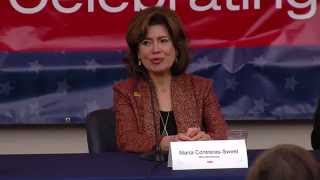
Maria Contreras-Sweet, the SBA Administrator, joins Henry Cisneros, Congressman Lloyd Doggett, and UTSA President Ricardo Romo to discuss how small businesses access capital. They cover SBA loan programs, challenges facing immigrant and veteran entrepreneurs, and San Antonio's network of support organizations like the Lift Fund and SBDC.
Chapters
Are we ready?
Hello, everybody. Thank you for coming. My name is Fernando Pizarro. I'm a correspondent in Washington D.C. for RenewCion. I'm very happy to be here and to have been invited to moderate this panel. This town hall, access to capital fueling the financial engine of small business growth. We have some very distinguished guests. And I realized I wasn't in D.C. anymore when I saw a gentleman like him there wearing these hats and another cowboy hat. I'm so, like, I'm not in D.C. anymore. Anyway, I want to welcome our wonderful host, President Ricardo Romo. And he wanted me to say a few things that are really unique about him. Not only he's the fifth president of the University of Texas in San Antonio, but of all his many achievements, he has one that I want to mention here. When he was at UT Austin, he was the first Texan to run the mile in less than four minutes. It's a record that lasted 41 years.
Still working pretty fast.
What you didn't know is that he did it again this morning. And he and his wife are avid collectors of art and have donated more than 2,000 lithographs to museums around the area. And now he was telling me that he has an exhibit. One of his collections is being exhibited at the Vincent Price Museum in East la.
Oh, wonderful.
So, anyway, we will welcome President Romo to give some few remarks.
I get trapped into these things. What shall I say about you? Are we oui on hat? And he said, I'd like to mention that you were a fast runner. I said, go ahead, because they only remember three things. And so he cut it to three. That was very good. And I only remember three things about many of the things that I. All the sessions we have. You can give folks too much information. And today you will not get too much information. You will get rich information. You will get information that will make you proud of. Of not just being from San Antonio, but being from Texas. And I am proud of the panel that is here today that have been introduced, but they do require additional introduction. The Honorable Maria Contrera Sweet, SBA administrator. What a pleasure to have her here. And she made some remarks earlier. Eloquent individual, of course, the Honorable Henry Cisneros, who has numerous titles, former mayor, former former cabinet member, Secretary of Housing and Development, and Congressman Lloyd Doggett, who I challenge. Anyone? Does anyone know who the. Anybody in the room who was the first person to vote for Lloyd Doggett? Yes, it was me. How do I know that? Because he was my student body president at UT Austin. And I assume that no one else in the room was from that generation because a bunch of young folks here, but I was there and voted for him. And so he's gone on to do some great things. This is a great turnout. We do have standing room only. We'll be turning people away. We are excited about having SBA here. Small business is big business in San Antonio. It accounts for 35,000 establishments here in the city. And it has been noted before some of the. The reason we have the employment growth and job growth that we've had is a large tribute to the successful small business groups that are expanding and new and arising. We have a 35 year relationship with SBA here at UTSA. It's a wonderful relationship. I'm proud of the fact that they recognize our work over the years. But last year we got the big one. We got the gold medal. And the gold medal was the number one SBA center, small business development center in America out of 1,000 different centers. So I think Bob McKinley and Alpha battle. So this shows you the great things that can be done in partnership and collaboration and in training and in getting people to learn of their potential and helping them realize their dreams. We are not only working closely in numerous areas, but in SBA and now with the State Department. Bob McKinley is hard to get a hold of now because he has been visiting many countries and I've gone to a few that he wanted me to attend, but he's been all over Central America. He's been to the Caribbean. He's planning to go to Cuba soon. He's been took me to Bogota. We have just really excited about the potential they have. Brazil has invited us. We're going to go there soon, I guess. But this is 20 countries, 20 countries in Latin America all interested in the model created here in America and what they see in growth has taken place. And that is the idea is, yes, you can wait for Toyota to show up in your neighborhood and everybody has jobs. But the likelihood of a giant company like this coming to your neighborhood is like winning the lottery. So some will get it and some will not. So Bob McKinley says, you don't have to win the lottery. You can create your own businesses and do something exciting. And every time I get a chance to introduce folks, Bob said, be sure to tell them about your small business development. I said, okay, this is a short story. So my dad grew up across the street where they just knocked down the building, the homeless shelter that was there. And he moved down to El Paso street, went into the service, came back and he went, like everybody else, veteran to Kelly Air Force Base. That's where Everybody went. Employed 20,000 people. Mom who had two kids, including me, said, you know, I think I'll start a small business. And on her own, she started a little grocery store. And the grocery store did so well that after a year, my dad said, why am I going to work over there when I can work over here with my own business? So they opened up their business and they were in business. They created three businesses. They were in businesses for 50 years. That little business that was created still is on Guadalupe street, which they founded. Another business they created is still on west side Castroville Road. That's been a business. They started in 1937, and they started from scratch. They came out of the housing project and they had nothing. But they were willing to work hard and they had a good sense to follow and understand other models and visit other places. And that's part of what makes America great and what makes San Antonio, Texas, one of the greatest cities not only in the United States, but that I've visited anywhere in the world. Thank you, Mr. Chairman, and thank you all.
Thank you, President Roman, again, for hosting this. Well, he already did an introduction, but some of the people in this panel almost need no introduction. They're local, so. But I'm going to start anyway, repeat some of their many achievements. Congressman Doggett, Lloyd Doggett, representing the 35th district, stretches from here to Austin even further, am I right?
North Austin to South San Antonio.
He told me he lives on I35. Another very local person, not only a mayor of San Antonio, former Secretary of Housing and Urban Development of the Clinton administration, also former president of Univision. I can't call him boss because by the time I joined the company, he was already moved on. Mr. Hendrick Cisneros. Thank you. And she has so many achievements. I have a. I mean, I'm going to have to make it quick. She just became the 24th administrator of the U.S. small Business Administration, and she is one of three Latinos in the cabinet today. Prior to her arrival, she founded the first Latino commercial bank in California in more than 35 years. She was the first Latina to hold a state cabinet post in California. She was Secretary of Business, Transportation, Housing Agency, and she managed 13 departments. Welcome. Maria Contrera suite.
Thank you.
Well, we're going to kick it off right away with. With questions. I guess we're going to start with you, Administrator. What do you consider to be the biggest challenges for small business owners, especially when it comes to financing? I know you have some announcements you'd like to make and talk about that?
Well, what we hear is. It's actually we hear about three challenges. And one is that small businesses say, I don't know where to go. You know, when you're the boss of your own company, your own business, you don't necessarily want to share with your employees what your struggles are. And so you're looking for somebody that you can seek counseling from. And then once you understand how to start or how to grow or repair your business, what you say to us is that you really want to know how to get more work for your company. And then third, then finally when you get that work, you want to know how to access capital. And so at the SBA, we call ourselves the three Cs, where you can get counseling through our SBDC operations. And as was just stated, you have one of the finest in the country here. And then second, you can come to SBA.gov or to your local SBDC to learn about how to become certified, to be able to get some of the contracting work that the federal government puts out or part of the supply, the corporate supply chain. And then third, we help you go out to get opportunities internationally. And finally, what you say is, how do I get capital? And so, in fact, the SBA is kind of some people have a wealthy uncle who can stand in for them. And with the sba, you have Uncle Sam who will come into the bank and be your guarantor so that you can get some of that loan guaranteed in case, God forbid, you default. And so then we stand in to guarantee 75%, or if you're exporting, we guarantee 90% of that loan and making more people in San Antonio possible in terms of their success in entrepreneurship. So that's what we hear, and that's what we're working on.
I just flew into San Antonio yesterday. I hadn't been here in a couple of years. And you see how much this community has grown. It's. I don't remember the numbers, but it's one of the, you know, fastest communities, growing communities and in the United States. To Congressman Doggett, to Secretary Cisneros, what are the challenges again, for these local people? Where can they go? What would you like them to. What would you like to see from SBA to provide business owners here in the area what's lacking? What's being done correctly? What should be done?
Well, I think we're very fortunate to have an SBA district office here with good leadership, having a new director here who has experience with certifications in his career at SBA to have effective regional administrator land up in Dallas. And we're really pleased to have the administrator here with an appreciation that our opportunities lie south as well as north. There is so much going on here right now that works. There's a reason that Inc Magazine named this community as one of the top four places to do business and so many others have done the same. And that is because there's good collaboration and we have good local resources. I was posing this question to Janie since Lyft is really formerly accioned such a great institution that spread from here to Austin, across Texas and across much of the country. And her answer was more is better. And just in talking to the administrator, we do need to get the authorization approved for it's a couple years out of date, provide more lending authority to sba. We also need in addition to what SBA is doing, Texas has really been a little underfunded for our certified development corporations. We have not gotten our fair share relative to the rest of the country of resources for the CDCs and also from low income housing tax credit. It's an issue I've raised first with Secretary Geithner and then with Secretary Lew. We need more there. We also, I think though I know there was some debate administrator in the Small Business Committee. I think some of the demonstration projects that you've done are really important and we need to continue looking for new ways to get resources out there. One that I worked on recently here, a small program through the Economic Development Administration with SAGE over on the east side, has provided some of the first where SAGE is actually helping to provide some equity funding to a small business here in San Antonio.
Wonderful. Just he is right. SBA has had a certain level of lending authority. And last year I went to Congress and believe it or not, in a few short months we got Congress to agree on one thing and that is that SBA's lending authority should be raised. And so I was able to get an extra billion dollars for the last couple of weeks of last fiscal year. So this year I went in asking for quite a bit higher lending authority, especially in light of the fact that we're running these programs at zero subsidy to the taxpayers. It's a really wonderful achievement because small businesses are prospering and they're paying back. So our default levels are quite down.
Mr. Secretary, for none.
The first.
Let me if I may add my welcome to the SBA administrator who I've had the privilege of knowing for about 20 years and supporting her work and she's really one of the stars of our country in public service and particularly in the Latino community. What she did in Los Angeles was highly respected by everyone in the community. And the formation of the Bank Pro America was a real breakthrough. The first Latino owned bank in Los Angeles, which is a big Latino center. And she did a great job. So there may be Uncle Sam, but for us there's Aunt Maria. Tia Maria, Tia Maria. And it's also a treat always to be with Congressman Doggett, who has to be one of the hardest working congressmen and every other job he's ever held, a state senator and member of the Supreme Court and everything else, he just gets public service. And we owe a special debt of gratitude and we're happy he's our Congressman.
Thank you.
Thank you. Also, if I may say just a quick word. Dr. Romo was introduced earlier, of course, but he makes possible events like this by opening up UTSA and making it part of the community. And an effort like this brings a community of people involved in small business together. I was in a meeting yesterday with Molly Agrawal, the Vice President for research at utsa. And UTSA has been ranked the number one institution in America. I mean, that's Stanford, Harvard, Penn State, everybody for cyber security related work. Now, the implications of that, implications of that are massive for our small business community here because that will be the talent pool and the research that supports what we think is one of the industries that could be a distinction for San Antonio, the creation of cyber security firms. But number one in the country, not a bad place to be. I obviously have great respect for SBA and what SBA does, but I also want to acknowledge that it is part of a spectrum of resources and assets that have to exist in the community to support small businesses. So I'm a big advocate of creating an architecture of policies that are the city government, the county government, utsa, the other public sector organizations like the Alamo Colleges, et cetera, the private sector corporations, and a whole range of things that allow us to functionally support small business in contracting, in networking, for market opportunities, in bonding, in capital, access to capital for small business startups. SBA is a critical piece of this, obviously, but that architecture is important to get right. And we're very blessed to have in San Antonio a whole host of organizations. I'm associated with one right now as chairman of the Chamber of Commerce, Richard Pettis, our president, is here and that's a major commitment to small business. The Hispanic Chamber here, hugely active in this arena and has been since its foundation as the first Hispanic chamber in the United States way back in 1929. Ramiro Cavazos is here as the president and to help us think through this architecture. In my year as chairman of the Chamber of Commercial, I asked the woman who I believe is sort of the iconic figure, the face of small business in San Antonio, at least in my view, and that is Janie Barrera, formerly Accion Texas, now the New Lift Fund, which by the way is opening its headquarters on Martin street next week, right in the heart of the west side. Janie has been named vice chairman of the Chamber this year with a specific responsibility which is to do an inventory, a look at what are we missing in this spectrum that would allow us to fill any gaps that exist in support of small business. She is actively behind Cafe Commerce, which is sort of a one stop resource center for small business, and is promoting a concept called Source Link, which is a virtual way to access services for small business across that spectrum. So basically, and I'll close with this, we know that everybody has pieces of this equation, as I mentioned a moment ago, everything from bonding and capital to networking and entrepreneurial growth assistance for entrepreneurs, the. The skill sets that they need to grow their businesses. What we want to make sure is that in San Antonio there exists, Madam Director, the most coherent, the most cohesive map of resources and institutions, advice, education, et cetera, to Support small business. UTSA critical role. Bob McKinley is a hero across the country for that small business center across the world. And we just want to make. My dream is that San Antonio would be thought of as the place that's got the best overall coherent plan to support small business, I believe, and always have. Even in the days when, you know, we were pushing attraction of industry like Toyota. And we've had our share of successes that fundamentally, in any city, the foundation of the economy is the small business sector. There are more jobs created in small business. You heard Maria say earlier, two out of three jobs created in the country, and you might want to expand on that, are out of the small business sector. And I used to say, you know, the newspaper would put a headline if there was a plant coming that was going to bring 500 jobs. But we're creating 500 jobs in the small business sector every week, you know, all across the city. And they have the additional benefit of staying local, being intergenerational. It can be passed on within the family, growing to substantial size, giving the entrepreneur some standing in the community so they can make civic contributions of time and energy. I mean, it's just a cornucopia of benefits that comes from a vibrant small business sector. So that's my hope, Congressman and director, that we're able to put that kind of model in place here.
Beautiful. Just in case you didn't get the hint from the big sign behind them, this is National Small Business Week, and they have her working a lot. You were in Miami.
Monday in Miami, Tuesday, Los Angeles, Wednesday, San Antonio, Thursday, New York, and Friday, D.C. wow.
Yeah.
That's a schedule. We covered when you were nominated. And I want to talk a little bit about Hispanic immigrant small business owners. And we went out to get reactions. We covered you not just because it was a nomination. You were, at the moment, another Latina member of the Cabinet. And we went out to this in the D.C. area. We went out to talk to immigrant small business owners, the restaurant owner, the bodega women, and they talked about the challenges that they have communicating or knowing about the sba. What are the opportunities that they have. Let's talk a little bit. I know you have developed also a Spanish language website that I read that it's in Florida. I don't know if it's still. It's already a nationwide.
It's live across the country.
All right, so let's talk a little bit about that, and let's talk about the challenges that some of these. You were born in Guadalajara. What these immigrant business owners need to overcome in order to get an SBA loan.
Well, let me just say that I really appreciate Dr. Cisnero's frame of what needs to be in place to have an optimal ecosystem for entrepreneurs. And what happens is, as you see, and we study other economies around the world, we see that there. You know, you hear about the struggling Greece, you hear about how much struggle there is in Ireland. Italy is flatlined. And so I visited with so many there across and around the world. We just came back from the Summit of the Americas where there were 35 presidents, heads of state, representing the Americas, the hemisphere. And I have to tell you that all of them said that they're growing their economies on the shoulders of the small. So it's not just an American phenomenon, it's a global phenomenon. And what I see is that there has been wage stagnation because of this global competition. We here in the US have been undercut dramatically. There have been 200 trade agreements that have been entered into amongst other countries around the world without the US and those agreements. That's all right. I think we're okay. We were as upset as that computer is about what's taking place It's a reaction to this. That's exactly right. But I want to say that the largest beneficiary of these trade agreements has been China because there have been no rules of engagement. So the wage stagnation in large measure is a result of the fact that we as small businesses are having to compete as we try to engage in global commerce. But China has no minimum wage. We do. We don't want to race to the bottom and compete by lowering and lowering wages. They don't have environmental standards that we respect and appreciate, that we can breathe and the environment. And so again, they cut prices, they can undercut our price, our small businesses. So what we have to do is understand that we, the United States, have to set the rules of engagement around the world and we want to lift people up instead of having a race to the bottom. And in that regard, I think what's really important to optimize our capacity to capture the 2 billion consumers, middle class consumers that are coming online is to make sure that we are setting those rules. So I'm working closely with the President around the world to make sure that we get the Trans Pacific Partnership in place. So we're asking our members of Congress to help us push it over the top because we can say that these agreements don't help us, that we don't need it, and that it'll hurt us. But we have learned lessons from NAFTA and CAFTA and the others that have been in place. And so this new TPP has the first, first SME chapter in the history of our trade agreements, a small business enterprise chapter that allows there to be a place to resolve disputes so that if you do business abroad that you're able to resolve the dispute. We have labor standards, environmental standards so that we're not undermined and undercut. We have ways in which we can go in and understand how to navigate and, and learn about the corporate supply chain opportunities that will ensue. So I invite people to engage, to speak up and to voice their concerns so we can get this passed and we can get more trade in place and then entrepreneurs can capture this marketplace. If we think we can just watch this happen, imagine the despotism, the tyranny that's taking place around the world because they don't have strengthened middle class economies. We are all here in the same boat. When someone says, oh, well, I'm not worried about what's going on in Greece because I'm over here, you know, it's like saying, I'm in the boat and you know, but the hole's on the other side. We will not be effective if we don't stamp out the egregious crimes being taken place around the world against Americans. So I ask you to join in, join the conversation, be informed and get out and voice your opinions.
Mr. Secretary, Congressman, you both represent San Antonio. In the case of the congressman, Austin as well. And they always continually rank among the fastest growing communities in the nation. Every time you see whatever, you know, we're in the, I don't know, we seem to be, you go to the Internet or we seem to be in the era of rankings from the, the happiest country to whatever. But what are these two cities doing right? That other this is being webcast. So it's not just here in San Antonio, but what are these two cities doing right that ought to be imitated.
Well, I think there's sometimes a sense of competition and there have been points of competition in the past between the two. But we're growing. Since I do live on i35, we're growing so much together physically. And there is a good opportunity for collaboration, to learn from one another, to work together. I know this is another focus of the secretary now as chamber, we've talked about this some. Indeed. When we talk about small businesses here in San Antonio, we're talking about everything from the family I still house to a startup down the street here at Geekdom. And there are things that we can learn from one another and ways we can support one another. President Romo is correct that getting a Toyota is a little like winning the lottery. But as I recall, Mayor Cisneros got a lot of lottery tickets at the time, but he actually had some support from Austin at that time, too. And so here's a specialty. There's a specialty here in San Antonio in cyber security, that there are one or two firms up in the Austin area in that area. But San Antonio is really the leader how we specialize and coordinate. And then the other thing that of course is really vital between our two communities and the larger world is transportation. And just as the Ex IM bank, which is important on some of the trade issues the administrator talked about is important. It's about to expire at the end of the month. We're about to have the highway fund go broke at the end of the month. There are so many areas, unfortunately, where Congress, through inaction there and on immigration reform, failing to act poses an obstacle. And we just have to work around that and try to have our communities, communities as partners at the local level, achieve the greatness that I think we already have, but can build on.
I appreciate the congressman's points and his.
Work.
And he's done a lot to sort of bring our communities together and focus on the opportunities that exist in so many fronts. Higher education, small business, many things. And he's fortunate to represent arguably the two fastest growing cities in the country. My guess is if you compared yourself and your district against every other of the 435, that's pretty near the top. Pretty near the top in terms of the hottest economy. And that's gone on for a little while now. It wasn't just during the recession when our balanced economies and Texas were strong, but even in the recovery, we continue to stay very near the top. There have been several listings that Show Austin number one and San Antonio number two amongst 52 metropolitan areas in the country. So obviously there's some things that are happening that are right. I do think there are many things that work in our favor. The growth of Texas is a plus. The balance in both of our economies, San Antonio, biosciences, tourism, some manufacturing, the military continues to be strong and things like cyber and Austin, the state capital, the government base, the university, the massive tech sector, its own tourism base, those create a very balance, a great balance, and lots of opportunity. So today is a great time for people to be starting small businesses because, you know, the barriers to entry are less than they have been in the past. Today, if you have a good idea and smart on the computer, you can figure out a business plan that wasn't possible before. We have this unbelievable energy of immigrants and minorities in our part of the country. A lot of Latinos who come with the ambition that brought them to the country in the first place. I mean, think of it. We get the cream of the crop, people who are willing to walk across the border, you know, and show the courage of getting here and leaving a circumstance that is unattractive to them in their home country. And we get them here, and among them, the fastest growing, and I believe this number is correct.
Correct.
The fastest growing sector of small business in the United States is Latina owned businesses, Hispanic women. So there's a lot of, you know, a lot of assets in place. Add to that the fuel that comes from the government sector, both state and local and federal. It's spinning off contracts and opportunities. So there's a lot of things that are going right. We do have a pretty good base, I would think, of policies, state, I mean, local policies. The county has a very strong entrepreneurial small business effort headed by Renee and County Judge Nelson Wolf behind it, the city has relatively good, I think, proactive policies. I mentioned the chambers earlier, both and the North Chamber and the Women's Chamber and the Alamo Chamber and the south side Chamber. What Janie has organized in the micro enterprise, microlending space is big. I hope you know that Lift Fund is one of the most respected entities of its kind in the country. And we have the good fortune of having it here in San Antonio. And then it has spun off things like Cafe Commerce. So there's a lot in place. Now, again, let me just close by saying I do believe we owe it to ourselves to make sure that the architecture of the whole scheme is right and that we've covered all of the bases. I'm sure there are areas that we can shore up. I've always thought that one of the most important was creating training programs. Not mba, not even associate degree, but. And not even certificates, but practical training for what entrepreneurs need to make their business grow. Knowledge of the accounting skills, knowledge of the personnel and human resources skills, knowledge of the accountability and transparency required by the lending sector, etc. But targeted and necessary assistance to help people grow. To take a business that would have grown by three people next year and instead help it grow by six people next year or nine people next year, that would be huge. And I think there are a handful of places across the country where we can see the effect of small business literally changing the direction of a community, the destiny of a community, the trajectory of a community. One of them would be Atlanta, where the entrepreneurial Cuban community has remade Miami. Did I say Atlanta? I meant Miami. Miami, where the entrepreneurial Cuban community has remade Miami. It is a different place. You talk to people who went there in the 60s. It is a different place. It's just on fire. And a lot of that is just small entrepreneurial base. Pittsburgh, headquarters of Steel, now a completely different remade place with a large tech sector, because they just set a different direction and they supported small business in the process. And there are others across the country. Seattle is another place, you know, grunge, small, hot tech, you know, rainy, but. But hot, you know, in terms of the small business activity. So I think we could do that here in this region. And Lord, we should, because we got so many things lifting our boat that if we don't do it in this sector, we're just. We're not only missing the boat, but we're not doing right by a whole sector of people for whom small business is the best way up. It literally is the best way up because you can create something you own, be proud of, hand it on in your family. I just think it's huge.
I just want to add, to put a fine point on what Dr. Cisneros just stated, and that is that today one in ten employees is employed by an immigrant. The Fortune 540% of those corporations were founded by an immigrant or the son or daughter of an immigrant. We are twice as likely to file a patent. And so it's remarkable what's taking place across the country. The administration, President Obama just put out a task force on integrating new Americans, Welcoming cities, we call them. And I went to visit a couple. I went to Nashville to Dr. Cisnero's point to meet with Mayor Dean there. And he said, understanding again, this flatlined economy that we're expanding, experiencing in some communities, he said the only way we're going to continue to grow the energy is by making certain that we're embracing immigration. And so, in fact, he's put an entire advisory board committee there in place to make certain that he's doing just that. And I went to see example after example of families who had come from all over parts of the world. And Mayor Dean had set up a construct, an ecosystem that helped them understand how to acculturate, how to understand the local communities or where the resources were and to be able to help them start their business. And then after I just went back to, over to St. Louis to meet with Mayor Slay there, doing the same exact thing, meeting interesting people from all over the world who were successful. And now we're sitting on this advisory board to help replicate their stories. These are the examples that we can draw from. But I can't get away from saying that you here are another important national model for us. You haven't needed a task report, task force report to get you going. Since I have known San Antonio, it has been on the edge, on the cutting edge of embracing and honoring the people who come to this region to be able to start something special and to grow jobs. The relationship that you have had with, with Mexico in the fronterizas initiatives there are remarkable. So we want to salute you. There are exciting things happening around the country, but it starts here in San Antonio. Congratulations to all of you in Texas across the state. You're really a shining example.
Thank you.
It wouldn't be a town hall if we don't have any questions on the audience. Anybody want to take a question? There's two mics on every aisle. You want to go to the mic.
Or right behind you oh, oh.
Stand up administrator.
You.
I'm Janie Barrera.
I'm Janie Barrera, president and CEO of Lift Fund. And you. SBA has recently come up with a platform for small businesses to be able to enter into so that funders like ourselves can be. Can get more of that traffic. Could you explain that a little bit for us? Because we've already. Since the pilot program, we've received at least 18 inquiries a week, and we have actually funded almost 90 of those inquiries since the pilot program. So as a resource for us to be able to reach the market that doesn't even know we exist. Congratulations on that. You know, as a banker, one of the most valued elements for success is foot traffic. You want people to come into the bank, apply for loans, and so welcoming foot traffic is a priority. And I understood that if you don't have a big international brand, it's hard for people to pivot and to say, gee, I think I'll go to that place that I've never heard of before. And so what we did is we launched a new initiative called Linc for Capital. And what it is is we are leveraging our network. At the website at the SBA, we had about 2 million hits every month. And the majority of those people were looking for access to capital. They were looking for a banker. And on the other hand, we had a list of where all of our lending partners exist. So we said, well, if match.com can help you find a date for the love of your life, then could we get you a date? But this one would be with the lender. And so, indeed, the smaller lending institutions, and we started the program with our nonprofits, our smaller programs, so that we could, in fact, help generate foot traffic. And it empowers now the borrower who has usually got knocking at a bank and then wait for some slow. Maybe you get, you know, slowed down two to three months sometimes. And, you know, I'm a banker, so, you know, so understand that I feel that pain, you know, in terms of the process. Now, you answer 20 questions, and then somebody who is in that lending space who wants to see your business can respond within 48 hours. And as a result, I think we're transforming lending and empowering the borrower to have choices. So thank you for being one of our partners and. And leading the way in helping people who would otherwise be sitting on the sidelines. Thank you.
We have another question.
Fernando, may I. May I just ask a question of the audience real quickly?
Sure.
Just a thought that occurred to me. I described earlier that what we're trying to do with not just the chamber but the chambers and others is figure out where do we stand with respect to our panoply of small business programs and initiatives? Where are the gaps? If we were to organize a meeting like here in this room with our chambers and the UTSA and others together and created a panel that could simply ask, how are we doing? Where are the gaps? What should we be filling? Would this group be willing to participate? I guess that's my question. Would it be possible to do that? And Lloyd, if you would be willing to join us and if our Tia Maria could send somebody from sba.
I.
Think it would be a very useful exercise. Does that sound like something that we should try to do to get this right? That's the answer to the question of what we do.
And I would just add at that point, I think that's a really good idea. I would like to participate in it. And I know among the area chambers that we have here, Gabe Farias and Grace Rodriguez Elliot are there in the back from the West Chamber, the one that actually physically covers the area we're sitting in. But that one of the issues you've raised are some of the challenges on the really small loans that are hard, hard to handle for people that have a kind of spotty credit history. And so some of these small businesses that sometimes are not the principal focus of our chambers, that is one of the gaps we can talk about about what can we do to help. I know Janie does some micro loans, but how do we deal with those challenges?
Just to say thank you, number one, for doing those microloans. I know again that the paperwork is hard and the consultation process is a little more laborious, but nonetheless, let me just say that as a result of knowing of your interest and attracting more and more to this space, for example, I ventured into three MoUs with the credit union associations, knowing that they already have physical presence in communities, that they know how to underwrite and they have the capacity to do more. We've asked them to be partners with us on the $50,000 or under. And to accommodate this for all lending institutions, we have zeroed out fees on loans under $150,000, both for the lender and the borrower. We've put out more money for the technical assistance. So I hope that you will look at our small dollar loans and the programs that we have the technology in place to help facilitate your underwriting those loans. Thank you.
We're running a little bit out of time. We have a little less than 10, 10 minutes. So go ahead, please. I'm Ralph Franco from Abasys Technology and we're an eight small disadvantaged business. So thank you for your certification. Second C there. It's helped us out quite a bit. My question goes to the gaps that you're talking about.
And for us as an eight small.
Disadvantaged business, we see a gap in.
The program being circumvented.
What I mean by that is that especially with the federal government, we're seeing a lot of things, things kind of being bundled together so they can get too big and get pushed out of the eight program or a lot of large contracts like the Netsense is a good example where all of a sudden the small business grows out of the small business category, but they're already in the big contract, like an indefinite delivery.
Indefinite quantity IDIQ contract, and they get.
An extra five years beyond their eight program. And the rest of us are sitting out going, we're shut out.
We didn't get an award on this contract and, and we can't do anything. So what are you doing to address.
That is my question.
Yeah, what I saw was that there were many small businesses that first of all, as soon as you get into that time, you know, into an 8 certification, you know, there's a specific time frame and so the clock is running on you. Exactly. And usually by the time you figure it all out, you know, you've only got a few years left. And so we understand that. So we have a couple of programs that we put in place. One is called the Mentor Protege and it is so that you can get a mentor who gets a little benefit and so you can add a little more time. And then secondly, what I'm doing is a concept that I call teaming. And that is when a small business is trying to compete with a larger institution, you're naturally at a disadvantage in many instances. So what I said is, what if we team up like minded small businesses and created a new vehicle in a teaming environment, then they could come in even though they're larger as a small business still, because it's a series of small businesses. And so we're putting that rule and program out so that you can compete more effectively.
Sir, my question is for you, Madam Director, as well as for the rest of the panel. As somebody who's going to be officially retired from the military tomorrow after 20 years of service, I hear all about the programs for veterans and the funding assistance. Recognizing that I was going to be retiring soon, I started a company about six months ago. And when you Go out and you start looking for these programs. You find them, and they're great. However, the lenders have their hand wrapped.
Around the capital that you need so.
Much that it's almost impossible to get it. You shake the tree and nothing's falling. What are you doing to ease those restrictions?
Thank you. We're doing three different things just to share with you. One is I mentioned that we zeroed out fees on loans under $150,000 for vets. We are zeroing out fees for loans up to $350,000. And again, it's with the same level of guarantee with the bank. But secondly, the point is about training. What we're doing is now we are one of the few, maybe the only other agency that goes into the Department of Defense. And we're part of the TAP program, the technical assistance program to help men and women in uniform transition out into civilian life so that they don't have a languishing period when they get out. So while you're still in uniform, we go in on the basis and we introduce you to entrepreneurship and what it takes to build a business plan, help you build a business plan so that when you get out, you can partake and benefit from this plan. And third, what we're doing is we have for those who already have been out for a while, so we call the first one Boots to Business. And for those who have already been out for some time, we call it Reboot. And it's a similar program. But obviously we're not on the base, but out in our what we call veterans business outreach centers.
The last question from the audience over.
There, Congressman, did you want to say something about.
That's all right. In thanking you for your service, to say we work with many individuals, individual businesses out of our office here. Andrew Solano here heads our office. We're across from the Frost Drive in, though that doesn't assure us any special access to capital. But we would be glad to hear about your experiences with those programs to find out if there are some things that need to be changed and to be sure that you have navigated to every place that is available to try to help our vets, because this is a really important part of our segment sector here in San Antonio. We want you to stay and prosper here.
And if I have stories after stories of veterans that we have helped through their journey. But if there's something specific that you're really having a problem with, Yolanda, if you'll just raise your hand again so that people can identify you, so that we can give you the individual counseling that may be required.
This is going to be the last question from the audience.
Thank you, administrator. Really enjoyed being here today. My name is Jane Gonzalez and I am a woman minority Hubzone 8, a company which essentially I represent that segment that we're trying to help. But. And I share this with you because I believe it's important to address the wonderful success stories that we have and you shared many of us with us. But at the same time, I believe it's also important, important to address some of the barriers to entry to a company like myself so that we can find solutions by working together, as the honorable Mr. Cisnetto has just mentioned. And I'd like to be part of that inclusion. Another thing that I'd like to do is echo what we heard earlier about the 8 program. I've been in this program for almost seven years, and I'm sad to tell you the barriers to entry for my success were a failure. And I would like to address that problem because if I can use whatever it is that I've done wrong to not take advantage of the program or some of the things that could be disadvantaged from our policymaking. But I'd like to be in a solution mode, if I may, because that program is an awesome program and if we could help companies like myself where I choose, I choose to have my business on the east side of San Antonio, which is a historically underutilized neighborhood. Our core business is we provide medical equipment for our community that is sick. So that I want to be able to grow my business. I want to take my business from 10 employees to 30 employees to be able to make more of a contribution back into the community. But there has been a failure. And I was going to ask you one question is that I really believe that the Emerging Leaders initiative is a fantastic initiative. I applied for it. I didn't get in. So my question then will become, and I'd like for us to take a look at this. When you look at the criteria of companies that are going to be accepted into that program, are we weighing in any factors that would consider a Latina woman? They would consider a Hubzone company. They would consider an 8A company. They would consider a minority company. And if the answer is no, then I challenge all of us to take a look at it so that we can then begin to create jobs in those very, very poor areas where I can take someone that is unskilled. What I provide in the healthcare industry is highly skilled. I can elevate the community, and we could Work together in partnership.
Thank you for that very articulate presentation of some of the challenges. Clearly, we're not perfect and I'm not here to try to defend some failure of the system that the 8 program doesn't guarantee contracting, but it should offer counseling through the process so that you can navigate. And you've done a lot of things right. You're in a hub zone, historically underutilized, you've gotten your certifications all intact. And so I really don't know exactly what happened in your case, but please, thank you for your generosity, for allowing us to learn from it. We have tried different things. When I heard that the hubzones were as effective as they could be, I created a new campaign across government called Destination Hub to remind our federal partners across the government, the whole of government, to direct more initiatives, more procurement opportunities to these zones. So I just launched that a few months back just to remind everybody that those zones exist for a reason. But the emerging program that you outline, I just want to share with everybody. It's a program and it's a very tight, tight and competitive program to get into. We only pick about 40 people. It's a very expensive program for us. And so we create a cohort, about 30 to 40 people in a class. And it's where we actually take them through weeks and weeks. And it's a mini MBA essentially. So it is tough to get in. And I'm sorry that you didn't get in. I hope that you'll give us another try. And again, working closely with our partners here. But that program is specifically designed to help in underserved communities. As you mentioned, the Hubzone is the 8. All the things that you described are there to do that. And what I just fought for recently is one more tool, particularly for women, because I saw that we didn't, we weren't getting to the numbers that we needed with women contractors. So again, I went to the good men and women at Congress and they gave me a brand new authority that we had never had before, which is the ability to sole source a woman contractor. It's the first time we're able to do that. We're really pleased to be able to get that. So now the buying activity officers will have another tool that they hadn't had to reach in and to bring somebody in like yourself. But it's the first time because of the effort that the men and women do exercise across the country. It is the first time in eight years that I was proud to pronounce that last year we did meet our 23% goal with small businesses. So we're getting there. We can do more. And it should be a floor, not a ceiling. So let's work together to that end. Thank you.
Madam Administrator. I'm going to have to take the last question because we're running out of time, and I've been given the opportunity to do it in Spanish. I want to repeat a question that I asked you earlier. Negotiations.
Del spa empesando aurora vamosa prender el website sba punto cad y vac Totalmente en belingue en ingles y espanol parquetodos Pueda and venir ya porrobechar de todolo services sobre capital.
Thank you so much. I'm sorry, we're running out of time. If you want to approach him later. She really has to go.
Not a question.
I just want to thank UTSA, PTAC, SBA. I did win a second year in 8A contract with JBS, so sometimes you.
Get lucky, sometimes you don't. But I just want to say thank you to community leaders and, you know.
Thank you for everything. Thank you. Thank you again. Thank you for joining us. Thank you, Madam Administrator. Thank you, Mr. Secretary. Secretary. Thank you, Congressman. And thank you, Mr. President. Thanks a lot. Thank you for coming. Thank you.
Let me know.
More from Your







President Donald J. Trump and First Lady Melania Trump Visit Grieving Texas After Deadly Floods

💪 Thinking of starting a #biz? Go for it! — Kerry Boyle, Vermont #SmallBiz Person of the Year

President Trump Participates in a Bilateral Meeting with the Prime Minister of Canada, May 6, 2025

