Senior WH Officials Budowich, Miller, & Leavitt have a discussion on Tariffs with US Trade Rep Greer
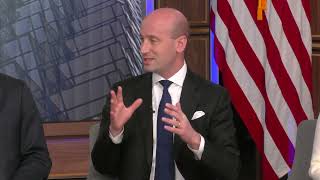
Taylor Budowich, Stephen Miller, Caroline Leavitt, and Jamison Greer discuss Trump's tariff policies and their economic and national security implications.
Chapters
I think people are tired of seeing the United States ripped off. Our allies have taken advantage of us more so than our enemies. Hold an eye for an eye. I will never apologize for defending America. We had the worst trade deals, now we have the best trade deals. My end game is I don't want to have a big deficit. We will pass the Trump Reciprocal Trade Act. Groups like this get together quite frequently before announcements like Liberation Day today. And we talk through what the President's decision is, what's the purpose of that decision and how it's going to be implemented. And then we strategize on how to communicate it to the American people. That communication usually goes through the media. They pick and choose the facts they want to focus on and the narratives they want to drive. And so we thought we'd do it a little bit differently this time. Take out the media and show the American people what the conversation's like that we normally have. Get into the details, the thinking and the purpose of this and how it's in through the short term and long term is going to affect the American people. Stephen, you've been with the President for a long time. You were part of the first administration and some of the battles economically, taxes that had historic impacts on improving the economy. Today is a big day. Can you talk about the President's historical view on global trade and the tool of tariffs or the use of tariffs that he envisions not just through Liberation Day today, but how he's used it over the years?
Yes. Well, the announcement today is the most significant action on global trade policy that's taken place in our lifetimes. It's not even a close call. I mean, this is probably the biggest event that's happened on global trade since the very ill fated decision that we are now reversing of knocking down all of America's trade tariffs and revenue policies that led to the offshoring and outsourcing of all of our industry. So this is the great reversal of that, great portrayal is how I look at it. So in the 20th century, successive American presidents knocked down all of the policies that we had to protect American industry. And they did insane things like letting China into the World Trade Organization as an example. And we watched all of our factories go overseas. This is the complete reversal of that. This is the great onshoring, the great reshoring of American jobs and wealth. So if you look at America today, we're totally dependent on, on foreign countries for the supplies that make this country run, for all of the essential goods, materials, manufactured products that make it possible for us to live our lives. Our cars, our electronics, all the materials that go into our homes, our buildings, our medical supplies, our entire supply chains are completely embedded in foreign countries. So if there's a national emergency of any kind of, and a country shuts off an import or a foreign power, embargoes a sea lane, we are then left defenseless, helpless, because of the decisions that prior leaders made that we, that President Trump is now reversing to let all of these industries leave our country. And so what he's doing today is, for the first time ever, he's saying that if you have stolen our jobs and therefore threatened our national security, we will apply a reciprocal tariff based on the degree of your misconduct. So for countries like China, for example, they will see a very high tariff rate because they've engaged in the most egregious conduct that threatens our national security. For countries that have severe, but not as severe misconduct, they'll see a moderate but not as high tariff rate. The effect, though, of those global tariffs will be that companies will have to move their production back into the United States. So factories will leave, whether it be Mexico or Canada or Vietnam or Cambodia or China or the European Union. They will come back to the United States to produce their products, to make their goods, and in so doing, yes, it will create jobs, yes, it will increase revenues, but most importantly, it will restore our national security so that we will not be dependent on anyone else to survive and thrive as a nation. That's the significance we're talking about today, the most important economic event of our lifetimes.
And Stephen, he didn't just wake up this morning and say, I want to implement tariffs. You talk about the national security crisis, but this is something the President has thought about, discussed, contemplated for years.
Decades, yes, his entire professional life. If you go back to interviews with President Trump in the 1970s, he's been speaking passionately about this issue. And he warned, for example, in the 1980s about all of our critical industries moving to, at that time, Japan. And he warned for years as well about the loss of our automotive industry, which is an essential element for national security. Those supply chains are essential for our ability to protect and defend our country, to make automobiles. And he's been focused on this issue for decades.
He took out an entire one page ad in the New York Times in the 80s talking about the threat of Japanese mercantilism and all the unfair trade practices they had that were killing our manufacturing.
So, Jamison, the devil's in the details, as they say. What are the details of this plan?
Sure. Well, Stephen just highlighted some of these. First of all, we're doing a reciprocal tariff, right? This is a golden rule for the golden age. We treat them how they treat us. As Stephen mentioned, we expect that those countries that treat us very poorly, where they have documented behavior over many years of whether it's high tariff levels or, or extreme trade barriers or taxes or other kind of charges that discriminate against our companies or burden our companies, they are naturally going to have higher rates because to achieve the kind of reciprocity we need, you have to have a higher rate. And then there are going to be other countries that have a lower rate because maybe they have a different level of unfairness or non reciprocity. And we expect there will be a global minimum on all countries because we have to deal with this deficit. We also want to make sure that there is no cheating, that we don't have people going from one to jurisdiction to another to try to get around the tariff. We need to make sure that we have no loopholes in this policy because as Steven points out, it's an emergency. The urgency of what's happening right now cannot be overstated. That's why the President on day one announced he wanted us to look into us into it. We looked into it over the past couple of months and we're taking action the day after we reported back to him. I have right here a book full of all of the unfair trade practices by our top 100 partners. We published it just a couple days ago.
And you said something interesting. They some countries will try to get around the tariffs by shipping their product through another country. They store it there for a couple months and then it all becomes the sale of another country. Can you talk through how that works?
Sure. Well, we're stopping that. We don't want a situation where China, for example, might just send a bunch of parts down to Vietnam. Vietnam puts them together in a light assembly and sends it over and says this is a product of Vietnam. At this point we will have the kinds of tariffs we need and a broad based tariff to stop that kind of behavior. And of course we're going to be very, very focused on enforcement to make sure nobody does that kind of thing.
And we use, the media uses the word tariff very broadly. What kind of tariffs are there and how do they work?
Oh, certainly. I mean we have, for example, rice. Japan in some instances will put a 700% tariff on rice. So if the United States wants to export rice to Japan, where they eat a lot of rice Japan will charge a 700% rate on that rice. It's incredible. Ours is much lower. Apples in the United States. If you want to import apples into the United States, it's duty free, it's a zero percent tariff. But if we're going to go to India, it's about 50%. If you want to go to Turkey and send American apples to Turkey, it's a 60% tariff and so it prevents it. But that's not even the worst part. The worst part are the non tariff barriers where they use fake science or fake standards or other barriers to keep out our things.
And Caroline, obviously Jamison thinks a lot about this. It's why he's the ustr. How should the normal American person, the consumer, think about tariffs?
Well, first of all, to the average American who's watching at home and trying to understand what this means for them, don't buy into the media's lies and the fear that they are going to try to instill in you after this announcement because we know that's exactly what the media will try to do. The President is looking out for the average American worker who has been ripped off by the elite political class for decades. And so what does this tariff policy look like? As Jameson so brilliant, brilliantly said, it's the golden rule for the golden age of America. We're finally going to be treated the way we're going to treat other countries, the way that we've been treated for too long. The President's going to put American workers first. But what does it look like? Think about your hometown where you grew up in the heartland, in middle America. Factories that have been abandoned, workers who have been put out of jobs, drug addicted generations of children and of families because there aren't good industries, industry here at home. There is not good industries here at home, in their hometowns. The President wants to restore that prosperity and that wealth. More money in people's pockets. The media will also continue to talk a lot about prices and what this will do to prices. And the American people need to understand that the President will effectively implement these tariffs while also having a whole of government approach to bring down the cost of living in this country. There was an inflation nightmare created by the previous administration. And while simultaneously implementing these fair trade practices to put Americans America first, the President is going is already launching a massive deregulatory campaign, a massive energy boom where gas prices are already coming down, inflation is cooling and so it's an.
All hands on and prices are coming down.
That's right.
You're seeing it across the board now. And it's important to understand. And I think, Caroline, you've talked about this a lot. This is decades of failed political leadership. We're not going to get in, get over it or change it without some fundamental reform. Biden administration definitely accelerated it, but this was decades of economic mis. Structuring of the economy.
And there's nothing the media and the political class hate more than change. And this is monumental change. The president is focused on restructuring the global economy, on restructuring our domestic economy as well. And the politicians in this city have not seen a president who is actually willing to take the steps to implement such changes really in modern history. So believe in this president. He was elected for a reason, because he's looking out for the American people across our country. And today is the first day of that in terms of trade and tariffs.
That's why we call it Liberation Day.
That's right, Steven, on that, can you talk? What is the goal here? What should the American people look forward to? What is the hope and dream that we're trying to pursue?
So if you went to a store in America in say, the 1950s and you looked at where the products were made, it would have said Made in the usa. That would have been the stamp you would have seen on everything from the toys that your children buy to the clothes that you wear to the cars that you buy and everything in between. You know, if you grew up in the 1980s, you would have seen a lot of things still stamp made in the usa, but a lot less by the time you get to the early 2000s, after NAFTA, after China's entry into the World Trade Organization, after, after other disastrous trade deals, it started to look more like we see it now, where you go to the store and everything is stamped Made in the foreign country, Made in Romania, Made in Thailand, Made in Cambodia, Made in Malaysia, Made in China, but not made in the usa. So that means those good high paying jobs that should be here in America are not here in America. At the same time, it also means that for a lot of the more advanced manufacturing jobs, these are essential industries that could be converted at a moment's notice to core national security needs. And so when you don't have those factories, you don't have the training and you don't have the workforce to be able to meet our nation's needs in a time of an emergency. So we are outsourcing to other countries the things that we need to keep America safe. The end result of this is going to be far more high paying Manufacturing jobs. These are jobs where you can support a family, you get a retirement plan, you get a pension, you have good health care, you're paid well, well above what you would consider to be the living wage for these new advanced manufacturing jobs. These are jobs you can build a family and a community around at the same time. It's going to relieve inflation because it's actually the most cost effective to make things in the United States of America. People don't think about this, but all those products you see on these store shelves that are shipped from thousands of miles away, we have to. We're paying the cost of all that shipping built into the price of the good. So it's actually more economically efficient, particularly with advanced manufacturing techniques, to have these factories in the United States near where you live, putting products on your store shelves, not having to ship things all over the globe. So you're actually going to see prices go down because our products are being built and manufactured here in the United States. The most important point to understand is that tariffs do not apply to any product that is made in the United States. So the original sin of how the modern economy in America is structured, the President talks about more than anything else that gets to Caroline's point about the overall economic vision. The original sin was that we created a tax system that punished you for making something in America and rewarded you for making something in China or a foreign country. So in other words, if you had your factory in America, you paid a sky high corporate tax rate, you were beaten to death with regulation, you had radically unaffordable energy prices, and Washington just in every way, made your life miserable.
And the political class didn't do anything about it. They allowed it to happen. They sat by and watched it happen for decades.
They actually wanted the opposite to happen. Especially if you look at the 90s, when we had NAFTA, we had the WTO, we had the entry of China into the WTO. The goal, the goal very clearly was to remove US tariff and trade barriers to make it easier for people to outsource to China. Because once we gave China what we call permanent normal trade relations, all of your manufacturers in the United States who are thinking in short terms in terms of quarterly earnings and that kind of thing, they said, listen, now I can go move my factory from Indiana or wherever, I can put it in China, I can put it in Mexico, and I know I will have sure access to the US Market today. President Trump is saying the best place to make American products and sell American products is here in America. If you make it in America, you're not going to have a tariff.
Think about how pernicious that deal is that he's describing. That was made. This was done by the Bushes, this was done by the Clintons. This was done by many American administrations, Republicans and Democrats. Republicans and Democrats was. They said to the factory owner, if you really want to be competitive, you need to move your factory to China. That's the best way to sell into America. And so all of a sudden, you're living in a community where one day there's these thriving factory towns and the next day all the factories are in Shanghai. And so my point about the original sin, it was the sin of saying that we were going to give most favorable treatment to foreign production, the least favorable treatment to American production. It's completely inverted, Right? So the President is saying today is the opposite of that. If you have your factory in America, you pay no tariff. You're going to reduce your taxes and we're going to reduce your regulations and reduce your energy costs. So you're going to get the best possible deal. But you have to do it here.
And to anyone questioning the effectiveness of the president's trade and tariff agenda, look at what has happened before Liberation Day. We have had billions and billions of dollars.
Billions.
2.7 now, great investments. Yes. Into our country. You have some of the biggest companies in the world, like Apple and Hyundai, announcing investments in American communities that are jobs in these communities. That's manufacturing in these communities. Those are American families who are going to now be able to live the American dream because of these investments. And the tariffs haven't even been implemented. So President Trump is serving as America's businessman in chief, America's negotiator in chief, by encouraging and incentivizing for once, finally, for these companies to do business here. We have the labor, we have the resources. We have the best market in the world. There's no reason we shouldn't have a president who's trying to champion America and America first policies.
And Caroline, or he had identified the problem and he's got a solution. But you spoke to this before. Tariffs are a big part of the solution here. But it's not the only part.
Right?
Companies coming in. We've all been sitting in meetings with him where he says, what is your problem for coming back? What's getting in your way? Is it regulations? Let's solve that problem. The president just had. He talked about it in a press conference this week. He had Stellantis, big car manufacturer, some of the best brands that there is and he says, what is your problem? He says, all the regulations, you have California, that's just crippling car manufacturing with their erroneous green new scam regulations. We need to pull him back. The President gets on the phone, he wants to bring companies back, he wants to bring jobs back, he wants to bring wealth back, he wants to make things more affordable. Jameson, how is he doing that?
Well, let's remember that he has a great track record. If you look at the first term, the President used tariffs to great effect and he coupled it with great tax bill, great energy policy, all things we're talking about now. And what happened in the first term, inflation went down, unemployment went down, real median household income went up for every demographic. I mean, this is incredible. Manufacturing jobs went up. So we know it can be done. He's already done it before, We're a couple months in, we're already doing it. Now. He knows exactly how to use the tools of the economy, whether they're trade tools and tariffs or other tools to really make sure that America can be competitive, that American workers can have good jobs and American families can have prosperity in their communities where they live.
And we want to wrap this up. So, Stephen, Caroline, some last messages. What do you think the biggest takeaway of today is? And what should the American public look forward to?
Well, I think at a fundamental philosophical level, when you talk about America, first it gets down to this. Who should have priority access to the US Market? Should it be the factory that's located in Cleveland or should it be the factory that's located in Beijing? That's the fundamental question. The radical left corporate media, the globalist corporate media that is attempting to criticize this plan, take the view that the best place to put your factory should be in Beijing or Shanghai or Bangkok or anywhere but the United States of America. The President's view is we should do everything in our power to make it so that the best place to put your factory is in an American town. So we get all the benefit. We get the economic benefit, we get the social benefit, we get the community benefit. And most importantly, we get the national security benefit of having our critical industries here in America. And that's why we're calling it Liberation Day, because he is freeing us from a global economic system that has made us subservient to foreign nations and foreign powers.
And Stephen, on that point, this means it's not a short term solution. This is a philosophical belief in a future for America. And so for those looking for predictability, we hear that word a lot. You can predict this policy will remain in effect.
Correct. The predictability is the absolute certainty that this program will remain in effect, that we will continue to have policies and continue to have tariffs that will ensure that we have the national security needs of our country met. And that means American industry. Inside of the United States of America, it's actually the most stable and predictable policy. Because everyone in the world knows, if I want to sell to America, just move your factory to America. Nothing is clear, more stable, more predictable than that. You want to sell to Americans, then get your company, get your business, get your plant and move it to America. That is the most predictable. And on top of that, we're going to have regulatory certainty, tax certainty, and energy certainty. So this is the definition of certainty and predictability. And to your point, it's not a short term fix, it's the total realignment of the global trade system to put America first.
Caroline, what's our closing message here?
Closing messages. Every taxpaying citizen in this country should be incredibly excited about Liberation Day. President Trump is delivering on exactly what he said he was going to do for you. The golden age of America. More jobs, more wealth, more prosperity, more security right here at home.
More from Your







President Donald J. Trump and First Lady Melania Trump Visit Grieving Texas After Deadly Floods

💪 Thinking of starting a #biz? Go for it! — Kerry Boyle, Vermont #SmallBiz Person of the Year

President Trump Participates in a Bilateral Meeting with the Prime Minister of Canada, May 6, 2025

