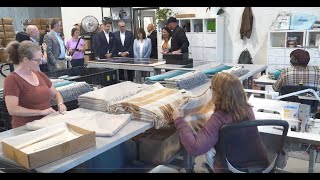
A short interview with Bob Dalton, founder of Sackcloth & Ashes, about how the company uses a buy-one-give-one model to donate blankets to local homeless shelters, local partnerships (including Navajo Nation and Danae Weavers), and the role of SBA loans and localism in scaling their social-impact business.
Chapters
Well, Bob, it's a pleasure to be with you because I do think at their core, small business owners, entrepreneurs, are trying to solve problems in their communities and a product or for the world, frankly. And you've really exemplified that to me, because when entrepreneurs, whether they're doing their business for a certain purpose, it oftentimes comes back to the communities that they serve. Sackcloth and Ashes, this company that I was able to visit with in Oregon is giving back. Every single blanket you buy goes to purchase another blanket for a community in need. And so I know that entrepreneurs at their heart are all about making everybody's lives better. And so I wanted to be able to sit down with you and hear from you directly about one, how SBA has been able to be part of that journey of making everyone's lives better. But also, you know, what entrepreneurship means to you.
Yeah, yeah. Early on, you know, we had to decide as we started to grow, are we going to take on an investment? And we decided not to in the early stages and try to see how long we can bootstrap the company, you know, as long as we possibly can. And it was about four years in that we got our first SBA loan that helped us tremendously. And it was mostly. Our company is very simple. We spend most of our money on product and people. And so, you know, we got to a point in when you're growing year over year for four years straight, you know, and you start doubling production, that a lot of money needed to be allocated towards the product. And so the SBA loan, both the first one and the second one, primarily went to the product as we continued to scale.
That's amazing. Well, and I know a lot of what small business owners do is collaborate with each other to really, you know, boost up each other's businesses, their communities. And so I love these collaborations, like you did with Navajo Nation, the Danae Weavers here, and really ensuring that there's joint action locally to really help build communities. And I don't know if you want to talk a little bit about that localism and giving back to the community that you do.
Yeah. So our company model is for everybody. Blanket that we sell, we donate a blanket to your local homeless shelter. And we've now donated to over 600 shelters in the United States and have built one of the most robust databases of shelters in the U.S. and as we started donating blankets, normally we ship them to the shelters and we donate based on zip code. But in about 2018, I started visiting the homeless shelters and doing what we call a Blanket drop, where we visit a shelter, pass out blankets, get to invite executives from companies that we're partnered with or influencers in the community to come and see some of the solutions that have been created to help the homeless issue. And so we do like a walkthrough of their facility. We share a little message with the folks in the program, and we give them a blanket. And after doing that over and over again all across the nation, I became more and more convinced that that if we're going to see real legitimate change long term, it has to be done on a local level. And we've tried to solve so many of these issues in the US Top down strategy. But when you're dealing with a complex issue like homelessness, homelessness looks different in Los Angeles as it does in Green Bay. And so the way that you're approaching a particular issue, it has to be done strategically based on a lot of different factors in geographic location. So I've gotten to come across a lot of different types of solutions of addressing homelessness and solving homelessness. And it's been life changing, but that's doubled down. My theory on, you know, local impact is the most effective strategy to create change.
Well, and that's what small businesses are. They are local. They're lining our main streets, defining our neighborhoods, and really transforming families and communities. And, you know, that's why that's what SBA is about. It's really about helping people achieve that American dream of business ownership, but also in the process, really making impact in people's lives. And especially as we gear into this incredible season of giving that's coming around the horizon, and people are trying to focus on where their dollars matter, and that's spending locally, investing locally in small businesses who create jobs locally. So you're just one of the great entrepreneurs that we've been able to be a part of your story, but really helping to advance our communities through entrepreneurship. And it is a small business boom. I was sharing with you earlier that more people are jumping into entrepreneurship. So any last advice for those entrepreneurs starting out?
Yeah, yeah. I mean, this country was built on the backbone of small businesses. And small businesses in America, you know, it's been a difficult last decade, you know, as a lot of companies have grown and big have eaten small for so long. And so we're at a pivotal moment right now where we're at a fight for human connection and community. And we're in a fight for protecting what this country has been built on, which is, you know, small organizations and smaller groups of people that are dedicating their lives to giving back to their community and serving their community in different ways. And so that's something that I've just become extremely passionate about. And I do think that the question that leaders should be asking the most right now on any level is what is the most effective strategy? There's so many different ways that we can approach issues, but what is the most effective strategy? And I think the most effective strategy is to empower individuals and small businesses and local organizations to make an impact in their communities.
That's great. You're here. Well, thank you. Thanks for joining me. Thank you for the beautiful products that you deliver and the impact you have in community.
Yeah. Thanks for being such a huge part. Part in our company's narrative.