Take Your Small Business Global
Dennis Chrisbaum from the SBA walks through how small U.S. businesses can sell overseas without getting crushed by payment and financing risks. Learn the payment methods that work (letters of credit, cash in advance, open account), which SBA loan programs cover export costs, and how trade-credit insurance protects you when a buyer doesn't pay.
Questions this video answers
Up to $500,000 (90% guarantee to lender for loans up to $350,000; 75% guarantee above that).
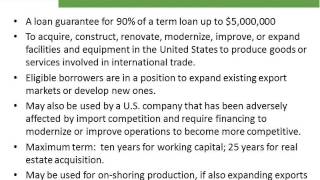
Up to $5,000,000 with a 90% guarantee to the lender (SBA program limit $5M; Ex-Im can finance above $5M).
95% of the invoiced amount (no deductible for the Express product).
Up to $300,000 and buyers can be approved in five days or less.
SBA has no US-content requirement; Ex-Im typically requires at least 51% US content for some programs.
Chapters
I would now like to turn the conference over to Dennis Crispom, Director of International Trade finance for the U.S. small Business Administration. Please go ahead.
Great. Thank you, Emily. And thank you so much, all of you who have joined today's webinar. I want to give you an overview of what you might face as an exporter, a small business exporter going overseas. I mean, some of the very quick questions that are near and dear to your heart are basically these five, how do I get paid? If you start selling overseas, it's a little different than selling to Chicago. Maybe your buyer is 10,000 miles away. You're not going to necessarily at a moment's notice, jump on a plane and go and see if you get paid. So what are the risks? And various countries have different levels of risk. So that's one question that frequently is on everyone's mind when they begin to explore overseas market. You understand they use different currencies. How do you get paid in US Dollars if that's what you want? And how do you reduce your payment risk? And so we will address that. Is there a way to mitigate risk if you sell on open account terms to somebody in Istanbul as opposed to selling to somebody in New York City? And then for those who might be starting to explore international markets, are there funds available that can help me go to a trade show or develop my product literature in foreign language to translate my literature or maybe produce to a metric standard if you need to modify and also packaging, Do I need to do packaging in a foreign language? And are there funds that might help me underwrite some of those costs? And then once you get and obtain overseas orders, is there working capital available so that you can produce that order? I mean, obviously you're running a business. Many of you have extensive domestic demand. Maybe the bank is at a point where they're not really comfortable lending you money to do business in a foreign market. So the US Government programs that can help underwrite some of that risk for the lender. And finally, if you're very successful in exporting and you need new equipment or maybe a need to expand your plant, are funds available to do that? And we'll talk about a solution there. So this is framed pretty much in terms of those questions. And so the first question is, how do I get paid? In this country, many of you, and probably most of you sell on open account terms. But internationally there are alternatives. You know, cash in advance is kind of send me the cash and I'll send you the goods. So it's pretty much risk free. You can do wire transfers. It might be a credit card transaction, and there's some risk involved with that. We definitely advise against international checks. Checks take a long time to clear. And once they clear, if there aren't funds there, your account will basically not show a balance. Documentary letters of credit are your foreign buyer, as the applicant would go into a bank and that foreign country, maybe it's in Paris, and say, I want to buy $100,000 worth of goods from somebody in the US you would be listed as a beneficiary. The letter of credit would specify very specific terms and conditions under which you're going to get paid. Those terms and conditions will include a packing list, transportation document. That is, they want to know that whatever is being ordered is being put on a vessel of some sort. It could be from your plant on a truck or a rail, or it could be onboard a ship or an airplane. So there's transportation document, commercial invoice, and obviously a description of the goods. So those three things are always in a documentary letter of credit. There may be other elements that are required. Certificate of origin, some sort of cytosanitary certificate if you're in food or egg products. And so it's very clear that I want you to be clear that the documentary letter of credit is paid against documents. So those documents are going to be brought into a bank, confirming or advising bank here, the bank will send it to the overseas bank for reimbursement. It's a little more complicated than that. But it's also as simple as knowing that there is money in a foreign bank that is going to pay you if you perform according to the terms and conditions of the letter of credit. Documentary collections are using the banking system to handle the documents. So if you prepared commercial invoice, if you prepared commercial invoice, transportation document, packing list, and basically present it to the bank, your bank's going to send it to the bank overseas. And the buyer is going to have to come in to collect those documents and either pay cash or agree to pay cash at some future date in order to have, for instance, a shipping document. And if it's a bill of lading, maybe you shipped on ocean, that's going to allow the buyer to then go down to the port of the warehouse and pick up the goods. And open account terms. We stress that, you know, insured accounts, and we'll talk about credit insurance on your accounts receivable. It's becoming more and more common as the world becomes more competitive. So these are the methods of payment that I outlined. Cash in advance. And if you look on the right hand side, the exporter in blue, the importer in green, and the risk to an exporter is low. If you get cash in advance, you have the cash and you have your product and all the buyer has is a promise that at some future date you're going to send them what they ordered. So it's a really high risk for the importer unless they know you very well. And you're probably not going to get a lot of orders if you say, please send me the cash and when I feel like it on a sunny day, I'll send you the goods. So it's an option. And it's an option if, for instance, you're the only one in the world making something and the buyer has no alternative, they may send you the money in advance. And it's also common with custom built equipment to have advanced payments or some sort of payment schedule where you actually get the cash because the buyer wants something that only you can make and then you have the working capital to produce. That overall transaction cycle is documentary. Letters of credit has indicated that buyers going into an opening bank, either establishing credit or depositing cash, which is why it can be very expensive for a foreign buyer to open a letter of credit and may not want to negotiate that term with you. The opening bank is going to send the letter of credit through a swift system to an advising bank. And the advising bank is going to do computer check and say this is a legitimate letter of credit and advise you that in fact there is a letter of credit that's been opened on your behalf as a beneficiary by the foreign buyer and it may or may not be confirmed. A confirming bank is going to undertake the risk of that letter of credit and basically say if you don't trust the bank in Zimbabwe or even Switzerland, we will take that risk. And if you present documents that meet the terms and conditions of the letter of credit, we, the U.S. bank will pay you. They will charge a fee for that. But it moves the risk from the foreign bank to the US bank that you may be more comfortable with, that you may know that may be down the street documentary collections. Again, as I indicated, you, you collect those documents, the required documents, transportation document, packing list, commercial invoice, any other documents, send them through the banking system and the buyer will come in to either pay cash to get the documents or sign a note basically saying that I will pay you in 30 days, 60 days, 90 days, and they create bankers acceptances in the Wall Street Journal. You'll See a rate for bankers acceptances, because then it becomes an obligation that can be sold. The advantage of documentary collections is, first of all, the buyer does not have to come up with cash in advance to support a documentary letter of credit. And so it's going to be a lower cost to them. And you'll see documentary collections used a lot in Western Europe. From your point of view, as an exporter, you are controlling the documents until there's either acceptance or cash is received. So if, for instance, the buyer decides that he or she's going to change her mind and not come in and get the documents, you still have title to the goods and you could sell them to another buyer in that country. You could renegotiate terms with the buyer. If, for instance, commodity, and I don't advise shipping on these terms on commodities where there's a big fluctuation in price, if the price drops, the buyer is going to say, well, I really don't want it, but for 10% less, maybe I'll take it. Or you can bring the goods back to the US which of course will cost you money, but at least you don't lose the entire transaction. And then open account terms are saying, from buyer's point of view, I want the goods, and when I feel like it, I'm going to pay you. And from the exporter's point of view, just like in this country, here are the goods. Please pay me in 30, 60 days. And you hope that they will. So you have a promise as an exporter, they have the goods, and there's certainly more risk to you. You can insure the accounts receivable against commercial and political risk. And we'll talk about that a little bit later. So the question is, when you sell internationally, who sets the method of payment? You know, if you're somebody that makes a very unique product that nobody else in the world makes, you can say, send me the money, I'll make it for you. And you don't have a working capital need. And what's important is that each one of these international methods of payment has an impact on what your financing need is going to be. Cash in advance. Give me the cash and I either have it in inventory or I will begin producing that particular order for you. Documentary letter of credit. You know, there's money somewhere overseas in a bank that will pay you when you produce, but you have to produce first. So you're going to have a working capital need to produce the good before you can collect the money. So there may be very competitive pressures. It may Be a region of the country where one method is preferred over another. In Western Europe, you're not going to see a lot of documentary letters of credit. You're going to see more open account or documentary collections. In South Korea, for instance, it's very common to under a documentary letter of credit. It's not going to be an insult to ask for one because they monitor foreign exchange that way. So in certain parts of the world, the Middle east, parts of Latin America, parts of Asia, you're going to see more use of a documentary letter credit. So that's basically one of the points I want to make. The other is competition. If you have a lot of competition in the world and if the German competitors are saying pay me in 60 days and you're saying you want a documentary letter of credit confirmed on a US bank, the German competitor is probably going to get the order. So the method of payment is going to impact exactly what your transaction cycle is and, and what the funding that's going to be required. And these are is kind of the timeline of what kind of financing might be needed on a pre order basis. If you're getting started, I mean you probably are going to have to go on to a trade show. It could be a domestic trade show that has a lot of international buyers in Las Vegas or Orlando, it could be in Dusseldorf or it could be in On Paulo or some other place that's going to cost money. You don't have an order, you don't have a transaction, but you need to fund that certifications in order to sell into the European Union you need a CE mark for your product. Is that going to cost you money? Or if you're doing electrical standards, is it going to cost money to be certified in a particular country? Translating literature English is certainly a universal language, but there may be a local requirement or it may be in your marketing advantage to obtain packaging material that's in the local language. Product adjustment Most of the world is on metric. You may have to adjust production lines to sell on a metric scale. Packaging and bid bonds. We'll talk a little bit about performance bonds and bid bonds later on once you get the order. It's really a performance risk. And a lot of banks are not going to come to your factory and make sure that if you have a documentary letter of credit that expires in 30 days that you're meeting that timeline, that you're packaging the goods, putting it on a truck and shipping it on time. So there are production costs related to that and it's performance risk can you perform. And what the US Government, through the Export Import bank and the SBA is doing with many of our finance programs is saying to the lender, we're going to, we believe that this small exporter can perform and we're going to underwrite 90% of that performance risk. So you need materials, production costs, labor. There may be a performance bond frequently set up as a standby and I'll give an example of that later. Once you ship, you create an accounts receivable and we'll talk about mitigating that risk. But if you look at this timeline, if you get an order and it takes 30 days to produce an order, and you extend 60 days open account terms, you have a 90 day financing cycle. And how are you going to meet that need and keep your business going, paying your employees materials and so forth? And then the last is buyer financing. And the Export Import bank has a program where in capital goods, if a foreign buyer needs three to five to seven years to pay, they can finance 85% of that particular order providing financing to the foreign buyer. So here's a, a question. What might SME, small medium sized enterprise, SME exporter need? So we talked briefly about working capital for export development. To attend a trade show, secure a CE mark, which is the mark in order allowing you to sell into the European Union, may be filing for an international patent or trademark to meet potential business partners. Maybe you have to go to Mexico to vet three or four potential distributors. That's going to cost money. In country promotion is something that you can work with the U.S. department of Commerce on through many of their embassies and translating your literature or other marketing costs. One solution to funding those types of development expenses is an SBA product loan product called the Export Express. It goes up to half a million dollars. We provide a 90% guarantee to the lender for loans up to 350,000, a 75% guarantee above that. They're processed by Export Express lenders. So when you talk to your lender, they may be an SBA lender, they may do normal SBA loans, but they may not have the authority to do Export Express. And at the end of this slide, if you encounter that, they can contact one of our 19 people in the field and find out the procedure to be certified by the SBA to do Export Express loans. They basically underwrite the loan. They're small loans. We just monitor it to make sure that the company is eligible. Working capital can be set up for seven years, fixed assets up to 25 years. The two main requirements for this particular loan is that as applicant, you are either entering or expanding in a foreign market and you've been in business operation, not necessarily exporting, for at least 12 months. So it's a one year in business qualification. To be eligible, it can be waived by the lender. If they do not do credit scoring, they do normal underwriting of the loan, and if the applicant's employees have expertise in exporting and small business success. The proceeds of this loan program can be used for any export development activity that includes developing the foreign market. It can be used for early transactions. You go to a trade show, you get a $100,000 order. You need 75,000 to produce the order. You can draw down the line, produce the order, ship it, get paid. You can issue a standby letter credit, and we'll talk about that a little bit later about how they function as performance guarantees. Or you could buy equipment or real estate. If you cannot get an export express from your local bank or you've checked a number of banks. The Export Import bank has a direct loan program called Global Credit Express. It provides short term working capital directly to you, so it does not involve a commercial lender. Can be used to finance early development activity as well as early export transactions. You have to have at least three years of operating operations, being business operations for three years, and have at least one year of export experience. It's based on a fixed rate. Terms are either 6 months or 12 months. They can be renewed and the maximum amount is half a million dollars. So if you find yourself in a pinch where you can't get financing through local commercial channels, you can be referred to the export. Once you go overseas and you obtain an order, maybe it's $100,000 order for a product, how are you going to produce that order? You have other domestic business that you're funding, you go to your bank and they say, well, it looks to me like you need a working capital line. You need money for materials, labor, inventory. Maybe you need to carry accounts receivable for 30, 60, 90 days. You need funds to pay for insurance, marine insurance and freight. There are bank fees and perhaps you need a standby letter credit, which we'll talk about. So there are a couple solutions. One is the SBA has a domestic cap line, working capital line of credit. It's kind of redundant, but it's a working capital line of credit that goes up to $5 million, has an 85% guarantee up to $150,000, 75% above that. It can be used for inventory and to finance accounts receivable. The advantage to an early stage exporter is that it's one line of credit been used for your domestic sales as well as your international sales. And of course the advantage for a lender is they only have to monitor one line of credit. If you're shipping on open account terms to a foreign buyer, the overseas accounts receivable have to be insured and I'll talk about that a little bit later. So you can fold both your domestic AR and your foreign AR into a borrowing base and, and have advances against that program's available to any business, whether it's a manufacturer, wholesaler, trading company or service provider. The product that SBA has that is solely focused on export transactions is called the Export Working Capital program. It too goes to $5 million, but it has a 90% guarantee to the lender. So we're encouraging lenders to provide the necessary financing to small businesses at export. It can only be used for export transactions. It's not to go to a trade show or to develop, you know, some sort of packaging material. It's, you have an order and you need money for labor materials to build that order and to extend perhaps terms to the full foreign buyer. It's for that transaction, it can provide 100% of basically your cost for the entire transaction cycle. It may be one order, a single or several orders during the year. If you are in capital goods, maybe you only ship four or five of whatever you make overseas a year. It could be a big ticket item. We're going to fund that particular purchase order. Or you can set it up as an asset based line of credit with advances made against inventory and accounts receivable transactions. Self liquidating loans. The loss rate on this product is the lowest of any SBA product because they're self liquidating loans. That is, you get an order, you advance against it, you ship it, you get paid, you pay back the line. So it's an order that self liquidates during the transaction. And this is kind of a schematic of what that is. Or we can, here's an example. This is a small company in the Rockies that makes flooring. Somebody in South Korea saw the website. All of you with websites are in international business or potentially an international business, whether you want to be or not. And so the Koreans were so taken by this, they actually flew somebody over. They looked at the plant, the mill, they looked at the flooring, said, here's an advance payment, we'll give you $15,000. And we opened a letter credit payable at site which means when you present documents and they look at them, the bank in South Korea is going to release the funds. What did the company need? They needed working capital so that every time a trucker brought in a load of logs, they got paid. And every time, you know, every week, at the end of the week, they were able to pay their laborers for milling this flooring. So they needed working capital for the materials, the labor to fill this order. It was basically a four month letter of credit, say, ship this to me in four months. And it was a four month loan. It was a single transaction. The company needed $115,000 to produce the order. When they shipped it, they got final payment. And the Export Import bank can not only insure overseas accounts receivable against political and commercial risk, they also can ensure payment under a letter of credit. This small community bank was very conservative and said they wanted the Export Import bank of the United States to ensure payment against clc. Here's an example of an asset baseline. And many of you are probably shipping on open account. You work, you have a line of credit, maybe you have a borrowing base with your current lender. And at the end of the month you say, Well, I have $200,000 worth of raw material. I have work in process a couple hundred thousand dollars finished goods, 600. I have a million dollars worth of inventory. And you go to your bank and they say, well, we will advance 40% against your raw materials work in process. If it doesn't, if it's not finished, it's probably worthless. So we're not going to advance anything against that finished goods, we advance 50%. Maybe we can sell it somewhere. Here's your collateral. We'll advance 380,000 with the US government, either the Export Import bank or the Small Business Administration. We're providing a guarantee of 75% to the lender, or 90%, actually 90% under the export programs. The bank is going to say, well, since the US Government is guaranteeing it, we allow an advance rate of 75% against all three of these categories. And so instead of $380,000 capacity, the borrowing capacity, you now have 750,000. And likewise with the foreign accounts receivable open account, if you have open account in Nicaragua, no lender's going to advance against that. But if the US government insures that accounts receivable 95% against commercial and political risk, they're going to allow a 90% advance against accounts receivable because the risk has moved from an unknown buyer and maybe a difficult country to the US government. And so a 90% guarantee expands that significantly. Likewise with a letter of credit. So over 100% increase from 800,000 in this particular example to 1.65 million is a tremendous expansion of the borrowing capacity of a company. Here's an asset baseline small company in the west that makes animal supplements for animals, animal supplements mainly for dogs and small animals for the most part. 70% of this company's business is one distributor in Japan. It's a high, I mean, that's high risk for SPA to have such a concentration of sales in one country and to one particular buyer. But the Export Import bank is ensuring, and there's a single buyer policy ensuring that accounts receivable against nonpayment. And the SBA provides a 90% guarantee on a $360,000 revolving line of credit. Because the company needs to pay their contract manufacturer in 30 days, the foreign buyer has basically demanded negotiated 60 day terms. So there's a funding gap in here. And what the facility allows is.
The.
Ability of the company to meet the terms of their suppliers and being assured of payment from the buyer. Working with our program and with the export importance banks, bid and performance bonds are frequently used by commercial banks as performance standby letters of credit are used as performance bonds or bid bonds. And standby letters of credit are letters of credit that standby and if some event does not happen, that fund is triggered, those funds are triggered and are transferred to the beneficiary. And I'll give you an example of that shortly. But I just want you to be aware that the Export Express, the Export Working Capital program of both SBA and the Export Import bank, they have a very similar program, can support standby letters of credit. And of course, the advantage is that standby letter credit is somewhat dangerous for a bank. I mean, if it's drawn, the money has to be there. So usually there's a requirement for credit or 100% collateralization under the SBA and the export Import bank programs. They require at the maximum 25% cash collateral. Here's an example of how a standby letter credit can be used. This was an example of a buyer in Chile, works in the mining sector having a problem. The problem was they have tailings ponds where all the waste from mining is stored. Water collects and if water is released, it goes into the mountain streams and it's a very polluting thing. So they needed to pump this water off these tailing ponds. They placed an order for a company for nine modular pumping units, $660,000 order they were so desperate, they said, here's a 50% down payment so you can start producing it, because we want them as soon as possible. 20% on final shipment, 20% on delivery to the mine site. So they got to Santiago, they had to truck it up to the mine site, and then 10% was a warranty bond. So how did SBA assist this company? They had a $330,000 down payment. So they had working capital to produce the order. But as a condition for that, they said, if for some reason you can't meet our deadline, if you can't produce this and we're satisfied with it and ship on time, we want a down payment back. We want a performance guarantee. So without the US Government involved, they would have had to have taken that $330,000, put it in an escrow account at a bank to support a standby, and the Chilean buyer would have said to the U.S. bank, this company did not perform, I want my $330,000 back with an SBA guarantee on the line of credit. We supported the standby letter of credit. They got to keep their $330,000 to produce the modular units. They were able to ship on time. And $330,000 was basically took care of, not only the advance payment, but they got another 20% on final shipment. And as soon as they shipped, which was the condition of the standby letter of credit, the letter of credit disappeared. So we opened a standby letter of credit for the advance payment for three months. They got to keep the advance payment, produce it, the bank took as collateral. Basically, the work in process. Here are advance rates on the Export working capital program. 75% against inventory work in process, 90% against insured accounts receivable. The SBA has no US content requirement. The Export Import bank does has a 51% US content requirement. The SBA's working capital program only goes to 5 million. Export Import bank has no upper limit. SBA does not have a prohibition against military sales. So if you want to sell something to the Canadian Air Force, we can finance that. The Export Import bank cannot. And obviously SBA only works with small businesses. The guarantee fee. Most of these export working capital loans are set up for 12 months, and the guarantee is a quarter of 1% on the guaranteed amount. So they're almost free. If it goes over 12 months, it can be over 3%. But most lines of credit are reviewed every 12 months, and we set them up for that length of time. So here's a summary of working capital solutions for you as an Exporter, The Export Express, up to half a million guaranteed loans, 7 million or 7 years maximum working capital. The Export Import Bank Global Credit Express again to half a million dollars. But it's a direct loan if credit is not available elsewhere. Terms are either 12 or 6 months. The SBA's cap line, 5 million. One line of credit to fund both domestic and foreign sales. If shipping on Open account terms, 10 year maximum term. And then the export working capital of SBA and the Export Import Bank. 2. 5 million for SBA, over 5 million for the export Import bank. Only for transactions typically set up for one year, although they can be set up for three years if the order justifies it. And lastly, not quite lastly, but what might an experienced exporter need if you're very successful and you need new equipment, or maybe you needed a separate production line for some of your export activity, or maybe you need a new building. And the answer for that is that the SBA has an international trade loan which is a term loan, that is it can go out 25 years. We provide a 90% guarantee to a lender up to $5 million. And it's to acquire, construct, renovate, modernize, improve or expand equipment or facilities used in the US to produce goods or services for international trade. I mean, those are the eligibility requirements. This is the use of proceeds that is authorized under this particular loan program. To be eligible, you have to be expanding or in an existing export market or developing new ones. So you need a business plan that's going to demonstrate that as a result of this financing, you're going to be more competitive and you're going to grow your export activity. And it also obviously can be used for onshoring. We certainly encourage people to bring investment back to the US as long as you continue to export. And then finally, what might a small business exporter need to reduce risk of not getting paid? And the answer is trade credit insurance. I mentioned it several times. It's a mitigation tool for risk to ensure foreign accounts receivable against non payment due to commercial or political risk. Maybe there's war, riot, revolution and all of a sudden nobody can pay. Or maybe your customer goes out of business. So if they don't pay, the credit insurance is going to be triggered. And under small business policy that I'll mention, you receive 95% of the invoiced amount. It's a marketing tool. If again, if your buyer is looking not only at you, but other competitors as a source of product, and you say that you only accept cash in advance or you only accept letters of credit and your competitor, competitors are saying, pay me in 60 days. You're not being competitive. So it's a marketing tool. If you can go to the buyer and say, sure, pay me in 30 days. If I can insure you as a buyer, you're going to be ahead of the game and be able to meet more foreign competition. Just as importantly, as a financing tool, as I gave an example before, if you're selling to an overseas market, lenders are not going to go to Brazil and try to collect on accounts receivable. But if you insure that accounts receivable, it moves from overseas risk to basically the risk of the insurer. And the product that the US Government has is through the Export Import bank that will insure that product. So it moves to the US Government. And obviously it's a health aid. If you know that well, this guy in Mexico doesn't pay you in 60 days, the export Import bank will. It's a lot easier than worrying about the next financial crisis. So credit insurance helps you expand into new foreign markets. You can add buyers and basically you're transferring the risk from overseas buyer to the Export Import Bank. There's credit express credit insurance goes up to $300,000. They basically will approve buyers in five days or less. And if in case of default, 95% of the invoiced amount is paid, there's no deductible, no application fee, no minimum sales, and the premium is only paid if you ship. If you don't ship a month, you don't pay. But if you sell on open account terms, 60 days, $100,000 shipment into Mexico, it's going to cost you $650. I mean, it's very cheap to be able to develop that market, to extend terms to allow your customer time to sell whatever you're selling them in order to pay you. And you get a discount on the premium. If you have one of the US Global Business Solutions loan programs, which means SBA or XM loans, eligibility for credit insurance through the Export Import bank is at the product is manufactured and shipped from the US at least 50% US content. If it's a service, at least 50% of the exported service is performed by US employees. And there is a link here to or if you go to the website EXIM for exportimport.gov and search for the country limitations schedule. There are about six countries where it's impossible to do business legally, but there are also other countries where they're not providing cover. So you need to look at the eligibility list and country limitations schedule list to see if it's eligible and open for credit insurance in those markets. Maximum terms under 80 days, with few exceptions for commodities and some capital goods, go up to a year. This is small business definition that both the SBA and the Export Import bank use. Manufacturers generally, 500 employees or less can go as high as 1500. If you're making aircraft or some other industries. Wholesalers, 100 employees or less. Services are based on revenue. And so it could be anywhere between 7 and 35, $36 million. Or you can apply the alternate size standard, which means that for a company looking for financing from the SBA, if you have less than $5 million in net income over the past two years and net worth of less than $15 million, you would qualify. Here's an important distinction. Some of you might not be directly exporting now, but maybe you sell a product to Boeing or Caterpillar and maybe that product's incorporated into a unit that is then sold to Singapore Airlines or some mine overseas. So both of us provide financing under these export loan programs for indirect exports. Indirect exports occurs when the borrower ships a product to another domestic company like Boeing, that in turn incorporates it into a final product like a Boeing 747 that's sold to China Airlines. And if we have documentation from the exporter of record that your unit, whatever it is, was used for a product that's exported, you can access any of these loan programs. This is a network of U.S. export assistance centers where the U.S. small Business Administration has international trade finance managers. It's a colorful map. But what's more important in the territories that they cover for Denver, the light brew from border to border and so forth. But probably what you want are the contact information. And so we'll go. We can go back to this in a minute. And the territories that these individuals cover for more information on any of the trade finance programs. That's my contact information. There's a lot of information that's updated on our website, www.sba.gov international. And let me just go back to this list so that you can see who the contact would be in your particular state. And at that point I will go to questions And Emily, I guess you can open the lines.
Sure. Thanks. If you'd like to ask a question, you can dial STAR1 to put yourself into the queue. You'll hear a notification when your line is unmuted, at which point you can state your name and your question. If your question is answered before we get to dialing STAR1 a second time will take you back out of the queue. You can also send a note to all moderators using the Notes tab on the right hand side of your screen. And we do have someone in queue at the moment.
Hi, I was wondering if I could get a copy of the slides. I don't see a way to download them. Is this sent out to Emily to participants or not? Or is a link sent out?
I am actually not sure.
I know I haven't gotten an email on previous SBA web webinars that I've been to with all the slides but this one in particular has detail and some other details and link that we use. Okay, I guess if you send me an email I'd be happy to send it out to you. I thought that they sent out a link but if not I can always do it as a backup and here's yeah, it's just Dennis chrisbaumsba.gov so shoot me an email and I'll send it back to you. What was your email address again and how do you spell your last name? Let's see if I can go to that. If you can go to the last slide, Emily, that might be good. Got it. Thank you. Yeah. There's a couple questions online on services. You know services are perhaps more difficult for most lenders because there's not a whole lot of collateral they can attach. So what we basically would look for is a contract. If you have a contract to perform engineering services overseas, we're going to look at your ability to perform and the ability of the buyer to pay. So we're going to look at performance risk on your part and payment risk on the buyer's part. Maybe they're opening a letter of credit. Maybe you're invoicing them every 60 days. Maybe we need credit insurance on the overseas accounts receivable, we probably would. And there's no reason both Export Import bank and SBA Fund Service exporters. So certainly contact one of these 19 people locations for more details on that SBA loan program. The Export Working Capital loan program is underwritten by the SBA personnel in the field and we provide a 10 day turnaround. And Export Working capital, the Export Express program is done by the lender. So it's basically however fast an ex lender would work. I'm not sure. On the direct loan program with the Export Import bank it might, might well be four, five, six weeks because it's a direct loan program and I think they're backlogged right now. The International Trade Loan program there Are many preferred lenders under SBA's loan program where they provide the guarantee, provide the loan on behalf of sba. So it's basically dealing with the lender. If it goes through our processing center in Sacramento, it's now up to, I think 21 days. But work with your lenders so they understand fully what your business is, what you're trying to do, and have a real comfort level with that. Credit insurance has to be, has to be in place before you do a shipment and you have to have approved buyers. That's why the express program, the express credit insurance product, the Export Import bank is basically qualifying your overseas buyers. They're going to look at at least five buyers and say, yeah, we'll provide a guarantee. If you have a more expanded small business policy, you're going to have to get credit reports from the foreign buyers and run those by the Export Import Bank. So they say, yeah, you can ship $100,000 to this company, but you can only ship $50,000 to this company. So it's like insuring your house. You're insuring the accounts receivable overseas against commercial and political risk. If you don't get paid, you need to file a claim with the export importing plan. And of course, once you ship, you know it's gone. So you can't insure something that's already not been pre approved or get coverage on anything that's not pre approved. I'm responding, I'm sorry, to an insurance question here. Does export or SBA require personal guarantees? Yes, we require. SBA requires a personal guarantee on its loans for anybody that owns 20% of a business or more occasionally a very inactive owner. The guarantee might be waived, but we need a guarantee on every single loan, a guarantor on every single loan. Were there any online questions? Anybody in the queue?
No one in the queue at the moment. But just a reminder, you can dial Star one if you have a question. I am not seeing anyone queuing up. Oh, we do have someone in the queue. Now.
Do the insurance programs require a guarantor as well or just the loan programs? Just the loan programs. And in response to another question the insurer is underwriting, basically they would look at in the application, I think you have to be in. They prefer in business, three years and one year of export experience. But they're going to look at your loss rate on open account terms and how you qualify buyers for credit. And so they're underwriting you as well as the foreign buyer. But I do not believe they have a personal guarantee on because it's an insurance policy. It's not money that is being dispersed. And they're looking at the default of a foreign buyer. So they could look very closely at them as well as when they allow you to qualify foreign buyers. And they will say you have a discretionary limit of $50,000 because you know how to extend credit. They'll establish that for you. And then if somebody's outside that norm, you'll say, well, ABC on Stockholm wants $200,000 worth of open account terms. And they'll come back and say, yeah, that's fine or no, it won't go that high. All right, thank you.
So once again you can dial star1 or send a note. Again, I'm not seeing anyone queuing up at the moment.
We'll wait 30 seconds if there aren't any more questions. Certainly want to thank everybody for participating and encourage you to follow up with any of the individuals listed here from more details. Both on the Export Import bank and SBA loan programs, we try to work very collaboratively. The presentation focuses on US Global business solutions. So these are solutions that the US Government has to meet your specific needs. We're not, you know, standalone agencies trying to promote only our own products, but products that are going to work to enhance your ability to export successfully and get paid. So many of these individuals are co located with staff from the Export Import Bank. If you call Atlanta, they will refer you. They sit next to each other. One focuses on insurance. Sandro and the Atlanta office would focus more on the loan program. Collaboratively, they're happy to do joint calls, joint calls with your lender to make sure you get the financing that you need. So the entire recorded presentation, I think there probably will be an email sent out to all the participants and I believe last time it was available for reviewing for a two week period. I'll check on that. But if you don't get an email, let me know and we'll see what we can do.
I believe that is correct, that they'll send, once they've posted it on their site that they'll send that out, right?
I think I'm almost certain. Okay. Well, I want to thank you all. Please think of the US Government as a solution to help you expand internationally. We want to be your partners and work with financial institutions, your bankers to make it possible. So thanks again and have a great week.
More from Your







President Donald J. Trump and First Lady Melania Trump Visit Grieving Texas After Deadly Floods

💪 Thinking of starting a #biz? Go for it! — Kerry Boyle, Vermont #SmallBiz Person of the Year

President Trump Participates in a Bilateral Meeting with the Prime Minister of Canada, May 6, 2025

