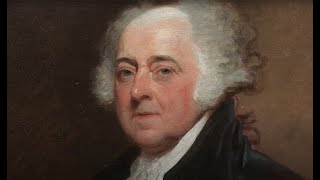
A single-speaker YouTube narrative about John Adams presenting him as an "indispensable American." The video traces Adams’s public career (Continental Congress delegate, diplomat to the Netherlands and Great Britain, first VP, second US president), his central role in independence (calling for a formal resolution, organizing the Declaration committee, nominating Washington), diplomatic achievements (securing French funds and a nearly US$2 million Dutch loan, negotiating the Treaty of Paris), legal career (defense in the Boston Massacre trial), and personal background (Braintree origins, Harvard scholarship). It concludes with Adams’s later life, his successful avoidance of war as president, and his July 4, 1826 death.
Chapters
In order to form a more perfect union. Our lives, our fortunes, and our sacred honor. It's commonly said about George Washington that he was the indispensable American. But there's ample evidence that John Adams may indeed be an indispensable American too. Though never a soldier, Adams fought for America's freedom in our nation's most important chapter. Few Americans in history have a political and diplomatic resume like Adams. Here's a list of some of the positions he held in public life. Massachusetts. Delegate to the Continental Congress, first US Minister to the Netherlands and Great Britain, America's first vice president and our second president, among many other prominent positions. Adams also authored several influential works on government, including most notably the Massachusetts Constitution of 1780, which he wrote loan and which is to this day the oldest written constitution in the world. It served as a model for the US Constitution, specifically its focus on separation of powers among and between the branches of government. But there's much more to Adams life than his resume, including real accomplishments and crucial battles fought and won for his country. Though Adams was impatient and viewed as too tactless for legislative life, he was a ferocious behind the scenes operator and ended up playing a big part in the most momentous decisions in our nation's fight for independence and beyond. His decision to nominate George Washington as commander in chief of the colonial armies was as consequential an act as any he would perform. Adams first met Washington while the two served as delegates to the first Continental Congress. He was impressed with Washington's military experience and Washington's demeanor and knew that to unify the colonies, he would need to choose someone to lead the Continental army that was not a Yankee. Virginia was not just the richest colony, but the largest. And as David McCullough noted in his biography of Adams, quote, the very proud Virginians felt they had a right to lead in the second Continental Congress. No delegate fought harder than Adams behind closed doors and on the House floor for the colonies to not merely sever ties with Great Britain, but declare independence outright. In May of 1776, it was Adams who called for the formal resolution for independence. And it was Adams who organized the committee charged with drafting the Declaration of Independence. Adams chose Thomas Jefferson, 33 years old at the time and the youngest delegate for the task. He recognized Jefferson's ability to make words work above and beyond the call of common prose for what was to be the most important writing assignment in world history. After Adams and 55 others put their name to paper and pledged to each other their lives, fortunes and sacred honor, Adams penned these Words to his bride Abigail, about how that day should be remembered. It ought to be commemorated as the day of deliverance by solemn acts of devotion to God Almighty. It ought to be solemnized with pomp and parade, with shoes, games, sports, guns, bells, bonfires and illuminations from one end of this continent to the other, from this time forward forevermore. Any one of these accomplishments would have been enough for anyone's lifetime. But there were more. Adams played a pivotal role in the fight for independence on the diplomatic field, securing critical funding from the government of France and negotiating a loan from Dutch bankers of nearly US$2 million. It was funding needed on the home front for provisions, arms and munitions necessary to secure military victory in America and independence. Thereafter. Adams wrote of his efforts later in his life. If this had been the only action of my life, it would have been well spent. And there were his efforts, along with John Jay and Benjamin Franklin, on the treaty that ended the Revolutionary War. The Treaty of Paris established the United States as an independent nation and doubled the size of America. Lest we forget, Adams served as the second president of the United States and managed to keep the nation out of war. No small task, given the events in France, which was experiencing a revolution of its own. Despite blistering attacks from his own party, particularly from Alexander Hamilton, Adams sent a peace commission to France with hopes of averting war. He succeeded, but at great personal cost. So what do we need to know about Adams to best understand the man? It's first important to understand where he was born and to whom. Adams was not born to wealth. His father made his living as a farmer and shoemaker in the quiet village of 2,000 people called Braintree, Massachusetts. Baptized in the church where his father served as a deacon, Adams learned from him the necessity and importance of hard work, good habits and trustworthiness. Adams wrote these words about his father after he died. A man of strict piety and great integrity, much esteemed and beloved wherever he was known, which was not far. His sphere of life being not extensive. The sphere of John Adams life would extend far beyond Braintree to the great cities of America and Europe, too. The turning point in Adams life came in the form of a scholarship to Harvard at the age of 15. While there, Adams cultivated his appetite for reading, which lasted a lifetime. But it was his time debating that he discovered he'd make a better lawyer than preacher, much to his father's disappointment. After graduating in 1755, he pursued a legal career. Harvard Law wouldn't open its doors until 1817, so Adams did what aspiring lawyers did back Then he worked by day as a teacher to pay for his legal training with lawyers in and around Boston, launching his professional career in 1758. By 1770, he was one of the busiest lawyers in town. Then came the moment that tested Adam's commitment to the rule of law and provided posterity with a window into the character and courage of the man. At great risk to his practice, he chose to represent the redcoats in the biggest case of his time, the Boston massacre trial. Adams rhetorical skills were on full display as he described how the mob pelted the British soldiers with every species of rubbish. One soldier, he said, was beaten to the ground with a club rising up, only to be beaten down again. Do you expect he should behave like a stoic philosopher lost in apathy? Adams asked the jurors and by proxy, the entire city of Boston. Adams then explained to the jurors that the presumption of innocence is the bedrock of any civil society. Better that many guilty persons escape unpunished than one innocent person should be punished. Adams closed his case, quoting Algernon Sidney, the English political theorist who wrote discourses concerning government, a textbook that profoundly influenced our founding fathers. The law no passion can disturb. Tis void of desire and fear, lust and anger. It does not enjoin that which pleases a weak, frail man, but without any regard to persons, commands that which is good and punishes evil in all, whether rich or poor, high or low. Tis deaf, Inexorable. Inflexible. The jury was out less than three hours. Six soldiers were acquitted. Two were found guilty of manslaughter. Adams suffered in the short term losing half his law practice. But as time passed, his defense of the redcoats enhanced his public standing. Years later, Adams concluded that this effort of his was one of the most gallant, generous, manly, and disinterested actions of my whole life and one of the best pieces of service I ever rendered my country. It was a trial that taught us all that unpopular people, or people we hate and hate for good reason, must not be subject to the whims of the mob or prosecutors doing the mob's bidding. That single story, more than any other, embodied the nature and character of Adams and the country he would soon help to birth. The American republic, after all, is built to protect the rights of Americans through law, not the mere opinions of man in poor health. In the summer of 1826, Adams, 90 years old at the time, was visited by some local leaders seeking a toast they could share for America's upcoming 50th birthday celebration. I will give you independence forever. Asked if he would add to the toast, Adams replied, not a word. Adams died on July 4, 1826, not long after Jefferson, who died remarkably on the very same day, just hours earlier. His last words before dying Jefferson lives. In a letter to Abigail written decades earlier on a matter concerning the raising of their children, Adams wrote, fire them. With ambition to be useful. At great personal risk to his family, health and wealth, Adams served his country like few others have before or after. What more could Adams have done to earn the honorific indispensable American? It's a question worth asking and answering as we approach our nation's 250th birthday celebration. Sam.