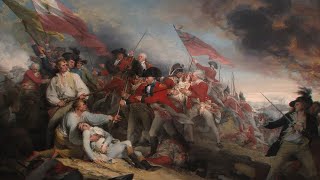
A narrated YouTube episode from the 'The Story of America' series recounts the Battle of Bunker Hill (June 17, 1775). It describes the lead-up after Lexington and Concord, Colonial efforts to organize forces around Boston under Artemus Ward, the decision to fortify Breed's Hill, British counterplans under General Thomas Gage and General William Howe, the repeated British frontal assaults, and the rebels' eventual withdrawal due to lack of gunpowder. The piece emphasizes the battle's high British casualties, its disputed tactical significance (British victory by field control) and its large symbolic boost to American morale.
Chapters
In order to form a more perfect. And our sacred honor. The spring of 1775, 250 years ago, was a tenuous tipping point at could have gone either way. After the skirmishes at Lexington and Concord, Massachusetts wondered if it would stand alone. Its legislature petitioned the Second Continental Congress to create a national army. As the army now collecting from different colonies is for the general defense of the right of America, we would beg leave to suggest you're taking the regulation and general direction of it. This was a bold step toward the unification of the thirteen colonies into a national government. While it waited for an answer, Massachusetts appointed French and Indian war veteran Artemus Ward to command the growing assemblage of troops surrounding Boston. His loosely organized command included regiments led by William Prescott from Massachusetts, Israel Putnam from Connecticut, and John Stark from New Hampshire. With little command and control structure, decisions were frequently reached by consensus or sometimes by force of personality. Such was the case on whether to occupy Bunker Hill on the Charleston Peninsula that pointed like a dagger toward British occupied Boston. Whoever controlled these heights controlled Boston. But for weeks both sides had left them unoccupied. Finally, General Thomas Gage, the British commander, decided to act. The British plan was to seize the hills at Dorchester to the south and then launch an assault against Bunker Hill. The Dorchester attack was planned for the morning of June 18, without much concern as to what General Ward's troops might be doing in the interim. For two days before this planned attack, at the urging of Prescott and Putnam, Ward agreed to fortify the Charleston peninsula and its 110 foot high point of Bunker Hill. Putnam, who was itching for an all out fight with the British, pushed for the construction of the main fortifications on a slightly lower knoll closer to Boston that would later be called Breed's Hill. On the rebel side, Ward soldiers were still less an army than a loose band of partisans, hardy in the cause, as one termed it. Few had uniforms. Most were in everyday work clothes. All carried muskets brought from home. Some of the weapons were older than the men who shouldered them. Almost no one had bayonets. The crude earthworks they dug on Breed's Hill were relatively small, about 130ft square. The main weakness was that its northern slopes fell gently toward the mystic river, offering an avenue from which an attack could surround the position and cut it off. When the British discovered the rebel position on the morning of June 17, General Gage postponed his Dorchester plans and expedited his attack against Bunker Hill. Cannon from Royal Navy ships in the Charles river and batteries atop Copp's Hill in Boston pummeled the newly constructed rebel positions, and General Gage ordered General William Howe to attack that very afternoon. Watching from atop Copp's Hill, General Gage handed his telescope to Abijah Willard, a loyalist who had sought safety in Boston, and asked if he recognized anyone among the rebels who might be in command. Willard did. William Prescott was a fellow soldier from the colonial wars, as well as his brother in law. Will he fight? Gage demanded. He could not answer for Prescott's men with Willard replied, but Prescott will fight you to the gates of hell. Now came the stuff of legend. Howe ordered 1500 men to cross the Charles River. They landed unopposed on the beach below Bunker Hill. Prescott's men in their trenches were content to watch because they were short of gunpowder. Howe formed his troops on a rise about 100 yards inland. But what he saw next gave him pause. Colonel John Stark's 1st New Hampshire Regiment. About 400 men had taken up positions behind a rail fence and a hastily erected stone barricade on the mystic beach anchoring Prescott's vulnerable left flank. Seeing this massing of rebel troops, Howe sent for reinforcements. By the time they arrived, he had about 2,200 men in the field against likely half that number in the immediate vicinity. For one fleeting moment, the difference between Lexington and what was about to occur below Bunker Hill stood in sharp relief. This could not be called an accidental encounter. As General Howe's troops advanced toward Prescott's and Stark's positions late on the afternoon of June 17, 1775, it was clear to any observer that the outcome would be a pitched battle. As British troops advanced uphill in two long lines and in column against Starke's position, the bulk of the American line stood silent, keenly aware of its limited gunpowder. Hold your fire. Commanders reminded their men. The quote most associated with the Battle of Bunker Hill is, don't fire until you see the whites of their eyes. Now, who said it? Perhaps William Prescott, or how often it was repeated, is uncertain. Another account claims that behind the stone barricade, John Stark admonished his men not to fire until they could see the enemy's white colored gators Onward. Then Howe's regulars came. At perhaps 50 yards, the command fire resounded and the entire rebel line exploded with a thunderous roar. The British troops staggered and fell back in disarray. Howe ordered them to reform and move forward again. Armchair strategists have faulted Howe for marching his troops directly up Bunker Hill. But this frontal maneuver was not Howe's initial intent. He had placed great faith in his light infantry to turn the left in end of the rebel line and create havoc along it. After that, the heavy grenadier companies were to bulldoze through with fixed bayonets. Eleven companies of light infantry, about 350 men, rushed headlong in a column of fours against the stone barricade where Stark's New Hampshire men stood three deep. Their first volley died decimated the attacking column. As other companies moved forward to take his place, they gained no more than a few yards before more volleys rent the air. The British infantry struggled onward, but the New Hampshire lads stood firm as granite. The granite air companies on the slope above heard these musket volleys without seeing the results. Howe indeed intended for the grenadiers to sweep through the rubble line and circle behind the trenches. But as the light infantry attack collapsed, the grenadiers too were thwarted by concentrated fire. After the second attack also failed, Howe ordered a third charge directly against the earthen fortifications. By now, the Rebels were dangerously low on gunpowder. Many had withdrawn to the higher hilltop of Bunker Hill. Prescott was down to about 150 men. What ended resistance there was neither a lack of courage nor unstoppable British resolve, but rather a shortage of gunpowder. The remaining defenders lost their lives to British bayonets. By evening, the Charleston peninsula was in British hands, but the Rebels had fought a fighting withdrawal and established defensive lines on the British side. There was a dazed sense of disbelief. The slopes were littered with red uniforms of the dead and dying. General Howe was in denial. He had won the field, but at a staggering cost. The Battle of Bunker Hill was his fellow general Henry Clinton opined a deer bought victory. Another such would have ruined us. After Bunker Hill, there was no doubt that this was all out war. Some suggest the military importance of Bunker Hill is overstated. Yet American history has long celebrated it and the public recognized it with the same reverence accorded Yorktown, the Alamo and Pearl Harbor. If one counted only control of the battlefield, Bunker Hill was a British victory. But for the rebel psyche of 1775, the battle was a huge morale boost. As the first major clash between rebel forces and British regulars, Bunker Hill showed that those who would increasingly call themselves Americans could hold their own. The American Revolution was not begun on Bunker Hill. It certainly was not decided at Bunker Hill. But the Battle of Bunker Hill proved that the fight for American independence and a new nation was truly begun. In the American Spring of 1775, Sam.