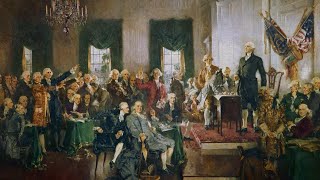
Larry Arne (president of Hillsdale College) delivers a short lecture interpreting the Declaration of Independence’s meaning and structure. He frames the Declaration philosophically (using classical causes, emphasizing the ‘final cause’ — the purpose of the nation), highlights its moral claim that “all are created equal,” and outlines the document’s three-part structure: (1) universal principles; (2) a catalogue of grievances against the king (the middle 28 paragraphs); and (3) a formal legislative act by the Continental Congress that declares independence and concludes with a mutual pledge. He also notes theological references (God appears four times) and connects the Declaration’s principles to later constitutional organizing devices (representation, separation/independent judiciary).
Questions this video answers
Larry Arne, president of Hillsdale College.
Four times.
Chapters
In order to form a. More. Hello, my name is Larry Arne. I'm the president of Hillsdale College, which is honored to be working with the White House to produce these videos in honor of the 250th anniversary of the Declaration of Independence, the greatest political document in human history. Our college was founded in honor of that document. We encourage you to love it and to celebrate it. And to celebrate it, you should learn about it. We're going to talk about two things, the meaning and the structure of the Declaration of Independence. First question is, what does it mean? Things have causes. There's a classical account of the causes of. Of things that include the efficient cause means whoever made it. The material cause means whatever it's made out of. The formal cause means what does it look like and how does it operate? And the final cause is what is it for? What love produces it. Declaration of Independence contains a lot of information about the formal cause of America in the middle, but its chief function is to provide the final cause of the country. What is the country for? And it begins very beautifully by explaining that it says that anytime in history, any people in history, have a right under the laws of nature and of nature's God to form a nation according to purposes that they adopt. What are these laws of nature and nature's God? What does that mean? The Christian view is that God made nature. The classical view is that each being has a good, and the good and the being are the same thing. Nature is full of things that are good, and it's wrong to violate the good of anything. What do these laws say about people? They say that they're all created equal. Think what a remarkable thing it is for a people to adopt a standard like that as their purpose, as their governing purpose. And we did that in opposition to a king who claimed that he was born to be our ruler because he was better born than we are. He was denying the proposition that all men are created equal. If you recognize this principle of equality and you recognize it properly, it will give rise to the most amazing diversity and difference among people, because it sets up a right of all of us to pursue our lives best we can without impediment by kings and emperors. We said in the laws of nature and nature's God, no one is born to rule anybody else. That's. And it sets up an agitation in the country which goes on to this day to always try to recognize those principles. And that's the final cause of the United States of America. Now, a word about the structure of the document. It Begins with this universal claim that we're all created equal and that nobody may rule us except by our consent. And in the middle bit, they claim the king has done a bunch of bad stuff that justifies the revolution. He took houses away from people and put troops in them. That means they were dislodged. They were driven out into the street. He arrested people. He put them on ships. And the ships were not very comfortable. They were in the hold of the ship. Sometimes they sat around for weeks in the harbor. And they were taken all the way to England. Most of them had never been there before. And they were put on trial in front of people they never met before. Not a jury of your peers. This is the 25th paragraph. He has plundered our seas, ravaged our coast, burnt our towns, and destroyed the lives of our people. He did kill people. And then he'd talk about the mercenaries there. Large armies of foreign mercenaries. Those were the Hessians, to complete the works of death, desolation and tyranny already begun, with circumstances of cruelty and perfidy scarcely parallel in the most barbarous ages and totally unworthy of the head of a civilized nation. But then that leads us to the second thing about this structure point. And that was some of them are direct violations of the best method, the founders argued, the only sure method to keep the government from doing things like that to you, to its citizens, to anybody. Right. And those methods are. They provide the organizing principle of the Constitution of the United States. They are representation. You know, the Continental Congress that passed the Declaration of Independence took great pains to be a representative body. That is to say, they're not acting according to their own wills. Somebody else, those who will be governed under this new government that they're creating, have appointed us to do this. We are acting for them. We have government by consent. And they say that the king is interfering with the legislatures that they had had before. He dissolved several of them and he prevented others of them from meeting. And those are all in these charges here. Right. He has obstructed government by consent. Then he's messed around with the judicial branch. And that means that the legislature has to pass a law. And then the executive enforces only the laws that have been passed. And then when the law is applied upon any citizen, he has to be taken in front of a judge who's not dismissible by the legislature or the executive. And then the judge has to decide. That's called the independent judiciary. It's a terribly important thing. So the middle bit of the declaration, these 28 paragraphs is the second part of the structure of the Declaration of Independence. And the third part is a formal legislative act that makes the nation. It's passed by the Continental Congress. I should mention that God appears four times in the Declaration of Independence. He appears in the first sentence as the maker of the laws of nature. And nature's God, the legislator. He appears in the beginning of the second paragraph as the endower of our rights as creator, the founder of everything. The last paragraph is personal. They refer to themselves for the first time. We, therefore, the representatives of the United States. The representatives of the United States. We in general Congress assembled. And then they appeal to somebody to judge whether they're right. And that person is not the king of England. It's the supreme judge of the world. The judicial branch for the rectitude of our intentions. In other words, we swear we're doing what seems right. And we ask God to judge in the name of the good people of these colonies. You can read it is a claim that the people of the colonies are good. You can read it as the claim that we're acting for the good ones. Or you can read it as the claim. We have to remember to be good. Because we are assuming this authority. Now. Free and independent states. That they are absolved from all allegiance to the British Crown. And that all political connection between them and the state of Great Britain is and ought to be totally dissolved. And that as free and independent states, they have full power to levy war. Now we get to the hard thing. Conclude peace, contract alliances, establish commerce. And do all other acts and things which independent states may of right do. And then the beautiful last sentence. This is where the executive branch comes in. Because, see, now it's war. And for the support of this declaration. With a firm reliance on the protection of divine providence. That's God. As the executive branch, we mutually pledge to each other our lives, our fortunes and our sacred honor. Only in the hands of God would all the powers of government be combined. Those men in that room, the same room where the Constitution would later be written by some of the same people. We mutually pledged to each other everything we've got. We Americans today owe those people. We should learn about them. Thank you.