The Story of America: The King's Call to Arms
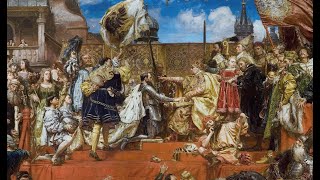
A narrated historical account (YouTube video) that dramatizes King George III’s October 1775–1776 call to Parliament and contrasts British ceremonial power at Westminster with the ideological and political rupture leading to American independence. The piece situates symbolic rituals (Black Rod, slamming Commons doors) alongside fiscal strains, colonial grievances, the Declaration of Independence, Burke’s reactions, and the failed Olive Branch petition to explain why reconciliation failed and revolution followed.
Chapters
In order to form a more perfect. And our sacred honor. The present situation of America and my constant desire to offer advice, inspiration and assistance on every. Within the cold, cavernous halls of Westminster palace, the air is stiff with formality and the marble floors echo under the measured footfalls of Sir Francis Molyneux. Sir Francis VII of the Molyneux baronets and a man of noble blood and loyal service, strides purposely across the legislative chambers. He's the Gentleman Usher of the Black Rod, the ceremonial voice of the Crown in Parliament. Upon his shoulder rests a simple yet potent symbol of the sovereign, a slender ebony baton tipped in gold at both ends. For centuries, the Usher of the Black Rod has summoned members of the House of Commons to attend to the sovereign in the House of Lords. The year is 1776. The day is October 31st. King George III prepares to address Parliament. Sir Francis approaches the heavy oak doors of the House of Commons when suddenly they slam shut. This is no accident. This symbolic gesture echoes a decades old precedent symbolizing the House of Commons independence from the monarchy. Its exact origins date to the 1640s, when King Charles I's attempted to arrest five members of parliament ignited the English Civil War and cost the King his head. Unfazed, the Usher of the Black Rod raises his staff and knocks thrice. With that, the doors swing open and all members rise. The summons is delivered. Mr. Speaker, the King commands this honorable House to attend His Majesty immediately in the House of Lords. At the head of the upper chamber, cloaked in ermine and surrounded by bishops and barons, sits King George iii, full faced, regal and blankly inscrutable. Just hours earlier, the King had arrived in his grand gold state coach, drawn by eight horses and festooned with gilded carvings. Lions to signify national strength, cherubs to signify divine right, and four gleaming figures of Triton, the Greek sea God, to proclaim Britain's naval supremacy. The monarchy's power was often memorialized in symbols. And yet beneath the pomp and circumstance, the edifice of imperial majesty crumbled. The late British Empire, overextended and over centralized, suffered under the pressures of factionalism and fiscal ruin. The national debt had nearly doubled by 1763, and interest payments alone devoured over half of the annual budget. Britain's incoherent colonial policies, the sugar interest battling the tea interest, Parliament in the hands of the squirearchy, had degenerated into a bureaucratic charade. No symbol of power could plug the cracks forming in its gilded veneer at Westminster, governed with more prudence and perhaps 13 colonies across the Atlantic may not have severed all political ties with the Crown just months earlier, invoking the right to life, liberty and the pursuit of happiness. As 56 signers penned their names on the Declaration of Independence. To the King, the colonists were simply deluded by an overly zealous and ill mannered class of leaders who had openly renounced the all allegiance to the Crown and all political connection with this country. Yet for decades, the colonists had endured repeated violations of what jurist William Blackstone called the absolute rights of every Englishman. The rights of British subjects, established over centuries of English constitutional history found their earliest expressions in 1215 with the adoption of Magna Carta. This lineage of liberties had been reinforced in the Petition of Rights in 1628 and the English Bill of Rights of 1689. The colonists, as proud Englishmen, were humbly requesting the same protections that they and their forebears had once enjoyed. Instead, for more than a decade, they endured a litany of humiliations and betrayals. Taxes imposed without representation, trade restricted by decree, soldiers quartered in civilian homes, and representative assemblies dissolved by royal order. What began as a dispute over a 3 pence per pound tax on tea had matured into a fundamental contest over the nature of political opposition authority. Whereas the British monarchy asserted divine right and hereditary power, the colonists cast their lot with a radical new creed. Governments are instituted among men, deriving their just powers from the consent of the governed. Still, there is a sentence, one sentence that is echoed across continents and endured through centuries. We hold these truths to be self evident, that all men are created equal. That sentence did not simply declare American independence. It declared a revolution in human thought. At a time when birth alone often determined the extent of one's achievement. This sentence shattered assumptions that for too long had governed the old world. It declared that truth exists, that it is knowable, and that man, by virtue of being human, is endowed with inalienable rights. It declared that liberty is not dispensed at the mercy of the state. Rather it is given by God. The English Civil war of the 1640s had already tested the the limits of royal power, culminating in parliamentary independence. Now over a century hence. The symbolic scenes at Westminster, the knocking of black rod, the slamming of the Commons doors, the King's florid address, were the mere remnants of a once mighty empire. The very ritual of barring black rod, once an assertion of defiance, echoed hollowly across the Atlantic. A much deeper form of defiance had taken root. The Declaration is a promise. More than that, it is a compass pointing always toward the dignity of the human soul. And the solemn duty of free citizens to guard against the rise of tyranny, no matter what title it claims. Senate after senate, Thomas Jefferson distilled centuries of political thought into one audacious proposition that government is not the master of man, but his servant. Among those in Parliament who grasped the gravity of this development was the eloquent orator Sir Edmund Burke. Just one year prior to the colony's Declaration of Independence, Burke, who had long sympathized with the colonists, issued the following warning before Parliament. A love of freedom is the predominating feature which marks and distinguishes the whole of the Americans. But that love, he added, rendered them suspicious, restive and untractable whenever they see the least attempt to wrest from them by force their liberty. Burke understood that the American attachment to freedom was the only advantage worth living for. And he warned that attempts to forcibly suppress this this yearning would only deepen the conflict. Upon learning of the Declaration of Independence, Burke was sick at heart, convinced that the moment for reconciliation had passed and that the empire's map and its future would be irrevocably altered. In the American insurrectionists, King George faced an existential challenge to the very institution of his kingship and the empire over which he reigned. Upon his ascension to the throne in 1760, at the young age of 22, the king famously proclaimed, born and educated in this country, I glory in the name of British. The colonies were part of that glory, extensions of himself as king. But by 1776, that identity was being reshaped by forces greater than him. One year prior to the signing of the Declaration, it was already becoming clear that the old world was giving way to the new. And so, standing before the House of Lords in October 1775, the king had declared the rebellious war now levied is manifestly carried on for the purpose of establishing an independent empire. And the object is too important, the spirit of the British nation, too high, the resources with which God hath blessed her too numerous to give up so many colonies. In carefully measured but resolute words, King George warned Parliament that of the dangers this rebellion posed not only to the loyal colonies, but to the entire European colonial system, he called for unanimity at home, promising to uphold British honor and restore order. British rule had undoubtedly grown increasingly arrogant and unaccountable, driving the colonists to embrace the only option left at their disposal independence. The colonists had tried to seek peace. In the summer of 1775, the Continental Congress drafted the Olive Branch petition, a humble appeal to King George iii, pleading for his intervention to secure the proper rights of his colonial subjects. The petition, largely the work of political moderate John Dickinson of Pennsylvania, addressed the king with reverence, blaming ministers in London rather than the monarch himself for the escalating tensions. But the petition arrived too late. When the colonial envoys presented the petition to lord Dartmouth, the king's secretary for the colonies, they were met with silence. His majesty refused to receive the petition personally or grant any reply. In fact, on October 23, days before the petition arrived, King George issued a proclamation branding the colonists as traitors engaged in open rebellion, commanding all officers to exert their utmost endeavors to suppress such rebellion. The king's decision was final. No compromise, no negotiation. Only the suppression of American unrest. And so we return to Westminster in the fall of 1776, where King George issues a call to arms. If their treason be suffered to take root, much mischief must grow from it. To the safety of my loyal colonies, to the commerce of my kingdoms, and indeed to the present system of all Europe. The king's implausible claim to British happiness rang hollow against the colonists cry for life, liberty, and the pursuit of happiness. By the time parliament rose, a new world had already sprung. The echo of black rod's staff sounded the first notes of that radical transformation. But the real knocking, one that would echo through the ages, was issued not from a black rod, but from a bold declaration nailed to the conscience of mankind. When the colonists slammed their own metaphorical doors on the British crown, they did so not as traitors, but as rightful heirs to magna carta, to habeas corpus, and to Parliament's own sacred independence. By the time the king stood before Parliament, the revolution was underway, not just on battlefields, but in the hearts and minds of men.
More from Your







President Donald J. Trump and First Lady Melania Trump Visit Grieving Texas After Deadly Floods

💪 Thinking of starting a #biz? Go for it! — Kerry Boyle, Vermont #SmallBiz Person of the Year

President Trump Participates in a Bilateral Meeting with the Prime Minister of Canada, May 6, 2025

