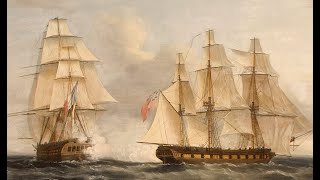
A single-speaker YouTube narration recounting the origin and early history of the United States Navy. It traces debate in the Continental Congress in 1775 that led to authorizing two armed vessels and later construction of frigates, describes early actions (privateering, raid on Nassau, first captures), highlights the 1778 Franco-American naval cooperation and the 1781 Battle of the Virginia Capes that trapped Cornwallis at Yorktown, then follows the postwar sell-off of the Continental Navy and the 1794 Naval Act that rebuilt a permanent U.S. Navy to protect American commerce.
Chapters
In order to form a more perfect. Fortune and our sacred honor, The American colony stood at the brink of revolution. On land, our founding fathers had already established Continental army and entrusted its command to General George Washington. But they soon came to a sobering realization. Their war for independence could not be won by land alone. Several delegates of the Continental Congress understood that control of the seas was critical to breaking free from the grip of British tyranny. But not all delegates agreed. On October 3, 1775, when the Rhode island delegation proposed the creation of a naval force supported by all 13 colonies, Maryland delegate Samuel Chase called it the maddest idea in the world. The objections were rooted in pragmatism, cost, lack of capacity, and fear of the far superior British Royal Navy, proven by their 200 year victory spree over the waves. The assured retribution from the tyrant King George fueled congressional trepidation. With Washington's support, the Continental Congress chose resolve over fear. On October 13, 1775, was authorized the outfitting of two armed vessels to intercept British supply ships for much needed gunpowder, weapons and other critical materials. From that authorization, the United States Navy was born. Not from vast resources or naval supremacy, but from the bold determination of a young nation fighting for freedom. They knew that the new republic could not defend its shores by the strength of an army alone. On November 5, Essex Hopkins was selected as commander in Chief and the first commissioned officer in the United States Navy. On November 25, Congress authorized Continental Navy vessels to attack any British warship or Transport. On November 28, the Second Continental Congress released Rules and regulations for the Navy of the United Colonies drafted by John Adams. On December 3, the colonies converted a purchased merchant ship to a 24 gun frigate. That ship would be renamed the Alfred and became the first ship commissioned in the Continental Navy with the flag raised by Lieutenant John Paul Jones. And on December 11th, Congress authorized the construction of 13 frigates to be built in seven different ports in the colonies. Despite these efforts to jumpstart a naval force, it was a slow beginning. One cannot build a navy overnight with little to no existing infrastructure or experience in building warships. There are extensive delays and massive cost overruns. To get as many ships in the water in the fastest time possible, the colonies turned to the practice of privateering. Privateering refers to a force of privately owned and operated ships armed and commissioned by government to attack enemy merchant shipping during wartime. Whatever spoils, captured ships, cargo, weapons, food, would be sold back to the government with a certain percentage of the revenue going back to the privateers. It would prove very lucrative to the privateers, and it would prove very helpful to the colonies. By the end of the war, privateers commandeered about 600 British merchant ships with much of the spoils directed to the war effort. By 1776, our Navy was proving consequential. On March 3rd, a six ship American naval force, along with 200 Marines from the recently established Continental Marine Corps raided New Providence and the Bahamas. Famously known as the raid on Nassau. It was our Navy Marine Corps team's first successful amphibious assault, capturing Fort Montague and much needed military supplies. 85 cannons, 15 mortars and 10,000 rounds of ammunition. On April 7, the converted 16 gun Brigantine Lexington under Captain John Barry, the first captain placed in command of an American warship commissioned for service under the Continental flag, defeated the HMS Edward, the first British warship captured by the Continental Navy. On October 11, an American naval force under General Benedict Arnold engaged a much superior force in the battle of Valcourt island on Lake Champlain in what is generally regarded as one of the first naval battles of the American Revolutionary war and one of the first fought by the Continental Navy. Though an overall defeat, the American defense of Lake Champlain stalled British plans to reach the upper Hudson river valley and delayed the British invasion of New York by a year. More importantly, it allowed the Continental army time to gather the forces necessary to defeat the British at the battle of Saratoga in October of 1777, in what is considered the turning point of the American Revolutionary war. While the loss had tremendous impact on the British, it was altogether more important for the colonies. Victory had convinced France to lend their navy to our cause, which at the time was one of the most formidable naval powers in the world. The Franco American alliance was ratified by Congress on June 6, 1778. With the French entry into the war, General Washington quickly recognized that the French navy would be critical to victory. Britain's ability to move large forces by sea and had resulted in the capture of New York City in 1776 and Philadelphia in 1777. As Washington would later say in 1780, in any operation and under all circumstances, A decisive naval superiority is to be considered as a fundamental principle and the basis upon which every hope of success must ultimately depend. His words were prophetic. On September 5, 1781, 24 French ships under the command of Comte de Grasse faced off against 19 British ships under the command of Sir Thomas Graves near the mouth of the Chesapeake river in what is known as the Battle of the Virginia Capes. French naval forces defeated the British fleet in hours long naval battle, leaving the French in control of the chesapeake and trapping 8,500 troops under British General Cornwallis at Yorktown. It was one that sealed the outcome of the war. Because of the effective French blockade, General Cornwallis was unable to be resupplied or extracted by sea by the British navy. The British would soon be surrounded by land as well as with a combined American and French army traveling from New York. It was a coordinated land navy action that Washington had been trying to execute since 1778, was one that convinced Cornwallis to surrender at Yorktown and convinced much of the British population and Parliament that the war could not be won. On September 3, 1783, the British signed the Treaty of Paris and officially surrendered, formally recognizing the United States as a free, sovereign and independent nation. But independence came with a price. The war left our young republic deeply in debt. And in the aftermath of the war, what remained of the Continental Navy was sold off. The last ship sold was the frigate alliance in the summer of 1785. There was also a growing sentiment that whatever the money the colonies did have should not be spent on sustaining a navy. That sentiment did not last. They would quickly learn that the only thing more expensive than having a navy is not having one. With their newfound independence came new challenges. American merchants no longer sailed under the protection of British warships, and our commerce quickly became vulnerable on the world's seas. Nowhere was this threat more evident than the Mediterranean, where the Barbary pirates of North Africa preyed on American shipping, seizing cargo and enslaving hundreds of our sailors. Without an American navy, we were defenseless. Action needed to be taken. After years of paying costly tribute, President Washington and Congress passed the naval act of 1794, authorizing the construction of the Navy's six the USS United States, USS Constellation, USS Constitution, USS Chesapeake, USS Congress and USS President. This act marked the rebirth of the United States Navy, and these ships would play a significant role in securing victory in the Quasi War with France, the First Barbary War War of 1812 and the Second Barbary War. Foreign. The Navy's earliest years were far from easy, but far more successful than they may have appeared. The Continental Navy, supported by privateers, not only disrupted British reinforcements, but also shook the foundations of Britain's trade dependent economy. From the beginning, it was clear sea power was essential to securing our independence. Perhaps most important, American officers and sailors demonstrated extraordinary valor even in the face of overwhelming odds, a characteristic that would permeate the U.S. navy even into the darkest days of World War II and to today. Alfred Thayer Mahan once wrote, whoever rules the waves, rules the world, an adage as true today, as it was throughout the history of our great country, it has also confirmed a belief I personally espouse that to be a superpower, you must be a sea power. As Secretary of the Navy, I'm profoundly grateful to every individual who has served and to every sailor and Marine who stood to watch, past and present, in defense of our republic. Let us honor the legacy of those who came before us. Let us reflect on the enduring spirit that began in 1775, because that spirit, one forged in honor, courage and commitment, remains in all of us today. Thank you for joining me today to celebrate our shared heritage. May God bless you, the Navy Marine Corps team, and the United States of America. Sa. It.