Top Reasons Why SBA Returns & Declines an 8(a) Application
Webinar (SBA, Your Advisor) covering why 8(a) certification applications are commonly returned or declined. Speakers Joe Danini (Chief, Division of Certification and Eligibility, Philadelphia Processing Center) and Darrell Hairston review the 8(a) program purpose, eligibility under 13 CFR 124 (U.S. citizenship, small business size, social and economic disadvantage, ownership and control, potential for success, good character, federal obligations), and a top-10 list of application problems: missing supporting documents; missing corporate records; incomplete tax returns (3 years personal, 2 years business); missing or unreconcilable business financial statements (3 years + interim); failure to devote full-time; insufficient evidence of social disadvantage (individualized, chronic incidents required); apparent control by non-disadvantaged parties or “front” arrangements; unresolved federal obligations; character issues (undisclosed arrests, omitted assets on Form 413). Guidance on documentation (Form 413 support, tax returns, corporate records, stock certificates, ledgers), ownership (51% direct ownership and rights to distributions), size and affiliation rules, waiver for two-year business requirement in limited cases, and program mechanics (9-year term, annual reviews). Q&A addresses new businesses, negative net worth, reapplying after return, part-time activity, and points of contact during processing.
Questions this video answers
Three years of personal tax returns (with all schedules and W-2s).
Business tax returns for at least two years and three years of business financial statements (balance sheet and profit & loss), plus an interim statement within 30 days of application.
Personal net worth threshold discussed: $250,000 (applicants must be economically disadvantaged under program rules; no one is presumptively economically disadvantaged).
At least 51% unconditional direct ownership and corresponding rights to distributions/dividends.
Form 413 (personal financial statement), Form 912 (background/character disclosure), SD-258 fingerprint cards (when arrests disclosed), Form 1450 (annual review), Form 355 (affiliation/relationship disclosure).
Chapters
I would now like to formally begin today's webinar and introduce Darrell Hairston.
Good afternoon and thank you, Eddie, to all who are joining us today. Welcome and we appreciate you taking time today to join us. We have a lot of material to cover today. We're going to focus today on the common reasons that applications for the 8 program are declined and particularly why they are returned before processing. I'm joined today by Mr. Joe Danini. Joe, chief of the Division of Certification and Eligibility in office in the Office of Business Development in the Philadelphia Processing Center. Unfortunately, his counterpart in San Francisco couldn't join us today. That's Mr. Teresa Tyhurst. But these are two individuals that are important to those of you who are planning on applying. And Joe is going to be with us today to give you some real expert input on preparing and submitting an 8 application. This is a follow on to the webinar we had last week where we talked about the eligibility criteria for the eight program. And particularly we also talked about the purpose of the program. Just as a brief recap, if we go slide number four, we talked a little bit about what the Business Development Program is all about. And we talked to those of you who joined last week, know that we talked about this program as being a business development program, not a contracting program. We talked about its intent being to assist firms that are owned, operated and controlled by socially and economically disadvantaged individuals to enter the mainstream of the economy, compete on an equal footing by providing access to critical resources, financial resources, access to technical and managerial resources, and important to most who apply to the program, access to federal contracting opportunities on a limited, competitive and sole source basis. Obviously, the objectives of the program is to help promote the business development of both concerns that are owned by eligible individuals and to promote their competitive viability. So Eddie, if you could move over To Slide Slide 6. We talked a little bit last week about the eligibility criteria. And on slide 7, we actually list out the eligibility criteria where it's located in the Code of Federal Regulations 13 CFR 124. And we point to those things that are most critical to eligibility. You have to be a U.S. citizen. The business has to be small. It has to be owned by socially and economically disadvantaged individuals. Those individuals have to control the company. They must exemplify potential for success. And then there are other criteria we look at like good character, one time eligibility and the fact that you are not delinquent or defaulted on any type of federal obligation, whether it be your taxes or a loan, a student loan, a business loan, or whatever it might be slide 8. Eddie, what we're going to focus on today are the top 10 reasons why applications are returned or declined. And we're going to do this in sort of a different way. We're going to. Joe and I are going to go kind of back and forth. So I think the top question is, after all that work, after you do all the work of getting application together, why did SBA return my application? So we have a top 10 list that we refer to. It's on page. It's on slide number 10. The top 10 list is not submitting supporting documents, essentially filling out the application form, but not submitting the actual documents. Joe, can you talk a little bit about that?
Yeah. I mean, in order for us to be able to make a reasonable determination as to whether an individual in the firm are eligible for the 8 program, we have to use supporting documentation in order to make that call. So all that supporting documentation entails tax returns, three years of personal tax returns, and business tax returns for at least two years, and all the corporate information, or partnership information, whatever the business form is, business financial statements. So without that information, the SBA has no clear way of making a reasonable determination in any of the areas that Daryl mentioned of ownership and control and social and economic disadvantage.
Okay, so basically, in general, the first and foremost reason is just not submitting documentation. So one of the other items that you added to this list, and by the way, this is Joe's list, not providing corporate information. Why is that important?
Well, again, Darrell, because of the fact that even though it's a one person corporation sometimes, or a few persons corporation, we need to see that as a corporation, it's operating as a corporation. And we also need to see that corporate documentation to determine legal ownership and control. Without it, again, we don't have that capability.
Okay. This is one of the areas that I mentioned last week when we were going over eligibility criteria. And one of the things that I pointed out during that conversation was that many times we actually receive corporate documents that don't necessarily truly reflect how a business is operating. And in most instances, when individuals start businesses, they will retain a lawyer or a consultant who will many times prepare these documents. And a lot of times they will prepare these documents. General format, following general state corporate law. One of the things that's really important is before you submit that documentation, you need to make sure that it conforms with what you're representing to SBA on the application form itself as to how you're operating your company. If it says that you are required to have Three directors, and you submit documentation to SBA saying you have one director, then that's a problem with your corporate documents. Those documents will also define how you vote in terms of your stock ownership and how you vote in terms of your board. And that in itself may conflict with what you represent to sba. So it's important that while you may have had it prepared by an attorney or consultant, that you read it and fully understand what it's. Joe, the next thing that you have here is submitting incomplete tax returns. Why is that a problem?
Well, again, we look at the person's personal financial situation, among other things, and the personal tax returns are critical in that regard. One of the issues that we look at, which we'll talk about a little later, is a person's average income. And we use the tax return to compare the income with the Form 413 information, which is a personal financial statement form. We need a complete return with all W2s schedules and attachments so that we can also determine any other businesses or in the case of a W2, whether an individual may have an outside employment, which, as we'll talk about a little later, you must devote full time. Disadvantaged individual must devote full time to the firm at the time of application.
Okay. And this information is actually provided in this slide deck. So if we could move over to slide 14. Number four on your list was not submitting business financial statements. Why do we care about that?
Well, as you had mentioned earlier, Dowddle, one of the requirements of the program is for us to be able to determine potential for success. One of the criteria under that potential for success umbrella is the financial capability of the firm. So we look for three years of business financial statements, including a balance sheet and a profit and loss statement. And we do an analysis on that on those three years and an interim within 30 days of application. And we look at trends and revenues and profitability and whether the firm has working capital, whether it's highly indebted, what the equity position is. So once we get that information, then we're able to make a reasonable judgment in that area of potential for success.
So what do we do when we get financial statements that can't be reconciled, that we may look at, and they just appear unreliable because we just can't connect the dots on the information being provided?
We wouldn't be able to make that reasonable judgment in the area of financial capability. Some of the errors we see is that the retained earnings from a prior year are not properly carried forward to next year or the balance sheet is not in balance or the income statement revenues don't. I'm sorry, profitability doesn't coincide with the equity position of the balance sheet for that year. So there's various errors that could occur. Our suggestion, what you don't have to do is that if you are unfamiliar with business financial statement preparation, you may want to seek help from someone who is right.
And I think I talked about this a little bit last week myself, but a lot of the times I get questions about, well, why is that important? This is a business program, a business development program for disadvantaged individuals. So why do I have to show some ability to perform well? That's it. I mean, one of the things I mentioned last week is that what's really important to a lot of folks applying for this program is not only the business development assistance, but the access to federal contracts. Those federal contracts that you have Access through the 8 program are actually contracts under which SBA is deemed the prime contractor. And like any other contractor to the government, we have to be able to demonstrate that we have the responsibility to perform. Responsibility means that we have the management wherewithal, the technical wherewithal, and the financial. So when we accept a contract into the 8 program on behalf of your company, we're doing so based on your capability to perform. SBA can't build a building, we can't design the building, we can't build IT system. So in order for us to be able to assert to a sister agency that we can build an IT system for them, we have to do that based on your firm and its capability. So that's something to keep in mind. Next. Joe, you said that top 10 reasons for denial is not devoting full time to the business. Why is it that we want our applicants who run these companies to spend the majority of their time toward developing the applicant company?
Well, as you noted, Dallas is a business development program. And if the applicant or the individual who's running this company is not there on a full time basis, it defeats the purpose of us trying to develop this business. So we do look at whether the individual is devoting full time. If we find that there's some inconsistency in the record that an individual hasn't shown us that they've left their former employer or that they're not working in another business that they own, we will ask for information to bring closure to that so that we can make that reasonable judgment in that area.
Okay, so, and then, of course, we talked a little bit. When we talked about the eligibility criteria last week, we talked about who was eligible to participate in the program on slide 16. One of the things that we have on our top 10 list for reasons applications are declined or returned is not submitting any evidence to prove or claim social disadvantage. Well, when we talked last week, we talked about the fact that certain individuals who are members of certain groups are presumptively socially disadvantaged. And we talked about that being black Americans, Hispanic Americans, Native Americans, Asian Pacific Americans and subcontinent Asian Americans. But we also said that this is. While this is viewed as a race conscious program, it's not a race based program. Anyone is eligible to participate if they can show by the preponderance of evidence that they've been subjected to social disadvantage. So when we have an individual who is not a member of one of those groups, and it could be an individual claiming to be disadvantaged because she suffers from a life limiting disability, or it may be based on gender, or it may be based on some other ethnicity that for whatever reason they feel that they have been oppressed by American society. So when that happens, Joe, what, what do we look for to support a claim of social disadvantage based on a preponderance of evidence?
Okay, Darrell, as you've indicated, this is an individual claim. So we're looking for the individual to present certain specific instances of bias or discrimination that they had experienced in the area of education, employment and business history or any other area that they may have. We're looking for details to that incident, dates, names, you know, adverse impact that may have happened. And we're looking for a pattern, not one instance, but instance that's going on for a period of time or over a period of time. Generalized statements or empirical information, such as information on the glass ceiling or, you know, studies of women in construction, for example. Those. We will look at that. But it must, your individual claim must be such that that's what we have to rely on. And you've got to make that claim and you can provide that information in support of that claim. But what your individual instances of bias are what we key in on.
Okay, so just the fact that a person who has a net worth under $250,000, that in and of itself not good enough to say that they're socially disadvantaged.
Right, because that's something different. Now they, for our purposes, they have to be socially and economically disadvantaged.
Okay, so and for those who participated last week, I'm sure you will recall that when I talked about social disadvantage and economic disadvantage, I indicated that at there is a presumption that certain individuals are socially disadvantaged. No one is presumptively economically disadvantaged. When we're talking about individuals. So we're going to talk about that a little bit. Also on slide. On page 17. Joe, you talk about applications are returned or declined because it appears, based on the information that was provided, that there is a strong likelihood that, or the potential likelihood that someone other than the individuals claiming to be disadvantaged actually control the company for various reasons. Could you talk about that a little bit?
Sure, sure. Daryl. Basically, there's no prohibition against non disadvantaged individuals being involved in a firm, however, where there's links such as the individual providing critical financing or licensing or bonding or providing leased space, or maybe that individual was a former employer of the applicant or is receiving higher compensation. So basically, SBA looks to those connections to see whether there's that potential for that non disadvantaged individual to exert control in any of those areas. And there's others as well, but those are key ones that we usually see a lot of.
Okay, and then the next one is which kind of follows suit, but where we see what appears to be an obvious attempt for someone who is not an intended beneficiary to actually be positioning him or herself to be the beneficiary through the eligibility of an otherwise eligible person. Now, we refer to those as what appears to be a front organization. And I think if you look at the slide, it says they get declined every time. Well, they get declined every time. We actually identify that potential and we see it frequently as just a commentary on that. When we see those, we obviously decline those. That doesn't mean that we decline every one. But the ones that do make it into the program, generally at some point in time in the program, they get caught. And as a consequence, the impact is tremendous for us because when that happens, not only do we have to defend the integrity of the program, but we also have to deal with the issue of the firm that took advantage of the program and allowed benefits to flow to individuals for which it was not intended, which meant that individuals who own companies that were legitimately eligible for the benefit were denied that opportunity. So it's really a bad thing on both fronts. So, Joe, you want to talk about that a little bit?
Yeah. We do get outside credit reports and other reports, and we do look at these types of cases carefully. And again, things where we just mentioned about someone being a former employer that may link back to something else, or sharing of space or providing critical financing or whatever the items are there that shows these connections. When we dig and we find these other things going on, maybe another thing could be they're operating in the same or similar line of business, we have to dig into those areas. And then of course, like Darrell mentioned, once someone gets caught, they will be denied for that issue of control, among others.
Yeah. Just as a follow on to that, we do validate, to the extent possible, the information that's provided on an application. So one thing to keep in mind is that any transaction, any personal or business transaction that occurs related to you or your business that hits a public database, we know about it. And a lot of times applications get returned or get declined because we identify situations or information that was not provided in the application or that was contrary to your response to a particular question. So keep that in mind. And a lot of times some of that information may be old because the public database wasn't updated or it just wasn't reported by you. Or like with your credit report, you may end up with something in a public database that doesn't directly relate to you. So when that happens, it's us doing our due diligence to protect you and to protect the integrity of the program. And in those instances where it may not be directly related to you, to put it very simple, don't get mad at us. Just understand that what we're trying to do is to make sure that we're giving you the full opportunity to participate in the program, if at the same time making sure that we do so by adhering to our program rules and regulations. Now, the 10th reason that you have on here is not satisfying federal obligations, taxes or otherwise. What's your take on that and what are our rules around that requirement?
Well, Darrell, of course, if someone wants to receive federal benefits, we want to see that they are. They pay their federal obligations. That could be federal taxes, student loans, federal loan of some form through HUD or something like that. Basically, we will. If you don't have it paid, you can enter into what's called a payment plan with the IRS or whatever the federal agency is. We'd have to see that payment plan and we have to see that you're making payments on it. And of course, that payment plan will be monitored throughout its time period once you get into the eight program. So the bottom line is, whenever we see a federal obligation, as Dowell indicated, it may a tax lien will show up on those third party credit reports. And there's questions related to that on the SBA forms about have you paid or in the process of repaying federal obligations. So again, let us know. And it makes this process go a lot quicker. It's not a bar, but it is a bar if you don't tell us about it, and we end up finding out about it.
Okay. And Joe, not specifically listed on your top 10 list, but as the individual who actually makes the final decision on these applications, I see a lot coming out of your office, as well as coming San Francisco Processing center on character issues. What are the most common issues that we run into with character and how can they be avoided? And basically, how fatal are some of these things?
Okay, well, an issue of character, Darrell, as you all probably know, There's a form 912 that's everybody needs to fill out that form, and it kind of you're supposed to identify to us whether you've ever been arrested for other than a minor motor vehicle arrest. And when you check yes to that, you have to give us a brief narrative as to what happened and a set of SD258 fingerprint cards. And then we have to forward that to our ig, who then gives us the clearance to move forward or not. Basically, if you don't tell us about an arrest and then we end up finding out about it, that would be a reflection of bad character. And we'd ask you to tell us why you didn't tell us about it. But ultimately, we would judge that harshly in the sense that you're trying to show good business character here. And by not telling us an arrest or not telling us about a federal obligation, federal tax lien or civil judgment, or, you know, telling us one thing on the SBA forms and the supporting documentation tells us another story. Those are all issues that would be indicative of poor character.
Right. And one of the things that another area where I see that frequently is failure to disclose assets on your personal financial statements. And we're going to talk about that a little bit, but we're going to talk about the personal financial statements and the requirements of those. But in many instances, we will find that you own properties that you haven't disclosed, or there are other assets that were not disclosed that would impact your personal net worth. What happens when we see that, Joe?
Well, again, it's an issue of the individual signing the form and dating it and telling us that the information is complete and accurate. And of course, when we find out about another asset, all assets must be reported at their present fair market value and all liabilities at their current, current level owed. You know, even if it's a foreign asset, a property owned in another country or whatever, all assets must be put on that form. Any other businesses, you know, trusts, whatever, they must be listed on that form. And Again, if we, if we see that an asset is left off based on our research, that would be an issue of poor characters or as.
Okay, so we've gone through the top 10 lists. Now we're going to spend some time talking to you about tips and give you some advice on some of the areas where we put a lot of emphasis on eligibility and some good ideas on the types of documentations we look at and how we review the documentation that you provide. Going from slide 19 through 21 is basically a kind of a recap of our top 10 list. That information we're obviously making available to you the regulations that govern the criteria that we apply to eligibility. And just keep in mind, I mean, we rely on these regulations at chapter 13 of the Code of Federal Regulation, Part 124 for the purposes of determining, determining your eligibility when you come into the program and your continuing eligibility once you get into the program. But these regulations are for your use as much as they are for ours in terms of governing your compliance. So it's important that you are aware of these regulations, that you read them, understand them. And we understand that a lot of times you won't understand what the government intent writes regulations, but that's why you have representatives at SBA and you should contact those individuals, or you can contact the individuals at the Small Business Development Centers or the Procurement Technical Assistance Centers or the Women Owned Business Centers or any of our other resource partners out there, and they will generally be able to explain to you what SBA is really talking about in respect to these regulations. So it's important to you to understand how you're going to be evaluated and what it is you need to do to maintain compliance with program eligibility. So if we move over to slide 23, this is a guide, we consider this part of our presentation to you today as a takeaway for you in terms of helping you to prepare your application. So we're briefly going to go through some of this stuff. And if you look at slide 24, we talk about U.S. citizenship and what's required for U.S. citizenship. And generally, you know, that's pretty much what we look at. And unless we have some reason to question citizenship, and then we may ask for some additional information. Slide 25, we talk about size, and this one is a really important one because not only does it go to the issue of whether you're small, it also goes to issues of whether or not you it may go to issues as to whether or not you are actually in control of your company. So, Joe, you want to talk About a little bit about size and what we look for there.
Sure, Darrell, the basics of size is that based on your NAICS code, it's either based on three years of average revenues based on the last three federal tax returns, or the number of people working for you. Besides that, we also look at whether your company is affiliated with any other companies. Affiliation could arise through contractual relationships. They could come about by a family identity of interest. They could come about based on control of the board or critical financing or bonding or other loan arrangements. Or if you're relying on one company for a significant portion of your revenues and there's other connections, maybe you used to work at that company, but more or less, if that's the case, we may have to do a formal size. If we can't eye it up here on our own to see whether these relationships, when combined, result in other than small business entity. Remember, the SBA is here to help small businesses. And if we have an entity that's a large entity based on being affiliated with another company or various companies, we're not in the business of helping large entities.
So.
Those are the keys in regards to looking at affiliation and size.
On the issue of size, a lot of times when we deny an application, one of the things we do in a letter of denial is we'll list items that we want you to provide us. If you choose to request a reconsideration and everyone denied has an opportunity that you request reconsideration, and during that process, you can fix the problems that we point out, you can change things, you can add additional information. So it's really a process that geared toward helping you as much as possible to be eligible for the program. Many times we'll ask for information regarding affiliation. We'll point out in the letter that it appears that you may be affiliated with it. We'll ask for that information. We'll ask for the Form 355, which is a disclosure of your relationships with companies. And we'll ask for financial. And a lot of times what we get back is a verbal comment that basically says, I'm not affiliated with anybody. They don't control my company. They don't have any ownership of my company. Obviously, we had a concern about affiliation where we would not have raised that issue. And that type of response is essentially not going to help you because we're going to say, based on your response to the issue we raised in the original decline letter, we're unable to make a determination that you're not affiliated and that you're. That you're not other than small. So by not providing the information that we request on this issue will not help you overcome the denial. So that's something to keep in mind. So the next section which starts on slide 29 and then goes to 30. We talked about this social disadvantage issue and I think Joe talked a little bit about the type of stuff that we look for, which actually begins on slide 32 through like 34 or 35. Joe, you want to just kind of reiterate some of that at a high level?
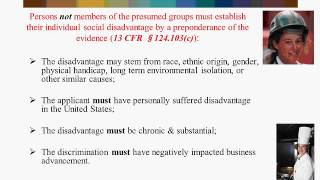
Sure, sure. As we noted, there are five presumed groups. SBA may, if we have reason to believe that an individual is not a member of one of those groups, we may request more information to make a reason reasonable call in that area. But other than that, again, Val mentioned, the program is open to everyone. Persons who are not members of a presumed group. They must establish their individual social disadvantage by a preponderance of the evidence. And basically, if you picture a balancing scale, it's that evidence that will tilt the decision maker in your favor. 51%, 49% if you want to talk numbers there. If we look at slide number 32, as Darrell mentioned, the disadvantage must stem from race, ethnic origin, gender, physical handicap, long term isolation and various other factors. It has to have occurred. The discrimination had to occur in the US it must be chronic and ongoing, not one incident. And it must have had a negative impact on the individual's entry or advancement into the business world. Preponderance, like I mentioned, is that information which leads us to decision maker to objectively conclude the existence of facts and that the incident more probably than not occurred. That's why when we mentioned if you give us general information, we won't be able to use that as well as if details of each and every incident that you believe occurred to you, whether it be in your pursuit of education, employment or business history, whether that be you were denied a job because of gender or your professor gave you a poor grade, you feel because of your ethnic origin, you've got to have the details that the individual, the date, time, as much detail as you can provide, and ultimately the adverse impact in that course, whatever other instance may have been.
Yeah, I think that's an important point. Regardless of what it is, whatever information you provide, we may find that you cite an incident that is in our mind potentially discriminatory. But if you don't make a connection as to how it impacts your entry into or advancement in the business world, you have not met the test for that particular factor to be fully considered in respect to determining whether in totality you suffered social disadvantage, it's key that you suffered a discriminatory or biased act, you personally, not some group of individuals who are similarly situated, but you personally and that that somehow impacted your entry into or advancement in the business world. That's key. So we talked a little bit, Joe and I mentioned earlier about economic disadvantage. I covered this criteria, which is on slide 40 about economic disadvantage in our webinar, and we talked about the thresholds. And we're not going to go over these thresholds again. I mean, this is pretty well laid out on this slide. But one of the key instruments that we use to determine this is what we call a personal financial statement. It's SBA Form 413. And anything, Joe, that you want to talk about in terms of backup information that they need to provide to support the 413?
Yes, Darrell. I mean, basically we look for the source documentation as to where you arrived at these figures that you placed on that Form 413, whether it be, you know, real estate valuation. Again, everything must be of present value, whether it be stocks owned or, you know, bonds or bank statements, insurance, you know, information. Similarly with the on the liability side, we look at the mortgage, the mortgage statement that you have, the latest one, where you pull the figures to put on your 413 any notes payable or any other obligations, personal obligations that you may have that should be reported on that form 413. Of course, we look at, as I mentioned before, we also look at the other information, like the third party reports. We look at your tax return and see if figures you place on that 413 make sense. One instance where they won't make sense, for example, is if you tell us to throw round numbers out. You have savings of $1,000, but then you have interest of $5,000. There's clearly something not right there because there's no investment that's going to throw off that much of a percentage of interest payment. So that will be a red flag for us. Or if you have properties overseas, even though they're overseas and they're yours, you must report that on the 413. That's a full counting of all of your personal assets and all your personal liabilities. You can't put business liabilities on the 413. You may be a guarantor on a business liability, but unless that the company defaults and you've, if you become personally liable, you can't put that on your Form 413. Contingent liabilities would not go on the Form 413 as a personal liability, a contingent liability, such as a tax that may be owed in the future, that would be considered a contingent liability. If you had a tax that was assessed and not paid, that would be obviously an actual liability that you must put on the form 413. So again, you are signing the form, you're telling us that what the figures you're putting on there are truthful and accurate. And again, you must report every asset at present value and all the liabilities at their current balances.
Okay, so now if we move over to slide 54, we talk about the ownership requirement. And the requirement is that the application company is at least 51% unconditionally owned by disadvantaged individuals. That ownership must be direct. And there are some examples on that slide about what we mean by direct ownership. We talk a little bit about ownership through trust. And on slide 55, we talk about partnerships and how you reflect ownership there, limited liability companies. And 56, we talk about corporations. And I think Joe has talked a little bit about what we look at to validate ownership, particularly in corporations. And then if you look at slide 57, ownership not only talks about what you have to do to show that you, in fact own 51%, you have to validate that you have a right to. To all the dividends and distributions associated with your ownership. And that, in fact, must be equal to your actual claim of ownership. So if it's 100% or if it's 51% or if it's 68%, whatever it might be, that all has to fall in line. Real quick, Joe, anything you want to add there?
No, Joe, I think that's pretty much it. Again, we're looking at your business tax returns to see what type of distributions come out of the firm. We look at the corporate information to see who owns it, the actual stock certificates front and back the ledger. And again, we look at all this information to make these calls as to whether you're receiving 51% of the retained earnings and at least 51%, if you own 51%, of course, of the annual distributions of dividends and so forth and so on.
Okay, and then we talk about. In the next section, Starting on slide 60, we talk about control and management. How we look at control and management and the information that we examine. And this is a pretty extensive area here, we look at a lot of different things. When we look at control, we look at whether or not the individuals claiming to be disadvantaged devote full time to the business, at least one of those individuals. And that One of those individuals holds the highest position and is the highest compensated person that those individuals actually control the company, whether it be through an operating agreement or a board of directors or however it might be set up. We also talked a little bit about the fact that we look at other relationships with those individuals and how that impacts their ability to actually control the company. The former employers or particularly the situations where you work for this company in some staff position for like 10 years and all of a sudden you become the president and become the majority owner and everyone who was involved in the company before that, who held those positions are now subordinate position positions. And you may be obligated to those individuals in respect to the ownership of the stock and you may be reliant on those individuals for leases and financing. So we look at all those things in totality. Anything on that, Joe?
No, I think you got it there, Darrell.
Yeah, that happens occasionally.
That's always a red flag.
So, I mean, if you look at these slides and like I said, we did this with the intent of trying to help you understand and to give you some guidance on putting an application together, there's a section in here on a test. I would highly recommend that you take a look at those. I would highly recommend that you go online and do the orientation on 8. There is a section in here on potential for Spent a lot of time talking about potential for success last week and a little bit today about why we look at potential for success. And I think the key point that I made there last week and I'm going to make this week is evaluate all of these things. Evaluate your readiness for the program. This is a nine year program and that nine years goes very quickly. And if you're really not ready to enter the federal market and be competitive in the federal market and to be able to show that you have the past performance, the track record and the wherewithal, it's going to be difficult for you to maximize the benefit of those nine years. And generally speaking, the majority of the companies that come into the program don't really start realizing true benefits until about year four or five. There is no ability to extend your term. Once once you are approved for the program, the nine years starts, the clock starts. And regardless of whether you get a contract in year one or you get a contract in year nine, we do not have the ability to extend that nine year term. So that's something to keep in mind. So with that, and we cover that in this deck as well, with that, I'm going to open it up for questions for and all the difficult ones go to Joe. Okay, so here we go. Joe, what about someone just started a business, There will be no three years of business tax. That person may also not want to leave current employment until new business is viable.
Right. Again, the issue is you've got to devote full time to the business at the time of application. The other issue that may arise is the fact that a firm must be in business for least two full years prior to the date of application. Now, the way the SBA makes that determination is based on revenues on federal tax returns filed with the IRS for the preceding two years. So from that aspect, it sounds like there may be two issues there, right?
The full time devotion and the potential FFS issue around two years in business. So basically what Joe is saying is we do have a requirement that says that you must be in business for at least two full years based on tax returns showing revenues for the prior two years. Those revenues have to be generated in the industry in which you are seeking eight certification. So many times we'll get tax returns from a business where they are applying to be a computer IT company and they show us two years of tax returns and some other type of, of consulting business that will not apply to the business for which they are applying in the 8 program, even though it may be the same business. Now, we do have a waiver provision for the two year rule. When we look at the waiver provisions, we look at your past performance. We look at the managerial and technical capabilities of the individuals applying the technical capability of the firm. We look at your access to finances and your access to the necessary resources to perform. And if we see those at a substantial level, we have the ability to waive the two year business requirement. We do not have the ability to waive the requirement that you actually devote full time to the business. So if you're employed elsewhere, that's an area where you would run afoul of the regulations. Next question. Is a negative net worth a disqualifier.
For eight program personal net worth or business? Either either? Well, for personal I would say no, obviously, because there's a $250,000 limit. And for business, the equity in and of itself may or may not be an issue. As Darrell mentioned on several occasions, we look at the total picture here. We're looking at trends in revenues and profitability and whether the company has financing or not. So on the surface, that one negative area may not be an issue. Now, if it's an extremely large negative equity, then that shades the whole total picture. Now, so in general, one aspect of that totality of the circumstances in and of itself would not result, should not result in a problem more or less, right?
I mean, we would be looking for past performance, demonstrated ability to do what it is you say you do, your ability to finance your operations. And the fact that you have a negative equity position in and of itself is not fatal. It may show that you had a substantial negative equity position at one point, and you have now, because of your trends, actually digging yourself out of that hole, so to speak. So that would be a positive for you. So negative equity alone is not a disqualified file. Next question. If SBA returns an application, when can I apply again? And it says, I guess this does not mean decline of application. Right? Actually, there's only one person that can actually approve or decline an application, and that's me. When you get an app, when you submit an application to the Philadelphia Processing center or the San Francisco Processing center, the initial action taken by that office is to screen that application to make a preliminary determination of what will be needed to process that application. In other words, what it is to make that application complete. And that's why we're here today to talk about what a complete application is. They will send you a letter, and in some instances, if the application is substantially incomplete, they'll return the application. And the purpose of that is to get as much information as they possibly can to give you the best shot possible at meeting the eligibility criteria. So, no, it doesn't mean that you've been declined and you can resubmit that as soon as you would like to. And from our perspective, we would like for you to respond to deficiency letters on applications. Keep in mind that these individuals are processing numerous amounts of applications. On a normal basis. We average about 40, 50 applications a week. So once they pick your application up and start working on it, you want them to continue to work on it. So the quicker you respond, the more likely you are to stay in that queue where you are. Next question. How far back in the past is evidence required to prove social disadvantage? Well, the only. The only way I can respond to that is that the law says that social disadvantage must be chronic and substantial. And when you look at the groups that were presumptively considered to be socially disadvantaged and the experiences of those groups, and then you look at chronic and substantial, then you get an idea that what we're looking for is a pattern of experiences over a period of time. We're not looking for fleeting instances where somebody did something one time or something happened 20 years ago. And then now something happened again this year. And we're looking for a pattern of events that impacted your life over a period of time. Now, it doesn't have to be 100 years, it doesn't have to be a century, it doesn't even have to be 20 years. But we do need to see enough of a pattern to show that there was a negative impact on you as an individual and your efforts to enter the mainstream of the economy. And it could be a combination of things. It could be educational experiences along with employment experiences and your business history. Or it may not be all of those. But I can't put an exact time frame on it. It's just that you've had these series of things that have happened to you that have impacted you over a period of time. I am a single female with a mortgage. Obviously quitting my job would ruin me. If I have a history of working two full time jobs, could I get approved working one full time job if I could prove that I'm devoting another 35 to 40 hours to my small business? That rule doesn't preclude you from having other activities. Generally where we see that is someone may be a of part. A part time professor at a school or they may have some other similar outside activity. What we need to see is something that's reasonable. And Joe, you want to expound on that?
Sure, Donnie. What we're looking for again is since this is a business development program, we want to see you working at the business during normal work hours. So as Darrell indicated, if you're teaching a night course or if you have something going on after business hours or a weekend, and you can show us that that wouldn't be an issue. The issue arises if you have a full time job during normal work hours because that hinders your ability to develop the business. You're not able to go out and market and contact other potential clients or have someone contact you. There's where that key is that you're at your business during a normal work hours.
And I think what's important there is that one of the things, and I'll go back a little bit of history, one of the things that they pointed out in the law when they first legislated this program as being a problem for disadvantaged businesses is the inability to develop the networks and relationships that are important to growing and sustaining businesses. And if you're not able to actually devote time to those types of efforts and activities during a normal course, then it's difficult for you to develop those relationships that are meaningful. To sustaining your operations. Do you have to complete any documents annually to continue eligibility? Yes, we do have requirement for you to submit what we call an annual review. There's a form that we use for that, and I believe it's a 1450 is what we call the form. And but more importantly, yes, we do have forms that you have to complete for continuing eligibility. In addition, you have to provide updated financial statements, updated personal financial statements, and any other information that we may deem appropriate for eligibility purposes at that time. Is an applicant that is on probation eligible for the program?
No.
Okay, that's a pretty straightforward answer. No. Let's see. Does being a part time real estate investor after business hours on weekends make one ineligible? I think we pretty much answered that one. Not necessarily, no. It just you need to demonstrate that that does not impact your business development activities associated with the applicant company. Does SBA consider applications in which there is an affiliation with a 501? Yes. I mean, that doesn't necessarily mean that you're ineligible. We may find you affiliated, but it doesn't necessarily mean that you're ineligible. Joe, is there a particular way we look at size when there's an affiliation with a 501?
Well, no, it's just the same thing. I mean, it's based on the applicant's primary NAICS code. If it's a revenue based one, then we look at the three years of revenues on both the 501 return and our applicant. Or if it's a number of people working, we look at the number of people working at the applicant along with who's at the 501.
As a business owner, you mentioned you have to be the highest paid individual. If I have taken on a business development role and choose not to be the highest paid, will this cause a decline in the application?
It may not. You have to give us some information to tell us how you being paid less is helpful to the business. Of course, if we see something going on where this individual was your former employer or other indications of criticism control, then we will find that's probably not in your best interest. But if you say need this individual because of his capability and you've got to pay that individual market rate, for example, and you're trying to grow the business and you decide to pay him higher or her higher and you take a lower salary, I mean, that sounds like a reasonable thing and I don't think we would have an issue with that.
Okay, It says, do we have. Do we have this thing keeps. There's so many questions coming in it's hard to keep up with them because it's rolling so fast. Do we have. I'm having a hard time reading the question. It seems like it says do we have one point of contact? Do we have one point of contact once the application has been sent to address questions. Joe, you want to respond to that? Yes.
What happens is we assign an application to an analyst here that will follow that application all the way through until it gets forwarded down to Darrell for his review and his final decision.
Right. So we're running out of time. For those of you who ask questions that we didn't get to answer, we will provide a written response to all the questions that we'll make sure it gets out to all of the participants. If you have questions, you can actually the contact numbers for our San Francisco office and our Philadelphia office can be found at www.sba.gov. feel free to and then you can also submit questions to 8aquestionsba.gov and we'll make sure that they get answers. And again, I would like to remind you that our most valuable resources out there are our local SBA District offices. You should feel free to contact them with any questions. And our Small Business Development Centers, Procurement Technical Assistance Centers, and our other resource partners like our Women Owned Small Businesses and our Veteran Owned Small Business Centers. They're all very knowledgeable about the 8 program and they're all more than half happy to help you with issues around your 8 application and any questions you may have about our rules and regulations. And we strongly encourage you to use those resources. And again, Joe, thank you for your input and thank you all for joining us today.
More from Your







President Donald J. Trump and First Lady Melania Trump Visit Grieving Texas After Deadly Floods

💪 Thinking of starting a #biz? Go for it! — Kerry Boyle, Vermont #SmallBiz Person of the Year

President Trump Participates in a Bilateral Meeting with the Prime Minister of Canada, May 6, 2025

