Webinar- Not Just Contracts: The SBA's 8(a) Business Development Program
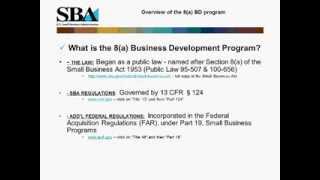
The SBA's 8(a) program is a nine-year business development initiative for socially and economically disadvantaged owners, split into four years of development and five years of transition. It offers contracting opportunities, consulting through 7(j), and support from district office specialists to help participants grow before graduating.
Chapters
Good afternoon to all of our participants today. We greatly appreciate you joining us and the interest in the SBA's Section 8A business development program. As you can see from the screen that you're looking at, we're going to talk about the 8 program, what the purpose of this program is. We're briefly going to cover some of the eligibility criteria. We're going to talk about some of the benefits around the program and the opportunities associated with this program. There is an extensive slide deck that's associated with this webinar that will be provided on YouTube along with the full webinar. Probably about four days following this webinar, the YouTube address will be included in the deck, so please be sure to get that address when we cover that next so we're going to talk about what is the 8 business development program next slide. As you can see on the screen, we're basically introducing you here to the originations of the eight program, talking about the public law. And the reason we're showing you that is because that really tells us what this 8 program is all about. When this program was legislated, it was legislated, probably to the surprise of everyone, as a business development program. And in doing so, Congress determined that the cost of unequal access to the normal resources required to start and operate a business, like financing, access to capital, access to human resources, technical resources, and other necessary factors to successfully operate a business, and particularly contracting opportunities, that individuals who were described as disadvantaged individuals had an unequal access to the marketplace. This program was legislated to facilitate the business development assistance necessary to help overcome those discrepancies or those inequalities that they had experienced. And among those tools that were being provided by this law was contracting. So let's start out with the notion that the 8 program is a business development program, it is not a contracting program. And it was actually legislated under two sections of the Small Business Act. One section we refer to as Section 7J, and that is the section of the act which talks about the types of business development assistance that is to be provided through the 8 program and the purpose of the 8 program. The 8 section of the act is essentially the section of the act that allows for the contracting activities that occurs in the 8 program. The rules governing the 8 program are described in chapter 13 of the Code of Federal Regulations, part 124. I would encourage everyone to review those regulations. They're easy to access. You can access them on the website that's noted on the slide. And just make sure that whatever Regulations, you look at whatever you pull up on the Internet that it has a date of March 2011. And additionally, regulations governing the 8 program are found in the FAR under Part 19, which describes the small business programs and the federal acquisition regulations governing contracting under the eight program. Again, that's accessible online under the website noted on this slide. Next please. So what are the objectives of the eight business development Program? And these are pretty much straight out of the statute. To promote the business development of small business concerns owned and controlled by socially and economically disadvantaged individuals and to promote the competitive viability of these firms and to clarify and expand the program for procurement for the United States. Now, what that last one really means is that we are essentially expanding the number of companies that have the ability to produce and provide for the services that are required for the operations of the government. Moving to the next slide. So how does this program operate? This program is essentially divided into two stages. It's a nine year program. The first four years of the program are considered developmental. And during those nine years, during those first four years, the intent of the SBA is to provide as much assistance and much contracting activity as we possibly can. But keeping in mind that this is a business development program. During those years, we're trying to develop the company to the point where it has developed the resources and infrastructure to prepare to exit the program. The next five years of the program we refer to as the transitional stage. And that's when things start to change for firms in the eight program. During those years, we are looking to wean you off of the support provided by the 8 program and to look for more dependency on opportunities that you are able to obtain competitively outside of the 8 program. Those opportunities can be both governmental or private sector. And there is a requirement during that period that we look at in respect to the level of activity you generate outside of the 8 program. Moving to the next slide. So once you get in the program, as I mentioned, it's a nine year program, you can essentially leave the program before nine years or after nine years. Now, how do you do that? Well, a number of firms will find that the program doesn't really work for them, so they will voluntarily withdraw early or they will themselves decide that we've met the objectives of the program. We've met the objectives that we set forth for our company when we came into the program. So they will volunteer early, graduate from the program. Some firms will complete the program in nine years. That means that they went through the entire nine years and their nine year term is up and they are automatically removed from the program. And then there is graduation from the program. Now, graduation can be after nine years, which means that following your nine years in the program, it's determined that you stayed in the program for nine years and you left the program meeting the objectives that you set out to achieve. You could be early graduated from the program. That's an action that's initiated by sba. And when that occurs, it's because SBA has determined that you have met the goals and objectives that you set out to achieve and you should leave the program early. And then, of course, you can be terminated from the program. And termination is an adverse action, which means that you leave the program because you have violated a rule associated with the program. Moving to the next slide. As I mentioned before, we're going to talk a little bit about our eligibility criteria for the program. However, as many of you may be aware, we have another webinar scheduled for next week. That webinar next week is going to focus on the eligibility criteria, but more importantly, it's going to focus on what is considered a good application. And we're going to talk a little bit about why firms, the predominant reasons why firms are denied participation in the 8 program and how to submit a successful application. Next slide. So the program as legislated was designed to assist firms that are small businesses, that are owned by individuals and controlled by individuals who are socially and economically disadvantaged and who are of good character. Now, the socially disadvantaged individuals, and this language that you see in front of you is language right out of our statute. Individuals or persons who have been subjected to racial or ethnic prejudice or cultural bias because of their identities as numbers of groups without respect to their individual qualities. Next slide, please. In legislating this program, Congress decided that certain individuals who were identified as members of certain groups are presumptively socially disadvantaged. And of course, that list of individuals on the screen in front of you, Black Americans, Asian Pacific Americans, Hispanic Native Americans, Subcontinent Asian Americans, those individuals, if you are identified as a member of one of those groups, then you are presumptively disadvantaged. Next slide, please. There are other groups that are eligible to participate in the program. We refer to those as entity owned organizations, and those are companies that are owned and operated by Alaska Native corporations, tribes, Native Hawaiian organizations, and community development corporations. Today we're not going to focus on those. We're going to focus on the individual eligibility. Next slide, please. Now, the question would be, what if I'm not identified as a member of one of these groups? Am I eligible to participate in this program? Yes. The 8 program, while it is a race conscious program, is not a race based program. So anyone is eligible to participate in a program if he or she believes that they are socially and economically disadvantaged and has been subjected to biased treatment because of some identification of some identifying characteristics. What's an identifying characteristic? It could be a disability, it could be gender, it could be because of long term residence in a particular area. And in order to establish that you are socially disadvantaged and have been subjected to biased treatment. The legal standard that we apply is preponderance of evidence. So in order to meet that requirement, you need to describe to SBA based on preponderance evidence, the experiences that you've had in business, education, employment, or whatever it may be, how you were treated in a biased way and how it impacted your entry and advancement in the business. Place. Next slide, please. So what is preponderance? Well, preponderance, as I indicated, is a legal standard and it essentially says it's evidence of equality and quantity, which leads the decision maker to objectively concluding that the existence of truth of the fact asserted is more probable than not. In other words, it's more likely than not that what you are representing to us is true. Next slide, please. Now, I mentioned that individuals who were members of certain groups were presumptively disadvantaged. No one is presumptively economically disadvantaged. And the economically disadvantaged individuals are socially disadvantaged individuals. And that's important to note that you have to be socially disadvantaged before you can be considered to be economically disadvantaged. And it's those individuals whose ability to compete in the free enterprise system have been impaired due to diminished capital and credit. Next slide, please. Now, we apply certain criteria to determine whether or not you are economically disadvantaged. And these next few screens, which I'm going to go through very quickly, describe the criteria that we apply to an application. When you are the initial application for 8 eligibility, first thing we look at is your net worth. And what we look at is individuals who have a net worth of less than $250,000. And as you can see on your screen, we exclude certain things. We exclude the equity in your primary residence. We exclude the equity in the business that's applying to participate in the program. We exclude retirement accounts that are subjected to penalty for early access. And if your adjusted net worth after those exclusions is less than $250,000, you pass the first test. The next slide describes the next test. And that's your personal income. And when we look at personal income, we look at an average of personal income. And that's we look at a three year average and it may not exceed $250,000. Now, important to note here is that if you are operating a company that is a pass through organization like a partnership, an LLC or a subchapter S corporation, we also look at the distributions that may be passed through to you out of those companies. And depending on how you handle those distributions, they may impact your three year average income. In other words, if you are getting pass through income and if that income exceeds the amount that's due in terms of taxes on the earnings of the company or your share of the earnings of the company, then we will consider that as part of your personal income. Now on the next slide, we look at total assets. So we look at personal net worth, we look at personal income and we look at total assets. And as you can see, including all the exclusions less the retirement account, if your total assets don't exceed $4 million, then assuming that you meet all three tests, more than likely we would consider you to be economically disadvantaged. Next slide, please. So looking at those same numbers after you enter the program, then those numbers change. For continuing eligibility in a program using the same approach that we use for program entry, your net worth figures that are allowable for continuation in the program, $750,000. The total assets goes to 6 million and your personal income goes to 350,000. Next slide, please. Please. As I mentioned when I described the eligibility for the program, good character. Next slide. This is an important one to note for you, and I'm not going to read through all the requirements. I mean, you can see that. But we look at things, when we look at character, we look at any adverse information related to any criminal conduct where you may have had a prior relationship with sba, if there were a violation of any SBA regulations, whether or not you are a company, you are associated with or have been debarred or suspended, where there is an indication of a lack of business integrity, whether you were incarcerated, on parole or probation, whether you, and more importantly, whether you have failed to pay a financial obligation to the federal government, that could be a student loan, that could be taxes or any other type of obligation that you may have been doing, these are important things. And the reason it's important is because part of the application we're going to ask you these. So it's very important to make sure that you are very forthcoming in answering. A positive answer to any of these questions doesn't necessarily lead to ineligibility. A negative answer. Where there should have been a Positive answer will lead to ineligibility. Next slide, please. Now, this is an area that I want to focus on. This is what we call potential for success and one of the requirements for the program. It's a business development program. And coming into the program, one of the things that you need to demonstrate is that you have the ability to successfully perform in the program. And while this program is not a contracting program, a major focus of the program is the ability to assist in the development of your company through the provision of of federal contracts. Next slide, please. So for those purposes, when you apply for the program, we evaluate your company for potential for success. And I have to tell you, this is one of the highest factors or one of the areas where we have the highest decline rate is in the area of potential for success. So what do we look at? First of all, when you apply for the program, you apply to participate in a program in a particular industry. We refer to that as your primary NAICS code, North American Industry Classification Code system. So let's say you are a construction company and your primary NAICS code is associated with one of the areas of construction. So we look at you and we determine first and foremost, have you, based on the information you provide, tax returns, have you been operating in that business, in that industry for at least two years? Do you demonstrate sufficient financial capability to capitalize the company, provide bonding, service your debt, pay your bills, pay your employees? Do you have the necessary management and technical capability to actually perform in this industry? Now, as an individual who is applying, who's saying that he or she is disadvantaged, we don't require that you have both managerial and technical capability. We require that you have one or the other. But the business itself must have both. Next slide, please. So when we look at management, we look at your education, your experience in training, and particularly related to the primary industry. And we look at the past performance of the company. Now, why do we do that? When you enter into a contract under the eight Program, in fact, SBA is the prime contractor. And as you probably know, if you're familiar with federal contracting, to perform on a federal contract, you must demonstrate responsibility. That would be the ability to manage the contract, to provide the services, to produce the products, and to meet the financial requirements of performing that contract. Those are issues of responsibility. When SBA as a prime contractor, accepts a contract into the 8 program, it is asserting its responsibility to perform based on your capability. So that's what makes potential for success requirement extremely important to firms coming into the eight program. Next slide, please. So one of the Things that I mentioned before is that there is a requirement that you be in business for at least two years. Next slide, please. Now, let's assume your company has not been in business for two years. We do have waiver criteria. And if you are applying to participate in the program and you have not been in business for two years, you have to request a waiver. And these slides describe what we look at in respect to waiver criteria. So as you can see, we're looking for the individual or individuals upon whom eligibility is based have substantial and demonstrated business management experience that the firm, when we refer to the applicant, we are referring to the firm, has demonstrated technical expertise. In other words, that you've got the past performance and that you have wherewithal within your organization to meet the technical requirements associated with the industry in which you are operating. That you have adequate capital. Next slide please. As I mentioned, that you have a record of successful performance on contracts from government or non governmental sources in your primary industry and that you have the wherewithal and can demonstrate the wherewithal to obtain the necessary resources to perform the contract as personnel, facilities, equipment and any other thing that you might need to perform on a particular contract. Next slide, please. Talked about ownership and the company needing to be owned by individuals who are socially and economically disadvantaged. Next slide. Our requirement is that at least 51% unconditional ownership by a disadvantaged or disadvantaged individuals. Now what do we mean by unconditional? That means that you must have direct rights to that ownership. It can't be conditioned on any other terms and conditions. And that you have, you have the right to 51% of the distribution profits and that that 51% is no. Is not otherwise encumbered. If you have a partnership agreement, the agreements must reflect that you have 51% unconditional. Same thing is true with limited liability companies. Next slide, please. We talk here about the corporations and the ownership requirement for corporations. We talk about the 51% of each class of voting stock and then 51% of all outstanding stock. Now, one thing important about stock options. If you have individuals involved in your company who are not disadvantaged individuals and they have stock options, we will consider those stock options at the time of eligibility as though they have been exercised. So what that means is that if you apply and you say you own 51% of all the stocks and you have a non disadvantaged individual who owns 49% of the stock, but they have options to acquire additional stock that may not have been issued at the time of application, we will consider those options as being exercised and calculate your ownership based on the impact of those options. On the other side of the coin, if you have stock options, we will not consider those to be exercised. Next slide please. You can only use your eligibility to qualify one firm in the 8 program. So when you apply to participate in the 8 program, if you say that you are disadvantaged and you exercise your disadvantaged status for the purpose of qualifying a firm, you can only use it one time. You cannot use your eligibility status to qualify a second firm or participate in a second firm as a disadvantaged individual. Or you could have an individual who owns 49% of your company who is a member of one of the designated groups. If that individual doesn't use his or her disadvantaged status to qualify that firm, that individual is considered to be a non disadvantaged individual for the purpose of participation in the program. You also One important point on this slide is that if you have an immediate family member who currently owns or previously owned an eight company, you may not be eligible to participate in the program. There is not a strict prohibition against it. However, we look at that relationship between your family member and the existing eight company or the former, and where we find that there are relationships, contractual or otherwise, where you may have been a former employee or an officer or director in that company, even though you didn't use your disadvantaged status, we may find that there are relationships that exist that would preclude you from participating in the 8 program. Now what we are basically saying is that if what the regulation says in this regard is that there is a compelling consideration that if you have a relationship with a former family member, that you would not be eligible to participate in the program. Now that can be waived. That can be waived by the Associate Administrator for Business Development, which happens to be me. And in waiving that, I'm looking at product connections and relationships associated with that particular company and that particular Next slide, please. As I mentioned before, the individuals upon whom eligibility is based must demonstrate that he or she controls the company and manages the company on a daily basis. Next slide, please. And I'm not going to go through all of these slides to any great degree because we're going to talk about this a little bit more next week in the webinar on eligibility. But when we look at control, we look at the agreements. If there's a partnership, if it's a liability limited liability company, or if it's a corporation, we look at what the corporate papers say about the management and control of the company. Next slide, please. When we look at corporations, we look at the Board of Directors, we look at your ability to establish quorum. Next slide please. One of the things, and again, I'm not going to get into great detail about this, but when we look at individual, when we look at corporations in respect to voting, and if you're voting stock or if you're voting on a board of directors, we're looking for disadvantaged individuals to have the ability to exercise control. Where you have provisions that would allow non disadvantaged individuals to have an equal vote, then we would find that to be negative control. One thing I would encourage you to do here, and you're going to hear this next week, is to make sure that when you apply for the program that you read the provision in your corporate governance or your partnership agreements to ensure that if you are the disadvantaged individual that you have the ability to exercise control over the day to day operations and the management of the company. Next slide please. And you'll have an opportunity to read through these slides yourself. So I'm not going to go through these. But again, this is talking about how we look at the voting requirements and what your corporate or corporate documents or what your agreements say in respect to those issues. Next slide please. Next slide please. What constitutes control? When we look at control, we look at the positions that are held by disadvantaged individuals who are the highest compensated individuals, who has the ability to hire and fire, who sets policies, who's actually committing the firm in respect to contracts and who signed the contract contracts, and who has control over the budget and financial matters of the company. Next slide please. Next slide. So some of the tests to look to determine whether or not you control the operations of a company, do you devote full time to the business? Do you have employment outside the company? Are you operating other businesses? We expect that the individuals who are applying as the disadvantaged individuals who will be in control of this company actually devote full time to development of this company. As I mentioned, this is a business development program and we expect that you will commit yourself to developing the necessary resources and infrastructure to build a successful company. And in order to do that, we feel that you need to devote full time to the operations of this business. That doesn't mean that you don't have the ability maybe to teach a class somewhere or you may have some other outside activities that are going on as long as they don't detract from your ability to manage this company on a full time basis. Do you have the necessary managerial experience to be able to control the operations or do you have to rely on someone else for those purposes? And again, do you have and if you don't have the technical capability, do you have the managerial whereas to manage the individuals who do have the technical expertise or who may be providing critical licenses to your company? Next slide, please. Do non disadvantaged individuals have the ability to control your firm? Next slide, please. Now this is one of the things that SBA pays a lot of attention to. Next slide, please. Okay, we're having a technical difficulty moving to the next slide. But when we look at whether or not non disadvantaged individuals have the ability to control the firm, we look at things like contractual arrangements that exist that allow non disadvantaged individuals to control the firm? Or is a non disadvantaged individual involved in your company, a previous employer or supervisor? And does that individual hold licenses that are critical to the company or have an equity interest in the company? Do they provide bonding? Are they leasing facilities to you? Or do they have unlimited access to bank accounts? Are they providing critical financing? Do they control loan arrangements? So we look at those things and not one of those things alone would necessarily make you ineligible. We look at the totality of those circumstances when we look at that issue and we look at size. And obviously to qualify to participate in the 8 program, you must be a small business and we follow our size regulations in respect to size determining your size. So your size is based on your primary NAICS code, the average revenues over a three year period. And that information is available in Chapter 13 of Code of Federal Regulations, Part 121. So I would suggest that you take a look at that. And particularly if you're planning on participating in next week's webinar, you should take the opportunity to look at these things so that you would be prepared to have your questions answered regarding these particular issues. Next slide, please. A little bit about application processing. Next slide, please. This slide sort of lays out the general rules around application processing. When you originally submit your application, the first thing that happens is that we screen it. We typically try to do that in about 15 days. If the application is incomplete, then we'll contact you and request the additional information that we deem to be appropriate once we get a complete application. Once we have an application that we deem complete, we try to process applications within 90 days. Now, to be honest with you, that doesn't happen all the time and it depends on the complexity of the application. Right now we're probably averaging about 70, 75 to 80 days on applications. But keep in mind that based on when we have accepted an application as being complete, if you are declined on the original application, you have an opportunity to request reconsideration and you have to do so within 45 days of the date of the decline. If you are declined on reconsideration, then you have to wait 12 months before you can reapply. If we decline you either initially or on reconsideration on issues related to social disadvantage, ownership, or control, you have the ability to request a reconsideration or you have the ability to submit an appeal to our Office of Hearings and Appeals. And we'll talk a little bit more about that next week as well. Next slide, please. So while we're getting the next slide up, just a couple of notes. There are certain businesses that are ineligible to participate in the 8 program. Brokers are ineligible. In other words, if you are not taking possession of goods, if you're not selling goods, in a normal course, you would be considered a broker and that firm would be ineligible. If you've been debarred or suspended, you would be ineligible. Nonprofit organizations are ineligible. And then there are certain franchises that may be ineligible. But those are things that we have to look at on a case by case basis. And as I mentioned, about individuals only being able to participate once, a business may only participate once. And even if you were to purchase a business that had previously participated in a program, that firm would also be ineligible. And again, any person who uses disadvantaged status to qualify another firm would no longer be regarded a disadvantaged individual and would be ineligible to participate. Next slide, please. Okay, this slide basically shows you the checklist that we require for eight applications. And again, this checklist, it pretty much delineates what we're looking for in an eight application. We're going to cover that again next week. But as you can see, there's an opportunity for you to look at this checklist. It's online at that particular portal noted at the top of that slide. Next slide, please. Next slide, please. These next couple of slides actually identify the application process. Again, I'm not going to go through these. You'll have an opportunity to review, review those. Next slide, please. Next slide, please. This next slide basically talks about where and how to file your application. Again, this will be covered in our webinar next week. Next slide, please. This slide basically shows, you know, we have two offices that actually handle the processing of applications. One is in San Francisco, one is in Philadelphia. The addresses are noted on this slide. And this map pretty much shows the parts of the country that are covered by those offices. Next slide, please. So I want to go back for a minute real quick and talk about potential for success around this program and the purposes of this program, I talked a little bit about being what we look at in respect to your ability to successfully perform in the AAP program, and particularly in respect to the ability to take advantage of the contracting opportunities associated with the program. So the first thing that you want to do is when you go back and look at the requirements that we have in place for potential for success and the areas that we assess and the ability for you to be successful in this program, keeping in mind that it's a nine year program, the question that you should ask yourself, are you really ready to participate in the program? It's a nine year program. Nine years goes very quickly. And one of the things you want to do when you come into the program is to hit the ground running. So the question that you should be asking yourself is, am I really prepared to take full advantage of this program? And if not, what are the things that I need to do in respect to my company to be prepared to get into the program? As I mentioned before before, you know, there's a lot of. There's a lot of. There's a concept out there that this is in the contracting program and it's not, and it's not a loan program. And another question that pops up routinely is, do we have to pay somebody to apply to get into the 8 program to get approved or to get contracts after approval? Next slide, please. So the first answer is, no, it's not a contracting program. We talked about that. And no, it's not a loan program. And programs about business development and contracting are just one of the tools that we provide for getting into for purposes of helping to develop your company. Next slide, please. Do you have to pay someone to get approved? No. And I will tell you from personal experience that probably one of the best experiences that you'll have as a business person is actually sitting and reviewing the requirements of an 8 application and actually preparing it. And I can tell you from personal experience that there have been a number of occasions where we have denied applicants based on issues associated with the documentation provided. And the response that we usually get is that, well, that was prepared by my accountant or it was prepared by my consultant. Well, ultimately, when you submit an 8 application, it's your signature on that application and you're indicating to the SBA that you are providing the information that truly represents circumstances associated with your company. With that in mind, I would suggest that if you decide to apply for the 8 program, and particularly following the webinar next week, make certain that you completely review your application before you submit it. Regardless of whether you prepare it or not. But to really. I think most of the individuals who have prepared their own application have found out things about their business that they were not fully aware of simply because in setting up their company, they relied on consultants or accountants or attorneys who prepared documents that they themselves did not read or pay much attention to what they actually say. So that's an important point. Make sure that you fully review the information that you submit to sba. Whether or not you decide to use an outside business and pay someone to help you prepare an application. That's a personal decision and that's something that you have to decide yourself. But again, no one knows your business better than you and you should be involved in that process. Next slide, please. Next slide, please. So you get in the eight program, what's the first thing that's going to happen? Is someone going to give you a call and say, we have contracts for you? No, that's not going to happen. Do federal government agencies have to give you contracts because you're certified? No, they do not. And is it possible that you might not get a contract? And if so, can SBA extend your term in the program? No, we cannot. And that's an important thing to note at this point as well. It is a nine year program. The nine years is set by the statutes governing the program, and SBA does not have the authority to extend the term. And going back again to being prepared and ready to get into program, it is an opportunity to really grow your business, to develop the necessary infrastructure and performance capability to be a successful operation beyond the eight program. And getting in the program at a time when you can take full advantage of it is very important. Next slide, please. I think the important thing on this slide is that if you look at the percentages of firms that receive contracts in the program, as I mentioned, we have a lot of applicants and we get a lot of firms approved for the program. And while they meet the basic eligibility criteria, they are truly not ready to participate in the program. Based on the regulations, we don't have the authority to preclude those firms from participating in the program. And the consequences of that are basically depicted in these ratios. About 40% of the firms who get in the program receive contracts. About 60% of the firms never receive a contract over the nine year period. Next slide, please. So with that in mind, the 8 certification is really. My employees describe it as like a fishing license. And just because you have it doesn't mean you're going to catch a fish. Next slide, please. So what type of assistance do we provide to people who are approved to participate in the program? Next slide, please. Once you are approved for the 8 program, you are assigned to a district office that is responsible for servicing companies in the area in which you are located. And under the program, you are assigned to what we refer to as a business opportunity specialist. That person is responsible for facilitating your business development assistance. So the first thing that happens when you get approved for the program is you have to develop a business plan. My suggestion is that you prepare a business plan before you apply for the program so that you can understand what your needs are and what you expect to receive from the program. Now, what you should expect from SBA is that you are assigned an individual who will help you facilitate those needs. Now how do we do that? We have program called the 7J program which allows us to provide you professional consulting assistance. The business opportunity specialist will work with you to facilitate meeting your financial needs. And we use our resource partners to assist us in helping you with business planning, with marketing planning, contracting assistance, and any other area of your business that needs assistance. Our most common resource partners that help are the Service Corps Retired executive. We refer to that as score. The Small Business Development center is one of our very active partners located all over the country. Our women business centers provide business development assistance. And the procurement and technical assistance centers are excellent resource partners in helping you identify contracting opportunities and preparing to be successful in the federal marketplace. Next slide, please. So what are the responsibilities of this business opportunity specialist that I referred to? Next slide, please. Their primary responsibility is to help you to develop your business plan, to review your business plan, to determine what your needs are in terms of development, make you understand how to market your company, what resources you need to be competitive in the federal marketplace, to help you identify opportunities, to understand how to do research about identifying opportunities in the federal marketplace, keep you apprised of opportunities that they become aware of and communicate with procuring activities on a regular basis to maximize the use of the 8 program. And not necessarily specifically just your firm, but all the firms that they are responsible for. Next slide, please. So we talked about your business plan. When you get approved for the program, the first thing that's going to happen is they're going to contact you, they're going to give you an orientation, and then they're going to sit down with you and they're going to try to help you identify strengths and weaknesses, and they're going to help you try to develop a plan in overcoming those strengths and weaknesses. And that business plan is updated on an annual basis. Every year you have to submit an annual update to your business plan. And again, they look at your progress. They look at what they need to do to help you going forward. One of the things that I would advise you to do is that this is a program that you have to take full advantage of. You can't wait for someone to reach out to help you. You have to let this person, this business opportunity specialist, know what your needs are. Be proactive about seeking assistance with your needs. Next slide, please. Next slide, please. Just a little bit about 8 contracting. In the 8 program, contracts are made available on two bases. One is sole source, one is competitive. Next slide, please. Any contract, including options for manufacturing, if it's $6.5 million or less, it's eligible for sole source AW. If it's for any other service or construction, if it's $4 million or less, it's eligible for a sole source award. Next slide, please. Contracts that are offered to SBA by agencies that exceed those thresholds are awarded in the eight program on a competitive basis where only eight firms are allowed to compete. And in these instances where these contract opportunities exceed those thresholds and there are at least two, in order for it to be an eight competition, there have to be at least two eligible eight companies to bid, and the coffers must be fair and reasonable, no different than any other federal contracting opportunity for small business. Next slide, please. That map demonstrates the SBA District office network. You'll access that online and by doing so you can contact our local offices and find out when they are going to have seminars about the 8 program or any other type of service that the SBA may provide. I would strongly encourage you to contact your local office about upcoming seminars regarding the program and to get some hands on assistance. Next slide, please. This slide basically talks about our government contracting classroom. One of the things that we try to do is to help people prepare for the federal contracting arena. And we have a number of classes that are associated with government contracting, government contracting opportunities. I would strongly encourage you to take a look at this as well. Next slide, please, please. This slide talks about our upcoming webinar and with that I would like to say I know I ran through a number of things very quickly, but I wanted to just give you kind of a brief overview of the program, the opportunities and the benefits of the program. And I do strongly encourage you to participate in our webinar upcoming next week. And with that I'll be happy to try to respond to as many questions as I can within the the time that's allotted. Okay, so I've got a list of questions here, and I'm going to try to go through these as quickly as I possibly can. Can you reapply for the program after a voluntary withdrawal? The answer to that, unfortunately, is no. Remember, I indicated that you can only use your eligibility as an individual once and your business can only participate in the program once. Next question. While determining eligibility for the 8 program, are you separately examining each person who has ownership in the company or just one? We are examining each individual who has ownership in the company. That would be any individual claiming to be economically disadvantaged would have to meet the social and economic disadvantage criteria. Depending on that individual's particular position in the company, we would determine his or her suitability in respect to their experience and capabilities. When we look at non disadvantaged individuals, we are looking at those individuals in respect to the influence and their role in the company and whether or not they would have the ability to actually exercise control over the company. Now keep in mind that our intent is to ensure that the benefits of the program flow to the intended individuals and those would be the individuals who are considered disadvantaged for the purposes of that firm's participation in the program. Would a disabled veteran fall into the disability title of the 8 program? When we look at an individual who is disabled, what we look at is a distinguishing feature. So you have a disability that has, as a consequence of that disability being recognized by American society, you have been subjected to biased treatment. So let's say that you are, as a consequence of your disability, you are sight challenged. Well, because you are site challenged, you have suffered certain types of biases. So whatever your disability is, the bias has to be associated directly to that disability, not the fact that you are disabled. And that disability has to be something that is recognizable to American society. Next question. Is it possible for employees, not directors, to work for more than one company or another 8 company? Interesting question. It's possible. However, keep in mind that when you have employees or shared employees in particular, we would be looking at the relationship between your employees, your company, and the company that you are sharing your employees with. And there is a potential there for affiliation. And when we look at affiliation, there is a potential that you could run into issues of control and you could also run into issues related to size. Depending on the size of that company that you are sharing employees with, you could be deemed not to be a small business. If a firm receives an email declining the application, but the hard copy comes much later, when does the 45 day start? And that question is in respect to requesting a reconsideration. And keep in mind the rule says that you must request reconsideration within 45 days. Our regulations say that the 45 days start from the date that you received your first notice. So if in fact you receive the email notification, then your 45 days starts from the date of the email notification. The next question Does SBA pre screen applications before they are formally submitted? There is no formal process for prescreening an application, but that doesn't preclude you from contacting your local SBA representative and asking them to sit down and help you review your application. Most of our all of our field offices and our boss are more than happy to sit and talk to you about the requirements for the 8 program and give you recommendations and suggestions in respect to what you're submitting. So while there's no formal process for that, that is a service that you would be able to obtain through your local SBA district office. Question regarding Economic Disadvantage does the $250,000 net worth for husband and wife are only as the owner of a corporation should be considered with 50% of the net worth or it includes both persons net worth? We only look at the net worth of the individual that's applying. So in other words, when you apply, you will submit a separate financial statement for you and your spouse. If your spouse is not clean, disadvantaged or not otherwise involved in the business, we don't consider that individual's network unless he or she has some type of equity interest in the company or is in some way facilitating the financial needs of the company or otherwise providing some support for the company. If we find that your spouse is somehow guaranteeing loans for you or providing financial assistance, we will consider that person's financial resources. When you prepare your financial statements and depending on how you manage your home affairs, your mortgage for instance, you would simply divide it in half. You would divide the mortgage balance in half and you would divide the value of the business in half and you would provide that on separate financial statements. If a firm receives that's the second someone repeated. Is there an expedited review process? We try to expedite every review process, but there is no special expedited review process. Are there restrictions on location of eight companies? Specifically, are there any restrictions on how close eight companies can be in proximity to each other? For example, if a tribe owns two companies, can those companies share an office space? First of all, no. There is no restriction on proximity of eight companies. And if you're an entity owned company because the way the law reads. The law basically says that if a tribe or an Alaska Native corporation owns more than one eight company, they are not considered affiliated because of the common ownership. So there wouldn't necessarily be any prohibition against them being housed in the same facilities. Final question. I think I'm running out of time here. Are there contracting value limits to the 8 program? Yes, there are. And basically associated with sole source contracts over the period of participation in the program, $100 million. So with that, again, let me thank you for taking time to participate today. I know we covered a lot of material. I'm hoping that you will take the opportunity to review these slides once they are posted on the Internet. And to the extent that there were questions that were not answered over the phone, we're going to get answers out to those questions and we'll make sure that all participants receive a copy of those answers. Again, thank you very much and I hope you have a great day. And by the way, if in fact you do have additional questions, feel free to submit those questions to 8aquestionsba.gov that's 8aquestionsba.gov and again, thank you very much.
More from Your







President Donald J. Trump and First Lady Melania Trump Visit Grieving Texas After Deadly Floods

💪 Thinking of starting a #biz? Go for it! — Kerry Boyle, Vermont #SmallBiz Person of the Year

President Trump Participates in a Bilateral Meeting with the Prime Minister of Canada, May 6, 2025

