Webinar: What the Affordable Care Act Means for Small Businesses
Small Business Majority, the SBA, and HHS/CMS explain how the Affordable Care Act affects small businesses. They cover the health care tax credit, the SHOP Marketplace for buying coverage, and employer responsibility rules including full-time definitions and penalty calculations.
Questions this video answers
April 16, 2014.
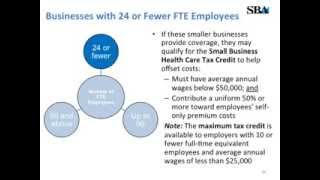
(1) 24 or fewer full-time equivalent employees; (2) average annual wages below $50,000; (3) employer contributes at least 50% toward employees' self-only premium costs.
Up to 35% of employer premium contributions through 2013 (25% for tax-exempt employers); up to 50% starting in 2014 (35% for tax-exempt employers) provided coverage is purchased through SHOP.
Owners, family members, and business partners are not counted as employees for the FTE/wage thresholds.
Employers with 50 or fewer full-time employees (uses federal FTE method), including non-profit and religious organizations; must have at least one common-law employee who is not the spouse.
Chapters
Good afternoon ladies and gentlemen. Thank you so much for joining us for today's webinar presentation on the Affordable Care act and what it means for small businesses. My name is Emma Hollister and I'm the Network Manager at Small Business Majority. We are so pleased to continue presenting this series with our partners at the Small Business Administration and the Centers for Medicare and Medicaid Services. This is part of an ongoing series. We hold this webinar Every Thursday at 2pm Eastern. If you would like to attend the presentation again or know of folks who would be interested. We will be sending out a follow up email following the conclusion of the presentation today that will include that information, the links for the upcoming events, Just a couple of housekeeping tips before we get started. This call is off the record and not intended for press purposes. If you are a member of the press and you'd like to speak with someone about the Affordable Care act, you can reach out to me again. My name is Emma Hollister and you can get in touch with me by responding to any of the emails you've received about this presentation today and I can put you in touch with someone who can speak to the issues covered here. Finally, we will be sharing a copy of the slide deck used as the basis of this presentation that will go out to you all in the reminder email that will be going out immediately following the presentation today. So please be on the lookout for that. And if you have any additional questions throughout the course of the presentation, please chat them in the text box on your lower left hand corner of your screen. We are not able to address the hand raised function, but if you chat your questions, we will answer as many as we can at the end of the presentation. And if you have additional questions after the presentation is over, please feel free to get in touch with me by responding to any of the emails you've received about the presentation today. With that being said, I would like to turn today's presentation over to my friend and colleague Meredith Olufsen from the Small Business Administration. Meredith great.
Thanks so much Emma. It's a pleasure to be here today. As Emma mentioned, I am a Senior Policy Advisor with the US Small Business Administration. We are the federal agency that advocates on behalf of America's 28 million small businesses and we've been working to educate the small business community about the benefits of the Affordable Care Act. Today's webinar, just to give you a recap or an overview rather, will cover three main topics. We will talk about the Small Business Health Care Tax Credit, which has been available to small businesses under the health care law since 2010. My colleague Julie Kosterlitz with the Department of Health and Human Services will talk to you about the new health insurance marketplaces and with a focus on the small employer side of the marketplace. And then we will cover the employer shared responsibility rules under the law, which are also sometimes known as the employer mandates. At the end, we'll talk a little bit more about self employed business owners and what they need to know under the law and a few additional provisions before we get started today. Wanted to flag the red language on this first slide. We're providing this information to you today for educational and informational purposes only, not intended as legal or tax advice. We really want to be able to give small business owners kind of the general issues that they should be thinking about with regard to the law and some of the benefits of and opportunities. But obviously each of you have your own unique individual business circumstances. So we do encourage folks to consult their own tax and legal advisors to determine how this information relates to your own unique business circumstances. With that, let's go ahead and get started. So we've been hearing from small businesses for years that one of their number one concerns has been access to affordable health care. How can they stay competitive in the marketplace, offer coverage to their employees in a way that makes sense for their bottom line? Currently, small businesses in the small group market have on average paid about 18% more than large businesses for health insurance. As you'll see under the Affordable Care act, the law is really helping small businesses by leveling the playing field, giving small businesses access to quality affordable health insurance. The law is helping to lower premium cost growth and all of this is making a difference within the small group market. So before the Affordable Care act was passed in 2010, as many of you know, small employers often had many obstacles to trying to provide coverage to their workers. They had fewer choices in the small group market, often higher premiums or unpredictable rate increases. For those with groups with women and older workers, they had higher rates. And for those with workers with chronic health concerns, higher rates and often no coverage for those with pre existing conditions. When the Affordable Care act was passed in 2010, two reforms came into play immediately. First, insurance companies had to spend, and now must spend at least 80% of their dollars on actual medical care. And if they don't, they have to rebate the difference between that 80% or anything in excess of the 80%. Also, insurance companies for the first time had to justify double digit rate increases. So so they had to disclose and demonstrate the rationale behind premium rate hikes of 10% or more. Also now insurance companies can't charge higher rates or deny coverage based on chronic or preexisting conditions. They can no longer charge higher rates for women and face limits on additional premiums for older employees. As you'll see when we talk about the new health insurance insurance marketplaces, insurance companies must now pool risks across a small group, across small groups, creating larger risk pools just like larger companies have been able to enjoy. And all plans offered in the small group market starting in 2014 must provide these core essential health benefits under the Affordable Care Act, a set of about 10 or so basic fundamental benefits that must be offered in the small group market. So we'll talk today about three main topics. As I mentioned, two of those are on this slide. One is the small business healthcare tax credit. From 2010, when the credit was first in effect through 2013 tax year, it's accredited up to 35% of employers, premium contributions, 25% if you're a tax exempt employer. And then for 2014 and beyond, eligible small businesses can get a tax credit worth up to 50% of their premium contributions. We'll talk more about how to get that credit and what it looks like. And then employers in the small group market are now enjoying better options for through the health insurance marketplaces, which we will also talk about today. Won't go into this next slide in a lot of detail, but we wanted to flag the way that the Affordable Care act is making a difference across the board. So things like allowing young adults to stay on their parents plan through the age of 26, children can no longer be denied coverage due to pre existing conditions, electronic records reform, so things like that that are making a difference across sectors in the US and feel free to go back to this slide at your convenience, but we wanted to flag this for you here today. As we're going through these topics and talking about the Affordable Care act and what it means for small business, it's important to know that often the way that the Affordable Care act impacts a small business is really going to depend on the size of the workforce. So we've got some of the main buckets up here. If you've got fewer than 25 employees, up to 50 employees or 50 or more depending on that size of workforce, the Affordable Care act is going to affect you differently. So keep that in mind as we work through these main topics here today. And with that, we'll start on the first main section, the small business health care tax credit. So this is A tax credit that's been available, as I said, to employers since 2010. And there are three eligibility criteria that are important for you to know in terms of the tax credit. The first is, as the header says, you have to have 24 or fewer full time equivalent employees. When we say full time under the tax credit, we mean a 40 hour work week. So the definition of full time for the purposes of a tax credit is an employee who's working 40 hours a week. That's different, as you'll see than the definition of full time under the employer shared responsibility requirements. So this is a unique definition for, for the business credit, the tax credit. When we talk about shared responsibility, that definition of full time will be based on a 30 hour workweek. So again, first criteria is that you have 24 or fewer full time or full time equivalent employees, average annual wages below 50,000, and that you contribute at least 50% toward your employees self only premium costs. So if you meet those three criteria, you'll be eligible for the tax credit right now through 2013 tax year of up to 35% of your premium contributions. This tax credit works on a sliding scale. So if you have 10 or fewer full time equivalent employees and average annual wages of less than 25,000, you may be eligible for the maximum tax credit of 35%. Again, tax credit from now through 2013, it's important to know that you can still deduct the remainder of your premium contributions. So you can take the credit and then take a partial deduction for the remainder of the contributions. Starting in 2014, the tax credit rises to 50%. And in order to take advantage of this enhanced tax credit, you need to meet the three criteria we talked about. And this is really important. The employees of your company must enroll in coverage offered through the Shop Marketplace. So my colleague Julie Kosterlitz will talk to you more about what the Shop Marketplace is and how it works. But it's important to know for the purposes of the tax credit that the only way to get the tax credit for 2014 and beyond is to enroll in a plan through the Shop Marketplace. And if you do that, you can take the credit for any two consecutive taxable years. So if you've already taken advantage of the credit from years 2010 through 2013, you can still take advantage of it, provided you offer coverage through Shop. And in that case, you can claim it for any two consecutive tax years. Note that this is a federal tax credit and some states may also have their own health care tax credits available to businesses. So it's worth looking into as well. A couple of other things before we shift gears away from the tax credit. I said if you're a nonprofit employer, you're also eligible for the tax credit. In that case, it is a credit of up to 25% right now through 2013 tax year. And then starting in 2014, if you're a nonprofit, the credit goes up to 35% again provided you purchase coverage for your employees through shop. If you don't have as a for profit employer taxes in a given year, you can carry back the credit or carry it forward to other years. And as a for profit entity, you would use the Form 8941 to claim the credit. As a tax exempt employer, the credit comes actually in the form of a refund and you would include the credit on the form 990T as in Tom and you would use line 44F. We often get the question who counts as an employee? When you are figuring out whether you meet that threshold of 24 or fewer employees to take advantage of the credit. Employees are those or workers who perform services for you during the tax year. The owner. As the owner, you would not count yourself as an employee for that purpose, nor would you count your family members or business partners. So when you're figuring out the FTE calculation and the wage $50,000 wage threshold, you would not count yourself as the owner or family members or business partners. The next slide is just a recap of the eligibility criteria that I mentioned before. And the bottom box highlights the fact that this tax credit rises to 50% for 2014, provided you purchase coverage through the SHOP Marketplace. So for businesses with up to 50 employees, you will want to know more about the new SHOP Marketplace and what the eligibility criteria are for the SHOP Marketplace. So with that, we'll transition into Julie Kosterlitz who will present on the new Marketplaces.
Thank you, Meredith. This is Julie Kosterlitz and I am with the Department of Health and Human Services and the Centers for Medicare and Medicaid Services. And I'm going to talk to you about the SHOP program. As Meredith said, this is a program that's open to employers with 50 or fewer full time employees in 2014, including nonprofit and religious organizations. This Small Business Health Options program, which is a long way of saying shop, is basically a new program designed to help you offer health insurance to your employees. It's part of the new Health Insurance Marketplace, which is still sometimes referred to as an exchange and is available in each state. It offers employers a choice of health plans and dental plans and some tools to make informed purchasing decisions. When you offer your employees SHOP coverage, you can be sure you've selected the plan that conforms to the new standard because all SHOP qualified health plans include the package of essential health benefits that Meredith referred to earlier, like coverage for doctor visits, preventive care, hospitalization, and prescription drugs. In addition, if you offer your employees coverage through the SHOP and meet other eligibility requirements, as Meredith mentioned, you may be able to claim the Small Business Healthcare Tax Credit, now worth up to 50% of your premium contributions for for tax year 2014. The Marketplace Shop Marketplace is designed to work with the other provisions of the health care law, including the reforms and the tax credits, to help small employers overcome the traditional obstacles to offering their employees health insurance. The kind of thing that resulted in the routinely sort of higher costs that small employers and not to mention higher hassle factor that small employers encounter. So next slide please. I think we're actually onto yeah, who can purchase Shop coverage? The Shop is open to small employers with 50 or fewer full time employees and the Federally Facilitated Shop, which is the Shop. In states that did not choose to operate their own Shop Marketplace, the Federally Facilitated Shop Marketplace uses the federal full time equivalent accounting method to determine whether an employer meets the requirement of 50 or fewer full time equivalent employees. However, the transitional measure in 2014 and 2015, a shop marketplace that's run by a state, can continue to use the state's established method for county employees to determine whether or not the employer meets that requirement. So if your state is running its own Shop Marketplace, you'll want to check on the methodology that it uses. You must have at least one common law employee who is not your spouse on the payroll. In order to be eligible for SHOP coverage, you must offer coverage to all of your full time employees in the Federally Facilitated Shop. That means to all those who work an average of 30 or more hours per week. You also need to make sure that you meet any minimum participation requirement that your state has set. In many states that are using the Federally Facilitated Shop, that requirement is that 70% of your employees who are offered coverage must accept the offer before you can enroll. Now, if you're a sole proprietor or shareholder of more than 2% of an S corporation that has no common law employees, you can't buy insurance through the Shop. But you and your spouse can buy insurance through the Health Insurance Marketplace, which sells health insurance for individuals and families. Depending on your level of income, you might qualify for premium assistance when you buy as an individual through the Health Insurance Marketplace place or as a family visit healthcare.gov for more information about that. And just a reminder that we'll probably want to emphasize a couple times during this presentation that if you are shopping for health insurance in the individual health Insurance Marketplace, you want to pay attention to the open enrollment period, which runs through March 31st. And after that, other than a few special exceptions for changes in status, you would need to wait till the next open enrollment period next fall to buy insurance that would take effect in 2015. Okay, so let's see, we're on to, I believe, buying Shop coverage. Thank you. So you can start enrolling in SHOP health coverage now. You can also offer your employees health coverage through the SHOP Marketplace at any time during the year. And the same is true of Buying Shop Qualified Dental Plan. This is to distinguish from the individual Marketplace, where there is an open enrollment period that closes at the end of March. For the Shop, it continues year round. Here's how the timing would work. If your employee enrollments are submitted between the 1st and the 15th day of the month, your group coverage begins the first day of the next month. So, for example, if your employee enrollments are submitted on May 10, 2014, your group coverage begins June 1, 2014. But for those enrollments submitted after the 15th of the month, coverage begins on the 2nd following month. That is, if employee enrollments are submitted on May 18, your group coverage will begin on July 1. If you're seeking SHOP coverage for your employees in the federally facilitated SHOP Marketplace, you'll need to purchase that coverage directly from an agent, broker, or insurance company that offers a SHOP qualified health plan during 2014. This process is referred to as direct enrollment, and this is because online enrollment is not available in the federally facilitated shop in 2014, but it is expected to be available for coverage taking effect in 2015. So for this year, direct enrollment in the federally facilitated SHOP plan is pretty similar to how many of you have already enrolled in coverage. If you've bought coverage before the process that you've been using, you can start by learning about the SHOP plans available in your area from an agent broker insurance company that is offering plans certified by the SHOP or by using the Premium estimation tool on healthcare.gov this is sort of a new tool that allows you to go in and look at all the plans in your area, and I think we'll be talking about that a little bit more later and it can give you some estimates of what your likely premiums are. After you find one that interests you, you've selected one. The agent, broker or SHOP insurance company can give you an Exact price quote. If you decide you like that, you want to take that one, you'll offer it to your employees, and those that accept will enroll with the help of the insurance company, the agent or broker. Once they've enrolled, you pay the insurance company directly or with the help of an agent or broker. And be aware that if you're in a state that runs its own Shop Marketplace, they may have a different enrollment process. The Shop in many of these states already offer online enrollment. Next slide please. So when you are using the Direct enrollment process, although you can't apply for Shop coverage online and must use direct enrollment, you can still qualify for the Small Business Healthcare Tax Credit as long as your employees are enrolled in a SHOP Qualified health plan and they meet the other that you meet the other requirements for the credit and you get a determination that you're eligible to participate in the Shop. So some people have thought that because there isn't a way to enroll in the Shop Online, the federally facilitated shop online in 2014, they've assumed that that means that they can't purchase Shop coverage and therefore that they can't qualify for the tax credit. But in fact, despite the fact that there is not online enrollment, you can still qualify. You need to make sure that you ask your agent or broker or the insurance company that you're talking to. 4. You need to ask for a SHOP Qualified Health Plan Just to confuse you further, there are such things as qualified health plans that meet some of the other requirements of the ACA but are not SHOP Qualified health plans. So be sure to ask because that will make a difference when you go to apply for your Small Business Healthcare Tax Credit if you meet the other requirements. So to be determined as eligible for the Federally Facilitated Shop, you must have submitted an application and have been found by the SHOP to meet the requirements to purchase Shop coverage. We'll explain a little bit more about how to do that, how to file that application in a moment. In 2014 in the federally Facilitated Shop, you don't have to wait for an eligibility determination from the Shop Marketplace before buying a qualified health plan. That might allow you to get your coverage more quickly and to take advantage of the tax credit more quickly. Because once you're determined eligible to participate in the Shop and to receive the credit, you can claim the tax credit for the entire time your employees were enrolled in Shop coverage during the tax year, even if you didn't apply for your eligibility determination until after you enrolled. But you do need to get the Shop eligibility determination sometime before the end of 2014. And we suggest that you mail in your application within a week of enrolling your employees in SHOP coverage, but no later than December 1, 2014. This is important because if you're found eligible, the SHOP will also send your employee enrollment information to the IRS to ensure that if you meet all the other requirements, you can claim the tax credit for tax year 2014. If the shop Marketplace determines that you aren't eligible to participate in the SHOP after you've already enrolled in SHOP coverage, you wouldn't be able to claim the Small Business Healthcare Tax Credit, but you may be able to keep your coverage that you enrolled in. Okay, so onto the next slide. How to Apply for this Federally Facilitated SHOP Eligibility this is something employers do that employees do not need to do and can't do. The SHOP will verify employee eligibility based on information that's sent by the insurance company. The Federally Facilitated Shop Marketplace agents and brokers insurers can help you fill out mail in the paper application. Also, a Marketplace Navigator or other assistor can help you with this, or you can fill out and download the paper application on healthcare.gov the website has instructions for completing the form and the mailing address, which is also listed on the application. Finally, you can complete the application by phone through the SHOP Employer Call center, which is listed there on this slide. It's also listed in many places on healthcare.gov the federally facilitated Shop Marketplace will notify you of your eligibility to participate in the SHOP by phone and email and if requested, by mail as well. You should get a determination on your SHOP eligibility three to five days after the SHOP Marketplace receives your fully completed application. Plan to keep your eligibility determination notice for your tax records. And keep in mind that the Federally Facilitated SHOP can only determine whether you're eligible to participate in the SHOP and not whether you can receive the tax credit. The IRS will ultimately determine if you meet all the other requirements for the Small Business Health Care Tax Credit after you file your tax returns. Next slide please. So how the SHOP works and moving towards employee choice Want to remind you that the ultimate goal of SHOP is to give small employers more options for their employees, including the option to offer their employees a choice among health plans. In 2014, small employers in states with a federally facilitated SHOP can select only one of the available qualified health plans, and the same goes for SHOP qualified dental plans. If you're planning to offer that option to your employees as well, you can only select one to offer to your employees. In states that are running their own SHOP Marketplace, employers may have the option already to offer their employees a Choice of Plans Many state based shops are making employee choice available now in the federally facilitated shop, direct enrollment and a single plan offering are transitional measures while the SHOP Marketplace is building a robust online experience for 2015. Online in addition to the online enrollment capability, starting in 2015, all states may offer small employers the option to offer their employees a choice of plans through the SHOP Marketplace. So that's pretty much it for Shop. And I'll be on through the end of the call to answer any questions you might have. And now I'm going to turn it back over to Meredith.
Thanks so much, Julie. Now we'll turn to our third and final main topic for today, Employer Shared Responsibility. These are the rules that basically say if you're a business owner with 50 or more full time or full time equivalent employees and you don't provide coverage to your full time folks or the coverage that you offer doesn't meet certain criteria, then you may have to make what's called a shared responsibility payment as part of that non offer of coverage or coverage that's not adequate. And these rules take effect in 2015. And we'll talk through kind of what the rules look like. There is kind of the permanent rule which I will emphasize throughout the presentation and then there's some transitional rules which are going to apply for the first year only. So for 2015. But I'll try to clarify the difference between what the permanent rules are and what some of these transitional rules look like. So again, under the permanent rule, you are only affected by the employer shared responsibility provisions if you have 50 or more full time or full time equivalent employees. 96% of firms in the US are below that threshold. So it's only about 4% of firms in the US that are subject to the employer shared responsibility requirements. And when I say employer under these rules, that includes for profit entity nonprofit entities. If you're an employer with 50 or more employees full time or full time equivalent employees, you would be subject to these rules. Again, that's about 4% of U.S. firms. So what are some of the important definitions for the employer shared responsibility rules? The first is this definition of full time. When I was talking about the tax credit, I said that that definition of full time is a 40 hour workweek. A little different here. So for shared responsibility for employers, full time is defined as an employee who is employed on average 30 hours or more per week. So how does this play out in terms of figuring out whether you're covered by these rules? So if you as a business owner have 50 or more full time folks. So those working 30 hours a week or more or full time equivalent, which would be a combination of employees who work, for example, 15 hours per week. Two such employees added together would be a full time equivalent. So when you're looking at whether or not you meet the threshold of 50, you do need to look at your full time workers and those that are working part time and you would add the entire workforce workforce together to figure out whether you meet that threshold of 50 or more. The other thing that's important to know when you figure out whether you have the 50 or more employees is if you're part of a control group of employers, so you've got common ownership among different employers or you're otherwise related to one another, you have to add your workforce together to figure out if you meet 50 employees or more. So the permanent rule is you're covered if you have 50 or more employees for 2015 only, that threshold is generally 100 employees or more. If you have 50 to 99 employees, you aren't subject to the shared responsibility rules for 2015. They would not kick in for you until 2016, provided that you meet certain certification requirements. And we'll look at what those are in a few slides. So in other words, the permanent rule going forward is you're covered if you have 50 or more employees. There's a one year kind of grace period if you certify to certain things if you have 50 employees to 99 employees. So we'll look more closely at what that certification looks like. But talking about the person permanent rule, what do these rules look like? So I mentioned at the beginning that generally speaking, the employer shared responsibility means that if you don't offer coverage to at least 95% of your full time employees and their dependents or the coverage that you offer to your full time folks either isn't affordable or doesn't meet minimum value, you may owe a shared responsibility payment. You would owe a payment in this scenario if at least one of your full time employees receives a premium tax credit in the new healthcare marketplaces. So I know that's a lot of information on one slide. I'm going to try to break it down for you in the next few slides. But again, the shared responsibility payments are triggered on one of your full time folks, at least one of them receiving a premium tax credit to buy coverage in the new health insurance marketplace. So in that first slide, when I outlined what shared responsibility looks like, I said that you could be responsible for one of these payments if the coverage you offer to Your full time individuals either isn't affordable or doesn't meet minimum value. And so the two definitions of affordability and minimum value are on this slide. Coverage meets minimum value standards. Under these rules, if the plan covers on average at least 60% of the plan's total cost, so that means that the plan itself is covering at least 60% and your employees are responsible for the remaining 40% or less. Know that most employer plans that are offered do meet that minimum value standard and then coverage must be affordable. So under these rules, that means that your employee's share of self only coverage is no more than 9.5% of his or her household income. If you don't know your employee's household income and many employers won't know it, there are certain what are called safe harbors that employers can use to determine affordability. And the one we have up on this slide is probably the most common and that's using the W2 wages. So if the cost to the employee of a self only plan is no more than 9.5% of his or her wages on the W2, then it would be considered affordable. You would have offered them affordable coverage if you meet that test under these requirements. So what do the shared responsibility payments look like? Well, well, there are again two basic scenarios depending on which category you fall into. On the left hand side, that would be the category of business owners who don't offer coverage to at least 95% of their full time employees. Note that for 2015 only, it's a threshold of 70% and that's one of those transition rules I was talking about. So if you don't offer coverage to at least least 95% of your full time employees and their dependents, then you may have to make a payment. Again, if any one of your full time employees goes into the new marketplace and receives a premium tax credit to help offset the cost of coverage, in that case, the payment owed would be $2,000 per year times your number of full time employees minus the first 30. So what would that look like? Kind of hypothetically speaking. So let's say assume for the purposes of this first scenario on the left hand side that you're a company with exactly 50 actual full time employees. So it's 2016, you are covered by these rules, you have exactly 50 actual full time employees and you decide not to offer any health care coverage at all. If employee number 17 goes to the individual marketplace and qualifies for a premium tax credit to get coverage for themselves, then you, as the employer may be responsible for paying $2,000 a year times all of your actual full time folks, minus the first 30. So under this hypothetical, that means the company would be responsible for paying $2,000 a year times the 20 employees. So employees number 31 through 50, and that's because you get to deduct the first 30. So if you're a business of 50 employees, you deduct the first 30, your payment would, hypothetically speaking, be the $2,000 times 20 full time employees, which equals a $40,000 payment that wouldn't be tax deductible. So that's scenario number one. Scenario number two is, let's say you do offer coverage to at least 95% of your full time folks, 70% in 2015 only. But that coverage either isn't affordable or doesn't meet minimum value, then the payment owed would be $3,000 times the number of full time employees who actually get the premium tax credit. So, so in the first scenario it was based on your full time workforce. Here the payment is based on the number of full time employees who actually get that premium tax credit. So under the scenario I used before, let's say employee 17 goes out and gets coverage in the marketplace and receives a premium tax credit. But that's the only employee that gets the premium tax credit. The payment owed would be only the $3,000 a year. It's only for that employee, employee number 17 who got the premium tax credit. And by the way, the definitions of minimum value and affordability remain the same, you know, when the rules go into effect in 2015. So it's not like the definition of minimum value changes. Other key points to know about these provisions, no employer payment is owed for part time folks, even if they get a premium tax credit. The payment is only triggered by a full time employee who gets the premium tax credit. If you as the employer offer affordable coverage that provides minimum value to one of your full time employees and they decline that coverage, you wouldn't be responsible for a shared responsibility payment for that employee. So it is the offer of coverage that matters, not whether or not you're employee accepts it. Sort of related to that, if your employee obtains coverage through a means other than the individual marketplace, so through their spouse, for example, you would not owe a shared responsibility payment for that employee. And that's because the shared responsibility payments are only triggered by the receipt of the premium tax credit in the marketplace. So if somebody is going outside of the marketplace to get coverage, that would not trigger a shared responsibility payment under these rules. And then also it's important to know that to avoid a shared responsibility payment, if you offer coverage to full time folks, your full time employees, you must also offer coverage to the dependents of those employees who are kids under the age of 26. And there's an asterisk there. Again, some transitional relief for 2015. If you as an employer make steps during the 2015 year to offer dependent coverage but you haven't fully implemented it, you would not owe a shared responsibility. So there's that buffer year where you can start to take steps to offering dependent coverage and not be on the hook for a shared responsibility payment. I sort of started to mention some of the transitional relief, but here we're going to cover briefly the certification requirements. So as I said, For 2015 only, generally speaking, these rules apply to businesses with 100 or more full time or full time equivalent employees. If you're in the bracket of 50 to 99 employees, you would not be subject to shared responsibility until 2016. But you have to provide the following certifications to get that exemption and they are number one, that you in fact had 50 to 99 full time employees throughout the year. Number two, that you didn't reduce your workforce for your hours in order to to get that transitional relief so that you didn't take action to fall under the threshold of 100 in order to not be subject to shared responsibility. If you made decisions based on legitimate business reasons, that's different. But you do have to certify you didn't reduce hours or workforce in order to qualify for this release. And then finally the you maintain previously offered health coverage to your employees. As I mentioned before, these employer shared responsibility payments are not tax deductible. Wanted to quickly mention some things for self employed folks that they'll need to know about. First, most individuals in the US have to have minimum essential coverage starting in January of the this year unless they qualify for an exemption. There are exemptions based on things like income levels, other hardship exemptions, religious exemptions. If you don't have coverage every month and you don't qualify for an exemption, you have to make a payment when you file your tax returns. It's important to know that as Julie mentioned when we were talking about the marketplaces, if you're a sole proprietor without common law employees, you would come in to purchase coverage not through the shop side of the marketplace, the small employer side, but rather through the individual side of the marketplace. And if you do that, if you come into the new health insurance marketplace. One advantage of buying coverage through the marketplace as a self employed person is you may be eligible for premium tax credits or cost sharing based on your income. So we encourage folks to to go onto the healthcare.gov site to determine whether they might be eligible for these tax credits. Also important to know, as Julie mentioned, that if you're an individual and you are looking for coverage in the marketplace, open Enrollment closes on March 31, so 20 days from now. So you'll want to sign up then. Unless you're eligible for some kind of special enrollment for, you know, a divorce or birth of a child or something, some other special life circumstance, the deadline really is March 31st. As an individual, if you are a small employer for the marketplace, as Julie said, there's open enrollment throughout the year. Won't go into these in detail because I do want to take your questions in the last 10 minutes or so, but we wanted to highlight a few other provisions. Small business owners should know about all of these provisions. These provisions are outlined in detail on our website sba.govhealthcare so you can read more about them. The one I'll flag on this slide is the last one. Under the Fair Labor Standards act, employers must notify their employees about the health insurance marketplaces. And this is employers of any size so long as you're covered by the Fair Labor Standards Act. And then looking ahead to 2015, there are new reporting requirements. One of them applies if you are subject to the employer shared responsibility rules that I talked about a few minutes ago. The other, the last bullet, would apply if you are a self funded or self insured employer of any size. Finally, some links to more resources business.usa.gov, great website. If you haven't been on it before before, it compiles information across the federal government for business owners, including healthcare. You've got our website number two, healthcare.gov, the place to go to enroll in the new marketplaces and then IRS.gov, which has a lot of great resources around the tax credit and the employer shared responsibility requirements. So with that, let's take some of your questions in the remaining 10 minutes or so.
Great. Thank you so much, Meredith. Julie, do you have some questions you'd like to answer?
Yes, I'm just looking at these. So there was a question about clarifying the SHOP open enrollment rules. The questioner says, I thought there was restricted open enrollment period for SHOP coverage for employers that don't meet the participation requirements. Yes, that's a slightly different topic than open enrollment generally. What I think is being referred to here is the question about minimum participation rates as we mentioned that states set these minimum participation rates and that if you don't have the requisite share of employees accepting your offer of coverage and you are, you would not be able to enroll. But there is an exception to that. Just like there's always, it seems, an exception to everything. There is a month during which time employers that do not meet the minimum participation rates can nonetheless enroll. And I am going to. It's been so long since I've talked about it, I'm going to have to refer back. I believe it's this past year. It was November 15th to December 15th, and I believe that would probably hold from year to year. I'll try to double check that when Meredith is answering some of her questions. But there is a one month long period for open enrollment that you do not need to meet the minimum participation rate requirement. So that's a question. One shop question. And Meredith, looks like you've got a few too. We can alternate.
Sure. So let's take a few on the tax credit because I actually have a couple that are showing up here. First question, the 50,000 threshold that I mentioned for the eligibility is that per employee or total wages for the company? So that's per employee. Just to give you an example. So let's say you're an auto repair shop with 10 employees looking to get the tax credit. You've got 250,000 in wages total. So you would divide the two 250,000 wages total by your 10 employees, making it $25,000 per worker. So you're well below the threshold number of 24 or fewer employees and below the $50,000 wages per worker. So you qualify on those fronts. You're offering coverage to at least 50% of your workers. Let's say your healthcare costs in that example are 70,000. So for 2010 through 20, your tax credit would be roughly 24,000, which is the 35% credit times the $70,000 premium contribution. In 2014, because the tax credit rises to 50%, your tax credit would be a credit of 35,000 because it's a 50% credit times your health care cost of 70,000. So does the employee have to make less than 50,000 for 24 or fewer or 25,000 for 10 or fewer? Hopefully I didn't confuse folks. The requirements, the eligibility requirements are 24 or fewer employees, average annual wages of less than 50,000, and the 50% or more contributions. I mentioned the 25,000 and the 10 or fewer employees only for the purposes of who gets the maximum tax credit. So again, because the tax credit works on a sliding scale. And let me go back to that slide. Those with pulling it up here, Those with 10 or fewer full time equivalent employees and average annual wages of 25,000 would be eligible for the maximum tax credit. But so long as you fall under the larger umbrella of fewer than 25 employees and wages below $50,000, you'd still qualify for the tax credit. It just wouldn't be the maximum amount. Is the credit no longer available starting in 2014? If I don't participate in Shop, but I still provide coverage. So as we mentioned, just Julie and I both mentioned, we were talking about SHOP and the tax credit. In order to take advantage of the tax credit starting in 2014, you do have to participate in SHOP. If an employer isn't participating in Shop, they won't be able to take advantage of the tax credit starting in 2014. Of course, you can still take advantage of it, have taken advantage of it 2010 through 2013. But that rule changes once the SHOP Marketplace is open opened in 2014.
So, Meredith, I just wanted to chime in and confirm that I was correct about the exception to the 70% participation rule that applies in most states. It's from November 15th to December 15th each year, you can get coverage through the Shop Marketplace without having to meet this minimum participation requirement. So. So this allows employers who don't meet the required participation level to offer a SHOP plan.
Great. This next question bleeds a little bit into the marketplace as well, but I think it's worth reiterating. So I'm a small business owner. Looks like I have an employee plus the owner and a spouse. What insurance deadlines apply? So just so we're really clear, and this is an important point, so the Shop Marketplace that we talked about, so you're a business owner, you want to offer coverage to your employees, you can enroll at any time. And Julie can expand on this more. But if you. So long as you have coverage by the 15th of the month. I'm sorry, as long as you apply by the 15th of the month, coverage would be effective by the first of the following month. So that should not be confused with this open enrollment deadline that we've been talking about. The open enrollment deadline applies only to the individual side of the marketplace. So in that case, there is a defined open enrollment period. It ends this year on March 31st. And so you need to enroll by March 31st in order to have 2014 plan coverage on the individual side of the marketplace. Julie, did you want to add anything in that regard?
Well, the only thing I would say is that it's worth keeping in mind that your employees who you are planning to cover have some requirements to have coverage or face a penalty if they don't buy, if they don't have insurance. So if you're thinking of them, it's worth trying to purchase before the and you're planning to provide them coverage and you don't currently provide coverage now or there's a lapse in your coverage or whatever you would want to consider purchasing before the 21st because there are some special rules about waivers of the penalty until that coverage takes effect. So I think we said after March 15th when you purchase, your coverage would take effect May 1st. Yet your individuals who purchase anybody who purchases before the 31st does not face a penalty for not having coverage between the time of the end of the open enrollment March 31st and the advent of that insurance May 1st, as long as they purchased within the open enrollment period. In other words, that they purchased sometime before March 31st. So while you can as a small employer purchase coverage and enroll your employees at any time during the year, it's just something to keep in mind from their standpoint, from your employees standpoint as individuals, they need to have either purchased or be getting employee coverage through you if you're their employer that was purchased before the 31st in order to not be liable for that penalty. So that was not a very clear, clear explanation, but it's something to keep in mind.
Thank you so much Julie, and thank you Meredith as well. We want to be respectful of folks time, so we're going to let you get back to running your businesses. Thank you so much for joining us for today's webinar presentation and please keep an eye out for the follow up email that will be going out shortly. Thank you so much for joining us.
SA.
More from Your







President Donald J. Trump and First Lady Melania Trump Visit Grieving Texas After Deadly Floods

💪 Thinking of starting a #biz? Go for it! — Kerry Boyle, Vermont #SmallBiz Person of the Year

President Trump Participates in a Bilateral Meeting with the Prime Minister of Canada, May 6, 2025

