Product Led Growth w/ Blake Bartlett, Partner at OpenView Venture Partners
Blake Bartlett of OpenView Venture Partners explains product-led growth as software distributed through the product itself rather than sales teams. Nineteen PLG companies are now public and worth over $200 billion combined, outperforming traditional SaaS. The shift happened because infrastructure got cheaper, buying power moved down the org chart, and end users now discover tools directly.
Chapters
Hey everybody, this is Mike Bellocito, co-founder of Product Collective, and we're back for another industry interview. Um, if you joined in the last interview, you saw that I wasn't here, but my partner Paul was here. So I hope you enjoyed time with Paul, but I'm back, so I am glad to be here. And this is going to be a really awesome industry interview. It's actually gonna be a little different than those in the past. Our guest actually has something to walk us all through. So what we figured is rather than the normal back and forth questions, we would definitely will have questions for our guests. We'll sort of save that to the end. And our guest is going to walk us through some things that he's been putting together that I think we're all going to be interested in, of course, all related to product-led growth. And so before we get to our guest, I just want to give sort of a couple sort of housekeeping type things here. First of all, if this is your first industry interview, thank you for being here. These are generally, you know, live video Q&A chats, although again, you know, sometimes we, we do it a little bit differently. So we do these on the first and third Wednesday of every month at 1 PM Eastern. And these are all recorded. So if you had to pop out or if you have any issues, you know, feel free to come back at the same URL and you'll be able to watch the recording there. But But hopefully you can see and hear me okay and there won't be any issues. But know that this will be recorded just in case. And then the other thing is, if this is your first time, you might not know much about Product Collective. So Product Collective, we're a community for product people. We have about 20,000 product people throughout the world at this point that are a part of it in one way or the other. I mean, we have a weekly newsletter that goes out every Thursday, Friday, we do these live video Q&A chats. We call them industry interviews. We also have a really active Slack group. So if you haven't been invited already, you can sign up at productcollective.com and you should be able to get an invite to the Slack group. Otherwise, just shoot me an email, mike@productcollective.com, and I'll make sure to get you in the Slack group. There's about 10,000 people in that Slack group. So every day there's folks trading ideas, best practices, running things by each other, that sort of thing. And then of course we meet in person twice a year at Industry: The Product Conference. That's the conference we started organizing back in 2015. We should have close to 1,000 people with us, maybe even over 1,000 people with us this September, which we're really excited about. We've got Jason Fried from Basecamp, Grammy and Academy Award-winning artist Common even will be joining us with product leaders from Walmart, Walt Disney Imagineering, There's all sorts of people. There's 20+ speakers that will be with us. It's 2 full days or 3 if you want to come for the workshops. And then we're also planning Industry Europe, and that takes place in March 2020 in Dublin, Ireland. So you can check out the details on both of those at industryconference.com, and I hope to see some of you there. I know I already saw some familiar faces of folks I met at Industry in the attendee log here, so Thank you for coming to the chat, just like you came to the conference. But with all that out of the way, you know, I do want to introduce our guest, Blake Bartlett from OpenView. And Blake, it's really good to have you here with us.
Well, it's great to be here, and thanks for inviting me. Absolutely.
You know, I know we had a phone call a couple of months back where we talked about this topic, and I thought it'd be a great fit for an industry interview. So I'm glad we're able to make it happen. Before we get into your presentation, I want to sort of give a directive to everybody here. If you have questions throughout Blake's presentation, use the Ask a Question section, and you can actually do that at any time. But after the presentation, we'll go into that section and I'll, I'll kind of pull out which questions seem like we should get started with. So use that Ask a Question section. There's also the chat, so feel free to use that chat at any time to sort of introduce yourself and, you know, share where you're from and what product you're working on. That's always fun to see. But, but I'll be monitoring that ask a question section. So I just want to mention that. But, but Blake, yeah, I'd love to sort of turn things over to you at this point and we could kind of get started.
Definitely. Well, so yeah, I'm Blake Bartlett. I'm a partner here at OpenView. We're a venture capital firm in Boston, and we're going to talk about product-led growth. One quick funny call out to begin with. I logged into the Crowdcast and noticed that I'm wearing the same exact outfit right now live as I was in the picture. So consistency and staying on brand, really important. But anyway, so let's dive in. I'm gonna share my screen and have some slides to walk you guys through. So give me one second while I do that. So I just pull up the presentation, go full screen.
All right.
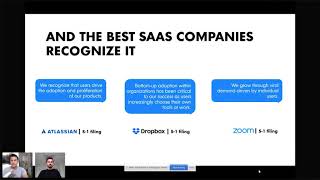
I can see it. Okay, perfect. So product-led growth. Product-led growth is how to build a software company in the end-user era. So starting with a question, how did your company adopt Slack? Think about it. I'm sure basically everybody on this call here today, this screencast here today, uses Slack. So think about it in your company. I don't know your company, but it probably went something like this. Jane, an individual person at your company, heard about it from a friend, so she signed up. Pretty soon, Jane's team started using Slack, and before you knew it, everyone was on Slack, and we love it. We can't live without Slack. It used to be hard to adopt new software. We all remember the long sales processes, the complex implementation, training and certification, sometimes extremely formal in a classroom, needing to get a badge before you're allowed to use the software. And all of this took lots and lots of time, and we're talking months, quarters, sometimes even years before you're actually using the new software that you purchased. And that's not really the case anymore today. So today, in this environment that we live in today, in 2019, software just kind of ends up showing up inside your company. It shows up unannounced. And the really, the dynamic that we're seeing is that end users are finding these products, any of the products you saw on the prior screen, Slack, Zoom, Dropbox, DocuSign, you name it, and they're telling their boss which ones to buy. So we can call this the end user era. So the end user era is here and the best SaaS companies, the best software companies that we're all talking about, they recognize it. So here's some quotes from the S-1s, the filings before these companies went public. —so the most important document of these companies' lives up to that point—describing their businesses. And here's how they describe themselves. So Atlassian says that we recognize that users drive adoption and proliferation of our products. Dropbox says that bottom-up adoption within organizations has been critical to our success as users increasingly choose their own tools at work. And lastly, Zoom says we grow through viral demand driven by individual users. So these guys have figured out that there's something to this end-user era. So why is this happening? Why is software magically showing up unannounced inside companies? How is Slack growing this way? Why are all these companies that are going public talking about this in their S-1 document? What's driving this whole dynamic? Well, I took a step back recently and looked at it, tried to think about it really kind of from a first-principles standpoint. And ask myself the question of, okay, if there's this evolution that's happening in the software market that we're seeing, well, what drives evolution in the software market? What are the most important factors that lead to sort of new situations? And I identified 4 different drivers. They're all interconnected and they all sort of lead us to this point where we're in the end-user era. So I'll walk through them, you know, here to start. So initially it's infrastructure and it's really the cloud evolution that's happened over the last handful of decades. So back in the '90s, software lived in the data center. We're talking of software living on a physical box, inside a physical rack, inside a physical data center. And then in the 2000s, we graduate and move into the cloud, where now the software lives in somebody else's data center. It's no longer in the customer's data center, it's in the vendor's data center, and I can log in through a web browser and access it remotely. So I'm no longer buying software myself and maintaining it from a CapEx standpoint through on-prem, you know, perpetual licenses. I'm now renting this software and accessing it remotely. And it's the software company's responsibility to maintain this single codebase through single instance, multi-tenant, all that kind of good stuff, and rent it out to me and other customers. And now today, software still lives in the cloud. However, there's an abstraction layer, I think, that's built on top of the cloud, or that's emerged on top of the cloud. So, you know, 2 decades into the cloud era, it is completely different to build software today. Software is increasingly composed, right? Rather than written from scratch, and written sort of, you know, using vanilla code or something like that. There's APIs, there's services, we have infrastructure as a utility, everything's built on AWS. I mean, the list goes on. So, this abstraction layer, it still is the cloud, but it's a completely sort of new evolved version of the cloud, that I would call the connected cloud, right? And this leads to an evolution in the cost to build the software and the cost to buy the software. In other words, price as well. So back in the '90s, when we had this, you know, physical software on a physical box in a data center, CapEx purchases, you were selling widgets, and it took a long time through waterfall development, years and years oftentimes, to develop new software. And then you're selling them one by one through CapEx purchases. So this This means it's super expensive to build the software and also super expensive to buy the software for, for the customer. Then in the 2000s, as we moved to rentable software, it's much easier to build and develop and maintain the software because again, it's that single code base that's maintained for all customers and continually updated. So it makes support, maintenance, adding new features, all that kind of stuff much easier, much more cost efficient. And those savings are passed on to the customer. And they're also passed on to the customer in the form of no longer having CapEx purchases that are super expensive, but now instead having rentable software that's for a fraction of the cost. And so we're moving from a world in the '90s where it was minimum 6 figures, oftentimes 7 figures, maybe even sometimes 8 figures to buy software, to now, you know, in the cloud era, I can get started for 5 figures on an annual basis through a subscription, and it's much more accessible. And then today, because it's so much easier to develop software through all of these APIs and services and building blocks and open source, and the list goes on, and it's also super easy to find this new software. I can go on any app store, any marketplace, the Chrome Web Store, you know, the list goes on, and one click later, I'm adopting and developing new software. So it's, it's also available to me as an end user that much more easily. And so this has driven the cost to build and the cost to, you know, adopt new software down to very, very low levels. And increasingly, to adopt new software, it's usually free. We all know this, right? Free trial, freemium, something like that. And this leads to an evolution in the buyer. Who is buying the software? Who's picking and choosing the software for the customer, for the organization? So in the '90s, when it was the data center era, the CIO ruled the roost, right? And her number one concern was IT compatibility. Is this new piece of software going to work in my current environment? And every software purchasing decision, ironically, was a full-stack IT purchasing decision. People were making considerations from a hardware standpoint, from a networking standpoint, from a security standpoint, and a software standpoint. And really, things had to be, you know, homogeneous and work together. And not on that list in particular were the features and the functionality and the design and the product itself. It was really about technology, not product. In the 2000s, we move into a world in which it's no longer about IT compatibility. It's now because you're not installing anything in the data center, you're renting it. So the software or the buying power and the dynamic shifts from that CIO to the executive who's buying the software for her team, right? So the VP of sales buys the sales software, not the CIO, and the CFO or the VP of finance buys the accounting package or the finance software, not the CIO, right? So it's all now about What are the KPIs that this is going to improve? What's the ROI that this is going to give me? And how is this going to help my team or my organization win in the market, right? It's all ROI-oriented. And then in the world of the connected cloud with super cheap and affordable software, this democratizes and decentralizes software purchasing and software budgets all the way down to the end user. And again, buying them and adopting them for free makes it, from a cost standpoint, accessible to do that as well. So as this evolution happens in infrastructure and in price and in cost, we also see a corresponding evolution where buying power and budgets go down the organizational chart from the C-level to the VP-level, all the way down to individual contributors and end users as this evolution continues apace. So you put it all together, and to me, it looks like we have three eras of software. So taking the dates away and sort of just saying, what can we use to describe this era? I think that the '90s era with the CIO, the data center, and super expensive stuff could just be described as the CIO era. Then in the 2000s, we move into the exec era where non-technical executives, you know, owning a business unit are making software purchasing decisions. They're renting software that lives in the cloud, and it's much more affordable both in terms of it being OpEx as well as an overall TCO, total cost of ownership perspective. That's the exact era. That's the original cloud era. And then we move into today, the modern era, where we are, where we find ourselves now, which is the end-user era, right? End users are finding and adopting software themselves, bringing it to work. It's extremely accessible to both build and to adopt new software through the connected cloud and this abstraction layer that's been built on top of the OG cloud from way back in the day. And it's much more affordable to both build and buy software. So these are the three eras that we have. And there's another important thing to talk about here. If this is the environment of software, then distribution of software— how do I adapt my product to this environment? How do I get my product in front of this evolving buyer with this evolving environment, this evolving budget? That's distribution of software. And distribution evolves over time to fit and to match the new environment that exposes itself in the broader landscape. So bringing this together, the distribution evolution looks something like this. In the CIO era, we had something called sales-led growth. This is field reps out there in the field carrying a bag, carrying a quota, supported by field marketing, you know, brochures and trade shows and trade rags and all that kind of stuff, going to the CIO, taking them to fancy steak dinners, perhaps 18 holes out on the golf course, course and convincing them that the right end result of the RFP is that you should choose my solution for 7 figures, right? And that seems extremely antiquated today from a distribution standpoint, but it made sense when you're going after C-level executives with 7-figure purchases and long, long sales cycles with a lot of complexity. Then in the executive era, we saw the dawning of what we think about traditionally when we think about software sales today, right? Inbound marketing fueling inside sales. So it's inbound inside. Because it's inbound marketing and we're adapting to this new buyer journey, we can call this marketing-led growth. And we started using terms in this executive era for the very first time, fun new terms like MQL and SDR and SAL and all of these fun things. And if you're online and you're reading any blog content from VCs and, you know, tech talking heads and all the rest, or if you attend, you know, the average SaaS conference in the world, you're gonna hear a lot about inbound marketing and inside sales, because it really is the cloud sort of native way to distribute. But we're seeing that with this evolution to today, the present era, and what we see from groups like Slack and Dropbox and Atlassian and Shopify, and the list goes on, is that they're not really doing this this sales-led growth, this marketing-led growth, they're really doing something that looks more like consumer growth models. And we can call that product-led growth. It's getting the product itself directly in front of the product user and getting them to adopt. And that's what the distribution evolution looks like. So we're in a world where it's the end-user era and it's dominated by product-led growth. So the end-user era is here. And product-led growth is how you adapt. So I can imagine that that's a really interesting perspective and you're saying, great, I'm with you. This is perhaps putting words to something that I intuitively understood for a long time, but now I'm left with a whole new question, which is what exactly is product-led growth? Like, how do I adapt to this new world order? Well, I think there's two big things that lead to product-led or that are components of product-led growth. You have to build the product for end users, and you have to distribute that product to those same end users. It's all about consistency, and it's all about the end user. So unpacking this a little bit, building the product for end users, two fundamental principles here. One, design is not enough, and two, you have to solve end user pain. So we all remember the consumerization of IT. And it worked. It delivered a design revolution. This was something that I actually did the Google Trends research on this. It seems to have peaked right at the end of 2011, beginning of 2012, so it was all the rage about 8 years ago. And the basic premise was that legacy software was terrible to use, clunky, ugly, you name it. We got used to using beautifully designed software like social media, websites, apps, all this kind of stuff. And we all said, wait a second, why does the work software suck so much? Why can't it look more like the consumer software? And so product design became a thing. And now it's table stakes. You can't get away with a terribly designed product or a horribly complex UX, right? And we're all the beneficiaries of that as end users. We have better software, so it's great. However, because it's table stakes, It means that it's not enough. You can't really win with just pretty pixels, intuitive design, emoji support in the app, a cute little cuddly mascot. Like, those things are good. Those things certainly appeal to end users, but they're not differentiators right now anymore, right? And I think you can all identify that. It's just common, commonplace to do those things. So you need to go down to end user pain. So talking first about, you know, these different types of personas you could be serving in the product. We have an end-user product persona and we have an executive product persona. I think those are the two main types of product personas and who you could be building for in this world. So end users think about their own pain as annoyance. So they would say, I'm annoyed with something, a repetitive task or something like that. And an executive, back to what we were talking about before, would say, I need ROI. I have a failing KPI. I need to improve it. I need to win against the competitors, whatever it may be. And what this looks like in practice would be Slack on the left, where the pain statement is, I hate internal emails. And so you get Slack. Again, very annoyance-oriented. And then on the executive side, you would have something that sounds much more businessy, much more ROI-y, and that would be something like, we need to manage our sales pipeline in order to hit quota. right? Or in order to achieve 75% of our quota for this next quarter. You know, very businessy, very sort of hard numbers and hard dollar ROI-oriented. But it can be easy to dismiss end-user annoyance and say, this is just frivolous, these are— people are just being petty, it's not businessy, there's no ROI. But that would be a mistake. In the end-user era, annoyance is opportunity. I jokingly can refer to the end-user era also as the annoyance economy, But you see it exactly here, right? All of these great product-led growth sort of modern companies all started with a simple annoyance-oriented pain solution that— or pain point that is oriented towards the end user. Slack: I hate internal emails, they're so annoying. Expensify: I hate expense reports, they're so annoying. All the way down to Calendly: I hate scheduling, it's so annoying, right? Everybody starts with this annoyance, not necessarily I need to improve a KPI. As a starting point. So that's building a product for end users. Design is not enough. You have to solve end user pain. So once you've done that, now it's about distribution. So how do you get this product that's built for end users into their hands? There's a handful of things here. So 4 fundamental principles: distribute where they live, make it easy to get started, deliver value before the paywall, and higher sales last. So just to start out, you have to pick a lane. Again, you have a product persona and then you have a distribution persona. You can't mix and match. If you build for the product persona of end user and try to distribute to the executive as a distribution persona, it's not gonna work because again, you're building for annoyance and the executive buys with ROI. So it's always gonna feel like a nice to have it's never gonna feel like something that's important enough. So if you're building this slick, pretty, end-user-oriented product, but then you try to get sales reps on the phone and cold calling VPs, it just ain't gonna work. So consistency in personas, product persona equals distribution persona, good, important. So if you're gonna build for the end user, distribute to the end user, and conversely, if you're still gonna build for the executive, then distribute to the executive, but don't mix and match. Alright, so this is down into the first principle now. Distribute product where your users live. So where do they live? I mean, every user today lives on a handful of primary screens. So your modern knowledge worker is going to live in Slack or is going to live in G Suite or is going to live just in the Chrome browser, sort of toggling between different SaaS apps. Sales reps live in Salesforce, modern merchants live in Shopify, you know, non-desk workers live on their smartphones. So figure out what is that primary screen where your end user lives and then distribute in that same exact place. So if they live in Salesforce, distribute on the Salesforce AppExchange. If they live toggling between SaaS apps on the Chrome Web Store, then distribute on the Chrome Web Store. The list goes on, right? Where they are, that is where they live, is where they're going to experience most of that annoyance, most of that pain, or perhaps toggling between those primary screens. So distribute at the point where the pain exists. Now that you've done that, you have to make it easy to get started, and end users demand self-serve. I refer to end users as consumers at work. So think about a consumer. What would you tolerate when signing up for a new app or a new website? You wouldn't tolerate anything that looks like friction. So "request a demo" or "talk to sales" is the call to action. End users hate that. Contracts that you have to review, perhaps get legal to look at, or an order form, even if it's a simple DocuSign, Think about a DocuSign for Uber. If you had to do a DocuSign for Uber before you could take your first ride, you would ditch it out and go to Lyft, right? Then once you get actually onboarded, configuration implementation, if that requires a CSM, that requires an SE, or if that requires, you know, customization, again, end users don't have patience for that. If it requires classroom training or formal training, but requires, you know, back and forth support, so you get the idea. If there's humans in the funnel, it's anathema to end users. So remove the humans from the funnel. This is gonna make some of you a little bit sad, I'm sorry, but your team is great, the humans on your team are great, but end users don't want to talk to them. Again, I gave that example of Uber, think about Instagram. If you're adopting Instagram for the first time, but you couldn't look at anything and you couldn't post your first picture before you got an onboarding session from a CSM, would you use Instagram? I don't think you would. right? If you're going to buy a 24-pack of toilet paper from Amazon, you don't want to call up the Amazon sales rep and say, hey, could you send it to me? You want the one-click purchase, right? So all of those places where humans are in your funnel, remove them. So make it a sign-up or a single sign-on call to action, very easy to get going. Just accept the Ts and Cs, no contract, automated onboarding, documentation and knowledge base to get me up to speed, bots in the community to sort of give me my support and remove the friction between me and solving problems. You get the idea. Make it easy to get started, get them to that value point as fast as possible. And once you do that, you have to understand that you're in a value exchange with your end users. So you have to deliver value to end users before they hit the paywall. So whatever that aha moment is in your product, you have to— if you put the paywall before that and say, please give me your credit card, it's gonna feel like a bait and switch. It's gonna feel like a broken promise to the call to action that brought the end user to you in the first place. So identify that aha moment. You guys are product people, so you're better at doing this than I am. Where is that moment of value? And put the paywall after it, because if you've delivered value and then you request value, that is a great equation versus the other way of doing it. And lastly, sales. So it's important to call out that sales is— or product-led growth is not anti-sales. A lot of people get that wrong. Sales still has a role. However, you just hire them last instead of first. And you'll hire them once end users have pushed adoption in their organization to a point at which sales is required, right? So product, everything starts with product. And when you have a product, what do you get first? You get individual users. And what do users need? Support. So you hire support. As those users become small teams, what do those small teams need? They need things that look like team support that's a little bit more proactive and perhaps identifying new use cases and switching from swipe credit cards to an invoice or something like that. So that looks like a good job for success. And then you get to a point where those small teams become big teams, aka departments or whole organizations. And now the deal size, now the value and all this stuff is getting to be incredibly complex. And so they need somebody to navigate the buying process with them. And that's a great process, or that's a great role for sales to play. So you still hire sales, but it looks a lot more like proactive, consultative customer success for somebody who's already using your product that wants to use more, more so than the old-school, please buy my product, cold call, dial for dollars-oriented approach to sales. So that's distributing product to end users. That's product-led growth. We got one or two more slides here. I know that we're running up on time, but look, you probably are wondering, why should I care about this? If I didn't get you with the end-user era and like, this is where the world's going, just ask yourself, what companies you're trying to emulate. You're probably trying to emulate one of these or companies like this, right? And they're all in on product-led growth. So here's some more quotes from— I won't read them because of time, but Atlassian, another quote from them, Zoom, Shopify, Slack, Twilio. This is a good one, I'll read this one. We put a commercial transaction after the customer is experiencing success with our products. We call this inverting the traditional enterprise sales model. Sounds a lot like value delivery before you put the paywall up and before you put salespeople or humans into the funnel. And Dropbox is another good one. As individuals increasingly choose their own products at work or their own tools at work, purchasing power has become more decentralized. So here's some evidence for you, right? These guys are doing it and they're all public companies. So the PLG, the product-led growth IPO wave is building. We now have 19 companies that are public that are PLG-oriented, and they perform better post-IPO than their SaaS peers, and then, you know, average companies on the S&P 500. Outstanding performance. And they've also created meaningful value, right? So we're now north of $200 billion of public company market value that's been created from product-led growth. And as you can see here, this is exponentially growing. So I expect more and more and more as we go from 19 to many, many more public PLG companies. So next time somebody tells you, be like Slack, right? That's not particularly helpful advice. The appropriate response when somebody says, be like Slack or do it like Slack is, what do you mean? How do I do that? I get it, I agree with you, that's not rocket science, but how? Now you know that how do you be like Slack? You go get Jane, right? It all started with Jane. Jane's an end user. She's calling the shots these days. So focus on Jane, build for Jane, distribute to Jane. And now you know what it means to be like Slack. So thank you so much. I know this went a little bit longer. OpenView is a venture capital firm. You can check us out. One thing that is timely, if you go to ov.vc and you look at the blog, the number one post there will be this product-led growth post. It's the blog post version of this talk that I just gave. It was published yesterday, so there's a lot more to dig into there. Excuse me. So go check it out. And thank you guys so much. And we have time for some questions. Maybe we can do that. Yeah, that—
thank you so much, Blake. That was awesome. And yeah, even though we normally cut things off at 1:30, for those that have to jump off, understood. But Blake, if you have a few minutes, I'd love to take a couple of questions if that's okay. Yeah, that'd be great. Awesome. So I'll start with one that came through. And by the way, if you have more questions, use that Ask a Question section. You could do that right now. But I saw one that came through that had brought up the question of, well, are there exceptions to this rule? Like, are there certain characteristics about a company where maybe, you know, going this route is not the right way to go? Like, how do we know if we should be like Slack or should we all be like Slack? Like, what's your take on that?
Yeah. So I think the, you know, to get back to this, the fundamental question is, the definition of an end user. And I think a lot of times people think end user and they think, well, that's just an individual contributor all the way down the most junior person in the organization. That's an end user. But managers still are end users, right? Now, they might have different end user pain than that individual end user. And so it's appropriate to identify if we're going after the end user and if end users are solving their own problem to alleviate annoyance, and your product area, this market, the customer segment, whatever, it's just not going to be a bottoms-up adoption from individual contributors, but it could be a self-service adoption from managers or from executives solving again their pain and then rolling it out to their team. Still all of the same principles. I think you can identify it that way. So just get really crisp on who the end user is, what their pain or their annoyance is. If they are a manager, maybe they have a little bit of ROI lingo in there, which actually makes your job a little bit easier because you can sell to both pain points. but still ultimately people want to buy this way and they want to have this value delivery. So all the other principles still apply.
Awesome. Thank you. Um, one other question, it's kind of related to one that came in. Well, I'll ask the one that came in and then I'll maybe add a little bit of my own flavor here too. The question was, in an oversaturated market, do you have other suggestions on convincing an audience that our products are worth their money? And I guess the one thing I want to add to that, though, is the fact that you're now trying to appeal to the individual consumers. There are a lot more of them. So it might be a lot harder because, you know, now it's like, hey, we need in the masses to consume or to get these consumers to agree that our product is good and they should— it should be tried. How do we— is it just, again, going back to focusing on the key personas? To be able to do that? Or I guess, how do we, how do we get ourselves in the right mindset to be able to do that in the first place?
Yeah, I'm just gonna share my screen again real quick. One second, because this is a great example. So Calendly, we talked about the pain point that leads us to Calendly. So if I pull up Calendly's website, right, remember, I hate scheduling emails, so annoying. So if you go to Calendly's website, what's the first thing that you see? The call, the entire tagline of the website, everything you see is Calendly helps you schedule meetings without the back and forth emails. It's an extremely straightforward, not in any way esoteric, not in any way, what does that mean sort of value prop or call to action. It's the exact inverse of what that annoyance statement is that brought them to you. So really what gets the product to resonate with end users relevancy, relevancy to their annoyance and to their pain point. Yeah, that's great.
I appreciate that. I get one, one question I want to add is that for folks that are watching and they're like, all right, I can, I can get behind this, but the rest of my organization, like, we're in this funk where this is what, this is the way we've always done it. What suggestions might you have to sort of help them prepare the organization? I'd add one, which is to watch this presentation and the presentation you shared on the OpenView website. What else might you say?
Yeah, I mean, I do think that showing some of that, that this is not just, oh, well, Slack has the emoji support, but we're a serious company, so we shouldn't do the Slack model. Or there's just a lot of times there's just really surface-level things that people use as as objections, but it's because they don't understand. It's because they think of really the surface-level expressions of product-led growth, like pretty design, freemium pricing, and things like that. And they think, oh, well, we shouldn't be freemium because we don't wanna give away our product. Our product's worth something. And it's really digging deeper below that to understand that there's fundamental drivers that can't be stopped leading us to this. And then also, if you adapt to the end-user era, as you saw with all these public companies and the $200 billion of value that's being created, and if you look at those companies and how they're performing versus, you know, non-PLG SaaS companies, becomes pretty obvious that PLG gives you an opportunity to have your cake and eat it too in terms of very quick growth, but also efficiency, you know, from a capital standpoint, because you're not, you don't have a human dependent distribution engine anymore. You have an automated, scalable product distribution engine that— and all the margin there is yours to compete against your competitors. And if you don't, then your competitor is going to have all that margin to play with to compete against you. So it does— I mean, it's not a life and death thing in the sense of like, do this in the next 6 months or 12 months or you're going to be dead. But it is sort of probably a next 3 to 5 years thing that if you're not building for the end user, It's only a matter of time before somebody else comes below you and disrupts you because they are oriented to the end user, because they have realized this exact dynamic.
That's great. I appreciate that. Well, we should probably wrap things up right now. Blake, I will ask, what was that link to the presentation that you have? Because I'll put it in the chat here for folks.
To the— on the overview website? Yes. So you can just go to our website. It's just ov.vc. Great. And then click on blog. And the first thing that will pop up on the blog is this What Is Product-Led Growth post.
Awesome. Well, I encourage everybody to go ahead and do that. And, and the other thing is, if there were questions that we didn't get to, feel free to email me at mike@productcollective.com. Blake and I were chatting before, and we might be able to have Blake as a guest on the Rocketship FM podcast. So Maybe there's questions that you have that I can incorporate into that. Um, I think that could be really cool. But Blake, thank you so much for joining us for this. I thought this was an awesome chat. Yeah, thank you guys so much, and thanks everybody else for joining, and we will see you next time.
More from Greg

Changing Buyer Behavior | A Conversation With Greg Coticchia | Tech Done Different Podcast With T...

3 Decades, 5 Marketing Truths and The Power of Perspective with Greg Coticchia and Bryan Scanlon



Changing Buyer Behavior | A Conversation With Greg Coticchia | Tech Done Different Podcast With T...

Hot Topics in the Summer Heat: Greg Coticchia's Take on Product Prioritization

The Great CEO Podcast with Pam Singleton from The CEO Project and Greg Coticchia CEO at Sopheon.

🚀 Lessons in Innovation Management and Entrepreneurship with Greg Coticchia, CEO of Sopheon


Sopheon CEO Tackles Smart Product Development Challenges on World Product Day 2021

Product Management Misconceptions w/ Chad McAllister, Host of The Everyday Innovator