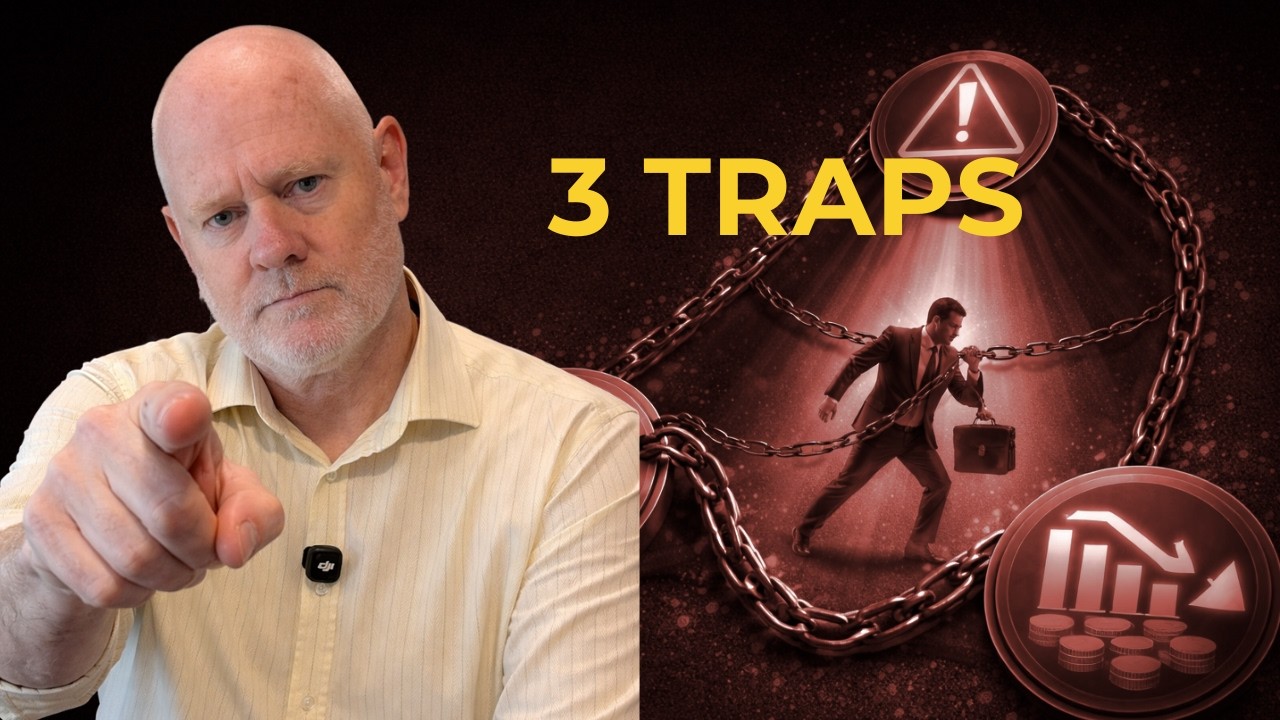
Greg Stevenson, an executive coach with three decades of leadership experience, identifies three patterns that trap senior leaders: solving the same problem repeatedly without fixing its root cause, mistaking busy work for real complexity, and continuously deferring uncomfortable conversations. Breaking free requires addressing the interior game, the mindset and habits that drive external outcomes.
Chapters
Most senior executives are not stuck because they lack capability. They're stuck because they keep solving the wrong problem. Not the problem in front of them, the pattern underneath it. In 30 years working at the managing director and CEO level, and now coaching senior executives preparing for that transition, I've seen 3 patterns come up again and again. Same patterns, Different industries, different people, same outcome. I want to name them today because once you see a pattern, you can do something about it. Pattern 1 is the symptom trap. You solve a problem, 3 months later, the same problem is back. Different person, different quarter, but same pattern. You solve it again. This is the symptom trap. If you're solving the same problem more than twice, You are treating a symptom. The root cause is still there. The symptom trap is not a failure of intelligence. It's a failure of depth. The pressure to fix things fast drives leaders to the surface solution every single time. The root cause question— why is this happening— gets skipped, and so the problem comes back. The shift is not more effort at the same level. The shift is going one level deeper, finding the structural or human cause beneath what is presenting on the surface. Pattern 2, the overwhelm illusion. You're running at a pace you cannot sustain. The volume is extreme. You're permanently reactive. You tell yourself, and it's true, that you're working on genuinely complex things. But here is what I find in most cases. Volume and complexity are not the same thing, and most leaders are treating volume as if it were complexity. Volume can be delegated. Complexity needs to be understood, then addressed at the source. The overwhelm illusion keeps leaders busy solving the wrong things at the wrong level. Their team steps back because the leader is always there first. The leader becomes the bottleneck and the volume keeps growing. The question to ask yourself is how much of what is on your plate right now is genuinely complex, and how much is just volume that should not be yours? Pattern 3: The Avoidance Loop. There is a conversation you have not had, a decision you have been circling, a relationship at work that is costing energy every single week. And it keeps getting deferred. The avoidance loop is not laziness. It is the interior game at work. The discomfort of the conversation feels larger than the cost of avoiding it, until the cost becomes impossible to ignore. I've seen this at every level. The board relationship that is not working. The direct report who is not performing and has not been told clearly. The peer conversation that has been building for months. Every week you avoid it, it gets heavier. Every week you avoid it, it costs you energy you cannot afford to spend. The avoidance loop is broken one way. You have the conversation. The close. 3 patterns. One underlying cause. All 3 are expressions of the same thing. The interior game driving the external result. You cannot solve them from the outside. The symptom trap, the overwhelm illusion, and the avoidance loop. If you recognize yourself in any of these, that recognition point, that recognition is the starting point. Subscribe for more on the interior game of executive leadership. And if you want to work on this directly, there's a link below will take you to a 30-minute conversation with me.