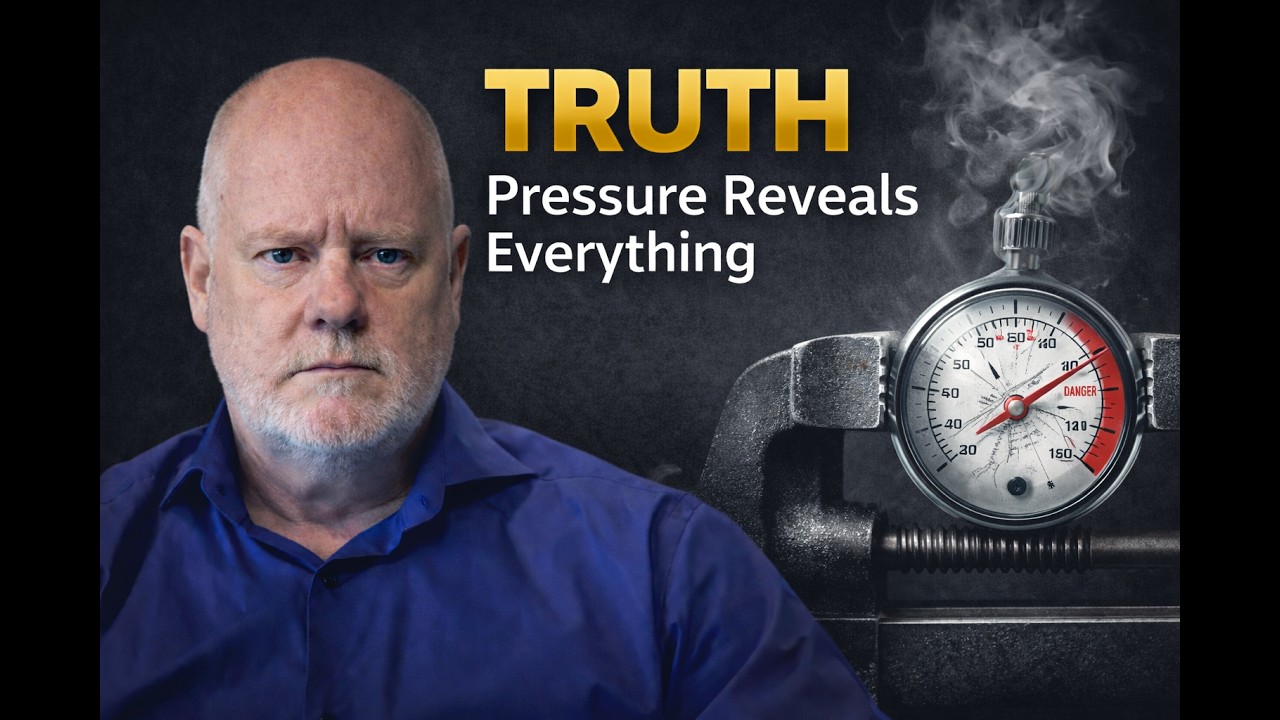
In this talk, Greg Stevenson recounts a pivotal army training exercise where soldiers endured four days of extreme physical and mental depletion, only to have their anticipated relief abruptly withdrawn. He describes how the directing staff used this moment to observe two distinct interior responses: some soldiers quietly accepted the renewed hardship and kept moving, while others vocalized frustration and threatened to quit. Stevenson interprets this as a test of the "interior game"—the inner capacity to endure unexpected, adverse conditions when external performance layers are stripped away. He draws a parallel between this military test and the evaluation of CEOs and senior executives, arguing that leadership effectiveness is revealed not by credentials or past achievements but by how one behaves when pressure intensifies and relief disappears. Stevenson critiques most leadership development programs for neglecting this interior work and explains that his Deep Leadership framework was created to fill that gap. He concludes with a call to executives to engage in interior development, offering a link for further conversation and encouraging viewers to subscribe for more content.
Chapters
I want to tell you about a moment from army training that I've never forgotten. We'd been out in the field for 4 days, no proper sleep, severely limited in food. The kind of sustained physical and mental depletion that strips away every layer you normally present to the world. And then it was over. Finished. The exercise finished. The trucks came. We handed in our equipment. The head directing staff called us all together and told us we had done well. He had 2 pieces of news for us. The first, it was going to be a bitterly cold and wet night that night, but that wouldn't affect us because we're going back to the barracks where the directing staff had a hot meal and a warm night prepared for us. You could feel the whole group exhale. And then he paused. A long pause. He looked at us. Let us settle into the relief. Let us feel the weight come off our shoulders. Then he said, The second piece of news is that you're going out, back out for another 24 hours. Get your gear off the back of the trucks and start moving. What happened in the next 60 seconds was one of the most revealing things I've ever witnessed in a leadership context. The directing staff didn't move. They just watched. That was the whole point. They'd engineered this moment deliberately. 4 days of depletion, the relief of being finished, the cruel withdrawal of that relief, specifically to see what each one of us was made of when the conditions stripped everything back. What they saw was exactly 2 types of people. Some of us, and I include myself in this, just went quiet, picked up our gear and started moving. Not happy about it, not pretending to be happy about it, but there was something underneath the exhaustion, the disappointment that held. Something that didn't collapse when the conditions became worse than expected. And some completely lost the plot. They were vocal about it. They said they weren't going back out. They said it was unfair. They said things that in a real operational environment would have ended their career and potentially cost lives. Same conditions, same 4 days, same depletion, same moment of relief withdrawn. Completely different interior responses. I've thought about that moment many times in 30 years since it happened, and what I understand now that I couldn't have articulated then is what the directing staff were actually testing. They were not testing physical fitness. They were not testing technical skill or tactical knowledge. We'd spent 4 days demonstrating all of that. They were testing the interior game. Specifically, who are you when the conditions are worse than you expected and you have no control over them? When the relief you were counting on is taken away and you have to find something inside yourself to keep moving? Because in a real operational environment, in war, in crisis, in the moments that actually determine outcomes, nobody cares how you perform when conditions are favourable. What matters is who you are when they're not. The people who kept their composure in that moment had something that the ones who didn't were missing. And it wasn't courage in the Hollywood sense. It wasn't toughness or aggression or bravado. It was something quieter than that, a kind of settled relationship with uncertainty, a capacity to absorb something unexpected and unwelcome and not let it take the wheel. I left the army and spent 30 years in business— CEO, managing director— running organisations through turnarounds, through growth, through genuine crisis. And I watched that same moment play out in boardrooms and executive teams more times than I can count. Different conditions, different stakes, but the same fundamental test. When the quarter is bad and the board is asking hard questions, who are you in that room? When the executive you trusted most performs an action that forces a conversation you have been dreading, who are you in that moment? When the strategy you staked your reputation on is clearly not working and everyone in the room is watching to see how you carry it, Who are you then? The directing staff watching us in that field at Wairarua were doing exactly what a board does when it evaluates a CEO candidate in the final room. They are not assessing your credentials. They already know your credentials. They are watching what happens underneath. How you carry pressure. Whether something inside you holds when the conditions strip away the performance. That is the question. And most leadership development never gets near it. Let me direct about why I'm telling you this. If you're a senior executive preparing for the CEO role, genuinely preparing, you're almost certainly focused on the external picture. The track record. The credentials. The strategy narrative. The relationships with the right people. And all of that matters, and I'm absolutely not dismissing it. But the CEO role will eventually put you in your own version of that field at Wairua. A moment where the conditions are worse than expected and the relief you were counting on has been taken away. And in that moment, nobody will care about your track record or your credentials. What will matter is what I watched play out in that field 30 years ago. Who are you when it gets hard in a way you didn't plan for? And here's the thing about that test at Wooroowa that makes it so useful as a lens. You cannot fake 4 days without sleep. You cannot perform your way through that level of depletion. Whatever was underneath the exhaustion, whatever each person actually had inside them, that is what came out when the relief was withdrawn. The CEO role is the same. Not in the physical sense, but in the sense that sustained pressure over time strips away the performance layer and reveals what is actually underneath. That is why the interior game is not a nice-to-have addition to the external preparation. It is the foundation and is the thing that almost no leadership development program in Australia directly addresses. That gap is exactly why I built Deep Leadership. The exercise at Wooroowoo eventually ended. We went back to the barracks. The directing staff had our hot meal waiting for us. But what stayed with me wasn't the relief of it being over. What stayed with me was the 60 seconds after the second piece of news was delivered, and what I saw in the people around me, and what I learned about myself. That 60 seconds told the directing staff everything they needed to know. And 30 years later, in a different context with different stakes, I'm still watching for the same thing, because it still tells you everything. If this has landed, if it's naming something you've been circling, Subscribe to this channel. There is more of this work here every week. And if you're ready to do the interior work because the CEO role requires it, there's a link below where you can get— where you can begin a conversation. So I'm Greg Stevenson. This is Deep Leadership, and let's get to work.