Why Most Executives Never Become CEOs (The Leadership Gap)
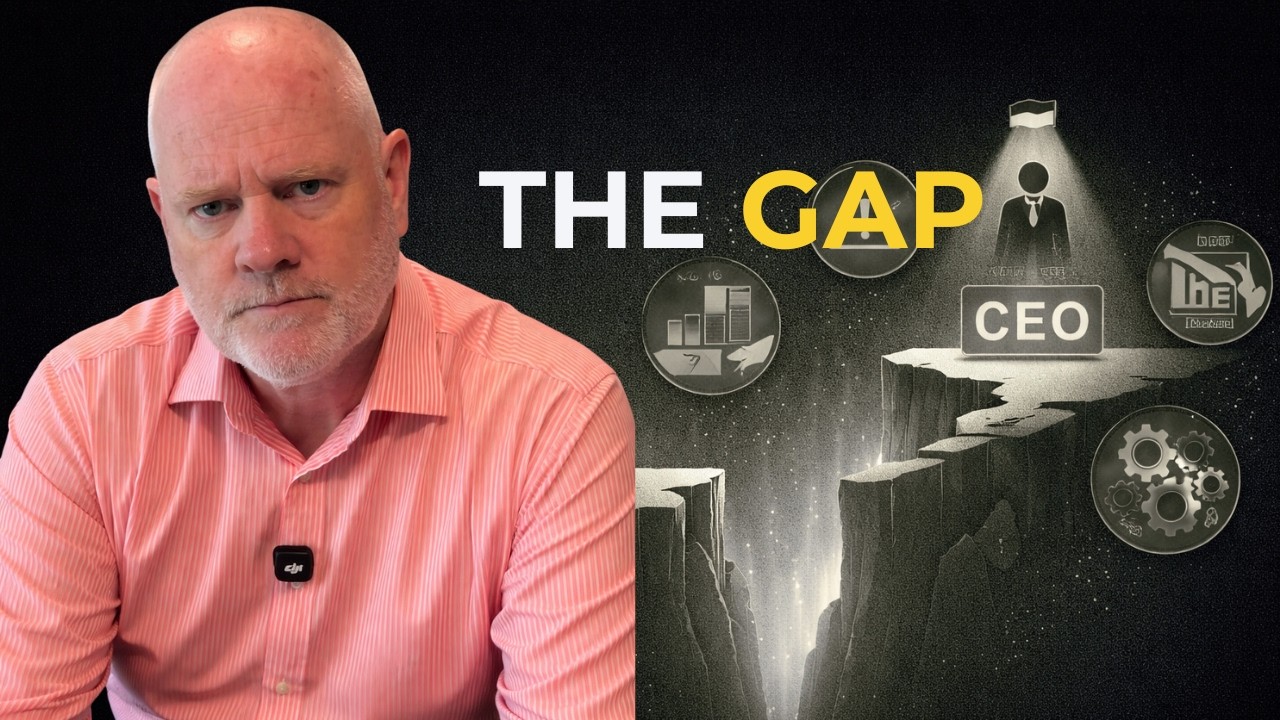
Greg Stevenson, a former Army officer and 20-year CEO across multiple industries, argues that most executives fail to reach the top because they neglect the interior game of self-knowledge and leadership psychology. He describes the achievement trap, the symptom trap, and the overwhelm illusion as barriers to CEO readiness, drawing on military and corporate turnarounds to show why pace and self-awareness matter more than credentials.
Chapters
It was 2 or 3 days into an exercise designed to break us. No sleep, no proper food for days, carrying a 30-kilogram ammunition box across terrain with a timeline that was set to be impossible. There were 6 of us. Morale was collapsing and I was put in charge. I tried the obvious move— rotate the carry, put fresher legs on the heaviest load. But it made things worse. So I walked over to the ammunition box, picked it up myself, and set off at a pace that forced everyone else to keep up. I lasted a few kilometres before I had to hand it back, but something had shifted. The patrol that was complaining and losing ground was moving again, not because I told them to, but because they watched me carry what they couldn't. What nobody saw, what I didn't show, was what was happening inside me during those kilometres. I was exhausted. I wanted to stop. But I understood in that moment that leadership lives in the gap between what you feel and what you show. That lesson, learned in the mountains of New Zealand, carrying a box of rocks in the dark, is the foundation of everything I do today. My name is Greg Stevenson. I spent 10 years as an Army officer, including time with elite Special Forces units of the Australian Army. I spent— then spent the next 20 years in the corporate leadership realm as Managing Director and CEO of businesses ranging from $50 million to $750 million— transport, aviation, logistics, fashion, food services, publicly listed company, private equity turnarounds, and businesses of up to 1,800 people. Today I run a private coaching practice working on one-to-one with senior executives who are preparing for the most important leadership transition of their career. The move into the CEO role. This video is my story, why I do this work, what I've learned in 30 years in the arena, and why I believe the gap between where most senior executives are and where the CEO role needs them to be is not the gap they think it is. I grew up wanting to serve. The Army was the right place for me, and my time with the elite special forces units of the Australian Army taught me something about leadership under pressure that I've never forgotten. The best operators under real pressure are not the ones who react fastest. They are the ones who stay clearest. They slow down when everything is telling them to speed up. They stay in the question longer than is comfortable, and they resist the first solution because they know the first solution is almost never the right one. I brought that discipline into the corporate world. My first significant test was a turnaround. Australian Helicopters, private equity acquisition, low morale, contracts that were quietly becoming unprofitable, a chief pilot who had lost the confidence of his pilots. I was not a pilot. I've never run an aviation company before. But I'd learned that you don't need to know every role to lead the people doing it. You need to know the people. I went and spoke to every manager, every line staff member, every customer before I formed a single view. I applied what I now call the 10-question test, a set of questions every leader should be able to answer about their own domain without hesitation. The chief pilot couldn't answer his. He had lost touch with the ground truth of his own role. I made the change. The business turned— returned to profitability. Then a transport business serving mining companies My first MD role. First week, I had a national operations manager spending 250 days a year on the road. Not because the business needed it, because he didn't want to go home. And then, 3 or 4 months into the role, a senior manager came to my office. She'd been inappropriately verbally abused by that same national operations manager, sitting at her desk and doing her job. I was 3 months into my first MD role. Picked up the phone and rang the chairman, and I said, I'm going to sack him. The chairman backed me. I removed him from the business that day. That moment, more than any result I ever delivered, told every person in that business what kind of leader had arrived. Then there was the investor moment. I delivered 10% growth in 6 months for an ASX-listed business. The immediate response from a large investor: great, But what about 12% next half? I drove home that night and sat with something I hadn't been able to name before. The bar never stops moving. Not because you haven't delivered, but because performance is never the same thing as enough. I call it the achievement trap, and I've seen it in almost every high-performing executive I've worked with since. But I want to tell you one more story from that journey. Because it connects to something your ideal client needs to hear about right now. Early in my corporate career, I met a man named James. He was a senior partner at one of the Big 4 global executive recruitment firms. We built a relationship. I made a decision. I would meet James every 6 months or so. Not when I needed a job. Not when I was unhappy. Every 6 months on a cadence regardless. And every time we met, I did something almost nobody does. I told him exactly what I was going to achieve in the next 6 months. Not aspirations, not a wish list. Specific commitments about what I was going to deliver in the role I was in. 6 months later, I came back. I told him I'd done what I said I was going to do. Here's the evidence. And then I told him what I was going to achieve in the next 6 months. Conservative commitment. Specific plan, deliver, report back, and repeat. It's the same system I used with every board and investor I ever reported to. I just didn't know that yet. James placed me in one of the most significant roles in my career 15 years later, not because I called him when I needed something, because for 15 years I had shown him every 6 months without exception That I was someone who did exactly what they said they were going to do. When that role crossed his desk, he already knew the answer. For all of that, the results, the turnarounds, the growth, there was a cost I wasn't measuring. For a period of my career, I was never home for the family dinner. I would arrive after everyone had eaten, repeat whatever, reheat whatever was left, and sit at the table alone. Weekends disappeared. Friends stopped inviting me because the answer was always the same. I remember driving home from work one night and driving and arriving with no memory of the journey. I'd been on the phone the entire way, and then realising it had been weeks, possibly months, since I'd seen my home in daylight during the week. And one weekend, working through emails, clearing the backlog I hadn't had time for during the week, I watched the responses come back in real time. My entire team on their weekend responding because the boss was in their inbox. I wasn't just losing my own weekend, I was taking theirs as well. My family never complained. They knew I was doing it for them, and their silence made it easier to keep going. That normalisation, the quiet accommodation of the people who love you, is the most expensive thing about the pace that senior leaders carry, and is a thing most of us never stop to measure. I had a mentor who told me I needed a great executive assistant. I spotted a sharp, inquisitive woman working at our reception desk and asked about her background. I recruited her. She could do things better than I could. The team ran more smoothly. The diary was managed. The bottleneck, which I believed was workload, was actually a belief system. I believed I could do everything myself faster and better than anyone else. I was wrong. I was the problem, and I couldn't see it until someone helped me look. Across 30 years of leading businesses, and in the last several years of chairing a group of 14 CEOs through Vistage, I've seen the same patterns appear over and over. The leader who keeps fixing the same problem— different circumstances, different people, different month, same root cause underneath. The leader who knows exactly what conversation needs to happen and keeps finding reasons the timing isn't right. Months pass, the cost compounds. The conversation keeps not happening. The leader who is performing brilliantly on the outside and running on empty on the inside. Doing it for everyone else. Sustained by a pace that is quietly breaking something. I call these patterns the symptom trap. The avoidance loop and the overwhelm illusion. And here is what I've come to understand about all 3 of them. They are not tactical problems. They are interior problems. The gap between most— where most senior executives are and where the CEO role needs to be is not in their technical capability. It is not in their qualifications or their track record or their visibility. It is in the depths of their self-knowledge. their leadership psychology, their ability to look beneath the presenting problem and find what is actually driving their results. I call this the interior game, and most leadership development— the programs, the governance courses, the MBAs— never touch it. Deep leadership is the work of going beneath the surface, not of your problems, though that matters, not of your people or customers, though though those matters too, but beneath the surface of yourself. Because a leader who knows themselves deeply, who understands their own patterns, their own blind spots, their own relationship with pressure and uncertainty and success, is a leader who arrives at the CEO role genuinely prepared. Not hoping they are ready, but knowing it. I work privately with a number of senior executives, No more than 8 at any time. The people I work with are already performing, already capable, already on the shortlist for the roles they want. They come to me because they are carrying something they cannot carry inside their organisation. A private question they haven't been able to ask out loud. A pattern they have recognised in themselves but don't know how to address. A pace that is working professionally and costing them personally. I bring 30 years of lived experience at exactly the level they are operating at. I'm not a theorist. I've been the MD who walked into the turnaround. I've sat in front of the board defending a strategy I believed in against investor pressure to change it. I've made the call that nobody else in the building wanted to make. And I've paid the personal cost that comes with carrying that level of responsibility without the right support. The work I do now is the work I wish I'd been able to do then. I call it the Deep Leadership Private Coaching Engagement. It runs for 6 months. We meet twice a month for 75 minutes. You have access to me between sessions for the moments that can't wait. And from the first conversation to the last, the work goes beneath the surface, to the root causes, to the patterns, to the interior game that determines whether you thrive or struggle when you get the role you're working toward. If any of what I have said today resonates, if you recognize yourself in any of these stories, I would like to have a conversation with you. Not a sales call, a genuine conversation about where you are, where you want to be, and whether the work I do is the right fit for what you need. There's a link below to start that conversation. I look forward to speaking to you.









