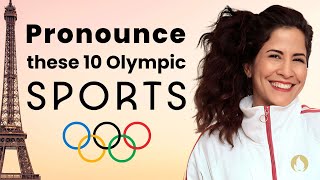
A short YouTube pronunciation tutorial (hosted by Hadar Shemesh) presenting 10 Olympic sports that the speaker considers commonly mispronounced. For each sport the host gives step-by-step articulatory cues (sounds, stress, common errors), models the word several times, and offers tips (e.g., inserting a schwa if a cluster is difficult). The 10 sports covered are: gymnastics; athletics; cycling; surfing; trampoline; volleyball; water polo; weightlifting; wrestling; triathlon. The video closes with a viewer prompt to name their favorite Olympic sport.
Questions this video answers
Hadar Shemesh
August 6, 2024
Chapters
The Olympiad is here. And as a tribute, I wanted to share some of my Olympic sports that I do daily. I'm sorry, I'm gonna be. I'm gonna be late. All right, all right. But kidding aside, the Olympiad is here, the Olympic Games. And today we're going to learn how to pronounce 10 of the most popular yet challenging to pronounce Olympic sports. So when you have small talk with friends, you can pull out that polished pronunciation of all of those ports. And it's a good opportunity to practice sounds, even if you don't want to talk about Olympic Games. Are you ready? Let's get started. The first is gymnastics. One of the more mesmerizing sports out there. And here's how you pronounce it. Gymnastics. You start with a J sound, then it's the I as in sit. Gym. Gym. Close your lips for the M. Then we have na. That's the primary stress. That's the A as in cat. Not gymnastics, but gymnasts. And then tics. If you struggle with pronouncing a lot of consonants together, practice it slowly. Gymnastics. I love gymnastics. Gymnastics. The next one is athletics. In athletics, we have a th sound, so let's practice it. We start with a sound ah. Ah, and then it's a th sound. Ath. Keep the tongue out and then pull it in for the l. And then athletics. Notice the T is pronounced as a soft D. It's called a flat T. Athletics. Athletics. The primary stress is the E sound, and there are a lot of challenging consonants in this word. So I recommend to stretch it out a little bit. First, because it's the primary stress, and that's what you're supposed to do. But second, it's going to give you a quick break before flipping the tongue again for the flap T. Athletics. Athletics. Athletics. The next one is cycling. In the word cycling, you start with an S sound, then it's the I as in my. Sigh. Sigh. Then you have two consonants together. Sight in the back. Psych. And then you bring the tongue up for the L, so you want to transition directly without adding a vowel in between. So it's not cycling, but cycling. It's not a big deal if you put a schwa there, but try to connect the two sounds together. Cycling. Like the word cling to cling on something. The end has an ng. Cycling. So you don't have to pop the G at the end. It's just ing. Ing. Cycling. Cycling. The next is surfing. I don't know how to surf, but I know how to pronounce. The word surfing. You start with an S sound, then it's the R, as in stir. So you transition directly from the S to the sir. Sir. Sir. Like. Yes. There isn't an oo sound there. It's not surfing or surfing. Sur. Sur, Sur. Sur. Fing. Sur. Fing. Surfing. The next one is trampoline. You start with a tr and when the t appears before an R, it actually sounds like a ch sound, as in chicken. Tra tra. Tram. Tram. Then we have the p sound and a schwa. Tramp. And then the end is an l sound. A high e and an n. Lean. Lean. The primary stress is on the first syllable, trampoline. Trampoline. That's how I say it. You can also put the stress on the last syllable, trampoline. Trampoline can even hop a little bit when you put the stress on the last syllable. Trampoline. However, I prefer to say it with a stress on the first syllable, trampoline. The next one is volleyball. Volleyball. You start with a V sound, then the ah, as in father, vah, then lee, an l sound and a high E. This is a light L. It's still a little heavy, especially for some speakers. Volley. But it's not a dark l as it is in the word ball. Listen to the difference between those two L's. Volley. Ball. The dark L is somewhere between an L, an r and a W. O. It's pronounced here and not here. Volleyball. Practice it. Volleyball. Let's play volleyball. The next sport is water polo. Now, the word water is a good word to know how to pronounce regardless of the Olympiad, right? Water. Water. A w sound, then the ah, as in father. Wa. Wa. Then a flat t and an R. Water. Water. In American English, water. And then we have the word po, low 2o as in go. Polo. The stress is on the first syllable. Polo. Water polo. Water polo. Are you coming to play water polo? No, I don't want to play water polo. Why don't you want to play water polo? Because I don't play water polo. Okay. I'm going to go play water polo. Enjoy your water polo. Water polo. That's a mouthful. The next word is weightlifting and an excellent opportunity to practice your held t. You start with wait. Just like. Wait a minute. Wait. A w, A as in day and a t. But when the t appears at the end of a word or before another consonant, it's a held t. That means you bring the tongue up and you wait and then you release it to the next sound. And in this case, the l Weight lifting. So transition from the T to the l directly. Weightlifting. Weight lifting. Weightlifting. I'm going to go do some weightlifting because I'm a weightlifter and I love lifting weights. Weightlifting. The next word is wrestling. I'm not a fan of wrestling. You're. You start with an R sound. There is no w here. Okay? Just an r and then an E sound. You also don't hear the T, so it's just wrestling. Wrestling, wrestling, wrestling. And lastly, we have the word triathlon. Triathlon. We saved the best for last. You start with a T and then an R. Try. Try again. The T sounds a little bit like a ch sound or a lot like a ch sound. Try then ATH as in cat and a voiceless th. Triath. And from the th, you transition to the l sound. Triathlon. With the oz and father. And then an N. Lawn. Triathlon. Remember the transition we had in athletics? Athletics. Triathlon. Same transition. Triathlon. Triathlon. Try saying triathlon. Now listen, if the transition between the th and the l is really difficult, there is another, less common but possible pronunciation where you add a schwa between a small sound between the th and the l. Triathlon. Triathlon. So if that's easier for you to pronounce, put the schwa in. Take the schwa. I'm giving you the schwa. Put a schwa between the th and the l and say the word with confidence. Triathlon or triathlon. Either way, the sport is a little more challenging than the pronunciation. So you're good. All right, now I want to hear from you. What is your favorite Olympic sport? Let me know in the comments. I'm doing a little survey among my subscribers to understand what is their favorite Olympic sports. Okay, so let me know and tell me if you're watching the Olympiad. I love it, but I usually love the ending, like the finals when it gets more. More exciting. All right, either way, thank you so much for watching this and enjoy the Games. Enjoy life, enjoy your day, and I'll see you next week in the next video. Bye.