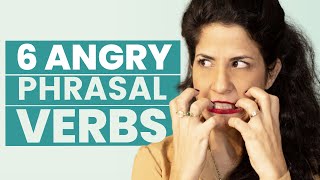
Hadar Shemesh (YouTube) explains six common phrasal verbs used to express anger. The video demonstrates pronunciation, stress, connected speech, and usage examples for: come on; pissed off; cut it out; freak out; blow up; get over. The presenter discusses when each phrase is appropriate and models angry-tone delivery. The video is informal and conversational.
Chapters
Oh, come on. Now I'm pissed off. You gotta cut it out. I'm. I'm. I'm gonna freak out. And if I freak out, you know me, I might blow up. Don't tell me to get over it. Hey, everyone, it's Hadar. Thank you so much for joining me. And if you did not get it just yet, today we're gonna talk about phrasal verbs to use when you are angry. So I don't know about you, but I get very expressive when. When I'm angry, I use some words. I express my anger. I sometimes raise my voice. And when I do that in English, I love using phrasal verbs. So today we're going to talk about six of my favorite phrasal verbs to use when I'm angry. We're going to talk about the pronunciation of the phrasal verbs, the stress and what they mean, and how you can use them in context. So let's begin with the first one. The first one is. Come on. It's like saying to someone, oh, please, come on. It's just like you're calling it out. Come on. When you're. You can also say that when you're trying to encourage someone. It all depends on the tone of voice and intonation. Come on, join me. But you can also say that when you're frustrated with someone or upset or you just cannot believe that they just said something. Come on. Now, when you say that, the word come has the cup sound and on has the ah, as in father. It's not the same sound. K Mon. The m of come becomes the beginning of the word on. So this is how it sounds actually. K Mon. Come on. And the stress is on the second part of the phrasal verb. Come on. Come on, my friend. Come on. The second phrasal verb is pissed off, which is basically really, really angry. Now, when you say words when you're angry, you can use the consonants to express your anger even more. So in the word pissed off, there is a p sound and then the. As in sit, the p is aspirated. So like I said, you can add a lot of air into it because p and then we have an s sound and a t. The ed is actually pronounced as a t pissed. And then the next part is off, an ah sound and an f here as well. The t becomes the beginning of the next word, so it's connected. Speech. Pissed off. Pissed off. Now I'm pissed off. Now I'm really, really angry. Oh, I'm so pissed off. She just didn't Tell me what she was supposed to tell me. And now I'm late. I'm pissed off. I'm so angry, I'm aggravated. It's not the same as pissed off, right? Pissed off. Say it. It's fun to say it. Pissed off. Next time you're angry, I want you to use the phrasal verb pissed off. The next one is cut it out, which is basically stop it. But I love saying cut it out. And here, what I love mostly about this pronunciation is that you have two flap T's. Look, the first word is cut, but then you connect it to it. The T of the cut becomes the beginning of the next word, but it's also between two vowels. So it becomes a flap T, as in the word betty or water. Cut it. But then you have another T and. And the next T. Because you connect it to the next word, which is out, it becomes a flap T as well. Cut it out. So basically what you're saying is cut it out. Cut it out. Cut it out. Cut it out. Now say it with an angry tone. Cut it out. The stress is on out. The last part of the phrasal verb, cut it out. Cut it out. Then we have the phrasal verb freak out or freaking out, which is getting really angry or going crazy or being really, really aggravated. I'm freaking out. I don't know what to do. You know, I haven't been able to get a hold of him, and I don't know why he's not calling me back. True story. My husband, after he. He has taken my daughter to drive around the city, and he hasn't been answering me for a few hours. So I'm freaking out. Not really. But that was just an example. Freak out. Here the sound of the word freak becomes the beginning of the next word, which is out, Free, like it's a free country. And count, Free. Count. Don't freak out. Why are you so angry? Stop freaking out. I'm freaking out. Ah, freak out. The next one is blow up. Blow up basically is explode. So you can use it in the context of, oh, my God, there was an accident and the car blew up right after. But you can also talk about someone's emotions or temper when you blow up, when you just cannot control yourself anymore. Right? I'm going to blow up if you don't stop this. Blow up. Blow. Here we have a B and an L. Then the O is in go. And then you connect it to the word up. Blow up. Notice that the stress in phrasal verbs is always on the particle blow up. The second part, the second word, blow up. Don't blow up. Nothing happened. Not going to blow up. I promise I'm going to blow up in just five seconds. 5, 5, 4, 3, 2. And then we have the phrasal verb get over, which is get past it or overcome something. Get over it. I do not like it when someone tells me to get over something, because if I'm feeling the feelings, I want to feel the feelings. I don't want anyone telling me to get over something. However, I can say that about myself. I need to get over it. I need to get past it. I need to overcome it. I need to come to reconcile with it to get over it. Get over. Can you see the pattern? The T of get becomes a flap T and we connect it to the particle get over. Get over it. So these were the six phrasal verbs that I love to use when I get angry in English. Sometimes I get angry in Hebrew, and then I do not use phrasal verbs because we don't have phrasal verbs in Hebrew. Okay, so what is your favorite phrasal verb out of the six? Let me know in the comments below. And that's it. Thank you so much for bearing with me, for holding the space for me, and for allowing me to get pissed off on camera. All right, have a great, great day. Thank you so much for being here, and I'll see you next week in the next video. Bye.