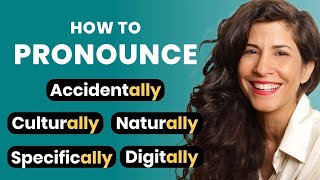
Hadar Shemesh teaches how to pronounce the -ally suffix in English adverbs. Most of the time it reduces to a schwa plus l plus y, not the full four syllables. Examples: accidentally, culturally, practically, politically.
Chapters
Hey everyone, it's Hadar. Thank you so much for joining me. Today we have a practice pronunciation with me video where I'm going to introduce to you a challenge that my students usually face. We're going to explain it and practice it together. Okay? And today we are going to talk about the suffix ali. A, L, L, Y, ali. Usually pronounced as ali. For some reason, this suffix poses a lot of challenges for my students. So let's understand how, how to pronounce it and how to use it in words. By the way, if you're new to my channel and you happen to stumble upon my video, then let me introduce myself. My name is Hadar. I'm a non native speaker of English and my job in this world is to help you speak English with clarity, confidence and freedom. You can check out my website@hadar shamish.com for a ton of free resources so you can practice along and learn from. And you can also come follow me on social media where I share daily content that can help you. All right, good. So let's talk about the suffix ali. We use the suffix to form an adverb from another word. For example, specific. Specifically, accident. Accidentally. Now, to pronounce this suffix, we pronounce it with a schwa sound that is represented by the a, an l and a high e. A l. Let's look at a few examples. Accident. Accidentally. Accidentally. Now, when the t appears after an N in unstressed positions, you can often drop it like in the word Internet or wanted. So here as well, some people might say accidentally and not accidentally. You can do both, whatever is easier for you. Let's practice a few more words culturally. Culturally. Stress is on the first syllable. Culturally. Naturally. Naturally. You can also say naturally. Naturally. Now, sometimes when you add the suffix after a certain word, you may not even pronounce the schwa at the beginning. It's like the a is eliminated. For example, practicing it ends with a k sound and then li. Practically. Practically. Even though you still write the a. But it's not practically. Politically. Not politically. It's probably not a mistake to pronounce the schwa, but usually people don't pronounce it. They just connect the k and the l. Politically. Graphically. Graphically. Specifically. Not specifically. Okay, so when you practice words with the ali suffix, remember that it's not pronounced as an ah, not specifically or accidentally, but it's reduced to a schwa. And also focus on where the primary stress is. Usually it's at the beginning of the word, so pay attention. The primary stress is always longer than louder and higher in pitch. And notice that sometimes you would pronounce the schwa like in the word so sh. Ly. And sometimes you won't practic Ly. Okay? But either way, this is just for you to practice. Say it again. And again and again. So you make it a habit. And even if you make a mistake, it's not a big deal. This video is designed to bring some more clarity, to let go of that fog that you might have when it comes to English pronunciation and to help you practice consistently. So you make it a new habit, and even if you still make mistakes, it's not a problem. It's not about not making mistakes. It's about building confidence, sounding clear, and communicating your message in a way that helps you say what you want to say and get what you want. All right, if you enjoy this video, consider subscribing to my channel. You can also follow me on my social media accounts and share it with other people that you think might enjoy it as well. Have a beautiful, beautiful, beautiful rest of the day, and I will see you next week in the next video. Bye, everyone.