Are you pronouncing the 5 most common words in English correctly?!
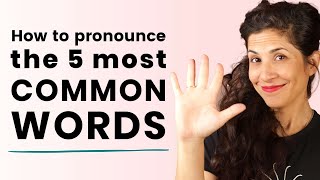
Hadar Shemesh, a pronunciation coach, breaks down how to say five everyday English words: the, a/an, to, and, of. She shows how they sound different when stressed versus unstressed, and how the next sound changes everything. Most people get these wrong because they reduce in connected speech.
Chapters
Hey, do you know how to pronounce the five most common words in English? If not, this video is for you. Today we're going to talk about a few function words, five to be exact, that we use in almost every sentence. And we're going to talk about how to pronounce them because I think not everyone knows exactly how to pronounce those words or to be more exact, the different pronunciations of those words. If you're new to my channel, then my name is Hadar. I'm a non native speaker of English. I'm a fluency and pronunciation coach. And I'm here to help you speak English with clarity, confidence, and freedom. You can check out my website@hadarchemish.com for a ton of free resources for you to reach limitless fluency. All right, so let's talk about the pronunciation of the five most common words in English. And the first one is the. The word. The. The word the is a definite article and it. The pronunciation of this word really depends on what comes after. So the first thing that we need to remember is that we stick the tongue out for the th. And it's a voiced th. Now, because it's a word that is usually pronounced really quickly, sometimes you don't fully stick the tongue out. Some people might even put the tongue on the back of the teeth. The. The. The. And that is perfectly fine. For the sake of practice, right now, we're going to practice by sticking the tongue out. When the following word starts with a consonant, then the pronunciation of the word the is going to be with a schwa. Schwa is a reduced vowel. The. The. And we want to pronounce it really quickly and connect it to the next word. The car. The house. The plan. The teacher. The child. The. The. The. Practice with me again. The car. The chair. The teacher. Good. When the following word starts with a vowel, we pronounce it with an E sound. The. The. The apple. The elephant. The animal. The egg. The. The. The. Now let's test it. If you have the word couch, would you say the or the. The. The couch. If you have the word our, would you use the or the. The. The hour? Why? Because the H is not pronounced and we're actually starting with a vowel. The hour. Hour. The hour. If you have the word university, would you pronounce it with the or the. The. The university. Even though it starts with a vowel letter, it actually starts with a consonant sound. J. J is a consonant. The university. Okay, good. Now, sometimes when people want to emphasize something, whether or not the Next word starts with a consonant or with a vowel, they would use the word the. It's the best thing you've ever tasted in your life. The best thing. If I were to not stress it, I would say it's the best thing I've ever heard. The best. But when I emphasize it, it turns into the the best thing. Alright, good. The next word we're going to practice is the indefinite article. Or the difference between the two is that one appears before consonants and the other one appears before vowels. A car, an apple. Both of them are pronounced with a schwa when unstressed. A car, an apple, a house, an ant, a person, an animal. Okay, so both of them are reduced to a schwa. However, when you want to emphasize it, or when you want to emphasize the fact that it's one thing, a car, not cars. Right? You would emphasize the word a to show that it's not many cars, but only one car. It's a car. Then you're not going to use the schwa. You're going to use the a diphthong. A car or it's an animal, not animals. And here we have either the A as in day or the a as in cat, when it's before and becomes more like an. An. An animal, not animals or an operation, not operations. So a, A an an. The next word is to. If the following word starts with a consonant, just like the example with the word the, then the to is going to be pronounced as to. To go, to think, to like, to love, to listen. T, T, T, short and sweet. And you want to connect it and you want to make it sound as if it's a part of the next word. If the next word starts with a vowel, it's going to be to. And then you want to keep your voice going until the next word to understand, to appreciate, to operate, to accept, to. So you connect it, okay, T or to. Again, when you want to emphasize something, I need to go. I'm telling you, get off your seat. Then I would probably use the to I need to go. Right? When you slow down and when you say it slowly, then you would use the long oo sound. But when you say it quickly and it's unstressed, you're going to say T to go, to think, to like the next word is and I love this word, or at least the pronunciation of this word when this word is unstressed, which is in most cases because this word connects content words, right? Words with meaning. So usually we stress the content words, the nouns, the verbs, the adjectives, the adverbs, the function words reduce. And is a function word that usually reduces. So we generally don't say and we just say. So we turn the a into a schwa and the D just eliminate. We don't really need it. Boys and girls, bread and butter. And even you can reduce it even more. Bread and bread and bread and butter. Rock n roll, rock n roll. Also notice the rhythm. Ta da da. Fish and chips, black and white, this and that. Okay, so that is how you usually pronounce this word. I need to go pick up my girls and then buy some groceries. And then, and then, and then when this word is emphasized, then the D comes back with all its presence and the schwa goes back to the pure vowel, which is the sound. And. And. Okay, boys and girls, not boys or girls. This and that, not this or that. So we would usually emphasize it when we want to show that it's something and something and not something else, not something or something. So we don't usually stress the word. And. But sometimes we do. And. And. And sometimes we might use the word and as a way to connect one sentence to another. And we want to emphasize that whatever comes next is important. We might emphasize the word. And just like I did, the next word is this. How do you pronounce it? Okay, it's pronounced when emphasized. Of. Of. Of. With a cup sound and a V sound. Even though it's spelled with an F, it's a V. Of. Of. Usually this word is completely reduced to a schwa when in a sentence, a cup of coffee, glass of wine, bottle of water. Out of the office. Okay, now something that is really interesting is that sometimes it is so reduced that even the V, not the F, the V sound, is reduced as well. Bottle of water. Bottle of water. Bottle of water. So if the next word is a word that starts with a consonant, you can also drop the V like we would do with piece of cake. That's a piece of cake. Bread and butter. Bread and butter. Piece of butter. Piece of butter. Piece of butter. Give me a piece of butter. Bread and butter. Right. So we reduce that last consonant. So let's practice a few more phrases. Couple of weeks. Couple of weeks. Couple of weeks. Couple of weeks. Couple of weeks. Out of the office. The office. Notice the pronunciation of the the office because there is a vowel there. Out of the office. Out of the office. Out of the office. Out of the office. I'm out of the office today. Okay, I think that's it. The five most common words in English and how to pronounce them because most of them have more than one pronunciation. The pronunciation of them when they're stressed and when they're unstressed, which is usually the case. All right, that's it. Have a beautiful, beautiful day and I will see you. You know, it's next week in the next video. Bye.
More from Hadar











Read Out Loud with me! Dare to Lead by Brené Brown | Pronunciation & Vocabulary practice