BoyS or BoyZ? S or Z? | How to pronounce the S in plurals, possessions and verbs
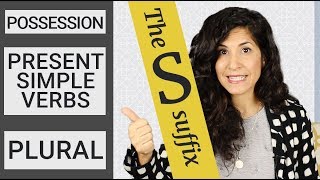
Hadar Shemesh breaks down when to pronounce the S suffix as /z/ or /s/ in plurals, possessives, and verbs. The rule: use /z/ after voiced consonants or vowels, /s/ after voiceless ones. A practical shortcut is to try /z/ first, and if it sounds wrong, switch to /s/.
Chapters
Hey, guys, it's Hadar. And this is the accents way. Today I'm going to answer a question that I get asked a lot. How to pronounce the S suffix, the S that we add to words. Okay? Is it an S? Is it a Z? Is it something completely different that we don't know about? So let's clarify this whole thing. Now, we use the S suffix in three different cases. One, when we use the plural form, A boy. Boys. A car. Cars. A cat. Cats. Okay? The second option is when we want to indicate possession. All right? So when you add the apostrophe S, right? And then you say the boy's shirt, the girl's house, the cat's tail. And then we also add the S soul suffix to verbs when we use the present simple tense. So, for example, walks, hears, plays. And we do this when the subject is either he, she, or it. Third person singular. You want to think about it as if it's a singular person. That is not you or me, okay? It's not someone in this room. So he, she, or it. When we talk about he, she, or it, we usually add an S to the verb when we use the present simple tense. So now let's understand how to pronounce those S's, because listen to how I say it. When I say cat, Cats. That's an S. Sleep. She sleeps in late on the weekends. Sleeps. That's an S. Things. Things. That's a Z. And then when we want to add the plural form to the word bus, buses. We add is. Is. So we added a vowel. Now, so, yes, there are three options to pronounce this S. S, Z is. First of all, let's talk about what's the difference between an S and a Z. So to create the S and Z sounds, the tongue goes up and almost touches the upper palate. And the air passes between the tongue and the upper palate, creating this really tense friction sound. Now, if you place your hands here and then you try Z. So you want to feel vibrations here because the vocal cords are vibrating for the Z sound. If you don't feel vibrations, then, then you're probably still pronouncing an S sound. So let's practice it together. S, Z. You want to feel a difference here and to hear the sound changes. S, Z. Now, here's the thing. First, I'm going to give you the official rule. But if you stick with me, I'll give you Hadar's rule, which will make everything a lot easier and much more intuitive. So the official rule says that when the S suffix appears after a voiced consonant or after a vowel, it's pronounced as a Z. A voiced consonant is a consonant that is produced when the vocal cords are vibrating. So some consonants are voiceless. For example, S, P, ch, F. Right. But it's just air coming out. And other consonants are voiced. V, G, M. All right. These are all voiced consonants. The vocal cords are vibrating just as the S is voiceless and the Z is voiced. So when a word ends with a voiced consonant, for example, bag. And then we add the S suffix. It's bags. Thing. Ends with an ng. That's a voiced consonant. Things play. Ends with a vowel. Plays. See? Seize. Bag. Bags. Right. It ends with a Z. When the word ends with a voiceless consonant. Then we add an S. Sleep. Sleeps. Walk. Walks. Back. Backs. Bet. Bets. S. Right. It's an S sound. Now, look, I am not expecting you to start analyzing your consonants, whether they're voiced or voiceless in the middle of a conversation. Hey, did you bring the hat? Sweet. A T is a voiceless consonant. Hat. So this is why I came up with this really cool and simple rule. So here it goes. Always try to make a Z sound. Okay? Always go for a Z. If we have words with consonants at the end, and then we need to add an S or a Z, and you're not sure which is which, just add a Z sound. If it's not supposed to be a Z, it's going to come out as an S anyway. So here's the thing. English doesn't like it when there are two consonants one after the other, when one is voiceless and the other one is voiced. So to say something like sleep is almost impossible, especially when it's at the end of the word. So in this case, when I try to add a Z, it changes the root. So all of a sudden it's going to sound like sleep. The P is going to sound like a B because one sound affects the other. So English wants it to be two consonant with the same voicing quality, either two voiceless consonants or two voiced consonants. So if I add a Z sound, it'll turn the previous consonant to. To a voiced consonant. Sleep. Sleep. Bz. Walk. Walk. Z. Right. If I add a Z sound, if I insist on the Z sound, it will change the root of the word, and that's not good. We don't want to change the root. The suffix is less important. So what the mouth does and the brain does is just change the voicing quality of the S suffix. So instead of making it a Z, sound. It's going to sound like an S. Sleep, sleeps. And then it's very simple to pronounce. Walk, walks, hate, hates, lack, lax. Now, sometimes it's impossible to pronounce an S or a Z. And that happens when the word ends with either a S sound, Z sound, sh or so when the S suffix is pronounced right after a consonant that is very close to to where the S or the Z is located. For example, let's take the word couch. And if I try to add a Z to it, Couch, Z. It's impossible. I need to indicate that there is another suffix there, another sound there. And to do that, I should add a vowel. Couch, Couches. Bus, Buses. Boss. Bosses. So we actually add an sound and a Z. Okay, so when the S appears right after a sh, Z, these very similar consonants, then we add a vowel in between. Now again, you don't need to memorize it. You'll see that it's impossible for you to add this S or Z suffix after these consonant, right? Pass. Pass. Z. Impossible. It doesn't sound like I added anything, Right? And this is why we need to add the vowel passes, couches, garages, and bosses. So let's turn all this nice knowledge into action and write in the comments below three words. One, when the S suffix is pronounced as an S, two, when it's pronounced as a Z, and three, when it's pronounced as is, as in buses. Okay? And if you're feeling really creative, then actually create a sentence for each of these words. What do you think? Let's see what you got. Thank you so much for watching. Please share this video with your friends if you liked it. I feel like I was just spitting all over the space here. Thank God no one's here and it's just me. Have a wonderful week. Don't forget to subscribe and I'll see you next week in the next video. Bye. So, since I'm not expecting you to analyze, so let's turn all this nice knowledge into action. So click the link below to download the practice sheet and audio I prepared for you with the different pronunciations of the S suffix. So it's really worth.
More from Hadar











Read Out Loud with me! Dare to Lead by Brené Brown | Pronunciation & Vocabulary practice