Breaking Barriers: Finding Your Path to Success | Core Training with Hadar
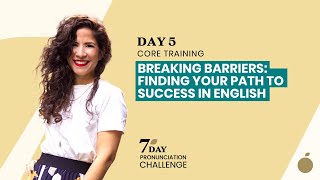
Hadar Shemesh teaches pronunciation and fluency for English learners, covering how to practice correctly without tension, the five steps from pronunciation to fluency, and techniques like shadowing and chunking. She explains prosody, offers tension release exercises, and shares resources including a free masterclass on March 14.
Questions this video answers
Doors to New Sound will open on Tuesday, March 14th.
Chapters
Hello. Hello again. Yes. Okay. Yes. I just. I just didn't plug in the. The receiver. Okay, good. So I actually told you a secret that I can't repeat right now at the beginning. So unfortunately, you won't be able to know what I said at the beginning of the video. Too bad. Too bad. Technology has ruined the opportunity of me sharing this big secret that I had to share, but I could only say it once. That's it. All right, everyone. Hello. Hello. Hello. I'm happy that you're here. Thank you so much for being here today. Again, I said at the beginning, kidding aside, that I see the familiar names in that people keep coming back. So I'm really happy to see that, and I hope that you're enjoying and benefiting from this clear and confident challenge. Okay. No, no, I wasn't telling a secret. Really. I'm just teasing you, my friends. I'm just teasing you. Okay. How are you doing today? Let me know in the chat. Tell me how you're feeling this morning, afternoon, or evening, like Luciana said. And I'm excited for today. And also, just so you know, today we have another surprise for those of you who join live. And we're gonna do the raffle. Unlike yesterday, we're gonna do it closer to the end, right before I go into Q and A. Why? So that you can stay concentrated and focused on the training, and I'm gonna show you what you're gonna get. Hold on. Stop screen and share screen. I want to show you. So for those of you who are joining us live, you might get a chance to win my English mindset training. So if you like the mindset talks, you are going to love this. 30 different audio recordings, tackling different obstacles that speakers of English as a second language face, and really trying to create a better, positive growth mindset that whenever it's related to English. If you're already a my English mindset member and you win the raffle, you will get to gift it to someone. So you'll get it so that you can give it as a gift to anyone that to whoever you want. So stay until the end where we'll share the link. 15 minutes before the end, we'll share the link, and anyone who is live will enter a raffle if you to win my English mindset. All right, good. I know that we have a lot of English mindset students here, so like I said, if you win it, you'll get to give it to someone and maybe change the way they think and feel in English. So for today, let me Go back to the slides for today. Here's what we have for you. Okay. What we're gonna do today is we're gonna talk about breaking barriers and finding your path to success. Everything, first of all, related to working on your pronunciation. So we're gonna start tackling some of the obstacles, but also talking about going beyond pronunciation. Because ultimately, you know, we want to improve pronunciation not just for the sake of the sounds, even though it's fun and it's exciting, but for the sake of really owning the language. For a lot of you, it is the missing link or a part of the missing link. When it comes to communicating confidently. You want to feel like yourself. You want to feel like there are no barriers. You want to feel authentic. You want to be able to say what you want to say without filters. And sometimes those filters are the sounds that are not what people expect to hear. And sometimes those filters are how you say it. Everything we talked about yesterday, intonation, rhythm, stress, tone of voice, pitch. So all of those things, when you take them into consideration, it just gives you more power as a speaker, power that you generally already have in your first language. And that power is sometimes taken away from us when we speak a second language, and we might feel like a pale version of ourselves rather than our full selves. One of my students, Francis, once said, after completing New Sound, he said, I feel like I've gotten my superpowers back. When he learned how to use English like he uses for him, it was Brazilian and Portuguese. So really, like I think it is, it is such an incredible tool, but not just for the sake of sound sounding a certain way, but for the sake of owning the language and feeling like it's second nature to you. Okay, so what are we going to learn today? How to know if you're practicing correctly. Okay, this is important. So let's say you know that you need to work on a certain sound and you actually even have resources. Maybe you created a list of words on ChatGPT, and now you want to practice it. How to know if you're practicing it correctly. So we're going to talk about it today. Then we're going to talk about how to stop exhausting yourself while practicing. This is another pain point that people shared with me when working on procedure. Just feeling really tired after some. You know, I had students that would tell me that they had cuts and bruises on their tongue after practicing the th, or that their mouth muscles would hurt really badly. It's not supposed to be that way. It really isn't. If you feel pain, then maybe you're doing something wrong, unlike feeling a little fake or artificial. That's fine. But you're not supposed to bruise your tongue or to hurt your jaw muscles. You're not. So I'm going to give you some tips and advice on how to stop exhausting yourself while practicing. And then I don't know why I have to keep clicking on it. How to continue your fluency path. That's what I said about going beyond just pronunciation and how to. What's your next step in this challenge? All right, so how to overcome common obstacles. And I see a lot of questions here. And by the way, tomorrow we have a Q and a day. So if I haven't answered your questions, I'm going to go through all of those questions that I haven't answered throughout the week and questions that you submitted tomorrow. So the question is, am I doing it right? Right? How. How do I know if I'm doing it right or not? So I'm going to try and give you some tips on how to do that. But I believe that you have to be your own coach. If you're learning pronunciation. It doesn't matter if you're planning on working with a coach or with a pronunciation teacher or use an app to give you feedback. If you want to make real improvement, deep improvement, that is here, not just here, then you have to learn how to be your own coach. And here are three reasons why you need to be your own coach. First of all, you will step up and pay more attention when you're not being told what to do. You have to be the one paying attention to what's happening, how you sound, how you're. You know, if you're pronouncing something, the way you intend to pronounce creates more accountability. And then you show up differently to your practice and to speaking. So it's harder. It's not easier. It's easier to just have someone tell you what to do when it comes to anything, really. I remember that, like, sometimes I would have serious questions about life and about business and about what to do, and I'd be like, I wish I could just Google it. I wish you could just Google what to do. When should I do this or that? Or go to chat GPT and be like, what? What should I do? Unfortunately, we can't. However, the struggle and the challenge of finding the answer or knowing what the right thing to do is is really what makes us better as human beings. It requires you to step out of. Outside of your comfort zone. And that always means Growth. It's painful. It's annoying. I wish we could avoid it, but we can't, so it's good for us. It's good pain, my friends. Good pain. You will become more independent and confident. You won't be dependent on other people. You won't have to wait for someone to tell you if you're doing something right or not. Anyway, non native speakers often have this thing like they feel like they need validation from native speakers. Has that happened to you? Do you feel that sometimes where you feel like you need to be validated, you need a native speaker to tell you if you're okay, if you're doing it right, or it doesn't matter unless the native speaker tells you that you're good, whether it comes to accent, your pronunciation or your accent, or whether it's about your grammar or how you communicate in English. Yeah, right. First of all, you don't need that permission. You can give that permission to yourself. You have the right to use English however you like, even with mistakes, and you don't need someone to validate what you worked so hard for. Okay? So always counting on someone to tell you if you're doing something right keeps that cycle of needing validation from someone else who is in the position of authority, in your opinion. Okay. So it's kind of like switching it around and reminding yourself that you are in a position of authority. You are the owner. Right? And mistakes, they don't make you any less in control or in authority or in ownership of your language. Okay. It's just another way to say something. And also, you will improve much faster. And I've seen that. I've had, you know, I've been teaching for a very long time for 15 years. And at the beginning, I was enabling my students. I would give them feedback on everything. I would not ask them to step up and ask themselves if what they're doing is correct or not. I would always tell them what to do. And I felt like I was helping them. And in fact, they became so dependent on me, so they couldn't tell when they are pronouncing something correctly or not. Same thing with speaking right. It's not just about pronunciation. It's also the confidence to know that you're communicating effectively. They would completely detach themselves from their own instincts and their own understanding of whether or not they are doing something right or they're on the right track. So at some point, I decided to stop enabling my students and started challenging them on detecting themselves if they're on the right track or not. And to tell me why. And it wasn't easy at the beginning. It's hard to know exactly what you need to do, but when you learn it. And this is an inherent part of our training programs where we teach students how to know if they're on the right track, how to identify their mistakes so that they get those tools and they become their own coach. Now, we do give feedback and support, and even here in the practice groups, you have an opportunity to ask some questions. But ultimately, if there is one thing that I could offer you here is to take ownership over this and don't always believe, like you need someone to tell you if you're doing something right or not. Everything else could be an addition. Okay, so here are a few tips, right. On how to know if you're doing something right now that I convince you that it's good for you to know. I hope. I hope. Did I convince you? Are you? Are you. Do you agree that it's good for you to be your own coach? Let me know. Yeah. Amar just used the quote. I'm going to add it here. If you give a man a fish, you feed him for a day. If you teach a man how to fish, you feed him for a lifetime. That's it. That's it. Okay. So, so good. And again, I'm all about help. I think feedback is important. I offer feedback in my programs. But first, you need to know yourself what you need. Okay. Don't delegate it to other people. Okay, good. So I do get some people who agree. I bet that there are some people who don't agree. And that is totally fine if you don't agree. But try it. See how it feels like when you do take ownership and start kind of like being more precise about what needs to be done. Okay. And it's not just about pronunciation. It really is about everything related to English. Grammar, vocabulary, all of that. Okay. Ways to know if you're doing it right. First of all, develop your listening skills. If you can't hear it, you can't make it. So if you're working on a specific sound, make sure you're able to hear it and detect it. One of my favorite exercises to do used to be listening to people speak. Back then, it was just movies on DVDs. And. And I would. Let's say we learned a certain sound, and I would pay attention to see if I can detect the sound when I was listening or watching those movies. I would watch the movies or the TV shows and. And then I would try to see every time there was an E sound or schwa sound. Right? So I started paying attention. And when I started paying attention, deliberately and intentionally, it was easier for me to notice it and to even become more aware of how words are pronounced. Okay, and you can do it on the go. Especially if you live in a place where you're immersed in English. You can definitely do it on the go. Anyway, you're going to have a conversation at the supermarket, so be like, okay, I'm going to pay attention to how they pronounce their R's, or I'm going to pay attention to the intonation. It doesn't take away anything. It's not like you're paying attention to your own pronunciation. I wouldn't recommend doing that when you are speaking to someone, but it's always good to have that external ear as you're listening to other people. And when you start noticing it more by intentionally looking for it and listening, then you're more likely to have an easier time knowing if you are doing it correctly or not. Because you already have the sound and how it needs to sound in your head. Then you want to find a recording or a reference and compare your recording to it. So, for example, you can take a TED Talk and you have the recording. Make sure that you find a speaker that you like. And then you take a script, and you read the script out loud and you record yourself. And remember that when you're working on a specific sound, try to only focus on that. Don't try, especially if you're just starting out, to incorporate everything that you've learned and to get everything about your pronunciation to be perfect. No, just focus on one, maybe two sounds when you practice. So you read out loud, focusing on those sounds. I actually have a video that teaches you how to do shadowing while focusing on a specific sound. It's shadowing with Wednesday. I took a scene from the show Wednesday and I showed what deliberate shadowing is. Intentional shadowing. So this is pretty much what I'm talking about. So you do that as you're speaking, and then you want to listen to the original and listen to. You only pay attention to those sounds. I know it sounds like a lot and like, should I do this with every single sound? Well, the more you do it, especially at the beginning, the easier it becomes with other sounds. And then sometimes you don't have to do this entire process for each sound sound. Then you want to listen to the recording and detect the places that you feel are different than the sounds in your head. Okay. So you can listen to your recording and either compare it to the original recording, another speaker, or you can just listen to your recording and pay attention to those sounds and see if you got them right or not. In most cases, you will know. And don't keep that limiting belief of, I don't have a musical hearing, I can't hear anything. I don't know. A lot of times it's just cop out, right? Like, I really need you to sit down because if you pay close attention and you close your eyes and you allow your brain to see, hear the differences, you're probably going to hear the differences. So don't let ideas and opinions and habits get in the way of you really doing something to move forward. Okay? So that is something else that you can do now once you kind of like learn how to do it on your own and to practice that on your own, here are a few more tips on how to learn it effectively. And I want to go back to the pronunciation confidence method. Remember that when you work on any sound, you want to go through the these steps to really implement and integrate a new sound into your speech. Because learning it and then trying to use it is just not, not enough. It's not going to. It's not going to happen that easily. In fact, in my masterclass that is coming up next week, I have one. One of the mistakes that I talk about is about learning pronunciation. Like you're learning history, right? Or something that does not require a lot of practice. And I'm going to go a little deeper into how to use in real life what you're learning when you're practicing. Okay? So if you want to learn more about that, then join the masterclass. I'm going to share the link at the end, but for now, okay, Pronunciation confidence, first of all, prioritization, which means that you need to identify the things that are important for you, which we have spent most of the challenge doing that I introduce you to the priority chart. I know a lot of people have used it and we tried to show you what are the main challenges when it comes to consonants, when it comes to vowels, and when it comes to prosody. Then it's all about perception, which we also talked about and we practiced together by me showing you the different sounds and then making sure that you can hear the difference between similar vowels or between what, how you are pronouncing something and how it's expected to be pronounced. And then it's pronunciation, which is the actual production. This is technical. This is pretty much the science of speaking, because your tongue needs to be in A certain place. Your lips need to do one thing to be able to produce a sound. If you're doing something slightly differently, it's not going to have the same quality or not going to have the same sound. And then once you get it right, you need to repeat it, but repeat it correctly, right? So you don't repeat a mistake and then develop a muscle memory based on a mistake. Not that it's a mistake, but like a mispronunciation. And then. So repetition is really important. And the way we do it in our courses is like words, and it escalates a little bit. So it's words and then phrases, and then more challenging phrases, and then minimal pairs and then sentences and then more complex sentences, and then tongue twisters. So you first of all learn how to pronounce it in the most simple form. And then you use it always in context, because you always have to use it in context. And then after you have practiced it and you have repeated a certain sound and you've escalated the phrases in which you're using, then it's time to practice, intentional practice. Now, what is intentional practice? And this is not what I want to go. Intentional practice is basically this idea that you are speaking, but you're really focused and intentional about producing a certain sound. So let's say you practice the I sound, and now you're speaking about your day, or you're practicing speaking about, you know, what bothers you in the world in 2023. And then you're making sure that every time there is a word with an eh, at least words that you're aware of, you're actually pronouncing it right. And then you're repeating yourself if needed. It's just you and your phone recording yourself. And that's it. That is intentional practice. And this is the one thing that could really, really help you start using those sounds more and more in real life. Okay, another challenge. I have a good question here, so I'm going to come back to it about the ng. Another challenge is how not to get tired. Okay? And that is relevant for speaking, but also for practicing. If something feels like it's pushing you beyond your boundaries or it doesn't feel comfortable, you probably should not keep doing it, right? You. You should probably take a step back and ask yourself, why is this happening? Right? It's like when you do go to a yoga class and you feel super strained. It's not the regular tension or muscle pain that you experience from doing these postures. It really is about. It's starting to Hurt your back. And they tell you, wait, wait, wait. Don't do it. Right? If it hurts your back, don't do it. It's the same thing. If you start feeling like you add a lot of tension or you're injuring your tongue or your cheeks, then check to see what you're doing incorrectly. Because when it comes to positioning all the muscles in the right place or. Or all the articulation organs, it needs to be natural. Okay, so three ways. If you feel that there is a lot of tension when you're speaking and also when you're practicing, here are three things that you can do. First of all, focus on optimizing your pronunciation. So that means go back to learning how to pronounce the sound. I have a lot of videos on YouTube. Some of them are a little old, but a lot of videos on YouTube teaching you how to pronounce the sounds correctly. If you decide to join us into new sound as we open doors and in next week, then you will get clear guidance on how to pronounce every single sound. So go back to the rules, like what needs to happen in your mouth. Right? And once you understand what you need to do to make the optimal sound, you're probably going to realize where you're putting tension when there is no need to be tension. And then you also want to practice awareness, because sometimes we do add tension. We start okay, and then we add tension as things get harder. Has that ever happened to you? To me, it happens when I. When I work on my computer, especially when I'm. When I have a deadline that I have to meet, I start building tension in my muscles and my jaw. Like, I clench my jaw and I start building tension. And then every now and then, I tell myself, let go. Right. So I think that it's really important to do that when you're speaking as well. You're practicing speaking, you feel tension. You're practicing pronunciation. And every now and then, you just need to breathe in and let go of tension. Right? And sometimes just massaging. Let's all do it together. Right now. Just massage your jaw. See if you're holding tension. Yeah, good. Okay. So you're relaxing the tension in your jaw, and you're relaxing the tension in your voice. Sometimes we hold a lot of tension here as well as we're practicing. So our voice might be more strident. Maybe we are pushing your voice. Maybe it's a little too loud. So also make sure that you're breathing into it, right? And that you're softening your voice, and you're not pushing and you're not straining. And then there are daily tension release exercises. And I have one like a five minute tension release exercise that I linked to it in the workbook. So if you haven't checked it out, have you checked it out? Have you done it? The daily tension release exercise, let me know. So you can do that whenever you feel that there is tension or I recommend for you to do that at the end of each day. We used, I've learned a lot of the exercises in acting class when we did a lot of vocal exercises and classes and we really had to let go of tension as actors. When you go on stage and you hold tension, it really blocks you from actually being present and feeling all the emotions that you want to feel. And I think that it's very much the same when you are in real life communicating with people. When you have tension, it blocks you from focusing on what you're there to do, to communicate with them, to talk to them. Right. Okay. Some not yet. So maybe today would be the day if you want to let go of tension and if not, then know that it's there for you to do it after you practice. I really recommend to do it at the end of each pronunciation practice if you have time. And no, you don't have to do it every day. You can just make it like to do this awareness exercise to check when you hold tension and when you feel that it's a little too much when you're not able to release it simply by taking a breath, then go do those exercises. Okay, before I go into this part, let's see if we have some questions. Let me answer some of the questions. So there was a question about N versus ng. Where is it on the chart? So actually replacing N with ng or n with M, it's a top priority chart. It's a high priority challenge, which is consonant swapping. I don't think we included all the possible swappings. Maybe we can add that. But that is definitely something that could be challenging. I think it is there, by the way, but it's the high priority consonant swapping. Okay, let me see. Where is the list of questions so I don't miss out on anything. There it is. Okay, Let me see. I saw your video this morning. Good. But using parts of the mouth that I don't use with my mother tongue kind of hurts my throat, I think. So here's the thing. I think again, it's. It's a perception, it's a limiting belief because you're not using your throat Differently for the sounds of English. Your throat in particular has nothing to do with the production of sounds. It's just moving your muscles to a different place now. Yes. Maybe if you're tensing your tongue for the R, and maybe if you're not using your lips for a certain sound, it might hurt a little bit at the beginning as you build muscle. I remember working with a Japanese speaker one on one years ago, and. And in Japanese, there is no U sound. In fact, there is, but the lips pull to the sides. Forgive me Japanese speakers, but it's something like this. If we go from to right. So the lips pull to the sides, but the tongue still does the same thing. And we were working on the tense U sound, and the tongue was fine. He had no issue with it. But his lips were very weak. Like he couldn't push the lips forward and he. He was like literally shivering. Like the muscles here because they were so weak and he couldn't hold out this posture, this. So he needed to practice it a little bit and to build muscle tone here. Oo okay. So yeah, at the beginning, sometimes you might have to build a muscle, but generally speaking, especially when it comes to your voice. Right there needs like, you shouldn't have any difference in how you produce your voice. What usually happens is that we manipulate the voice and we actually change the voice. We either drop in pitch or speak a little softer or speak a little louder because we're nervous in a second language. And as a result, a, we don't feel like ourselves, and B, we strain our voice. We misuse our voice, and then we feel exhausted, and even we get horrible horse really quickly where your voice is not strong anymore. You know, that's called horse. And then you think it's because of English, but no, it's because you changed your voice. And again, in the master class, I have a section. One of the mistakes that I talk about has to do with voice. This. Like in the challenge, we didn't get to talk about that. But if. If this is something that you're experiencing or if you don't feel comfortable with your voice, then we will talk about it there. Okay. I struggle with saying all over the world. I can pronounce all. All words separately, but not together. Do you have any advice? Yes. So I want you to redivide the sentence and take a moment to. In a second. In 10 minutes, we'll share the link for you to sign up to enter the raffle for the my English mindset course Mini course. We give it away as a gift for People who showed up live today. Okay. All over the world. You just need to remember that sometimes words connect. And then it's kind of like you're changing the order of the syllables because in your head, it's all over the world. But if we connect the words together, then the order of the syllables might change. And I would look at it like this. Ah. And then the next syllable would be low. Ah, low. And then we would have ver. A low ver. So except for the r at the end, if l is not a challenge for you, you shouldn't have a lot of trouble pronouncing this phrase. All over. All over. And then this is a tricky part, shifting from an R to a th. You just got to practice it. Earth, Earth. Earth. Ver the. All right, so we're already connecting the th to the r. All over the. All over the. All over the. And then it's kind of like you take a breath, don't really take a breath because it's one phrase, but. But you. It's almost like you have a break to get you ready for this challenging word world. But if you know how to pronounce it separately, you shouldn't have any issues with connecting it. All over the world. The world, the world, the world. Ver the. Ver the. Ver the. I'm just working on transitions. Ver the world. Ver the world. All over the world. All over the world. All over the world. All over the world. Is that easier? Let me know. Okay, so back to where we were going beyond the sounds. Just a quick reminder for all of us, here's why pronunciation is critical for other things. I know I have said that, but I really want you to understand why it is so important, first of all, to be clear and get what you want to understand other better. We didn't talk a lot about it, but when you learn pronunciation, then especially when it comes to prosody and reduction, when you reductions, when you practice it, your brain learns how to pay attention to it and to listen to it. And that significantly improves the way you listen to other speakers. So if you are having a hard time, understand who here has a challenge, Write me in the comments. Finds it challenging sometimes to listen to native speakers on tv, let's say, right? Just like a conventional TV show, if you have a hard time hearing, understanding, comprehending what they're saying, so let me know. Pronunciation can help you with that because you organize the speech by repeating them, by learning them, and then your brain learns how to listen to things and things that used to Be unclear all of a, all of a sudden become clear. And when you practice reductions, what are you how to shoulda. When you practice it, your brain connects the sound with how it's supposed to be. And you're not just hearing those sounds, assuming that it's something because you already know what it is. Yeah. So we have a lot of challenges here, people who are struggling with understanding. So to understand, of course, you need to expose yourself to speakers more, but we are exposed quite a lot, especially if you live in an English speaking country. So it will help you Pronunciation work will help you understand others better a lot faster. Okay. To speak effortlessly. Everything that I spoke about, about adding strain and tension, that is unneeded, right? Because we don't know how to pronounce something, we don't pronounce it in the most optimal way. And as a result, what happens is that we're adding a lot of tension. We're using muscles that we're not supposed to use and that creates tension. And then we feel just tired after speaking. So becoming more aware, letting go, and learning how to pronounce something in an optimal way. A sound in an optimal way is going to help you and to be more confident and in control. You're not avoiding sounds, you're using all the sounds. You know how to communicate something. And more importantly, you know what to do if something. Someone doesn't understand you. So it's not going to solve everything. It's not like everything's. The moment you start working on your pronunciation, everything is resolved right away the next day. No. Sometimes you'll still have some situations where you might be less understood. But when you have the tools, when you work on your pronunciation, you know how to shift immediately. Maybe you know, oh, it's a word with an R. Maybe I just need to pronounce it and be more intentional about how to. How I pronounce the R. Maybe the intonation didn't deliver the message clearly. Okay, let me be a bit more clear because we don't always think about it, right. It's a slip of the tongue. Sometimes you might know how you're supposed to say something, but your mouth will do something else. And it still happens to me. Okay. Sometimes the brain is in one place and the mouth is in another place and the mouth is not catching up with your brain. That's the case in to me in any language. But for most of us, in a second language for sure. Okay. So when there is a moment of miscommunication, instead of worrying about it, you have the Tools to know, okay, I know how to change that so that I'm better understood and I get what I want, okay, to understand the language better, like, understanding the rhythm, understanding the intonation helps you understand the nuances and the cultural nuances in the language. And then here's something that I love about this type of work, and it has helped me significantly to build the foundations for the pronunciation confidence method effectively. So when you do those repetitions and you practice, it doesn't only help you with pronunciation. You actually learn a tool that you can apply when learning grammar, when. When learning vocabulary, and basically when learning anything. And I have done that. I've never learned grammar. I've never went through lists of words and tried to memorize them. But I have used this method to memorize texts when I was an actor, right, like in acting school, and I was practicing speech and pronunciation. So I did a lot of those repetitions, and I developed my own unique technique that I'm, you know, teaching you here and I'm teaching in my programs. And then I noticed that I'm doing the same thing when I'm. When I was. I was doing the same thing when I was trying to learn grammar or when I was trying to remember a new word. So the method of repetition, this active method, is really helpful for other things as well, because it helps you build new habits. So it's not just new sounds, but also new words or new grammatical structures. So this, like I said, I put it here because I know that this is a question that I get a lot. I talked about it a little bit when I talked about intentional practice, but I will talk more about it in the master class. Okay, so what's next? What's coming up next? Tomorrow we have a live Q and A, and the following day, we will have a coaching session on Zoom. But before that, I want to talk about what's next, right? Like, we're about to get to the end of the pronunciation challenges after those two days. Pronunciation challenge after those two days. And I want you to have some more understanding as to the steps that you need to take, okay? Because I told you at the beginning, it's not just about sounding better. It's about putting it all together and owning English, making it second nature to you as if it's, you know, like you want to feel in your own skin when you're in English. You don't want to feel like you're in someone else's suit that is three sizes smaller or bigger than you. Okay? So when it comes to my method, for learning and teaching. I don't want to say fluency, because fluency is such a fluid word. It means so many things for so many different people. But like that sense of ownership, right? Like feeling like you're in control. And to me, fluency or the sense of ownership is not really about being flawless, and it's not about not making mistakes. So you want to make sure that you have strong foundations. We haven't gotten into it a lot. I will talk about it in the masterclass. But the strong foundations is really all about building the right habits. Because if you want to learn anything or you want to develop something, you want to make sure that you have the. The right habits in place, and in our case, our learning and practice habits, strong foundation. So you also want to know what is high performance practice, so you're not practicing and wasting your time. You want to know what your motivation is. You want to have clear goals. All of those things have nothing to do with specifically pronunciation or English, but they're designed to create the right infrastructure for you to reach your goals and get to your fluency success. Then, of course, pronunciation, because it's, in my opinion, the foundation for the spoken language. Not just the sounds, not just clarity, but everything that we just talked about, okay? Listening, communicating, ownership, confidence, and all of that. Mindset. And this is what we do in the daily mindset talks is. And in a second, we will share the link to host the raffle. Mindset is critical. It's just like it's. It's a part of the strong foundations. You want to develop your mindset, you want to actively work on your mindset, and in addition to that, you want to understand the concept of prosody. Everything that we learned yesterday, because I feel it's a little different than pronunciation and should be addressed differently. And prosody and mindset actually work together because you've got to give yourself permission to use prosody, and that is related to your voice as well. Okay? So I believe that these elements build upon each other and as a result, lead you to where you want to go. So it's not just working on pronunciation, not just working on building habits. All of it needs to work together. And then finally, you want to have the right strategy for you to know what to focus on. The 20%, not just when it comes to pronunciation, but also when it comes to your grammar and your listening skills and your vocabulary and what words you actually need to learn. And I have learned that this, like when. When all of these components worked together, that what has allowed me to reach fluency. And this is what I've been using. Because at first, when I just started in my teaching career, I was only focused on pronunciation. And then gradually, I started adding, okay, you know, I see that we need prosody as well, because at first I didn't do that, and then, okay, mindset. My students are missing that. Okay. But they're not able to sustain their practice. Okay, let's talk about forming habits. Let's talk about building those foundations. But then there was a question, especially when talking about mindset, the voice, and how is that connected to everything? And then what do I need to focus on? So when you put all of those things together, you have clarity and the right path for you to succeed. I will talk more about that and give you practical tools on how to start implementing those things in the masterclass that is coming up next week. So it's a separate session. It's not a part of the pronunciation challenge. So if you haven't signed up yet, I highly recommend that you do. It's called the Five Critical Mistakes Most English Learners Make. And I'm going to really tackle some of the biggest challenges that I have done that I've seen my students make, that I have made and I've seen my students make, and how to avoid them and how to overcome them. Okay. And I will talk more about this proven path that I have used. Also not working. I don't know what happened here. Hold on. Something. There we go. Okay. I kind of, like, talked about that. And also I will introduce you at the end of the master class to New Sound. For those of you who would want to continue working with us and would want to continue getting our support and our guidance, and if you don't want to figure everything out on your own, I taught you a lot, a lot in this pronunciation challenge. But if you don't want to have to figure out the resources and how to do it and the schedule and, you know, the guidance and the feedback and all of that. If you don't want to do all of that on your own, then stay until the end of the master class where I'll introduce you to that. Because New Sound is just so, you know, because a lot of people have asked me about. It is a one of the kind, one of a kind training program for speakers of English as a second language who want to make meaningful changes to their lives through English. New Sound is about the sounds of English, but it's also about discussing, discovering, and owning your unique voice in a language you weren't born into. So you, you've gotten a taste of what it's like, our philosophy and what we believe in and how we make things work. So if you'd like to learn more about that, join the Masterclass. Doors to New Sound will open on Tuesday, March 14th. And this is the day of the masterclass, so make sure you get your seat. Hadarshamage.com masterclass it's absolutely free. It's free. Okay. The masterclass is free. New Sound is our paid program and it's 14 weeks and you get lifetime access. But the masterclass, where you will get a lot of tools and resources to actually start implementing it on your own, this is free and it's happening twice on Tuesday and twice the following Sunday. So I really hope to see you there. How can I improve my active vocabulary? I'm trying to think. I will teach you that in the masterclass. I will talk about it a little bit and I have a video about improving your active vocabulary. Okay. I want to embrace my voice in English and change my mindset. I love that approach, which is a good opportunity to share the link. Amar, pop the link in the chat for people to sign up. All of you who are live here with us, and you get a chance to win my English mindset. So I'm going to answer some questions and in the meantime, you can sign up for the raffle and in 10 minutes I will announce who is the winner or for as long as Amara needs to join. So in the chat, notice you have two links. One to sign up for the masterclass and one to get on the raffle for today because you're here live with me and you can win access to my English mindset, which is basically a 30 day training designed to help you develop a positive, healthy and powerful mindset in English. All right. I have people who have already signed up for the masterclass. I have nothing to say. I'll just see you there. When are you joining? On Tuesday or on Sunday. Let me know. Okay. How to. In the meantime, I'm going to answer some questions, if you don't mind. And yeah, let me wrap up just to remind you what we talked about today. We talked about how to know if you're practicing correctly and how to be your own coach. How to stop exhausting yourself while practicing, how to continue your fluency path. What's your next step in this challenge? Join the masterclass. And that's it. Your daily task. Make sure you check out the workbook because you'll find, first of all, the tension release Exercise. But also I'm inviting you to identify what you can. How you can overcome, or what you can do. What can you do to overcome some of the pronunciation challenges or learning challenges when you're practicing and working on your pronunciation. Okay. And remember that tomorrow we have the live Q and A. All right. Have you signed up for the raffle and the masterclass? The raffle link doesn't work again, so I think you might need to copy the link and then go outside of Facebook. If you're on your phone on Facebook, sometimes it doesn't like links. So just copy the link and open it in your browser. Okie dokie, jokey. We're gonna wait a minute until everyone can figure out how to open their link. So Catherine is saying, why can I say words in the right way after trying to focus on a sound or of each letter? I think it's when. When. Let's say you're learning how to say the word strength, and you're like, okay, I know the th, and I know the R. R, and I know the str. Stir. You have to slowly show your tongue where to go. It's like you're taking a little kid by the hand, and you're like, telling them to be like, okay, now your left foot forward, and now your right foot forward. Your tongue wants to go back to what it already knows, maybe to say something like a strength instead of strength. Okay? Because it's totally different, and your tongue knows where the S is. But then we. When you're trying to say the word, it wants to go back to the old habit. So what I usually do is I teach my students to go from, first of all, to be clear about how to pronounce each sound. That's the first. And we divide it into chunks. Stir, stir, stir. And then e. Stre, stre. Stress. I would never ask my students to pronounce a difficult word right away and expect them to succeed on the first attempt. I really. It's like a tongue twister. Say it word by word. And then slowly. And then a little faster and a little faster. So stre, stre. And then you add the end. Stren, Stren. And then. And then just the nth. Right? And then, okay, I know how to make the nth strength. You can also add an ng, but you don't have to. So we're simplifying it now. Okay, so you really try step by step. And every time you are able to add another sound, you repeat that part. Stre, stre, stre, stre. Not thinking about pronouncing. The full word just yet. And then when you're able to say the word, then use it in context. Always use it in context. My strength. Your strength. My. I'm out of strength. Right. And you're trying to use it so that your brain starts connecting this new pronunciation as if you've just learned a new word with the. With the rest, like how it's put in the rest of the phrase. Okay, another question. Can you help me with the word water? I have a problem for a long time and I'm thinking, could be the ah or the T. Probably both. Probably both. Because these are two less traditional sounds that don't exist in a lot of languages. So first of all, congratulations on being so observant. This is what I'm talking about, my friends. Take a look at Linda. Linda. A round of applause because she is aware she's asking for validation. That's fine. Right? You do want the guidance. I do believe that if you want to improve in something, you need the experts around you. You need guidance, you need help. You need to be to ask. But she's already coming with, this is what I'm seeing. Am I right? Because the moment she says to herself, this is something that I'm noticing, then she is challenging what she's hearing. She's challenging her own pronunciation, and she's more likely to improve that way. So yes, water has the ah sound. A lot of times people just end up pronouncing it closer to an Right. So it's very different for a lot of people. Wa wa. That's the ah as in father. Wa, wa, wa. And then the flap T. It's not water. Okay. I'm just looking at the chat and I see that there are some people who are unable to do it. Amar, do we need to wait? Do we need a new form? Let me know if we need a new form. Okay, let's pop the link in the chat again. So I'm going to wait for an update from Amar and I'm going to tell you what the status of the form. Okay, so water going back to water. So think of it like it has two A's, Wall, wa, wa. And then the T becomes a flat T. Water. And then from the flap T go into an R. Water, Water. Water. Okay, good. Let's see what's going on. Don't worry, we'll fix it. If you can't sign up right now, then we will make sure that you're able to sign up. Another word, how to pronounce the T in often you just don't. That's the easiest. The T in often doesn't exist. You actually don't pronounce often. It's not like sometimes you can drop the T in a word like Internet, right, or center. That's when the T appears after an n. And a lot of people may drop it or may not drop it, both are fine. But in the word often, the T is just there for design. It's not pronounced. Okay. They tell me in my earpiece that more than 200 people already signed up. So the form is working. But if it's not working for you, then what should they do? Amar, tell me what to tell them to do. Copy the link and try to paste it in a browser, in a different browser. And maybe if you've already signed up today, it won't, you won't be able to sign up again. It seems that American English in general is high pitched. Should I change the tone of my voice? American English is not high pitched. It has high pitch. It has low pitch as well. It really depends on the speaker pitch or placement depends on a person's voice. Now, there are some languages that have more nasal sounds, right? And then the quality of the language is going to sound more nasal. It's not that the placement for that language necessarily is nasal, could be maybe more higher because there are a lot of. There are tones, for example, but in general, placement is something that you're born with and it's where your voice is most comfortable at. I will teach about the voice in the master class, so I'll talk about placement. Okay, So yes, you can sign up, even if you signed up before. And yes, open the link via your browser. And some, if you just click on it, it may not work. So just copy, paste it. Okay, let's. How to improve your listening skills. Okay, so first of all, working on your pronunciation will improve your listening skills. But here's the thing. When it comes to improving anything in any aspect of our lives, if you want to get better at something, you've got to do more of that something. So exposing yourself to different speakers, to different, at different ages, different dialects, different Englishes, right, is really important. So you're not set on just hearing the voice of the YouTube teachers or the standard American or the people on the news or the people in TED Talks, because then when you come across real life English, you're likely to be like, I don't get. I don't understand this person. Because you haven't exposed yourself. The brain knows how to start noticing those things. And how to start distinguishing between the different or associating certain sounds with even if they're pronounced differently. So the more you expose yourself to different speakers, it has to be interesting. But like listening to podcasts and listening to TV shows without subtitles titles, doing shadowing exercises. An exercise that we do inside of one of our programs is that you listen to someone. You. You listen to an audio, and then you transcribe it. And then you see when there. Where there is a difference between how you transcribed it. And then you see, is it where we. The person was reducing something? Is it a word that I didn't know? And you start noticing and learning more about your pitfalls, and then you're able to listen more carefully to those areas. Okay, so these are a few things that I can recommend. I actually have a video about how to understand people better on YouTube. The sound of coat and call. So the vowels are different, the consonants are different at the end. Coat starts with a k, has the O as in go, and then it ends with a T. Coat. Coat could be a healthy. So it might sound something like this coat, where the tip of the tongue blocks the air coat. And call has the ah sound. You can think of it as the oz and father or a bit more rounded aw. And then you raise the tongue up for the l call. If you know how to pronounce the dark L without lifting the tongue up, call. That's fine, too, as long as you have that dark quality and it's clear that it's an L and not an oo. My flap T sounds like a D. Is it right, or does it sound different? The D and D in the middle of a word between two vowels sound exactly the same. So, for example, if you say the word writing, like riding a bicycle and writing a book, and it sounds the same, great. But if you want to say hat and had and they both sound the same at the end of a word, then it's not good. So only if it's in the middle of the word between two vowels, then it's totally fine. Actually, it's good that your T's and d's sound the same. If it's at the end of the word or the beginning of a word, then no, you need to have a clear distinction. One is voiceless and the other one is voiced. All right, Amar, how are we doing? Do we have the raffle ready? Dum da da dum Soon. So Amar is going to send me the link to the raffle. There it is. Okay. Ooh, I like those colorful raffles Are you ready? Let's see who's going to win. Martin. My English mindset. Share screen. Hold it. I'm a little slow today, as you can see. There we go. All right. Wait, I want to see. Are you ready? Put yes in the comments. If yes is your name there? Can you see it? Okay, let's do it. And the winner of my English mindset is. Cynthia. Congratulations, Cynthia. I'm very happy for you. I'm excited. It's so much fun to listen to those audios and start making a change. Congratulations, Cynthia, and thank you for being here live with us today. Good. By the way, when you join the masterclass live, that reminded me of it. We actually have a gift for you immediately you get it, which is our guide on how to nail your job interview in English, how to prepare, and a bunch of questions. And even if you don't have a job interview coming up, it's a really good practice resource because just answering those questions will help you develop your fluency and talking about yourself. But definitely because, hey, we're here to change things up. We are here to change lives. And getting a better job or more opportunities is a part of what we do. Right. English does open doors. So I want you guys to have this resource. So whether if as long as you join live the masterclass, you're going to get, you're going to get this interview job interview guide. Okay? So if you didn't get my English mindset, don't worry. Join the master class and you'll get the guide. All right, my friends, that is it. I will see you tomorrow as we talk about as I answer questions that you might have, check out the we're going to send you the form to ask questions and it's also linked to your workbook. So feel free to submit your question. Okay, good. Thank you so much, my friends. Have a beautiful rest of the day and I'll see you tomorrow for the mindset talk on day six. Bye.
More from Hadar











Read Out Loud with me! Dare to Lead by Brené Brown | Pronunciation & Vocabulary practice