Different ways to pronounce the letter A in English | Vowel Masterclass
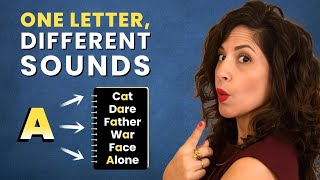
Hadar Shemesh teaches six ways the letter A sounds in English: cat, father, war, face, unstressed schwa, and air before R. English spelling doesn't reliably match pronunciation, and the lesson includes drills and notes on American versus British accents.
Chapters
Hello. Hello, everyone. What is up? Hold on. Changing my mic. Hello. Are we good? Hi. And here we are again in another live class about pronunciation. How are you doing? Let me know in the chat. Say hi. So I know you're here, so I don't feel alone. And we can get started with today's lesson. So for those of you who are new to my channel, hi, My name is Hadar. I'm a non native speaker of English. I'm a fluency and pronunciation coach. I'm exceptionally thrilled about teaching pronunciation and understanding it in a simple way. And I'm really glad that you're here. So let me just add this, because this is a better representation of what it is that we're going to do today. Today we are going to talk about the different sounds of English that are represented with the letter A. Okay? So this is what we're going to talk about today. Hello, everyone. Hello. Hello. Hello. It's good to see you. Thank you for saying hi. Now I do not. I don't feel alone anymore. All right, who here is completely new to pronunciation work? So let's. Let's try it out. Like, on a scale of 1 to 10, one being, I have never done any type of pronunciation work. I haven't learned sounds. Maybe I've watched a few videos here and there. But no, like, I only learn grammar, vocabulary, fluency, practice, and then 10, if you are an expert, maybe a teacher that teaches pronunciation. So on a scale of 1 to 10, let me know who you are and where you're at. Okay. Alejandra has some decent pronunciation experience. And let me know more in the chat. Hello. Hello. Hello. Jose Gopi says 3. We have Masura Efrain. Hello. Hello. Hello. Good. So whether you're just starting out or you have a lot of experience, I think you're going to find a lot of value in what we have to teach today. Because today I'm just going to introduce to you the connection between spelling and pronunciation. So if you're completely new, it's going to help you understand how we think of sounds and how it's different from spelling, because it is. And if you're very experienced, we're going to test your skills and see if you're actually familiar with how to pronounce each sound represented by the letter A. But let me give you a quick disclaimer at the beginning. English pronunciation is not aligned with the spelling. Okay? So when you see a certain letter or a certain spelling pattern, it doesn't necessarily mean that it's always going to be pronounced in the same way. While there are patterns that we're going to talk about today, it's not like it's not reflecting the. The pronunciation. The spelling doesn't reflect the sound. So we always need to think in the sense of sounds versus spelling. However, spelling, you know, how we write and how we read is the first thing that we encounter when we learn a new language. Usually, unless you're a baby born into a language where you've immigrated and you first hear before you learn how to read and write, you usually your first encounter with English is reading and writing. And as a result, it impacts how you think about sounds. And that's especially true if your language, your native language is a phonetic language. What you, how you write it is how you say it. For example, in Spanish, what you see is what you hear. A is always A. E is always E. I is always E. Right? So we, we have like, you can assume the pronunciation based on the spelling, and in English, that's not the case. So we need to acknowledge that. And then we want to look at patterns and see the different pronunciations. So this is what we're going to do today. Let me ask you this before we get started. How many ways can the letter A be pronounced in English? Take a guess. How many ways, how many different pronunciations does the letter A have? 1, 2, 5, 10. Okay. Daya says 5 to 6, Adriana says 3, and Stefan says 2. Okay, good. Now, for those of you who said 1, 2, 3, 4, right in the chat, and even if you're watching the replay, write in the chat. That, or just write to yourself words that are spelled with a, but the A sounds different in each word. Okay. Misura is like 10, 10 different pronunciations. Somewhere between 2 and 10. Okay, that's the, that's the real answer. So let's look at it. Let me ask you, and let's play a little game. I'm going to show you a word and you are going to tell me how it's pronounced or just say it out loud and then we'll start counting it together. Okay? First pronunciation. How do we pronounce it? Say it out loud, Cat. If we isolate the sound, ah, this one. And don't worry, I'll go deep into each pronunciation so you don't have to remember anything right now. Just be with me. Okay? No need to write anything. No need to take screenshots. And this is also going to be recorded. Father. Ah. Ah. Okay. This is more of an ah sound. Okay. Ah. Ah as in father. What is this? War. Oh, oh. Can you hear the difference? What about this? Bake. Bake. A. A. So we have A as in cat, ah as in father, O as in war. And we can also find it in words without the R. There is a little, you know, change there that we're going to discuss. A as in face and as in alone. Alone. That is also the pronunciation of the letter a when it's the schwa alone. And we also have air as in dare. Okay, so how many pronunciations for the letter A? Six different pronunciations. Okay, so let's practice it one by one. Okay. The first one is ah. Ah. Ah. Let's practice it together. To pronounce this sound, you want to drop your jaw, pull the lips to the sides, keep the tongue flat. Dad. Dad. A lot of times people either take it to the e sound. Dead. Dead. And then it sounds like a different word. Remember that if it's spelled with a, it's not going to sound like a. Eh. Okay? Ah. Dad. Dad. Map. Map. Okay. Are you trying it with me? Map. Flat. Flat. Ah. Ah. Flat. Flat. Happy. Happy. How do you pronounce this one? It's the same sound. A. A, A. Ambush. Ambush. Are you pronouncing it with the a sound? And if not, what is it that you're doing? Is it ambush? Is it ambush? Is it something else? Am. Bush. Glass. Glass. Say it with me. Glass. Glass. Let's do it together. Dad. Map. Bag. Flat. Happy. Ambush. Glass. Okay, good. The next pronunciation is ah as in father. Usually the sound is associated with the letter o, actually not a. But you do have a lot of words with some spelled with a that take the ah as in father, more in British English than in American English. In American English, you have less words spelled with a that have the ah as in father. Just so you know. But we have a few spa. Especially when it's at the end. Calm. With the LM pattern, don't pronounce the l. Calm. Calm down. Bra. Park. When there is an r after that's also the ah as in father. Always spelled with a park. Large. Okay. Here the sound changes a little bit because it's a diphthong shifting into the r sound. But originally that's the ah as in father sound. Market, Wash, Spa. Calm. No need to pronounce the l, even though some people might pronounce it. Depends on the dialect. But as far as you're concerned, you can just drop the L. Bra. Park. That's an R. Diphthong. Large. Market. And wash. Open. Ah. Then father. Keep the tongue down. Tongue in the back is down. The difference between the two. Ah. Ah. Ah. Cat wash. You see the difference? Cat wash. Ah. Ah. Good. Next one is a sound that is usually associated with the letter o. It's a more rounded version of the oz and father. Aw. Aw. Okay, before an R, you really hear a more rounded O sound. War, War. Warm. Warm. If you don't pronounce the o sound represented by the a, then it might end up sounding like worm, which is a different word spelled with o. Here you don't really hear the vowel. You just transition from the W to the R. Worm versus warm. Okay? So make sure you keep the tongue down and pronounce that oish sound spelled with a really strange right now. Also, this sound is associated with a spelling pattern of a L, L. Fall. More rounded. Fall. Now, here's a little caveat. In some dialects, West Coast, Midwest, this sound is pronounced more like the oz and father. So we can hear it like this. Fall, especially East Coast. And you can hear it like this. Fall. More open. Either one is fine. But you need to remember that this A, the letter A represents the sound that is closer to an O sound. If you, you know, if in your language, you only have five vowel sounds, like A, E, I, O. Right? It sounds a little bit closer to an O rather than an ah. Okay? It's not fall. Okay? It's fall. More oish. Especially because we also have the dark l that makes it a bit more rounded at the end. Haul. Salt, bald talk. No l here. Okay, but we have that rounded sound spelled with a. But you can see that there is l in the spelling, whether you pronounce it or you don't pronounce it. When you see a L, a L, K, a L, L, that spelling pattern is a good indication that this a is actually pronounced like an o closer to an O. An open one. War. Warm. Here we have the R. Fall. Haul. Salt, bald. Talk. Okay? And remember that if you don't have the R in some dialects, people might open the mouth a bit more. Fall. Hall. Salt, bald talk. For some of you, that might sound pretty similar. For others, it might sound different. If you've done a lot of pronunciation work, you might know the difference between those two sounds. The most important thing is that it's not a. It's not. It's not tak. Okay? It's not. Which I think that if you've heard this word unfortunately before, you already know that it's not A. Okay? The next sound represented by the a is the a diphthong. A, as in Day or as in phase. The interesting thing about this is that it's a transitional sound. It starts with an E sound, high E, and then it shifts into an E, E, E. You have to hear this transition. Face, Face, face. Right? Not face. Okay. You don't want to end it within the first sound. Not E, but a, A, A. Name. Name. Get to the second part. Not name. Name. Name. What else? Baby. Baby. Not Bebby, but baby. Lady. Get to the E sound. Lady. Station. Same thing. A, A Angel. A. Ancient. A, A Face. Name. Baby. Just follow me. Repeat after me. Shadow me. Lady. Station. Angel. Ancient. Good. Last but not least, we have the schwa sound. The schwa is the most neutral sound in American English or British English or all Englishes. It's a very short sound, and it sounds something like this. Keep your jaw relaxed. Keep your tongue relaxed. This is the schwa sound. The schwa is an unstressed vowel. And when a syllable is unstressed, the vowel there is reduced to a schwa. So actually it doesn't matter if it's the letter A, the letter O, the letter E, the letter I when that syllable is unstressed. Okay. Then usually what happens is that the vowel sound is reduced there and ends up being a schwa. This is why the schwa is represented by any vowel letter or combination of vowel letters. Okay, I have a lot of videos about the schwa, so if you're new to this, go check them out. So let's see how that sounds. Like, this is alone. Alone. And I'll answer some questions. I see some good questions. I'll answer them in a second. If you have questions for me, ask them across. Not across, but it's smaller. Not a big deal if you say across, like putting a neutral sound, but you can make it smaller, shorter. Across. Pillar. Can't even hear the A, Right. You kind of like transition from the L to the R. Extra. Truck. Sofa. Sofa. See how it's reduced at the end? How would you pronounce this word? Think about it. It's not cigarette. Cigarette. Cigarette. The primary stress is on the first. Good. Next one. How. How would you pronounce this one? Machine. Machine. Let's do it together. Alone. Across. Pillar. Extra. Sofa. Cigarette. Machine. Good. The shorter the better in this case. Right? Exactly. Okay. This is another sound represented with the A. It's more rare. Rare. That's a fun word to say. Tried rare. But usually it's associated with the AR pattern. So it actually sounds like air. Right. We practice it with the R. Like car. But not every time you have ar. That's the R sound. Sometimes it's the air, as in this word. Dare, scary, nightmare. Any. Here there is no R, but it's an S sound. It's not Annie, it's any. Many. And now this is in American English. It will be pronounced as an eh. Carrot. Carrot. In British English. This is in American English, carrot. In British English, it's more of an a, as in cat. Carrot. Carrot. So in American English, when the A appears before an R, it ends up sounding like e, carrot or arrow. But some people in the US and definitely in. In England, in British. In Britain, they may pronounce. They will pronounce it as a. Okay, so this is something to consider. Okay, so let's practice these words together. Dare, scary, nightmare, Any, Many. And in American English, carrot and arrow. If you want to practice your British English, take these words and practice them with the A as in cat. Okay, so let's do a little quiz. But before that, how would you know which A it is? Okay, how would you know when you see an A and you don't know the word? So sometimes you can't tell. Okay, sometimes it could be, you know, ar. If you've never heard the word before, you don't always know if it's R or air. However, you'll notice that the more you practice pronunciation. And when I teach pronunciation, what I do is I take one sound and then I help you drill it down and practice it in words, phrases, and sentences. And I use all the different spelling patterns, so you subconsciously start recognizing them. So when you do that, then you can definitely start understanding. Okay, you can start understanding and recognizing the sound with the. With the spelling pattern. For example, if you see the silent E, like in the word take or bake, then usually the A is spelled with the long diphthong. The a sound like it would sound in the Alphabet. Right? Bake and ate. When there is the silent e. And usually if it ends with a consonant, like cat or hat or laugh, when there is one consonant at the end and there is no silent E, usually it's the ah, as in cat. So these are. This is something that I can kind of like teach you. That is not always the case, but it could be pretty consistent. Like, this pattern is pretty consistent. And if you don't know, then you might just need to go and look it up. Go to Google, search for how to pronounce, or go to any dictionary. I do not recommend asking ChatGPT for pronunciation. It doesn't always do a very good job at giving you the right. It will give you an answer, but it's not always going to be the right answer. So just take that into consideration before we go into quiz time. Then you can let me see if you have any questions. Ask me your questions now. I also want to say, if you're interested in. In learning more and practicing more pronunciation, I have a 14 day pronunciation plan. It's absolutely free and you can just go to my website, hadarshemish.com and right there at the top you can sign up to get my 14 day pronunciation plan. So you'll actually get access to. Let me just write the website. So you can go there and if my team is here, they might be able to put it in the chat as well. A link for you to sign up for the 14 day pronunciation plan. Okay, so the 14 day pronunciation plan is absolutely free. It's one lesson per day with drills, exercises. Someone was asking for the resources. I don't have resources for this lesson. But in the 14 day pronunciation plan, you will have lessons every day. Like a lesson, a video lesson and a free PDF and you'll be able to kind of like track your progress. It's on my private app. You can get free access to it. And. And so just go to my website, hadar shemish.com you'll see it right at the top. DSA. So sometimes the A is not an A. This is exactly it. That is the mindset that we want to have. Okay. Sometimes the A is not an A. Okay, let's go ahead. Let me remove it. Okay, Hide and let's remove. Where is it? Okay, good. Helena, thank you so much for your lovely comment. Oh, not this one. Wait, not this one. Not that you guys don't have. Thank you. Just wanted to highlight it and say I appreciate this. Let's quiz you. Okay. Which one is it? Say it. See if you know what it is. Which sound is it? Try to isolate the sound. Just say the side the sound in isolation. And a plate. Okay, we're starting with easy words and then I'm going to trick you so there's something to expect. What sound is this? Say it out loud. Let's test your skills. Ward. Ward. So we do hear that oish quality of the sound. And funnily enough, the word word with the letter o is pronounced with almost as if there is no O word. My words or ward. A hospital ward or. Good. What about this? Which sound is it? From all the sounds that we have discussed. Water. Water. Good. Open. Ah. Or sometimes it could be more of the rounded Water depend depending on where you are in the us. In the British English, it's always rounded. Water. What about this? What's this? So we said that before the R you have two options. Three. But if it's the same syllable, then it's either R or air. Okay, R or air. Which one is this? Is it glar or glare? Very good. DSVs. Eh. What about this? Okay, you're already starting to see the connection, or start seeing the connection between the spelling and the. Even though it's an A, it's always in context. So the spelling and the sound. Ah, right. When it ends with one or two consonants and no vowels after. In most cases it's the as in cat. If there is no R. What about this? Quality? As in Father. Quality. 3. As. What are those A's? One of them is a schwa, at least. Okay, say it out loud. Can you isolate the sounds? Can you start thinking in terms of sounds and not in terms of letters? Okay, Juan, how is it? How is it? Air. If we don't have the R here in the spelling, we have to have the R to get it to be the air. B. Very good, Johan. Very good. B. Na. Na. Banana. As in cat. Banana. Here's a little trick. When the as in cat appears before an N, it actually sounds a little bit like an eh. That opens up. Okay. It's not as in. What was the previous word? Fast. It's not exactly the same. Banana. Especially in American English. Banana. What about this? I'm hungry now. Agenda. Schwa. Schwa. Agenda. Okay, what is it? Balance. Balance. Balance. Balance. Balance. Okay, so we do have an A somewhere there. Ba. Lunce. Schwa. Balance. What about this? Calendar. Calendar at the beginning and then at the end. Okay, so AR could also be a schwa. R. Not just R or air. We don't say calendar or calendar. No, calendar. Calendar. This is one of my favorite words to pronounce. What about this one? Where is the primary stress? Remember that the primary stress will never be a schwa. So is it radar? Rather, radar. So we have two strong vowels here. No schwas. Radar. Radar. Very good. Radar. Animal. Kind of like. Already showed you the answer. Animal. Again, when the athen cat is before an N, it's more of an E. Kind of like open up slowly. Animal. Yes, it's a schwa at the end. Very good. Try it. Say it out loud. Think about it. I'm going to say it slowly. Radioactive. A lot of big vowels here. Radioactive. Re. A, A and then radio. Active. Radioactive. Very good. I know it's A little hard to write it in the chat. Just I hear it. But you get A for effort. Good. What about this? What's the first word? First A. G. Zeen. Magazine. Very good, johan. Very good magazine. What is this? Handicap. Handicap. Now here is something interesting to notice. Both of them are the A as in cat. But can you hear a slight difference between the 2? Handicap. Can even see how my mouth moves? Handicap. So it's not handicap. It's not the oz. And father, as in cat. Handica. Ca. Cap. Okay, the. The reason why they're not the same, even though in the dictionary they're going to show up as the same sound, is because in American English, before the N, the ah is a little smoother. Closer to an E. Handicap. What about this? Do you know this word? To abandon. To desert. Abandon. Okay. Leave someone without taking care of them to abandon. A ban again, as in cad. Before an N. Den. Another schwa. Abandon. Ballad. Ballad. Okay, so it's the as in cat. Ballard. And then a schwa or a lacks e. Actually, sometimes the A is A lacks e. Okay. Very rarely. But in American English, people usually drop it to a schwa. B. Lud. When the sound spelled with a is unstressed, it's usually pronounced as the schwa. What about this? Fatal. A is in day. Fatal. Fatal. Fatal. Good. What about this? Say it out loud. Think of the pronunciation of the letter A. Or both A's. Gar. R. Garbage. Garbage. Galaxy. Gala. Look, look. So again we have the as in cat and then the schwa. Can you hear it? Can you start noticing it? Galaxy. Okay, so let's do a quick recap here. When we think of the letter A, these are the common pronunciations. We have A as in cat. Most common one, I think. Dad. Map. Bag. Flat. Happy. Ambush. Glass. We have the oz and father. A little more rare when it's just in isolation without the R. Or as part of the R's and car sound. Spa. Calm. Bra. Park. Here's with the R. Large with the R. Market. With the R. Wash without the R. Then more rounded. Warm. Fall. Right. It changes a little bit because of the R. Hall. Salt. And remember that in American English this could be pronounced as the as in father. The one in the second column. Then we have the A as in day. Face. Name. Get to the E sound at the end. Baby. Lady. Station. Angel. Ancient. And then we have a schwa sound. Alone. Across. Pillar. Extra. Sofa. Cigarette. Machine. And then finally we have the E as in bed. It's more rare. More rare. Rarer. Rarer. We don't say that like just say more rare. To me that sounds more natural. Dare, Scary nightmare. Any many carrot. Arrow. Okay, Remember that carrot and arrow could be pronounced with the as in cat. It's not a mistake, carrot and arrow. But it's more of the British English pronunciation. First column. Okay, that is it. Well done, my friends. You did it. Well done. Now I want to remind you that if you want to get on a good schedule of practicing pronunciation, I can help you with that. I have a 14 day pronunciation plan. It's completely free. It's on my app. Basically, I took some of the most important pronunciation lessons that I have. I put them on my app so you can learn it day by day by day with free resources, a PDF audio recording. Just go to my website@hadar shemesh.com which is just my name. And right at the top you'll see an option to sign up for the 14 day pronunciation plan and get access to free lessons daily for 14 weeks. The best part about it is that it helps you build a habit of doing something every day. You don't have to think about it, you don't have to plan, you just do it. Okay. Which is pretty cool. All right, that is it for today. Let me see if we have any questions about the. The. A car would be the Oz and father. Okay, so if someone asked, car would be the second column. Ah, ah, ah. Because not air, right? It's not eh. It's car, car, car. All right, my friends, thank you so, so much. Have a beautiful rest of the day. If you have any questions, I'm here. You can comment below my video and I will be here to answer. Have a beautiful day and I will see you next time. Bye.
More from Hadar











Read Out Loud with me! Dare to Lead by Brené Brown | Pronunciation & Vocabulary practice