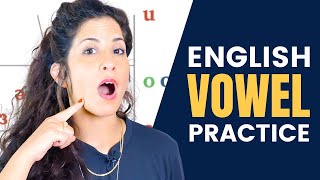
This content was created by Hadar Shemesh. This content was uploaded by Hadar Shemesh. This is a YouTube video titled "Effective American English Vowel Practice for clear speech | IPA" created on August 22, 2023. It features Hadar Shemesh conducting a vowel pronunciation practice session, focusing on American English vowel sounds using minimal pairs to improve pronunciation clarity.
Chapters
Leak. Lick. Lack. Lack. Luck. Lock. Luke.
Look.
Lock.
Do you sometimes feel like you're saying one word but it sounds like another word? The reason for that could be because of mispronunciation of vowels. In American English, There are about 16 vowel sounds, sometimes more depending on the dialect. And in many other language, there are a lot less. 5, 6, 7, 8. What happens when a speaker of a language that has five vowel sounds wants to speak English? Those 16 different vowels end up merging into the five vowel sound categories that the speaker generally uses. So when learning another language, especially pronunciation, one of the things that you want to focus on is understanding the vowel sounds in the language. In this video, we are going to map out the vowel sounds of American English. And we're going to do that by practicing similar words that the only thing that is different between those words is the vowel sounds. These are called minimal pairs, words that are exactly the same except for one sound, like sheep and ship. Bed and bad. I actually have an entire masterclass about vowels in English that I'm going to link below if you want to have a better understanding of the different vowels. But, but in short, I want to explain something about vowel sounds. You have front vowels and back vowels. Front vowels are produced when the tongue rolls forward. Back vowels are produced when the tongue pulls back. You have closed vowels and open vowels, and that happens if your jaw is closed or open. So we are going to go through all the vowels and you'll see how the mouth changes as we pronounce those words. We're going to start with front vowels, and we're going to use a word that starts with a B and ends with a t. And in the middle there is the vowel that we are changing. So let's begin with front vowels, and we're going to start with a high vowel sound. That means that the tongue rolls forward to produce that sound.
E. Beat. Beat.
Now, if we lower the tongue a little bit, we will get to bit. Bit.
Beat, bit.
And as we drop the jaw a little bit more, we get to bet. Bet. And from here, if we pronounce it as a diphthong, we will get bait. Bait. And if we lower the jaw a.
Bit more, we will say bat.
Bat. And if at that place, we will pronounce a diphthong, a changing vowel, what.
We will get is bite, Bite.
Let's do it again.
Beat, bite. Bat, bite.
All front vowels. Let's do it again.
Beat, bite. Bat, bite. Let's move to the back, back vowels.
The high back vowel is a tense OO sound.
Oo boot, boot.
Just like the tense e beat, this sound is all the way in the back.
Boot, beat, boot.
Now, just like we have the tense e beat, and then the lax, I bit here as well, we have the.
Tense oo, boot and the lax here.
We have to change something because we don't have. But.
But we have book, boot, book, boot, book.
And then if we go down a little bit lower, the tongue, open the mouth, we get to the O as.
In go, boat, boat, boot, book, boat.
Back to the t. And then if we drop the jaw and relax the tongue at the back.
Bought, bought. Boot, book, boat, bought.
Let's do it again.
Boot, book, boat, bought.
So we talked about the front vowels. We talked about the back vowels. What about the middle? In the middle, we don't have a lot of vowel sounds, but we do have the as in cup, which is also a stress schwa. A schwa is a reduced vowel, and.
A cup is but. But next to the schwa, there is.
The stir sound, that in American English, it is always associated with the r sound.
So we can try it.
Bert.
Bert. But Bert.
And also, there are actually two additional diphthongs in English. The ow as in now bow, bow, and the oy, as in toy, boy, boy, bow, boy. That's it. We covered all the vowel sounds in American English. Now let's review them again without stopping. Ready? Let's go. We're going to start with front vowels.
Beat, bite, bat, bite, bow.
Central vowels.
But, Bert, back vowels. Boot, book, boat, boy, bought.
Let's do the same with a word that starts with an l and ends.
With a k sound. Leak, high front vowel, E. Lek. Lacks e. Lac.
That's the E sound. It's not a real word, but we're still going to say it. But we do have lake, A as.
In day, lack.
Loud. We have to cheat a little bit. And then I like central vowels.
Luck, lurk.
That's the stir.
Luke tense. Oo, Luke. Luck. Lacks, uh, low o as in go, oy, loy. Ah, lock.
Now we're going to practice a shorter sequence of those words. Let's go.
Tack, tuck, talk. Front, center, back, tack, tuck, tock, tack, tuck, talk. To, took, toke, talk. To, took, toke, talk, do, took, toke, talk.
And one final one. Bean, bin. Ben, ban.
Been.
Ben, ban. Now let me ask you this. Can you come up with more sequences like these where it's basically the same word except for one vowel sound and that changes the entire meaning? Write them down in the comments below. Now, if you like this type of exercise, then you are probably going to love my spring sprints. I have a few sprints on my channel, so I'm going to link to them in the description below. I also have a free mini training called the Sprint Rookie where you get three sprints. And sprints are drills designed to help you boost your pronunciation, grammar, vocabulary, where you improve those elements through intentional repetition, which is what we did. Right now. It's absolutely free and you can get it by clicking the link below and you will get lifetime access to those three sprints, sprints and scripts all right, thank you so much. I hope you enjoyed this vowel practice and I cannot wait to see your examples in the comments below. If you enjoyed this video, make sure to like it and subscribe. And you can also follow me on social media where I share daily pronunciation and confidence tips. Have a beautiful, beautiful rest of the day and I will see you next week in the next video. Bye everyone.