Fluency, confidence and teaching English on YouTube | With @andreseningles
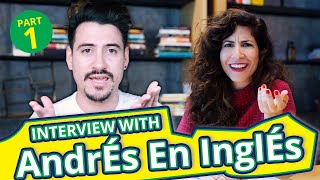
Andres, a Colombian YouTuber with 460,000 subscribers, talks about teaching English pronunciation to Spanish speakers. He breaks down why vowels, intonation, and sounds like 'th' trip up learners, and explains how practicing pronunciation builds confidence, not just clarity.
Chapters
Hey, everyone, it's Hadar. Welcome to my channel. And today I have a special treat for you. So you are exactly where you need to be because today we have a special guest. And that guest is Andres from Andres and Ingles. Andres is a remarkable YouTube creator based in New York City. He's originally from Colombia. His videos are engaging, fun, and creative, and he has helped thousands and thousands of English learners change the way they speak English. This video is going to be divided into two parts. The first part is where Andres will share with us his inspiring story about turning from an English learner to an English teacher and coach on his channel and how he started his channel just because he wanted to help his friends learn English in a fun way. And on the second part, we are going to answer questions from Andres community about how to pronounce the most difficult words. And yes, the word world is going to be there.
World. Oh, my God. It's groundbreaking.
Also, I appear as a guest on his channel, so definitely go and check out the video there where we had a beautiful conversation about English. English learning, different methods, fluency, limiting beliefs, and so much more. So make sure you check it out as well. And when you're there, be sure to subscribe, especially if you're a Spanish speaker. So what are we waiting for? Let's check out the interview I had with Andres.
Andres, Hi, Hadar.
Hi.
Welcome to my channel.
Thank you so much for inviting me.
Oh, it's such a pleasure. Actually, you're inviting me because I'm in your apartment in New York City.
Yeah.
In Chelsea. And why don't you tell us a little bit about yourself?
Wait.
I'm gonna say that Andres is good friend and he is also my student.
Yes.
And we're going to talk a little bit about that. But I think that the most incredible thing about you is your journey. So I know it, and I think a lot of people don't necessarily. So why don't you tell us a little bit about yourself and how you got to do what you're doing now.
How much time do we have? So my story started 30 something years ago. I'm originally from Colombia, and my whole life I wanted to live in the States, in New York, and I didn't have the means to study English when I was younger. My family didn't have enough money to study, to put me through bilingual school. I might look young, but I wasn't that. You know, it was like 20 years ago when there was no Internet. There was like, you, you needed to buy books and you need to Pay for a education.
Yeah.
And that was like 20 something years ago. 30 years ago. And so I decided to study on my own. I didn't want to study. I was very curious about the English language. So I started watching movies, I started watching TV shows. And that's how I fell in love with living in usa. Yeah. Because I was watching those shows, those movies. And in a way, you know, I'm from Colombia, and I was like, maybe I want to live there.
The American dream. Everything looks nice and pretty and flawless.
Until you come here and realize it was all bs. No, no, actually, it could be. It depends on what you do with it.
Yes, exactly.
When I was going to class, I realized that they were boring. And I didn't want to go and sit down for 40 minutes or an.
Hour and, like, answer questions in books.
And reading book, like, you know, reading copies. And it wasn't engaging enough for me. So I was like, maybe I should keep studying on my own. And I did. Then, you know, I start working. I graduate, I start working, and I use my English, you know, a couple times. But I spent more than 30 years speaking only Spanish. Yeah.
So even if you learn, you don't really put it to practice unless you take action, specific action. But, like, and then, you know, it goes away.
It did give me a little bit of advantage when I was working because I was the one that my boss will take to the meeting with the international contacts or clients. And that did give me an advantage. And I started learning about what it means to have that knowledge. It really put you in a different box. It really give you that advantage. And I start feeling that I needed to improve how I was speaking English. Right.
So because you realize that English is not just a language that you need to learn. It's your leeway. Like, it's your door to all the opportunities. Totally would like to fulfill the dreams or the goals and to, like, live the life that you want.
Totally.
It's just a tool. And then get what you want.
Yeah. And then it's not really about not feeling like a Latino or not owning my voice in Spanish, but it is about being comfortable enough to speak to a crowd that only speaks that language. And if they can understand what I want them to understand from my own perspective on any different topic, I need it to be clear enough. So then I start pursuing, learning more about English. I was always learning grammar. I was always learning writing or, like, reading from books. But honestly, Hadar, I never, ever, ever studied pronunciation or intonation or any of that for that matter. So I thought I knew enough. And then I moved to New York three years ago. To make a long story short, I wanted to give my friends an opportunity to work here in the States for us to have an apartment and a lifestyle and the same opportunities as any other person in New York. But they didn't speak English, so I was like, I want you guys to start speaking English, So go to YouTube and find some lessons and learn. So they said to me, everything's so boring on YouTube. They're like, just only teachers. We like big boards. White boards. Yeah. And hey, it's all, you know, if it works for you, I respect that.
Stick with that. Yes, for sure.
But for them, that wasn't engaging enough. So it was funny because I decided to start my own channel for my friends. I never thought that it was going to be what it is right now. The opportunities they have brought into my life. You have no idea. Like, I have to make a video only about how speaking English changed my life forever. After a couple of years making videos, I felt this need to go deeper on pronunciation, and that's how I found you. And I decided to start learning a little more about how could I sound better in English and understanding why it sounded different if I thought that I knew how to pronounce things in English.
Why was it important to you?
Because I thought that I had this level of knowledge and grammar or how to express ideas and put together words. But I thought. Or sometimes I found situations when I thought that I was saying something and people understood a different thing. And I was like, why? I'm doing everything that I'm supposed to do, but there's so many layers to pronunciation, and I think that's why it's important to go deeper in that. And that's. That's where I'm at right now.
So as. Because you go through my online program, what is the hardest thing for you as a student trying to. Or as a learner trying to work on that aspect of spoken English?
One thing that I found about your course was there this thing that happened to me was like, you name that. Regression. Regression. Right, Regression. So when you have so much knowledge and you think, oh, I understand now. The T, the flat T, the th, the voices, the.
And you can make the single sounds.
Yes. And then you try to create them and you get confused. Yeah. When it comes to the vowels, for me, especially because I'm a Spanish speaker, we only have five sounds, and English had, like, about 16.
Yeah.
Yeah. So that. For me. And when you try to. I. I've Been watching her videos. And then when she's like, just you. You put your tongue here. I'm like, where? I don't get it. Like, how I'm trying. Doesn't sound the same.
But you get all tangled up with your tongue. It, like, goes out through your ear. You're like, what am I doing wrong, man?
The vowels for me are the most confusing thing.
So one of the things that you told me before we started is like, I can't hear it. I'm deaf.
Right. I.
Well, first of all, change that language.
Yes.
Because once you say that, your brain will not hear it, because if you decide that you don't hear it, you won't hear it.
It's funny how dar did you mention that? Because, you know, I like to think of myself as a person who doesn't have those limiting beliefs.
Oh, we all do.
And we all do. We all do. Oh, my God, that is so funny that that happened, like, today with us here when I was so self conscious. That was like, oh, I don't want to speak English around her. She's gonna start criticizing everything that I say.
And that's what he was thinking. And I was just, like, at the same time thinking, wow, Andres, you're so expressive and fluent and engaging and, like, I totally see your personality. And I was so thrilled to listen to him. You. And at the same time, you're like, oh, she's judging me. It's like we put so much pressure on ourselves and say here and on, like, we. Yeah, and like, so many expectations, so many stations, and we put other people's opinions, like, so high up. Like, and it's more important than our own expression. How many subscribers do you have?
460,000 subscribers.
So 460,000 subscribers later, you know, obviously have something important to say and people want to listen.
I think so.
With all.
I hope so.
And still, like, what I wanted to talk about and show you is, like, it doesn't matter where you're at in your journey. There's always something that you can work on, but especially your mindset. Because you see, like, you know, oh, he's so successful. It's easy for him. It's not easy for him. He's working at it every single day. But he's still showing up because you have made a decision. I'm not gonna let that stop me. The judgment, like, you know, you were like, oh, what is she gonna say Still? You invited me. You're like, I'm gonna speak to her. You could have easily said, no, I'm you know, like, Adar is coming to New York. Great to see you. You coffee and that's it. Afterwards, I want you to go there to Andres in Ingles and watch the video there where we talk about the mindset and common, challenging sounds for Latin speakers and for non native speakers.
We did go over different aspects. What it means to have an accent when you're not a native speaker. What it means to have an accent, Is it that right? Is that wrong? How far can you go with it? And some tips if you're a Spanish speaker on how to be more clear and confident when you speak English. You got. It.
Took a while to figure out how to say the whole thing.
But no, no, it's actually, it's really important for you guys to understand that those are not only words, it's a mindset.
So I don't like to use lose your accent, eliminate your accent, or speak like a native because not that it's not achievable, but it takes a lot of hard work. And I don't that people need to do that, but I do think that you need to learn pronunciation to speak with clarity and confidence.
Yes.
First of all, let's agree that once you tell yourself something negative, oh, I can't do this, I can't hear that. I'm just bad in this. It's not reality. It's your perception of reality. And it is called a limiting belief. That your limiting belief has become your reality, but it doesn't mean it's true.
It doesn't. Then I want to add to it. And, and I love the fact that we met today because sometimes you need somebody else to let you know that what you're doing is okay. That you thinking, thinking like that is not wrong. It is part of the process.
Yeah. Recognizing it, catching it is our work, our constant work.
The fact that you think that you are perfect or you need to be perfect or perfection by itself is a limiting belief.
Yeah.
Because it is the process.
And perfect is not interesting.
And I want to know what I'm doing right. And I want to know if I'm not doing it right, why am I doing it that way?
So you have the power.
Yes.
Okay, I have to stop here because we have come to the end of part one. In part two, we're going to talk about the most confusing words for Spanish speaking people and also for non native speakers in general. Because these, these are tricky words in English. And you'll also get to see how I work with people, how I coach someone one on one, which is a lot of fun. Okay, so make sure to subscribe so you'll get a notification when the new video is out. And don't forget to check out Andres channel. The links are right below and you can also click here. Have a beautiful day and I'll see you tomorrow.
Bye.
More from Hadar











Read Out Loud with me! Dare to Lead by Brené Brown | Pronunciation & Vocabulary practice