Have you signed up yet? It’s FREE
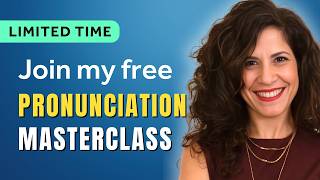
Hadar Shemesh teaches a free 60-minute live class on English pronunciation, focusing on the physical mechanics of speech: sounds, rhythm, intonation, stress. Most language learning skips this, leaving intermediate learners clear on grammar but sounding strained. The class covers your personal challenges and gives you a practice plan to use right away.
Chapters
Hey everyone, I want to invite you to a free pronunciation masterclass that I'm hosting this week on Wednesday and on Saturday. I'm only teaching 4 classes, and I want to tell you what this class is about to see if it's going to be the right class for you. Either way, it's absolutely free, and I teach my pronunciation framework there, and it's going to help you speak With clarity, confidence, and freedom, I'm going to teach you the secrets to becoming more expressive, speaking with ease, and absolutely more confident. So this training is 60 minutes, it's absolutely free, and if you want to join, go to hadarshemesh.com/masterclass. You can also click the link right below this video. If you're watching this on Facebook, you can just write the word masterclass and then I'm going to send you a link. Directly. Okay, so here is why I think this training is going to be so impactful. The problem nobody talks about is that when you learn a language, you know the words, you know the grammar. Now maybe you don't use confidently all the tenses, and maybe you don't know all the words, um, and you feel like you need to grow your vocabulary, but you know enough to communicate, right? And yet something still feels off when you speak. What does that mean? It just doesn't come out right. You feel like you're putting in a lot of effort. It doesn't feel natural. It doesn't feel second nature like it does in your first language. Maybe you hesitate, you overthink, you hold yourself back from speaking. Maybe people misunderstand you, whether it's the word or your attitude or what you mean. Or maybe you think that you're angry and you're not. Maybe they didn't really get the message. Your message doesn't fully land. You don't feel persuasive. You don't feel expressive. You feel monotone. You feel like you're doing the bare minimum. You're just speaking, right? You're just saying the words. And we all know that language is a lot more than that, and you probably feel it in your first language, but for some reason, when you move to English All of that is stripped away, it's reduced, and you are left with just like a limited version of yourself. So why does this happen? Why does this happen? First of all, because we have to understand that speaking is a physical skill. We use our muscles, we use our mouth, we use our tongue to communicate. Most of the learning happens in the brain, and most of conventional learnings They teach you things, you learn things, you process things, you manage them in your brain, you think about them, you plan how to speak, you improve your listening skills, you prepare to write, but you don't practice your muscles, the physical elements of speech. So everything happens in the brain, but speaking is physical. Think about how babies learn a language. They don't start by learning all the words. They definitely don't start by learning the alphabet, and they definitely don't start by learning grammar in all the tenses. They start by producing sounds, starting from a few— like when a baby is a few months old, they start with just creating the speaking habits, the sounds, so that then they can form them into words and then phrases and then sentences. And only after comes grammar, and only after after comes reading and writing, right? And usually conventional teaching, what it does is it first teaches you how to read and write in English, the alphabet. And it's so different than how the brain naturally acquires a language. So speaking is physical, and school taught you only grammar and vocabulary and maybe a little bit of speaking, but definitely not enough for you to learn or to use what you learn confidently without thinking about it. And all the elements of speech that are so critical for communication, like the sounds that you produce, the rhythm, the melody, all of that was never addressed. Okay? These elements were not addressed. And these elements are part of what turns a speaker into a good speaker, what creates communication, what allows ideas to land, right? It's the voice that you use, the pitch, the intonation, the rhythm, how you connect everything together. So all of these elements that are a part of the physical skills are not taught. And unless you wanted to pursue them on your own, watching YouTube videos or maybe studying it, most people don't incorporate it in their studies. I can tell you now, I am learning Spanish and I have learned with like in different schools with different teachers. Pronunciation is never something that is discussed. Only in one course that I took, there was like this quick intro about how to pronounce all the sounds, and that's it, right? And for me, like, that felt not enough for me to start using the language and to be able to speak confidently and to be confident in how I produce words. And I definitely know that from my own experience learning English 25 years ago and how learning pronunciation and intonation and rhythm and stress, how all of that has completely transformed how I communicate, how confident I was, the amount of effort that I put into speaking. Because without those elements, you struggle to communicate what you need, okay? Because it's physically difficult. You get stuck. Maybe you, you're not able to produce the sounds. You put in a lot more effort than you need, so you get tired because of that. And again, like, clear pronunciation is not just so you can sound like a native speaker. That is not our goal. Our goal is to understand the optimal pronunciation of a sound so that you don't overpronounce it. You don't put a lot of effort into saying it, right? And the other option is if you put the least amount of effort, and then you might be reverting back to how you might pronounce it in your first language, which is not how it's expected to be pronounced in English. Okay, so let's say that you don't have the TH sound in your first language. So instead of saying think, you might say fink because you have an F you don't have a TH. Easy, no effort whatsoever, right? But then when you say the word 'three,' you say 'free,' and then there's miscommunication because the person listening, they're expecting to hear 'three.' When they hear 'free,' they think that you're saying another word, and that starts to get confusing, right? So let's say you're learning how to pronounce the TH and you put in a lot of effort— 'three,' right? And you feel the pressure, and that creates kind of like this, this heavy experience when speaking. So yeah, you're pronouncing it correctly, but you're also putting a lot of effort into it, which is also not ideal. Learning the optimal pronunciation of sounds is freedom, right? Because first of all, you have clarity because you're pronouncing the sounds the way people expect to hear them, therefore just serving yourself so that you are clear. You don't have to repeat yourself. You can allow your ideas to land clearly, but also you don't overdo it, you don't overpronounce it, and then you are more effortless when speaking. Okay, so this is why you need to learn this. And also, let's not forget that sometimes if we're not sure about pronouncing something, or when we get stuck, or when we don't connect things together, we become more self-conscious, and then we keep quiet, or we hold ourselves back from speaking. Which is also not ideal. Okay, so we want to stop letting your English hold you back, the current version of your English. Okay, because it's possible to change, and it's— I'm not going to say easy because language learning and improving, that's, you know, like, it requires practice and dedication, but it's— there is a clear path, and I will be sharing all of that with you in the masterclass, which is different than my YouTube videos because every time I teach a different topic here, I share with you my, um, my framework for understanding how pronunciation can absolutely transform your clarity and your confidence. So I'm inviting you to join my free pronunciation masterclass. Go to hadarshemesh.com/masterclass, or if you're on Facebook, you can just write the word masterclass and get a link to sign up. If you're on YouTube, click on the link below this video and save your free seat. Now, in the future, when I teach this master class, this may not be free anymore because it is very, very elaborate and you get a lot of tools. But for now, it is free, and this is why I'm inviting you to join. I'll teach you the physical elements of clear, expressive, and confident English, how to dramatically increase your clarity, and the framework most learners never learn, but they should because it's fundamental for speaking. Now you might be asking, is this class for me? Maybe you are just starting out with English, or maybe you have a lot of experience learning pronunciation. So this class is for you if you're an intermediate or advanced speaker but you still feel like something is missing. If you are a beginner, as long as you understand my videos, because I tend to speak fast, and in my master classes I use some technical terms that you might need to know and understand. So this is why I'm saying you need to already know English to really, really take advantage of this masterclass. But even if you're just starting out, you can, you can at least get the foundation. You know what you want to say, but you hesitate before saying it. Okay, so even if you think to yourself, well, I don't need to practice my pronunciation, that's luxury problems, or I don't have any challenges with pronunciation, the method that I'm going to teach you is going to be super useful for building your vocabulary, for really building speaking habits around your grammar and other elements of speech that you'd like to learn. So it's also very effective for overall fluency because again, we're doing things differently, practicing it physically. And if you're ready for a real strategy, not random quick tips, because again, like, if you are a self-learner, then you have probably exposed yourself to excellent content out there in the world, because there's excellent content by really great teachers. But the problem with consuming content on your own is that, A, it could be overwhelming because there are a lot of things that you learn, but how do you create a plan out of it, right? Like, how do you understand what is the right strategy for yourself? That's the first thing. Second thing is that sometimes you just learn passively and you forget to practice it, and you don't put the time into practicing and learning it. So as a result, what might happen is that you may just still learn passively but not put it into practice, and therefore you won't see a change in how you sound. So in this masterclass, I'm going to teach you all those elements from beginning to end, so you have a plan, you can use it. So it's absolutely free, 1 hour, 4 different events, and the format is going to be me teaching you live, and there is a Q&A at the end. I highly recommend for you to join live because I'll be answering questions. I will guide you on how to identify your challenges. So it's really, really important that you join live. Remember, in this masterclass, by the end of the masterclass, you are going to come out with learning how to identify your key challenges so you know what's holding you back. You won't have to guess. You're going to learn how to use your intonation, rhythm, and stress so that you can communicate any message confidently. And finally, I'm going to teach you how to practice effectively so everything that you learn sticks. And it's not just you receiving knowledge, you saying, oh, this is really great, but then not putting it into practice. So I'm going to give you the tools to practice super effectively so that everything that you learn will really help you change on the same day that you watch the masterclass. All right, so I hope to see you there. Thank you so much for watching. Again, go to hadarshemesh.com/masterclass to save your free seat. And if you're watching this on Facebook, just write the word masterclass in the comments or click the link if you see it right around this video. By the way, one of the things you're going to come out with after this masterclass is you will be able to identify your key challenges when it comes to pronunciation. So you, you'll understand that you don't have to learn everything, but only the things that get in your way, that make you sound less understood or create a lot of effort in your speech. I'm also going to teach you the key elements of prosody, intonation, rhythm, stress, and I'm going to teach it in a very structured way. So it's not just like random lessons about all these elements, but how one builds on top of each other so you can understand how to use that to become more impactful. More persuasive, more communicative speaking in English. So that part of your speaking is not stripped away because you now move to English, and maybe you are a lot more expressive and persuasive in your first language. These elements are going to help you improve that aspect of your speaking so you don't have to compromise for monotonous or very limited speech. And Also, I'm going to teach you how to take all the things that I teach you and turn them into your speaking reality, right? So it's not just ideas, but I'm going to teach you how to practice it effectively so that your mouth remembers it, not just your brain. Thank you so much, and I'll see you there.
More from Hadar











Read Out Loud with me! Dare to Lead by Brené Brown | Pronunciation & Vocabulary practice