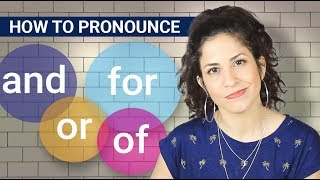
A short instructional transcript by Hadar Shemesh explaining how four common English function words — and, of, for, and or — are pronounced in isolation (stressed) versus reduced forms in connected speech. The speaker demonstrates that these function words usually reduce to the schwa or other weak forms (dropping consonants or vowels) when unstressed and gives many example phrases and pronunciation tips for natural connected speech.
Chapters
Hey, what's up? It's Hadar. Thank you for joining me. And today we are going to talk about the pronunciation of four small but mighty words. Those words are very frequent in the language, and each word has two possible pronunciations. And those words are and, or, for, and of. So let's begin by understanding the function of these words. And it's funny that I say the function of these words because these are called function words. Now, the thing about function words, like these four words, and there are like dozens more, these words are usually reduced. They kind of hide and squeeze themselves almost to an unexistent position to allow the more important words like the nouns and the verbs to stick out. So while nouns and verbs are longer and higher in pitch, function words like and, or, for, and of course, reduce to a very neutral, small, simple sound. And that is the schwa sound, which is a neutral sound. And it sounds something like this. So for each word, for each of those four words, there is the proper pronunciation. So how you pronounce it when you stress the word or when you say it alone, and how this word is actually pronounced in context in a phrase or a sentence. So let's begin with a proper pronunciation of the first word, the word. And the word and has the A as in cat, then n and d. And. But when the as in cat appears before an n sound, then it turns to something like, you hear this transitional sound as if you're starting with an e and then gradually opening it to an and. And so, for example, if someone says something, so I met Michael last night. And. Right. So this word is stressed, is pronounced alone. And this is how I pronounce it. Now, when this word appears in a sentence, and this is in most cases, it is reduced. So the A as in cat, is reduced to a neutral sound, to the schwa. And instead of and, we say, notice that I also drop the D because the N is a lot easier to connect to any other sound. I don't want to emphasize every single word, and I do not want to pronounce them separately. So it's not going to be bread and butter, Bread and butter, but I. I drop the D. I reduce the at to bread and bread and bread and butter. Bread and butter, Right. So I'm reducing everything together. I even connected the D to the N immediately. Listen. Bread N, bread and butter. Boys n girls. Boys n girls. Not boys and girls. Boys and boys and girls. Milk and sugar. Milk and milk and. Not milk and sugar. Milk and sugar. Milk and sugar. The next word is O. When the word is stressed. The first vowel is the ah, as in father. So you want to drop your jaw and relax your lips. And then the F is a V sound off. Always a V, always a V of av. However, when it's reduced, it's pronounced as. So the ah sound turns into a schwa again and the V remains for now. So let's look at the next example. Box of apples is going to be pronounced as box of apples. Box Z vaples. I'm connecting everything. So the word of has to connect either to the previous word or the second word. But it has to connect, right? And usually everything connects together. Box of apples. It feels like it's two words. Box of apples, box of apples. Cup of coffee. Right? Not cup of coffee. And definitely not cup of with an F. Coffee. Cup of coffee. Now, another way you can pronounce it is cup of coffee. Cup of coffee. What have I done here? Cup of coffee. I actually reduced the of to. So not only I reduced the aw sound to a schwa, but I also dropped the V completely. Cup of coffee. And that's the case when the word of appears before a consonant. Cup of coffee, cup of tea, bottle of water. Out of here, right now. It's not a mistake to say the of. It's easier for you to say out of here. Cup of coffee, bottle of water. That's awesome. That's great. Keep it up. As long as you're reducing the O and you're connecting everything together, you don't have to drop the V. But if you want to. Right. You can. And the more you practice it, the easier it gets. And ultimately, the less sounds you make, the easier it is. The word for is pronounced with the f and then the or as in for. So when the word is stressed, you want to make sure that you hear the O sound. You drop your jaw, you round your lips, you keep the tongue down. 4. And only at the end, you bring it up for the R. For. For. Right? So it doesn't sound like fur when it's stressed. For so, for example, when you say something like, who is it for? The word for is stress. And then I need to pronounce it just like that with a nice long or as in for. However, when the word for is unstressed, and that's usually the case, then the for is reduced to fur, fur, fur. And yes, it sounds just like the word fur, like a dog's fur, fur, fur. So it's an F, a schwa sound and an R. There is no o in the middle. Okay, I Don't want to pronounce every word separately. It's for me. But the word for is reduced to fur. And I connect everything together. It's for me. It's for me. I did it for you. I did it. Fur, fur, fur. I did it for you. With the word or. It's the same case. The proper pronunciation is or. You have a nice long open sound and only at the end you bring the tongue up for the r. Or. Or. So, for example, if we're going on a picnic and I ask my friend to bring a cake or wine and she brings cake and wine, I'm like, no, I said cake or wine, not cake and wine. Right? Why do you have to always bring everything? So in that case, and that's usually the case with my friends, just so you know that. So here I want to stress the or so I will pronounce it properly, cake or wine, not cake and wine. And then I reduce the end. But when the or is reduced, it turns into er. Er, coffee or tea. Coffee. Er. Reducing, connecting coffee or tea. Coffee or tea. Blocker. White. It actually sounds like blacker. White. Black or white. Coffee or tea. Boys or girls, this or that. Right. So it sounds like the er suffix that connects to the first word, this or this or this or that. Okay, and why is it so important? First, to save you energy. You don't need to invest a lot of energy in pronouncing those words. You don't need to add vowels that don't exist because all those o and ah and ah, they don't need to be there if the words are unstressed. So if you want to practice, just create a lot of expressions with those words. With and or of and for and use them in the reduced form and say them over and over again. And try to see how people pronounce it around you. And that way you start integrating it into your day to day speech and. And you start using it and you make it your own. And remember, practice makes better. Better. Because perfection is overrated. Okay, that's it. Thank you so much for watching. Consider subscribing to my channel if you like this video and share it with your friends. So they also know how to reduce. Right. Why keep it to yourself? Share it. Share the knowledge. Let me know in the comments below what other words you have noticed that are being reduced in English. Okay. Because there are more than these four words. And that's it. I guess I'll see you next week in the next video. Bye.