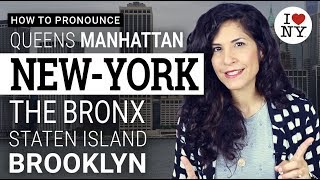
A short, spoken YouTube tutorial by Hadar Shemesh explaining how to pronounce "New York" and each of its five boroughs (Manhattan, Queens, Brooklyn, The Bronx, Staten Island). The presenter gives step-by-step articulatory instructions (sounds, tongue/lip positions), contrasts common variants (e.g., glottal stop vs. nasal T), and emphasizes stress patterns and vowel qualities. The video closes with a viewer call-to-action to comment their favorite borough and location.
Chapters
Yo, yo, what's up? It's Tadar. And this is the accent Sway. And today we're gonna talk about how to pronounce the name of my favorite city in the whole world. New York and its five boroughs, Queens, Manhattan, Brooklyn, the Bronx, and Staten Island. So let's begin with the name New York. A lot of you might be saying New York, new, an N sound, and then a, and then the U, as in food. New. But to be honest, you don't have to add that Y sound. You can just say new, new, an N sound, and then U N, Then you have a Y sound and the or as in for York, York, and end it with a K sound. New York. The stress falls on the second word, but new is kind of stressed, too, because it is an important word. New York. The first borough is going to be Manhattan. Here you may find several pronunciations of the same word. Manhattan, Manhattan, Manhattan. But we'll talk about the way people usually pronounce it in New York, which is kind of a generalization because there are many, so, so many different dialects. So it would be a lie to say that there is only one way to say it. But anyway, let's begin with the first syllable. It's an M sound, then a schwa and an N, a reduced vowel. So technically, there is no vowel between the N and the N. The second syllable is ha, an H sound. And you have to pronounce it so it's not but manha. And drop your jaw for the A as in cat, Manhattan. And then that's the trick. We have a T schwa, n, and when there is a T, a schwa, a reduced vowel, and then an N, we release the T through the nose. I call it the nasal T, Manhattan. So I bring the tongue up, block the air in the mouth, but instead of releasing it here, I block the air with my tongue, and I release it through the nose. It's a sound when you have a cold, you can't make it. You have to have open passages there in your nose. Manhattan, Manhattan. However, you'll notice that a lot of people pronounce it slightly different, and that is because they're not even bringing the tip of the tongue up here. They block the air in the throat. It's called a glottal stop. A glottal stop is when you abruptly stop your breath with your vocal cords. It sounds something like. When you're about to say something like ahead. That's the sound ahead. Or when you agree with someone. My daughter always does this when she understands something that sound is the glottal stop. And some people substitute the T with a glottal stop. And you keep the tongue up as you do it, so you do hear something that resembles the N at the end. Manhattan. So it's not Manhattan. Right. I cannot close my lips. The tip of the tongue needs to be up. Manhattan. But I blocked the air here. It wasn't a real T. Manhattan. So Manhattan through my nose. Manhattan. We'll have Manhattan, the Bronx and Staten Island. Let's talk about the word Queens. Queens. Here we have a K sound and a W quote. And then we shift to a high E, as in C. Quee. It's not quins. Quince, but quee. So it needs to be a little longer than what you're used to, probably Quee. Then we have an N sound and a Z. Queens. Queens. Not Queens. Queens. Following that, we have my favorite borough, Brooklyn. Here we have a B sound and an R. Round your lips, pull the tongue back. Not brook, but br. So you need to be able to hold out the sound forever. Bruk. Bruk. It's not oo. It's not Brook. Brook. It's somewhere between oo and O and ah. Brook. Imagine like you have a hot potato in the back of your mouth. Brook. Brook. And then from the K sound that is in the back of your throat, you move to the L immediately. Brooklyn. You don't release the K. It's not Brooklyn. Brooklyn. You release it into the L. And for the L, the tip of the tongue has to touch the upper palate. Brooklyn. If you tend to confuse the L with the r. And then it sounds something like Brook. Rin. Brook. Rin. Right. Make sure that the tip of the tongue touches the upper palate. Hold it out if you need to. Brook. To make sure that you actually pronounce the L correctly. Brooklyn. Then it's the relaxed I sound and an N. Brooklyn. The Bronx. For the word Bronx, we start with a B sound, then the R. Br, and open it to the ah, as in father. Bra. Then we move on to the ng. Bra. That is released to the K. So sound bronc. And then immediately you want to shift to the S. Bronx. Bronx. The S consonant sound, right? Not in the spelling. Bronx. Don't add any vowels. I know it's sometimes difficult to move from one consonant to another, but practice it. Hold out the consonant. Bronx. Right. Bronx. We'll have Manhattan, the Bronx, and Staten island, too. And lastly, Staten Island. Staten. Staten. Here we have an S and then a T right after sta. And we open it to the A as in cat. Sta. Sta. Drop your jaw. Pull the lips to the sides a bit. The tip of the tongue is pushing forward and the back of the tongue is up. The front of the tongue is flat. Sta. Like staff or stack. And then again we have the tishua? N. We already know how to pronounce it. Statin. Statin. Or statin. When I release it through the nose. Staten. Do whatever is easier for you. Staten Island. Island. Of course, there is no s here. We begin with I as in I am I. And then Lund. Lund. Not land. Not land. Lund. It's an l sound. A schwa. An nd Lund Island. Staten Island. Staten Island. Stress falls on Island. Staten Island. Okay, that's it. Thank you so much for watching. Let me know in the comments below which of the five is your favorite borough. And if you live in New York, let me know in the comments as well. So I know where you live when I come visit so we can hang out. Okay, thank you so much for watching again. Have a lovely, lovely week and I'll see you next week on YouTube. Not in New York, unfortunately, in the next video.