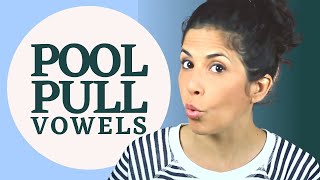
A short instructional YouTube video transcript by Hadar Shemesh explaining the difference between the tense 'oo' (as in "pool"/"food") and the lax 'u' (as in "pull"/"foot"). The speaker contrasts length, tongue and lip posture, and provides listening and practice exercises (listen in real speech, imitate, use in words/sentences).
Chapters
Hey, what's up? It's hadar. And today we're going to talk about the pulpol vowel pair. The tense U as in pool and the relaxed U as in pull and. Good. I've been asked so many times about these pairs and these vowels and for a good reason. This is such a confusing vowel pair for non native speakers because of the spelling and because of the fact that there are very subtle differences between the two sounds. So let's talk about the two. First of all, listen to the two sounds. Food. Foot. Food. Foot. What are the differences? What do you hear? The first thing I can tell you is that these two sounds are different in length, right? Okay. So it's not food and food, but one is definitely longer, double the length of a very neutral single vowel. Food. And the other one is super short, super relaxed. Foot. Pull. Pull. The tense oo is a long vowel. It's called tense because you tense up everything when you pronounce this sound. Maybe except for the eyebrows. You don't have to tense the eyebrows. Pull. But look at my mouth, right? The lips push forward, right? And the tongue pulls up. There's a lot of tension there in the tongue. But. But the one thing I want you to think about is when you make this sound is that you want to imagine the sound as if it comes out from the throat and then goes through a little journey inside the mouth and then comes out through your lips as if it's coming out through a straw. Listen. Foo. Woo. Then you push your lips forward as if you're pushing your lips for a W sound. Food. So it doesn't begin and end the same way. It's not food pool, but food. It's kind of like I'm starting really relaxed and then I tense up and form up the sound as I pronounce it. And then there's that extra W at the end. Food. You. It's almost like when you're saying ew. Say that Ew. You hear that, that transition. You hear the tongue actually going up, creating that ew sound. All right? That's what you want to look for when you make this sound. Food. You who it's not who. Who. Now the relaxed sound as in pull and foot is completely different. There is no transition here. There's no tensity. Everything is super relaxed and chill cook look. Alright, so my jaw drops. There is space of about one finger between the top and bottom teeth. Book. And the lips round just a bit, if at all. Some people don't even round the lips for this sound. Book. Okay. But I want you to round them just a bit. Book, look. Now, the tongue also pulls back. But you know that I find that it's so difficult to visualize the tongue or to imagine what the tongue is doing when it's all the way here in the back. So don't think about the tongue. Try to imitate the sound that you're hearing. And also think like you have a hot potato in the back of your mouth and you don't want it to touch anything. Book. It's so hot. So the upper palate rises up and the tongue kind of, like, drops a bit. Look. Cookie foot. All right, so now let's compare the two. Pool. Tense and long. Pull. Relaxed. Open. Kook. He's a kook. And cook. Cook. See, it doesn't even sound like an U sound. It's not. Cook. Cook. Somewhere between. O. Right. Luke Luck. Who'd. Short for who would. Who'd. Hood. And again. Pull. And pull. All right, so I know it's a tricky pair, but remember, the first thing you need to do is first of all to hear those differences. So what I want you to do this week is just to listen around you to people speak on the street, on television, on YouTube, and really try to detect the difference between those two sounds. Okay. And see how it looks when people actually say them. And then try to pronounce those two sounds. Practice them in words and sentences, and then try to use it when you speak. Now, when you go and buy food or fruit juice, then make sure that you round your lips and you tense up and you make the sound a little longer. And if you're going to a bookstore and you're looking for a good cookbook, then make sure that your lips are not too pushed together and your jaw drops a bit. Okay, good. And don't forget to let me know in the comments below. How's that going? Okay. Have a nice week. Thank you for watching. Share this video with your friends if you liked it. And don't forget to subscribe to my YouTube channel. There's a lot more coming. Have a great week and I'll see you next week in the next video. Bye.