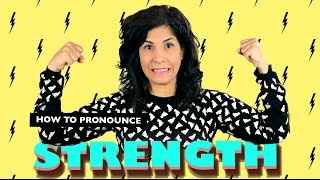
A short American English pronunciation tutorial by Hadar Shemesh that explains how to pronounce the words 'strength' and 'length'. The speaker breaks 'strength' into constituent sounds (S→T→R, vowel, NG + optional soft K → TH), demonstrates two acceptable NG/N realizations, and notes an alternative SH-like onset some speakers use. She then briefly describes 'length' (L + vowel + same ending cluster) and gives practice advice and closing remarks.
Chapters
Hi, it's Hadar. And this is the accent's way, your way to finding clarity, confidence and freedom in English. Let's talk about the word strength. Strength. A lot of consonants. So I have a lot to say about this word, so stay with me. We begin with an SDR consonant cluster. A lot of consonants put together the S sound. For that. You bring the tongue up for the S. S. Then the T. So you hold the air abruptly. That's the T all right. It's not S. T. You don't have to hear the pop of the T. You're just holding or stopping the S abruptly. S. Now the tongue is up there for the held T. And then you pull the tongue in for the R. Alright? And then you round your lips a little bit and you have that nice strong tension of the R sound. Stir. Then you have time to open your mouth for the E as in red stre. And now we start over with another consonant cluster. We have the NG consonant sound. And then you shift to the th sound. Now, the NG consonant sound is an N that is pronounced in the back of the mouth. What do I mean? To make an N sound, you bring the tongue up N. You block the air in the mouth and then the air comes out through the nose. N. Right. An NG consonant sound is where you raise the tongue in the back. Alright. You block the air in the mouth, but with the back of the tongue, the air still comes out through the nose. Then you bring the tongue up for the th. Now, in between the NG and the th, there is a very soft K sound. Listen. Strength. Which allows you some time to prepare before you bring the tongue out for the thin. Listen again. Strength. Strength. Strength. Now there is another way to pronounce this word that is a little easier. Where instead of bringing the tongue up in the back for the ng, you just bring it up for an N. Strength. Strength. Now here, because the N appears just before a th sound, then you can place the N on the teeth, preparing for the th sound. Strength. And then you're just releasing the tongue for the th strength. Listen to the two Strength and strength. Choose whatever works for you. One more thing. You may hear people pronouncing the SDR consonant cluster with a SH sound sound. For example, strength. It happens often when there is the SDR consonant cluster. Like street strange stripes. Okay, that's also totally fine. You choose whatever works for you. These are both okay. I personally prefer the SDR pronunciation. Strength. It's a little cleaner and easier for me, but do whatever works for you. Strength. Strength. Or strength. Okay, good. Now let's talk about the word length. All right, this one is a little easier. The ending is exactly the same, but you begin with an L sound, then the E as in red. Drop your jaw, relax your tongue. Length, Strength. Length. All right, that's it. I hope this was helpful. So please practice this word over and over until you feel really comfortable with it. That's the thing about words with many, many consonants. You just have to kind of, like, know where your tongue is going in what consonant for what consonant, and then it's a lot easier. Have a wonderful week, and I hope to see you next week in the next video. And you're welcome to come over to my website to check it out. And more great content every single week. Take care, and I'll see you next week in the next video. Bye. All right, that's it for today. Thank God. We're done. Okay. Okay, that's it for today. Okay, that's it for today.