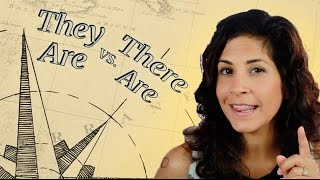
YouTube pronunciation lesson by Hadar Shemesh answering a viewer (Delphine) about two problems: distinguishing 'they are' vs 'there are' and pronouncing a /s/ or /z/ followed immediately by a 'th' sound. Key points: the auxiliary 'are' reduces to an unstressed /ər/ and links with preceding words (so 'they are' and 'there are' often acoustically overlap); when /s/ or /z/ precedes 'th', you must move the tongue quickly from the s/z position to the th position (use soft tongue, breath pressure) and drill the transition (recommended 10–30 repetitions daily) to develop muscle memory.
Questions this video answers
June 28, 2016
A viewer named Delphine
"10, 20, 30 times a day" (repeat the transitions 10–30 times daily)
Chapters
Hey, guys, it's Hadar. And this is the accent's way, your way to finding clarity, confidence and freedom in English. I got a question from Delphine asking me two important things and I think you can benefit from the answer as well. So this is what she writes. Hi, Hadar. I discovered your videos on YouTube a few days ago as I was searching some help about English pronunciation. I think yours are very clear and really helpful, actually. Thank you for making a new one each week. You are very welcome. Personally, I'm still struggling to pronounce. There are and they are. I can't make the difference between the two. This is so annoying. Do you have any tips? I know, and yes, I do. Also, I can't pronounce properly. Is there? The transition between the z and the th is challenging. I watched your video simplifying the th sound many times, but I still can't find the right way to pronounce that clearly. Many thanks, Hadar. Now, thank you, Delphine, for these awesome questions. And my answer is going to be divided into two pronouncing. They are versus there are and the sth transitions. So let's begin with the first. They are and there are. The first thing you need to remember is that the word are reduces into er. And when a function word, it's a function word reduces. We connect it to whatever comes before or after, okay? These words reduce in order to allow the more important words, nouns, verbs, adjectives, adverbs to stick out. Those words are elongated, okay? That's the basics of American intonation and rhythm. So when you have the word they are and the word are is reduced, what you receive is actually there. There. Yes, Just like over there. So, for example, they're very happy about it. They're coming tonight. They're over there. Do you hear it? It sounds exactly the same. They're over there. The word there are also. The words. Sorry, they also connect. There are. Now, another thing you want to know is that when a word ends with a consonant and the next word begins with a vowel, the consonant of the first word becomes the beginning of the second. So instead of saying there are, you actually say they are. They are. It's a lot easier to pronounce as well. There are. However, we already established that the word are reduces when it's unstressed. So what you actually get is the R. The R. There are a few things we need to talk about. There are a few things we need to talk about. There are a bunch of great movies out there. They're there. They're Saying that there are a few things we need to talk about there and there. There, there. Okay, good. So that's about the there are and versus they are. And now let's talk about the sth transitions. When it comes to the sth transitions, you need to remember two things. One, the tongue has to be very soft and quick. And two, you have to go through these two positions. Inside the mouth for the Z and s and outside for the th sound. Alright? So in the simplifying the th video, we talked about tip of the tongue consonants such as T, D, n, l. And we said that when they precede a th sound, you can cheat and place the tongue on the tip of the. On your teeth, for example, tell them. And then the tongue is already there for the th, instead of placing it behind the teeth as you usually do. Tell them. Then you have a long way to go tell them in them. Put this. But when it comes to the S or Z before th, you cannot cheat and you definitely don't want to merge the two sounds. Okay? You cannot say is there anymore left or has has. Okay? You can kind of like leave the tongue inside and then it sounds like 2z sounds or 2th sounds. Okay? No, you have to go through both sounds. Is the. So for that again, your tongue has to be really quick and really soft. What you want to do is use a lot of breath and actually push your tongue forward with your breath has them. Is the. Okay, don't push your tongue against the upper palate as you pronounce the Z sound. Then it's gonna get stuck on the way. Okay? And what you're gonna get is the. It's gonna sound like a D is the. Has them soft, very light. And use your breath to push the tongue forward and backwards. Same thing with some soft with some people, with some. Alright, now if you want to practice it, what you want to do is just go through these transitions, you know, 10, 20, 30 times a day and then sth, st and backwards. Okay? So when you go through these transitions outside of conversation, it's going to be a lot more, a lot easier for you to use them in conversation. Okay? Your tongue is going to be prepared and in shape. Okay? Think of it. It's a muscle. There are a lot of muscles in the tongue and you want to train those muscles and develop muscle memory. Okay? And these transitions are really, really helpful. So try it out. I promise it'll get easier. All right, so that's it for today. Thank you, Delphine, for your awesome email and your questions. I hope you enjoyed it. And guys, if you liked it, please share this video with your friends and come on over to my website to check it out and get more great content. Have a wonderful week. Thank you for watching again and I will see you next week in the next video. Bye.